CAMPBELL, Calif.--(BUSINESS WIRE)--Aug 21, 2025--
ChargePoint (NYSE: CHPT), a leading provider of EV charging solutions, today announced conversion kits to install its Omni Port adaptable charging solution on older stations. The kits are now available for immediate delivery, joining new Level 2 stations pre-fitted with the innovation. Omni Port ensures any new EV can charge in any parking space, regardless of its connector type, without the need for expensive or dangerous adapters.
This press release features multimedia. View the full release here: https://www.businesswire.com/news/home/20250820033150/en/
ChargePoint estimates that it holds more than 60% market share in publicly available networked AC charging ports in North America, so the adoption of Omni Port can eliminate connector issues for a significant amount of the nation’s EV drivers. The innovation marks ChargePoint’s latest proof point of solving problems for the nascent EV industry.
“As many automakers shift toward the NACS charging port, charging providers need to serve all of their customers - regardless of their vehicle’s connector type,” said Hossein Kazemi, CTO of Hardware at ChargePoint. “Omni Port enables customers to future proof their charging infrastructure and eliminates the hassle of dedicating parking spaces to a specific connector type. For EV drivers, it ensures they will encounter the connector type they need to charge at any Omni Port location.”
Omni Port not only caters to all modern connector types, it also ensures drivers receive a frictionless charging experience. Drivers can simply enter their EV into the ChargePoint app, tap to charge, and the station automatically releases the correct connector type. Notably, Omni Port is available at no incremental cost as a standard feature of applicable new chargers. ChargePoint’s modular designs allow station owners to upgrade for new features such as Omni Port instead of replacing their chargers, swapping minimal components as quickly as possible and saving money in the process.
For more information about Omni Port, please visit: https://www.chargepoint.com/resources/discover-chargepoint-omni-port-cp6000-and-express-plus.
ChargePoint, Omni Port and the ChargePoint logo are trademarks of ChargePoint, Inc. in the United States and in jurisdictions throughout the world. All other trademarks, trade names, or service marks used or mentioned herein belong to their respective owners.
About ChargePoint Holdings, Inc.
ChargePoint has established itself as the leader in electric vehicle (EV) charging innovation since its inception in 2007, long before EVs became widely available. The company provides comprehensive solutions tailored to the entire EV ecosystem, from the grid to the dashboard of the vehicle. The company serves EV drivers, charging station owners, vehicle manufacturers, and similar types of stakeholders. With a commitment to accessibility and reliability, ChargePoint’s extensive portfolio of software, hardware, and services ensures a seamless charging experience for drivers across North America and Europe. ChargePoint empowers every driver in need of charging access, connecting them to over 1.25 million charging ports worldwide. ChargePoint has facilitated the powering of more than 16 billion electric miles, underscoring its dedication to reducing greenhouse gas emissions and electrifying the future of transportation. For further information, please visit theChargePoint pressroomor theChargePoint Investor Relations site. For media inquiries, contact theChargePoint press office.
CHPT-IR

Conversion kits to install ChargePoint's Omni Port adaptable charging solution on older stations are now available for immediate delivery, joining new Level 2 stations pre-fitted with the innovation.
KYIV, Ukraine (AP) — Russia launched a second major drone and missile bombardment of Ukraine in four days, officials said Tuesday, aiming again at the power grid and apparently snubbing U.S.-led peace efforts as the war approaches the four-year mark.
Russia fired almost 300 drones, 18 ballistic missiles and seven cruise missiles at eight regions overnight, Ukrainian President Volodymyr Zelenskyy said on social media.
One strike in the northeastern Kharkiv region killed four people at a mail depot, and several hundred thousand households were without power in the Kyiv region, Zelenskyy said. The daytime temperature in the capital was -12 C (around 10 F). The streets were covered with ice, and the city rumbled with the noise from generators.
Four days earlier, Russia also sent hundreds of drones and dozens of missiles in a large-scale overnight attack and, for only the second time in the war, it used a powerful new hypersonic missile that struck western Ukraine in what appeared to be a clear warning to Kyiv’s NATO allies that it won’t back down.
On Monday, the United States accused Russia of a “ dangerous and inexplicable escalation ” of the fighting, when the Trump administration is trying to advance peace negotiations.
Tammy Bruce, the U.S. deputy ambassador to the United Nations, told an emergency meeting of the U.N. Security Council that Washington deplores “the staggering number of casualties” in the conflict and condemns Russia’s intensifying attacks on energy and other infrastructure.
Russia has sought to deny Ukrainian civilians heat and running water in the freezing winter months over the course of the war, hoping to wear down public resistance to Moscow’s full-scale invasion, which began on Feb. 24, 2022. Ukrainian officials describe the strategy as “weaponizing winter.”
In Ukraine’s Kharkiv region, the Russian attack also wounded 10 people, local authorities said.
In the southern city of Odesa, six people were wounded in the attack, said Oleh Kiper, the head of the regional military administration. The strikes damaged energy infrastructure, a hospital, a kindergarten, an educational facility and a number of residential buildings, he said.
Zelenskyy said that Ukraine is counting on quicker deliveries of agreed upon air defense systems from the U.S. and Europe, as well as new pledges of aid, to counter Russia’s latest onslaught.
Meanwhile, Russian air defenses shot down 11 Ukrainian drones overnight, Russia’s Ministry of Defense said Tuesday. Seven were reportedly destroyed over Russia’s Rostov region, where Gov. Yuri Slyusar confirmed an attack on the coastal city of Taganrog, about 40 kilometers (about 24 miles) east of the Ukrainian border, in Kyiv's latest long-range attack on Russian war-related facilities.
Ukraine’s military said domestically-produced drones hit a drone manufacturing facility in Taganrog. The Atlant Aero plant carries out design, manufacturing and testing of Molniya drones and components for Orion unmanned aerial vehicles, according to the General Staff of the Armed Forces of Ukraine. Explosions and a fire were reported at the site, with damage to production buildings confirmed, the General Staff said.
It wasn't possible to independently verify the reports.
Katie Marie Davies contributed to this report from Manchester, England.
Follow AP’s coverage of the war in Ukraine at https://apnews.com/hub/russia-ukraine
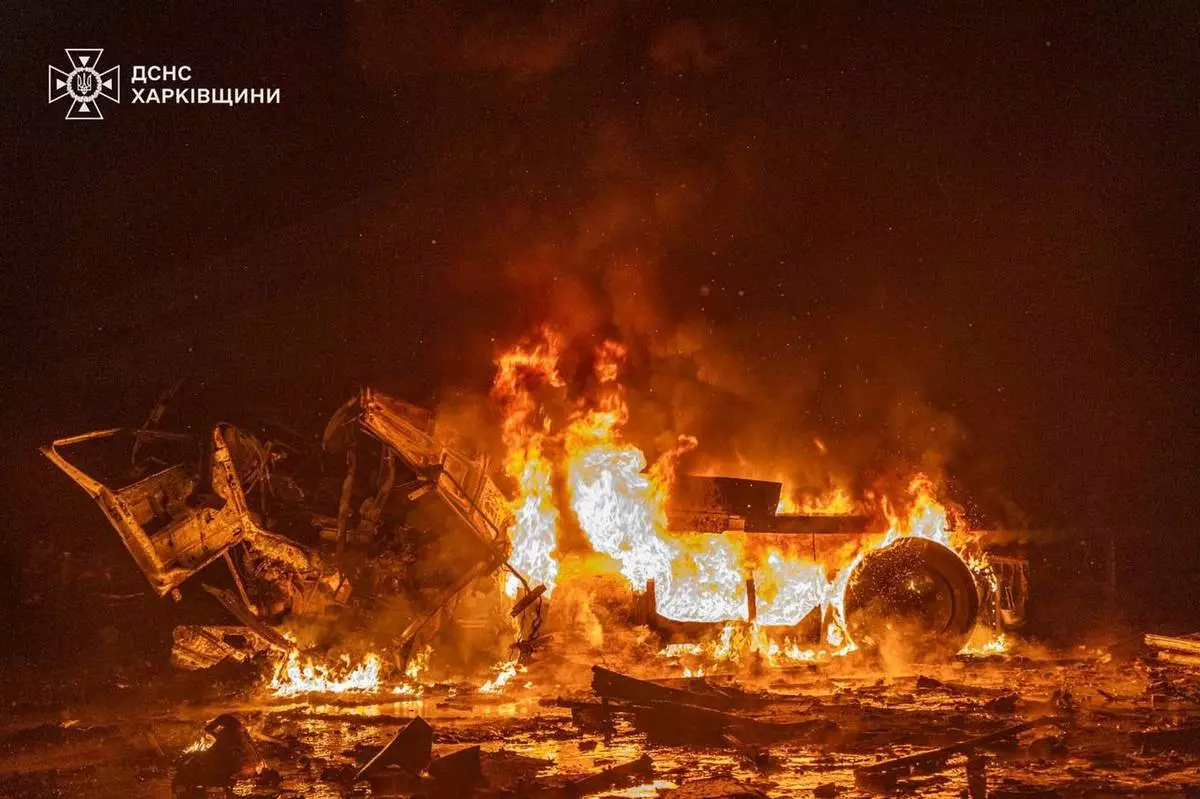
In this photo provided by the Ukrainian Emergency Service, emergency services personnel work to extinguish a fire following a Russian attack in Kharkiv, Ukraine, Tuesday, Jan. 13, 2026. (Ukrainian Emergency Service via AP)
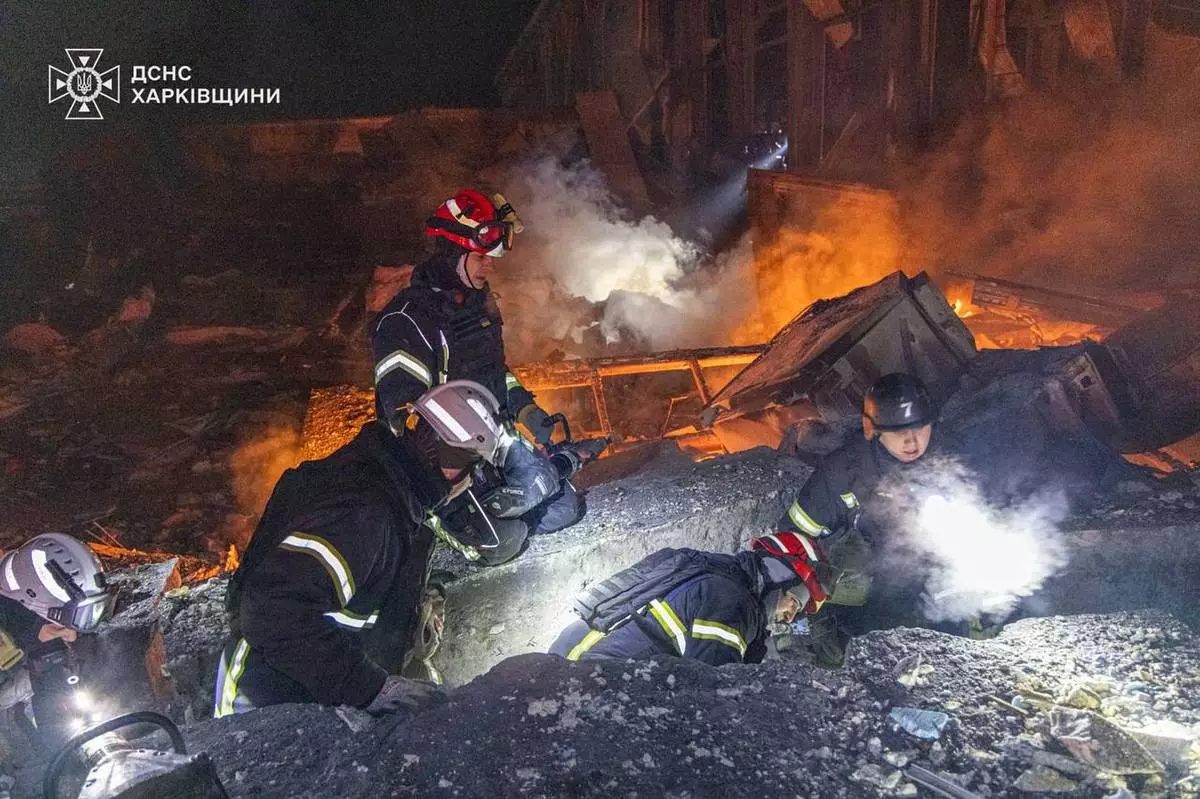
In this photo provided by the Ukrainian Emergency Service, emergency services personnel work to extinguish a fire following a Russian attack in Kharkiv, Ukraine, Tuesday, Jan. 13, 2026. (Ukrainian Emergency Service via AP)
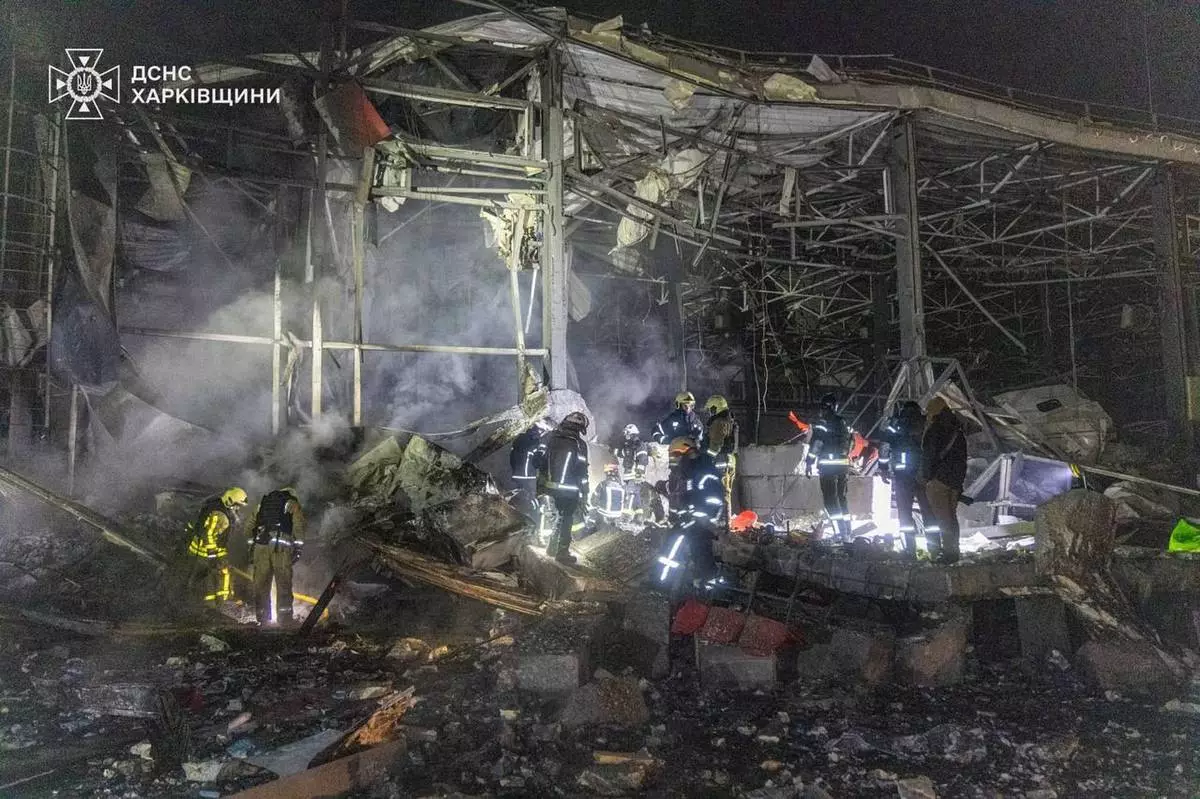
In this photo provided by the Ukrainian Emergency Service, emergency services personnel work to extinguish a fire following a Russian attack in Kharkiv, Ukraine, Tuesday, Jan. 13, 2026. (Ukrainian Emergency Service via AP)
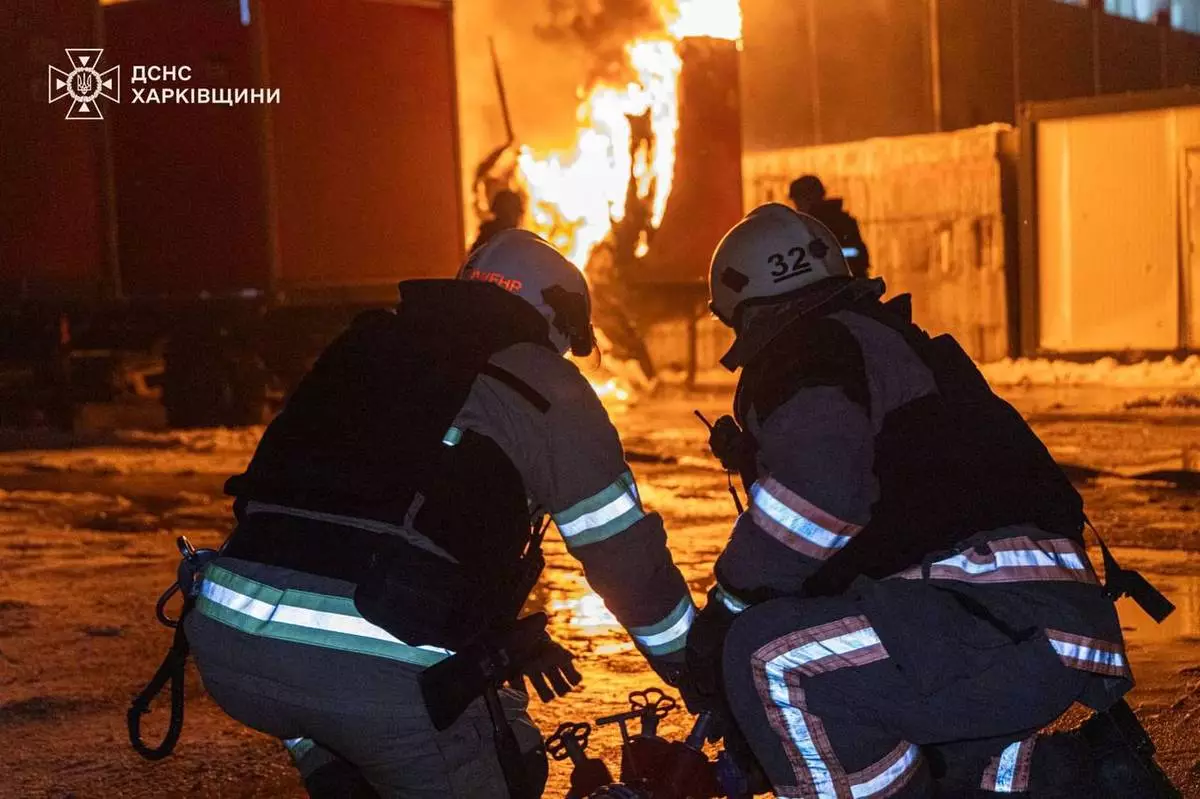
In this photo provided by the Ukrainian Emergency Service, emergency services personnel work to extinguish a fire following a Russian attack in Kharkiv, Ukraine, Tuesday, Jan. 13, 2026. (Ukrainian Emergency Service via AP)
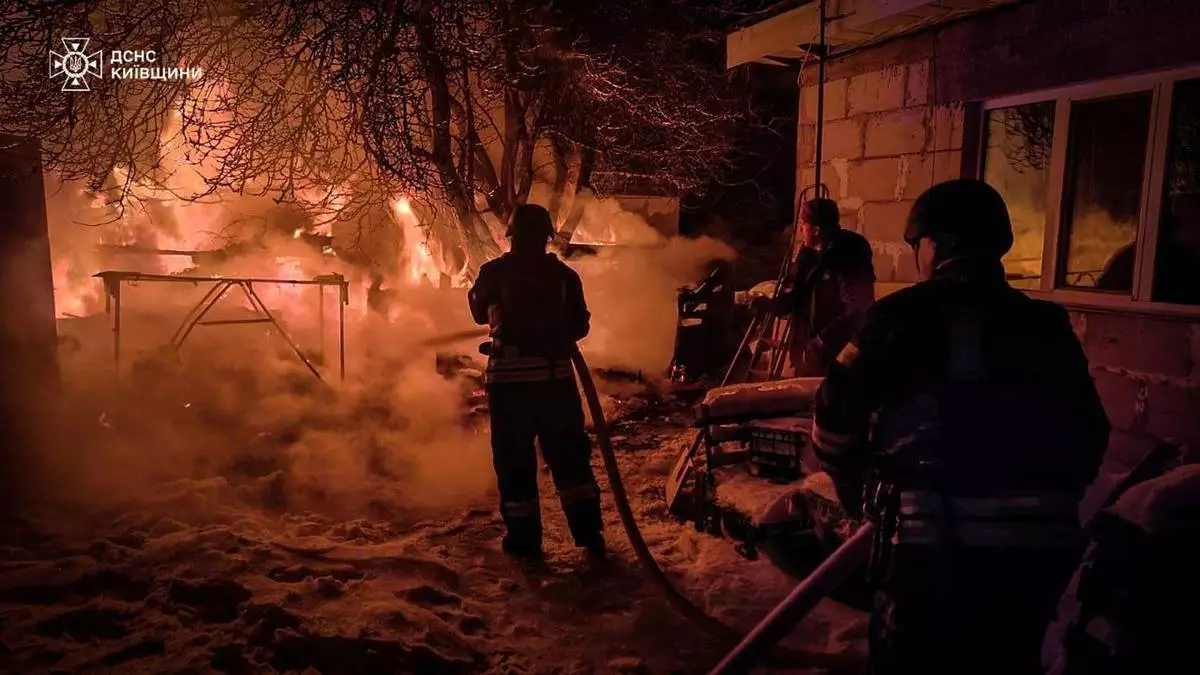
In this photo provided by the Ukrainian Emergency Service, emergency services personnel work to extinguish a fire following a Russian attack in Kyiv region, Ukraine, Tuesday, Jan. 13, 2026. (Ukrainian Emergency Service via AP)