UNITED NATIONS (AP) — Syria’s transition remains “on a knife-edge” and violence could resume at any moment in the southern city of Sweida, which saw deadly clashes last month, the top U.N. envoy for Syria warned on Thursday.
Geir Pedersen told the U.N. Security Council that while violence in Sweida has largely subsided following a ceasefire, “the threat of renewed conflict is ever-present — as are the political centrifugal forces that threaten Syria’s sovereignty, unity, independence and territorial integrity.”
Syria is grappling with deep ethnic and religious divisions following the ouster of Syria’s autocratic President Bashar Assad in December, which brought an end to decades of Assad family rule. The transition has proven fragile, with renewed violence erupting in March along the coast and in July in Sweida, a city with a significant Druze population, highlighting the continued threat to peace after years of civil war.
Clashes erupted in Sweida on July 13 between Druze militias and local Sunni Muslim Bedouin tribes, and government forces intervened, nominally to restore order but they ended up essentially siding with the Bedouins. Israel intervened in defense of the Druze, launching dozens of airstrikes on convoys of government fighters.
Pedersen said in a video briefing to the council that although the July 19 ceasefire agreement has largely held, “we are still seeing dangerous hostilities and skirmishes on the margins of Sweida. And violence could resume at any moment,.”
Pedersen expressed concern that “a month of relative military calm belies a worsening political climate, with escalatory and zero-sum rhetoric hardening among many.”
The U.N. envoy said there is an urgent need for security forces under the transitional government led by interim President Ahmad al-Sharaa to demonstrate that they are acting to protect all Syrians.
Pedersen called for major security sector reforms in Syria and the disarmament, demobilization and reintegration of non-government forces.
He warned that international support for Syria “risks being squandered or misdirected” without a genuine political transition that lays the path for long-term stability, good governance, credible reforms and a firm commitment to the rule of law and justice.
U.N. humanitarian chief Tom Fletcher called the humanitarian situation in Syria “dire,” saying 16 million people across the country need humanitarian support.
He said aid workers need protection and safety, noting that humanitarian convoys came under fire this month. He said money for food and other assistance is desperately needed, pointing to the U.N. humanitarian appeal for $3.19 billion for 2025 being only 14% funded.

Syrians gather to mark the anniversary of a chemical weapons attack carried out by Bashar Assad's forces in Eastern Ghouta in 2013, in the town of Zamalka on the outskirts of Damascus, Syria, Thursday, Aug. 21, 2025. (AP Photo/Omar Sanadiki)
WASHINGTON (AP) — Julia Dvorak is worried her 83-year-old mother’s emergency room trips for seizures are depleting her retirement savings and will soon force her to go on Medicaid.
At the same time, Dvorak, who's 56 and suffers from a chronic knee condition that keeps her on state and federal assistance, expects her own health costs to go up next year.
It's the kind of financial squeeze that has made health care a growing concern for Americans, according to a new AP-NORC poll that asked people to share their top priorities for the government to address in 2026.
The uptick on health care was much sharper than on other commonly mentioned issues. It comes after President Donald Trump's Republican administration reduced spending on Medicaid, a safety net program for poor people, and decided to end coronavirus pandemic-era subsidies for the Affordable Care Act, essentially guaranteeing that millions of people will see a steep rise in costs early next year.
The changes could return health care to center stage in next year's midterm elections, which will determine control of Congress.
“I see how it affects me and my loved ones,” Dvorak, who lives outside Cedar Rapids, Iowa, said about the cost of health care. “But I also know it’s affecting other people, and it’s getting worse.”
Despite the spike in health care concerns, immigration and broader worries about rising costs remain pressing issues, according to the December poll from The Associated Press-NORC Center for Public Affairs Research.
But Americans are also less confident that the government will be able to make progress on the important problems facing the country in 2026. About 66% of U.S. adults say they are “slightly” or “not at all confident,” down from 58% last year.
About 4 in 10 U.S. adults named health care or health issues in an open-ended question that asked respondents to share up to five issues they want the government to work on in the coming year. That’s up from about one-third last year.
The high cost of health care came as a shock to Republican Joshua Campbell when he and his wife recently sought a medical plan for their young daughter. The 38-year-old small business owner from Hot Springs Village, Arkansas, voted for Trump last year, and he mostly approves of the way Trump is handling his job, particularly on immigration. But health care expenses have become a major priority for him going into 2026.
“Health care costs are pretty crazy,” he said. “I just thought, ‘Man, there’s got to be something better than what we have.’”
Health care is a particularly high concern for adults between the ages of 45 and 59 — people who may have higher health care costs than younger adults but aren't yet eligible for Medicare.
The poll shows a similar landscape to the one Trump faced at the end of his first year in office during his first term, when health care reform was at the top of many Americans’ minds. But Trump has an added complication now. At the end of 2017, very few mentioned cost of living concerns — now, about one-third do.
Campbell described his politics as conservative, and while he recalled viewing the Affordable Care Act somewhat negatively when it first passed, he said he now views it as a step toward helping improve health care.
“I do think they were at least trying, and at least trying to do something," he said. "And I don’t really see that — it’s one of the things from the Republican Party as well that I don’t necessarily agree with. Or I think that they should be doing better at.”
Inflation and the high cost of living have been a top priority for many Americans since the end of 2021. Tommy Carosone is reminded every time his wife returns from the grocery store, especially with their two kids, both teenagers, still at home.
“My wife is spending so much more money on groceries than just a few years ago. Every time she comes home from the grocery store, I hear about it,” said Carosone, from St. Peter’s, Missouri. “She tells me it’s stupid expensive, especially meat. Ground beef, bacon, anything from the deli. It’s outrageous.”
The 44-year-old jet aircraft mechanic, the sole wage earner for his family of four, doesn’t see the cost of living coming down any time soon. He voted for Trump and generally agrees with his tariff agenda as a way to make the U.S. more competitive, and he figures prices will stay higher until the trade war ends.
“In the meantime, what are you going to do, not eat?” he said.
Carosone said he is glad he voted for Trump and had been concerned before Trump took office again about illegal immigration. But it doesn’t register even as a top priority for him now, in light of action the administration is taking.
“It’s a lot better,” he said. “It’s not really one of the main concerns I have now. I mean, don’t stop. That’s for sure. But I don’t think it’s something that’s a top concern.”
About 2 in 10 U.S. adults want the federal government to focus on housing costs next year. That issue has been rising in recent years, with young adults being especially likely to mention it. About one-quarter of adults under age 30 want the government to focus on housing expenses, compared with about 1 in 10 of those 60 or older.
Many Americans were hoping Trump would bring a hard-line approach to immigration when he returned to the White House in January.
Immigration was the top issue Americans wanted the government to focus on last year, with about half of U.S. adults citing it. A large number, 44%, said they want the government to prioritize immigration this year, too — but Democrats have grown increasingly concerned about the issue, while Republicans and independents have declined.
About 4 in 10 Democrats listed it as a concern this year, an apparent increase from 32% last year. Majorities of Republicans still consider it a priority -- about 6 in 10 mentioned it, but that’s down from about 7 in 10 last year.
Roxanna Holper, 64, is worried about the Trump administration’s approach to immigration, even though she believes Democrats have fumbled the issue in the past by failing to curb the “insanity” at the border. The Minnesota native describes herself as not ideological, and she has voted for Republicans as well as Democrats. Lately, she’s been voting Democratic.
“(Trump) campaigned with, you know, ‘We’re going to get the worst of the worst ... off the streets,’” she said. "Well, who doesn’t want that?”
She said she believes that's not what's actually happening. “You hear stories where a mom was deported with her two children,” she said. "Like, what the hell — well, who are we as a society that we would treat anybody like that? That is so appalling.”
Beaumont reported from Des Moines, Iowa. Catalini reported from Trenton, N.J. Parwani reported from Columbus, Ohio.
The AP-NORC poll of 1,146 adults was conducted Dec. 4-8 using a sample drawn from NORC’s probability-based AmeriSpeak Panel, which is designed to be representative of the U.S. population. The margin of sampling error for adults overall is plus or minus 4 percentage points.

President Donald Trump speaks during a roundtable on farm subsidies in the Cabinet Room of the White House, Monday, Dec. 8, 2025, in Washington. (AP Photo/Alex Brandon)
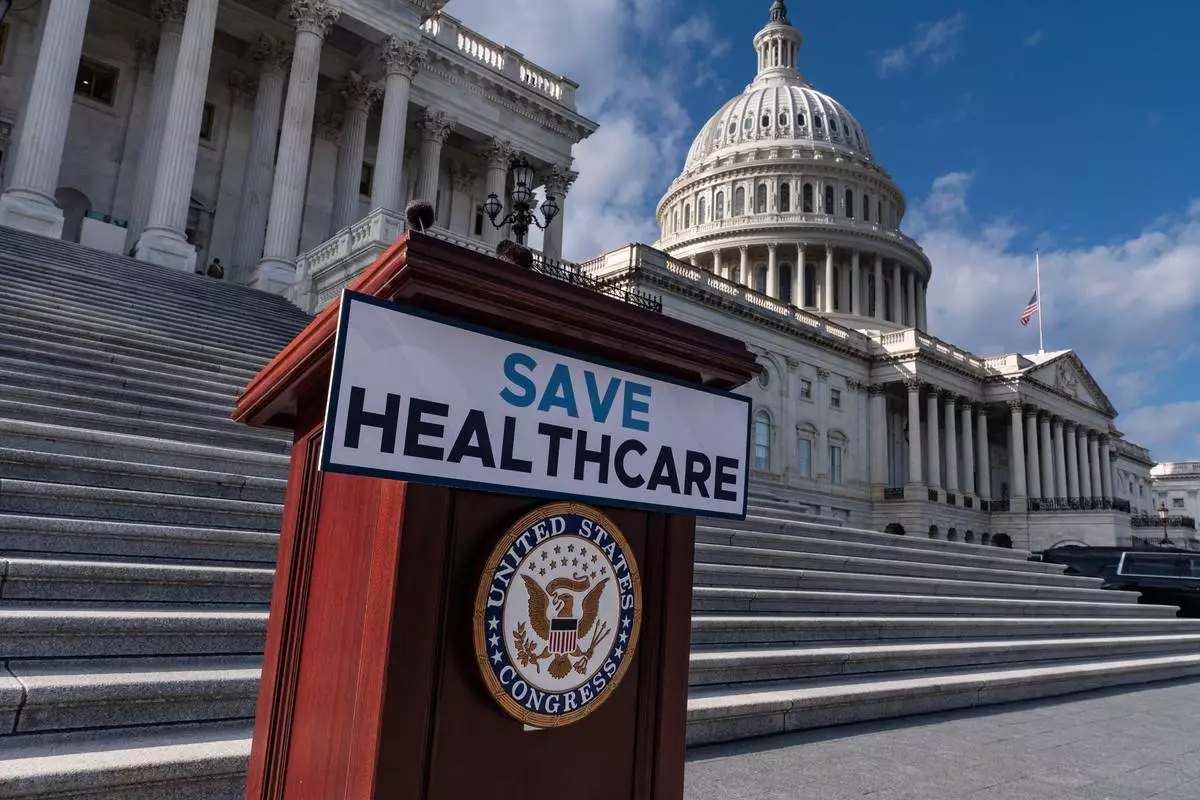
FILE - A lectern awaits the arrival of House Democrats to speak on the health care funding fight on the steps of the House at the Capitol in Washington, Nov. 12, 2025. (AP Photo/J. Scott Applewhite, File)