COLUMBUS, Ohio--(BUSINESS WIRE)--Dec 19, 2025--
Path Robotics, the global leader in physical AI for manufacturing, announced today the appointment of two industry leaders as independent members of its board of directors: Frank Klein, chief operations officer at Rocket Lab Corporation, and Geoffrey Chatas, senior vice president for operations at Yale University. The appointments reflect Path’s continued momentum and reinforce the company’s mission to integrate physical AI into traditional manufacturing processes, enabling manufacturers to build more, reshore production, and improve quality, despite increasing labor constraints.
This press release features multimedia. View the full release here: https://www.businesswire.com/news/home/20251219049319/en/
Frank Klein, Chief Operations Officer, Rocket Lab
Klein is widely recognized for scaling some of the world's largest technical, manufacturing-heavy corporations, spending the last 30 years in the automotive industry. His leadership includes launching electric vehicles at Rivian, overseeing global production for Mercedes-Benz Vans, leading full vehicle engineering and manufacturing at Magna Steyr as the first contract manufacturer to produce an electric vehicle, and he now directs worldwide operations at Rocket Lab.
“Frank embodies the kind of bold, mission-driven leadership we value,” said Andy Lonsberry, co-founder and CEO of Path Robotics. “He is unafraid to take risks, driven by results, and relentlessly committed to building things that last. His deep expertise in scaling technically complex systems across continents, teams, and technologies makes him an invaluable addition as we scale physical AI for manufacturing and exponentially expand deployments."
According to Klein, Path is addressing the very challenges he has confronted repeatedly on factory floors worldwide.
“I’ve spent decades in manufacturing plants and have felt firsthand the pain of missing production targets because we couldn’t hire or retain enough skilled welders,” said Klein. “What Path is building with physical AI directly addresses that challenge and has, and will continue to, truly revolutionize modern manufacturing. Helping Path to grow and solidify its leadership in the industry is an honor and a privilege.”
Geoffrey Chatas, Senior Vice President for Operations, Yale University
Chatas brings more than 25 years of leadership experience across finance, operations, and higher education, with a proven track record of stewarding large, complex institutions through periods of growth. Prior to his current role at Yale University, Chatas held senior leadership roles at several major institutions, including executive vice president at the University of Michigan, chief operating officer at Georgetown University, and chief financial officer at The Ohio State University. Before entering higher education, he held senior finance roles at J.P. Morgan, Progress Energy, American Electric Power, Banc One Capital Corporation, and Citibank.
“Geoff brings a disciplined, long-term perspective shaped by decades of leading complex institutions at scale,” said Lonsberry. “His expertise in capital strategy, governance, and operational excellence will be invaluable as we continue to grow and position Path for its next phase.”
“Path is advancing solutions that are delivering meaningful impact across industrial manufacturing,” said Chatas. “Drawing on my experience across finance, operations, the energy sector, and startup environments, I’m eager to work alongside the team in support of its continued growth and innovation, while delivering long-term value for Path’s customers and partners.”
Klein’s and Chatas’ appointments come during a period of rapid growth for Path as the company accelerates adoption of its physical AI solutions across manufacturing sectors worldwide. Together, Klein and Chatas strengthen the board’s operational, financial, and strategic depth as Path enters its next phase of growth.
For more information on Path’s leadership team and board of directors, click here.
About Path Robotics
Path Robotics builds physical AI for manufacturing, starting with its welding model, Obsidian™. Path’s intelligent welding cells perform the complex, variable welds that traditional automation cannot, enabling manufacturers to overcome chronic labor shortages while increasing production capacity, and improving quality. Since its founding in 2018, the company has raised more than $300 million to incorporate intelligence through physical AI into legacy manufacturing processes, turning traditionally impossible-to-automate work into reliable, high-throughput, and high-quality production. By combining artificial intelligence, machine learning, and computer vision, Path’s physical AI enables legacy manufacturing processes to see, think, and adapt, in real time, turning the complexity that made automating these traditional processes impossible into a reality.

Geoffrey Chatas, senior vice president for operations at Yale University, joins the Path Robotics board of directors.

Frank Klein, chief operations officer for Rocket Lab, joins the Path Robotics board of directors.

Path Robotics intelligent welding cell in action.
WASHINGTON (AP) — Julia Dvorak is worried her 83-year-old mother’s emergency room trips for seizures are depleting her retirement savings and will soon force her to go on Medicaid.
At the same time, Dvorak, who's 56 and suffers from a chronic knee condition that keeps her on state and federal assistance, expects her own health costs to go up next year.
It's the kind of financial squeeze that has made health care a growing concern for Americans, according to a new AP-NORC poll that asked people to share their top priorities for the government to address in 2026.
The uptick on health care was much sharper than on other commonly mentioned issues. It comes after President Donald Trump's Republican administration reduced spending on Medicaid, a safety net program for poor people, and decided to end coronavirus pandemic-era subsidies for the Affordable Care Act, essentially guaranteeing that millions of people will see a steep rise in costs early next year.
The changes could return health care to center stage in next year's midterm elections, which will determine control of Congress.
“I see how it affects me and my loved ones,” Dvorak, who lives outside Cedar Rapids, Iowa, said about the cost of health care. “But I also know it’s affecting other people, and it’s getting worse.”
Despite the spike in health care concerns, immigration and broader worries about rising costs remain pressing issues, according to the December poll from The Associated Press-NORC Center for Public Affairs Research.
But Americans are also less confident that the government will be able to make progress on the important problems facing the country in 2026. About 66% of U.S. adults say they are “slightly” or “not at all confident,” down from 58% last year.
About 4 in 10 U.S. adults named health care or health issues in an open-ended question that asked respondents to share up to five issues they want the government to work on in the coming year. That’s up from about one-third last year.
The high cost of health care came as a shock to Republican Joshua Campbell when he and his wife recently sought a medical plan for their young daughter. The 38-year-old small business owner from Hot Springs Village, Arkansas, voted for Trump last year, and he mostly approves of the way Trump is handling his job, particularly on immigration. But health care expenses have become a major priority for him going into 2026.
“Health care costs are pretty crazy,” he said. “I just thought, ‘Man, there’s got to be something better than what we have.’”
Health care is a particularly high concern for adults between the ages of 45 and 59 — people who may have higher health care costs than younger adults but aren't yet eligible for Medicare.
The poll shows a similar landscape to the one Trump faced at the end of his first year in office during his first term, when health care reform was at the top of many Americans’ minds. But Trump has an added complication now. At the end of 2017, very few mentioned cost of living concerns — now, about one-third do.
Campbell described his politics as conservative, and while he recalled viewing the Affordable Care Act somewhat negatively when it first passed, he said he now views it as a step toward helping improve health care.
“I do think they were at least trying, and at least trying to do something," he said. "And I don’t really see that — it’s one of the things from the Republican Party as well that I don’t necessarily agree with. Or I think that they should be doing better at.”
Inflation and the high cost of living have been a top priority for many Americans since the end of 2021. Tommy Carosone is reminded every time his wife returns from the grocery store, especially with their two kids, both teenagers, still at home.
“My wife is spending so much more money on groceries than just a few years ago. Every time she comes home from the grocery store, I hear about it,” said Carosone, from St. Peter’s, Missouri. “She tells me it’s stupid expensive, especially meat. Ground beef, bacon, anything from the deli. It’s outrageous.”
The 44-year-old jet aircraft mechanic, the sole wage earner for his family of four, doesn’t see the cost of living coming down any time soon. He voted for Trump and generally agrees with his tariff agenda as a way to make the U.S. more competitive, and he figures prices will stay higher until the trade war ends.
“In the meantime, what are you going to do, not eat?” he said.
Carosone said he is glad he voted for Trump and had been concerned before Trump took office again about illegal immigration. But it doesn’t register even as a top priority for him now, in light of action the administration is taking.
“It’s a lot better,” he said. “It’s not really one of the main concerns I have now. I mean, don’t stop. That’s for sure. But I don’t think it’s something that’s a top concern.”
About 2 in 10 U.S. adults want the federal government to focus on housing costs next year. That issue has been rising in recent years, with young adults being especially likely to mention it. About one-quarter of adults under age 30 want the government to focus on housing expenses, compared with about 1 in 10 of those 60 or older.
Many Americans were hoping Trump would bring a hard-line approach to immigration when he returned to the White House in January.
Immigration was the top issue Americans wanted the government to focus on last year, with about half of U.S. adults citing it. A large number, 44%, said they want the government to prioritize immigration this year, too — but Democrats have grown increasingly concerned about the issue, while Republicans and independents have declined.
About 4 in 10 Democrats listed it as a concern this year, an apparent increase from 32% last year. Majorities of Republicans still consider it a priority -- about 6 in 10 mentioned it, but that’s down from about 7 in 10 last year.
Roxanna Holper, 64, is worried about the Trump administration’s approach to immigration, even though she believes Democrats have fumbled the issue in the past by failing to curb the “insanity” at the border. The Minnesota native describes herself as not ideological, and she has voted for Republicans as well as Democrats. Lately, she’s been voting Democratic.
“(Trump) campaigned with, you know, ‘We’re going to get the worst of the worst ... off the streets,’” she said. "Well, who doesn’t want that?”
She said she believes that's not what's actually happening. “You hear stories where a mom was deported with her two children,” she said. "Like, what the hell — well, who are we as a society that we would treat anybody like that? That is so appalling.”
Beaumont reported from Des Moines, Iowa. Catalini reported from Trenton, N.J. Parwani reported from Columbus, Ohio.
The AP-NORC poll of 1,146 adults was conducted Dec. 4-8 using a sample drawn from NORC’s probability-based AmeriSpeak Panel, which is designed to be representative of the U.S. population. The margin of sampling error for adults overall is plus or minus 4 percentage points.
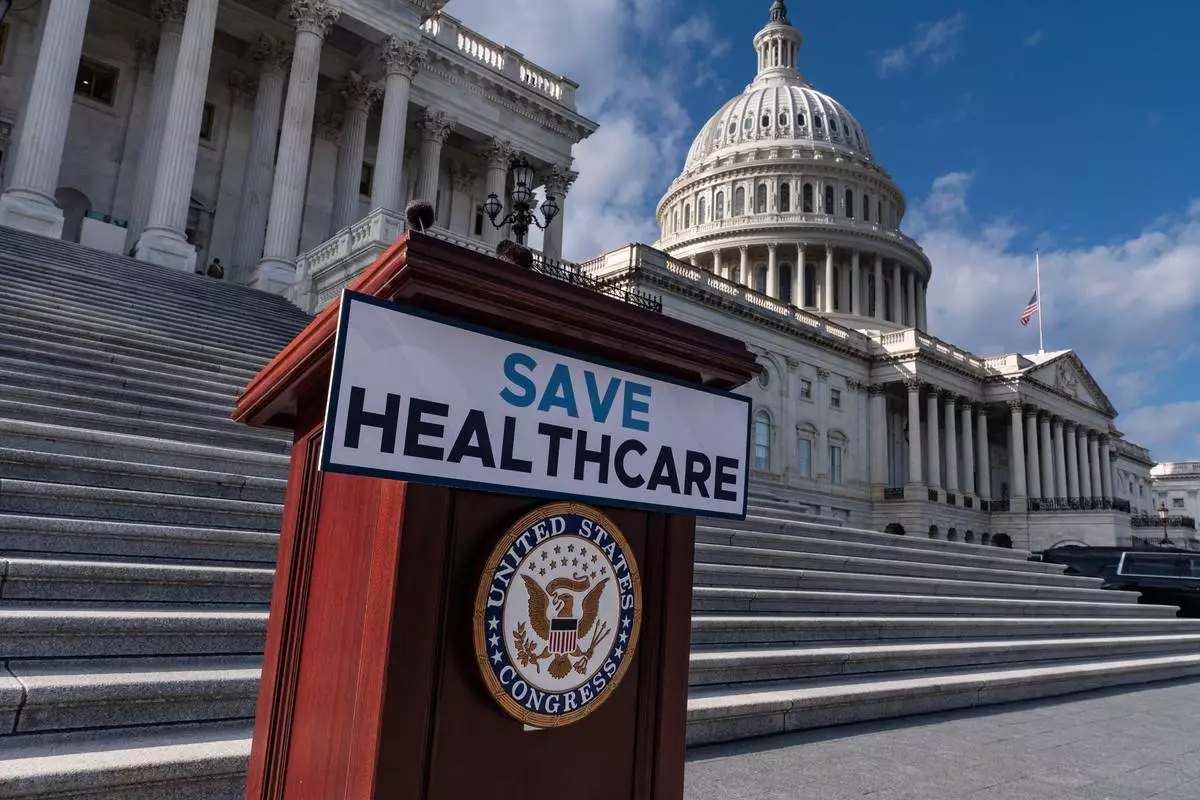
FILE - A lectern awaits the arrival of House Democrats to speak on the health care funding fight on the steps of the House at the Capitol in Washington, Nov. 12, 2025. (AP Photo/J. Scott Applewhite, File)