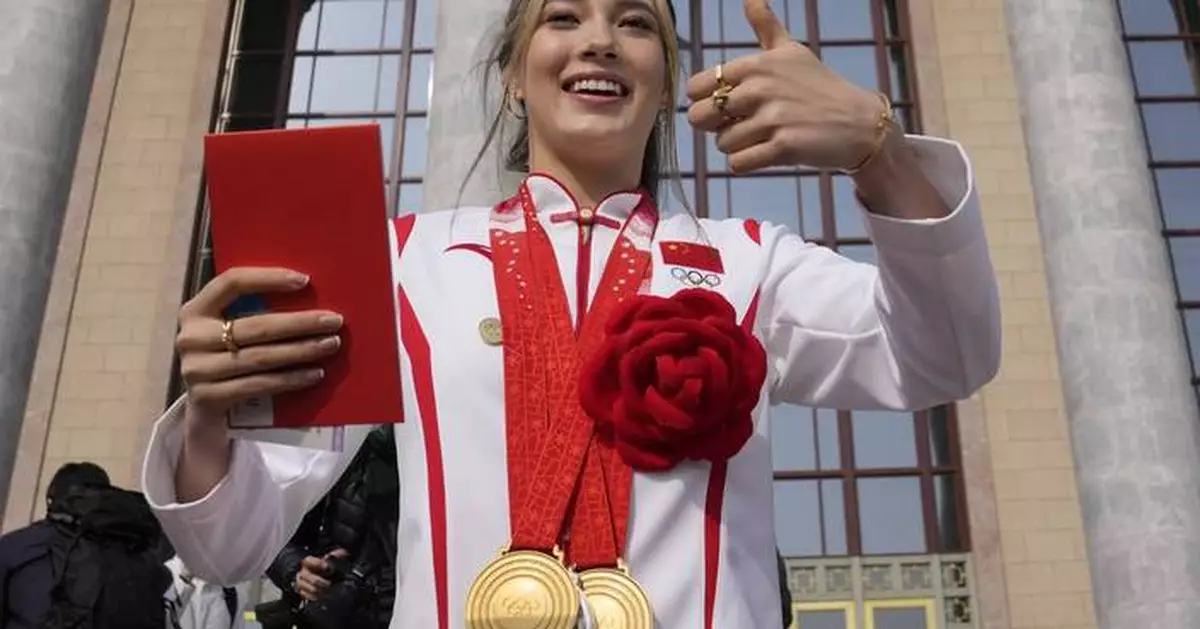
WELLINGTON, New Zealand (AP) — American-born Chinese skier and Olympic freestyle gold medalist Eileen Gu has suffered an injury while training in New Zealand, the latest in several setbacks for the 2022 Beijing Games champion.
The 21-year-old Gu was training at the Cardrona Skifield on New Zealand's South Island when the injury occurred on Aug. 15. Gu was flown the following day to the main South Island city of Christchurch for medical imaging.
“Unfortunately, a very terrible accident occurred yesterday due to a man-made accident,” Gu posted on the Chinese social media site Weibo on which she has 6.7 million followers.
"Early this morning we flew to Christchurch for a medical imaging examination. I hope I can return to the snow soon, but I’m still waiting for the final confirmation of the expert team.“
No further details of Gu's injury or condition were available. Gu, who has not provided an update since her post on Aug. 16, had only recently returned from a shoulder injury which caused her to miss the Asian Winter Games.
San Francisco-born Gu changed her allegiance to China to compete at the 2022 Beijing Olympic Games at which she won two gold medals in freestyle skiing at the age of 18. She will represent China again at the 2026 Winter Olympics in Milan and Cortina, Italy.
Gu's post on Weibo suggested an over-enthusiastic fan may have played a role in her injury.
“I have to concentrate fully during training, especially when I am preparing to start as it’s very dangerous to be interrupted," she said. "I also have to focus on picturing and imagining the moves while on the cable car.
"In order to save time, I don’t have lunch breaks and try to use the bathroom as little as possible. So please don’t record or take photos while I’m training.”
Gu was the second-highest earning female athlete in 2023 with $22.1 million, behind tennis star Iga Swiatek, according to the Forbes list.
AP sports: https://apnews.com/sports
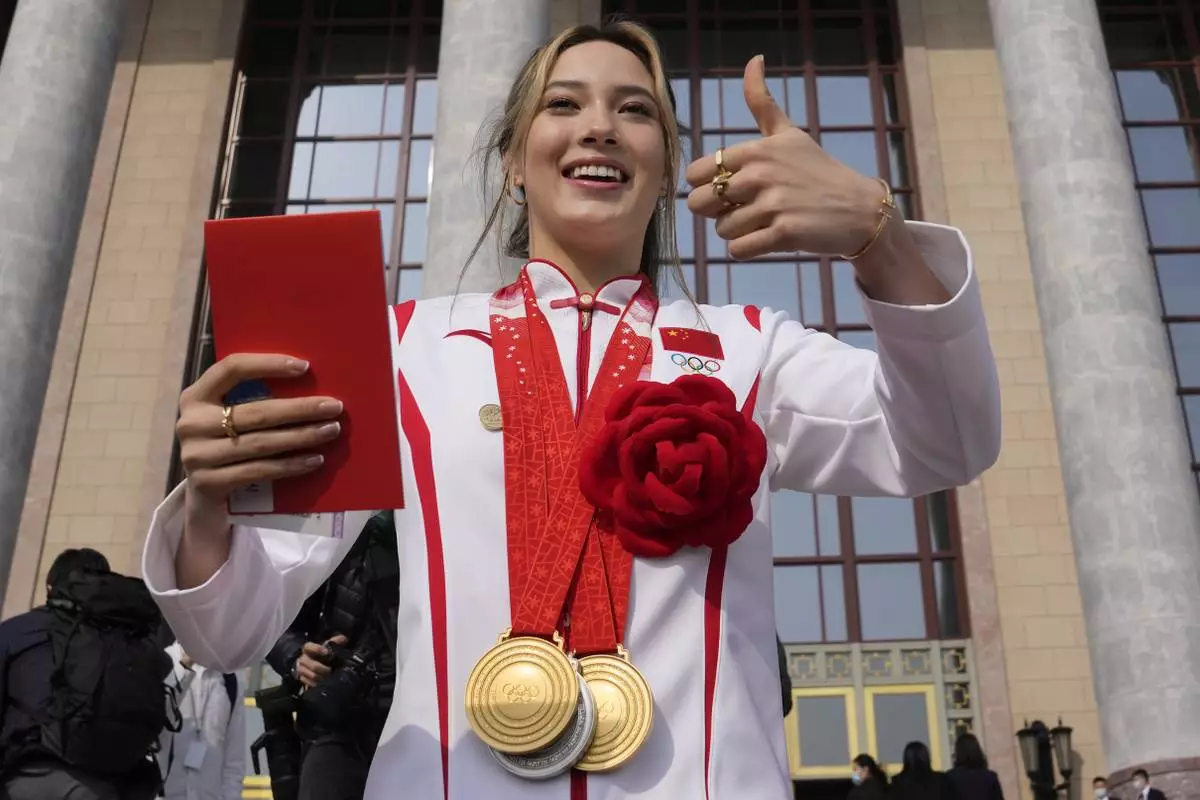
FILE - Olympic gold medalist Eileen Gu poses with her three medals before a commendation ceremony for role models of the Beijing Winter Olympics and Paralympics at the Great Hall of the People, on April 8, 2022, in Beijing. (AP Photo/Ng Han Guan, File)
OpenAI says it will soon start showing advertisements to ChatGPT users who aren't paying for a premium version of the chatbot.
The artificial intelligence company said Friday it hasn't yet rolled out ads but will start testing them in the coming weeks.
It's the latest effort by the San Francisco-based company to make money from ChatGPT's more than 800 million users, most of whom get it for free.
Though valued at $500 billion, the startup loses more money than it makes and has been looking for ways to turn a profit.
“Most importantly: ads will not influence the answers ChatGPT gives you,” said Fidji Simo, the company’s CEO of applications, in a social media post Friday.
OpenAI said the digital ads will appear at the bottom of ChatGPT's answers “when there’s a relevant sponsored product or service based on your current conversation.”
The ads “will be clearly labeled and separated from the organic answer,” the company said.
Two of OpenAI’s rivals, Google and Meta, have dominated digital advertising for years and already incorporate ads into some of their AI features.
Originally founded as a nonprofit with a mission to safely build better-than-human AI, OpenAI last year reorganized its ownership structure and converted its business into a public benefit corporation. It said Friday that its pursuit of advertising will be “always in support” of its original mission to ensure its AI technology benefits humanity.
But introducing personalized ads starts OpenAI “down a risky path” previously taken by social media companies, said Miranda Bogen of the Center for Democracy and Technology.
“People are using chatbots for all sorts of reasons, including as companions and advisors," said Bogen, director of CDT’s AI Governance Lab. “There’s a lot at stake when that tool tries to exploit users’ trust to hawk advertisers’ goods.”
OpenAI makes some money from paid subscriptions but needs more revenue to pay for its more than $1 trillion in financial obligations for the computer chips and data centers that power its AI services. The risk that OpenAI won’t make enough money to fulfill the expectations of backers like Oracle and Nvidia has amplified investor concerns about an AI bubble.
“It is clear to us that a lot of people want to use a lot of AI and don’t want to pay, so we are hopeful a business model like this can work,” said OpenAI CEO Sam Altman in a post Friday on social platform X. He added that he likes the ads on Meta's Instagram because they show him things he wouldn't have found otherwise.
OpenAI claims it won't use a user's personal information or prompts to collect data for ads, but the question is “for how long,” said Paddy Harrington, an analyst at research group Forrester.
“Free services are never actually free and these public AI platforms need to generate revenue,” Harrington said. “Which leads to the adage: If the service is free, you’re the product.”
FILE - The OpenAI logo is displayed on a mobile phone in front of a computer screen with output from ChatGPT, March 21, 2023, in Boston. (AP Photo/Michael Dwyer, File)