Update on mosquito-borne diseases
The Centre for Health Protection (CHP) of the Department of Health (DH) announced that as of 5pm today (August 22), no new case of chikungunya fever (CF) had been recorded.
There have been no new cases of CF in the past week in Hong Kong. So far this year, Hong Kong has recorded a total of nine confirmed CF cases. All are imported cases. All cases have recovered and been discharged without complications. From 2016 to 2019, Hong Kong recorded between one and 11 imported cases annually.
For dengue fever (DF), there have been no new cases in the past week in Hong Kong either. There have been 41 imported DF cases recorded so far this year.A total of 161 cases of DF were recorded in 2024, including 156 imported and five local cases.
For Japanese encephalitis (JE), Hong Kong has recorded one imported JE case fromthe Philippines this year. In the past five years (from 2020 to 2024), no JE cases were recorded in Hong Kong, and a total of 10 cases were recorded between 2016 and 2019 (including six locally infected cases).
"The current high temperatures and rainfall levels continue to pose risks of transmission of various mosquito-borne diseases in Hong Kong. Aedes albopictus, which is the vector for chikungunya virus, dengue virus and Zika virus, is common in Hong Kong. Although these mosquito-borne diseases are not transmitted from person to person, during the early stage after the onset of symptoms (especially when a fever is present), the blood of infected patients contains a large amount of virus, which is infectious to mosquitoes. If people are bitten by mosquitoes during the communicable period, further local transmission via mosquitoes is possible," the Controller of the CHP, Dr Edwin Tsui said.
"JE is prevalent in rural areas of Asia and the Western Pacific Region, especially in the hot season. As Culexmosquitoes (including Culex tritaeniorhynchus), the primary vector for JE, can be found in Hong Kong, especially in the rural areas, there is also a risk of transmission of JE locally. Culexmosquitoes breed in areas where there is a lot of stagnant water, and pigs or wild birds are natural hosts of the JE virus. Culexmosquitoes become infected when they bite pigs or wild birds infected with the JE virus.The infected mosquitoes then transmit the virus to humans and animals during biting.Therefore, members of the public should take proper mosquito control measures both locally and during travel. We must make a concerted effort in eliminating mosquito breeding, so as to cut the transmission links of mosquito-borne diseases in the community," Dr Tsui added.
Continuously strengthening prevention and control of mosquito-borne diseases
The Food and Environmental Hygiene Department (FEHD) is conducting vector investigations and targeted mosquito control operations and will intensify mosquito prevention and control measures at the residence of the CF patients, as well as locations visited after the onset of symptoms. These measures include:
 carrying out intensive fogging in the scrubby areas within a 250-metre radius of the relevant locations to kill adult mosquitoes;
carrying out inspectionof the locations, removing stagnant water, applying insecticides and disposing of abandoned water containers every week with a view to preventing mosquito breeding; and
enhancing public education efforts through organising health talks, setting up mobile education stations, and distributing publicity leaflets.
carrying out intensive fogging in the scrubby areas within a 250-metre radius of the relevant locations to kill adult mosquitoes;
carrying out inspectionof the locations, removing stagnant water, applying insecticides and disposing of abandoned water containers every week with a view to preventing mosquito breeding; and
enhancing public education efforts through organising health talks, setting up mobile education stations, and distributing publicity leaflets.
The CHP's Port Health Division continues to step up inspections at boundary control points and to remind cross-boundary public transport operators and other relevant parties to ensure good environmental hygiene and effective implementation of anti-mosquito measures. Furthermore, staff members of the Port Health Division distribute leaflets to travellers, conduct temperature screenings for inbound travellers, conduct health assessments for travellers with fever or related symptoms, and refer them to hospitals for follow-ups when necessary.
To raise awareness among the elderly about preventing mosquito-borne diseases, the Visiting Health Teams under the Elderly Health Service of the DH have been advising the elderly on mosquito-borne diseases prevention and tips on travel health at health talks conducted at District Elderly Community Centres and Neighbourhood Elderly Centres. Besides, the Visiting Health Teams have also reminded all residential care homes for the elderly in Hong Kong to enhance mosquito control measures. The DH's Maternal and Child Health Centres, Student Health Service Centres and Special Assessment Centres also advise pregnant women, infant carers and students on symptoms and preventive measures of the mosquito-borne diseases.
Dr Tsui reminded members of the public that those returning to Hong Kong from areas affected by mosquito-borne diseases should continue to apply insect repellent and closely monitor their personal health condition. If they feel unwell, they should seek medical attention immediately and inform their doctors of their travel history. The public should avoid using non-steroidal anti-inflammatory drugs (such as ibuprofen), to prevent aggravating the risk of haemorrhage. In general, children should not take medications containing aspirin to relieve fever or other symptoms because it may lead to Reye's syndrome, a serious and potentially fatal complication.
Members of the public should also adopt anti-mosquito measures during the rainy season against mosquito-borne diseases. Proper use of DEET-containing insect repellents or other effective active ingredients can prevent mosquito bites, but the following precautions should be taken when using them:
read the label instructions carefully first;
apply right before entering an area with a risk of mosquito bites;
apply on exposed skin and clothing;
use DEET of up to 30 per cent for pregnant women and up to 10 per cent for children (For children who travel to countries or areas where mosquito-borne diseases are endemic or epidemic and where exposure is likely, those aged 2 months or above can use DEET-containing insect repellents with a DEET concentration of up to 30 per cent);
apply sunscreen first, then insect repellent;
reapply only when needed and follow the instructions; and
in addition to DEET, there are other insect repellents available on the market containing different active ingredients, such as IR3535 and picaridin. When using any insect repellent, the public should follow the usage instructions and precautions on the product label.
In addition, the FEHD appeals to members of the public to continue to stay alert and work together to carry out mosquito prevention and control measures early, including inspecting their homes and surroundings to remove potential breeding grounds, changing water in vases and scrubbing their inner surfaces, removing water in saucers under potted plants at least once a week, and properly disposing of containers such as soft drink cans and lunch boxes. The FEHD also advises members of the public and estate management bodies to keep drains free of blockage and level all defective ground surfaces to prevent the accumulation of water. They should also scrub all drains and surface sewers with an alkaline detergent at least once a week to remove any mosquito eggs.
The public should call 1823 in case of mosquito problems and may visit the following pages for more information: the CF page of theCHPand theTravel Health Service, the latestTravel Health News,tips for using insect repellents, and the CHPFacebook Page,Instagram AccountandYouTube Channel, and also theMosquito Prevention and Control dedicated pageof the FEHD.
Source: AI-found images
Government announces updates on follow-up work on Tai Po fire
The three task forces set up by the Government for the fire at Wang Fuk Court in Tai Po - the Task Force on Investigation and Regulation, the Task Force on Emergency Support and Fund-Raising, and the Task Force on Emergency Accommodation Arrangements - are making full efforts to follow up on the support, relief, and investigation work related to the incident. Details are as follows:
Financial and welfare support
---------------------------------
For the Support Fund for Wang Fuk Court in Tai Po, established by the Government, donations received are about $3.4 billion as of noon today (December 15). With the start-up capital of $300 million from the Government, the fund's total has now reached around $3.7 billion. The fund will be used to assist residents in rebuilding their homes and providing long-term and sustained support.
The Government earlier announced that a living allowance from the Support Fund will be provided to each affected household, and the amount has been increased from $50,000 to $100,000. As of today, 1 883 cases have been processed. In addition, the Government will provide families of each deceased victim with a token of solidarity of $200,000, as well as $50,000 to cover funeral costs. As of today, a total of 130 cases have been processed. The allowance will be disbursed in phases.
Social workers from the Social Welfare Department (SWD) have been in contact with more than 1 980 affected households, providing the "one social worker per household" follow-up service to more than 4 900 residents. The SWD will maintain liaison with the affected households to provide all necessary assistance while fully supporting the relief work of the Government.
In addition, the Government also provides support and assistance to foreign domestic helpers (FDHs) affected by the fire. The Labour Department has been maintaining close liaison with the Consulates-General of the Philippines and Indonesia in Hong Kong to co-ordinate and follow up on the relevant work. Besides providing tokens of solidarity of $200,000 and funeral grants of $50,000 to families of each deceased FDH, as well as injury grants of $50,000 or $100,000 to injured FDHs, the Government has disbursed a special subsidy of $20,000 to 110 FDHs employed at Wang Fuk Court.
Meanwhile, the Immigration Department (ImmD) has made special arrangements for FDHs whose employers are unable to continue their employment contracts due to the fire. Under these arrangements, affected FDHs are allowed to remain in Hong Kong for three months as visitors to seek new employers (extendable if necessary), without having to return to their places of origin first. The ImmD will also waive the relevant fees for their extension of stay.
Accommodation support
---------------------------
As of this morning, a total of 1 336 residents have been accommodated, through the co-ordination of the Home and Youth Affairs Bureau, in youth hostels, camps, or hotel rooms. Another 3 247 residents are currently living in transitional housing units provided by the Housing Bureau, units from the Hong Kong Housing Society (HKHS), or Po Tin Interim Housing in Tuen Mun.
Currently, there is still an abundant supply of more than 1000 units that can provide affected residents with longer term accommodation. The transitional housing and HKHS projects in different districts can altogether provide around 400 units at the moment. Besides, Po Tin Interim Housing in Tuen Mun and Runway 1331 at Kai Tak can provide a supply of around 900 units.
In consideration of the extremely urgent situation of the residents affected by the fire incident, a special arrangement of a full rent exemption has been made earlier by the Housing Bureau to provide accommodation support to those affected residents moving into transitional housing or HKHS projects. In other words, if needed, the affected residents can stay for a longer period of time. The Government will continue to support the affected residents in terms of accommodation, and the residents in need do not have to worry about the relevant rental expenses or the duration of stay.
In addition, staff from the operating organisations of transitional housing and HKHS, as well as volunteers have been working around the clock to furnish the units with essential supplies, striving to meet the needs of the residents. All the currently available units in transitional housing and HKHS projects are equipped with furniture and appliances such as bed frames, mattresses, induction cookers and water heaters, etc, enabling the residents to settle in comfortably. At the same time, a number of organisations have proactively stationed their staff in some projects to provide residents in need with various forms of support. Taking T-Loft@Kai Tak in Kai Tak and T-Loft@Lok Wo in Ma On Shan as examples, the operators have not only arranged social workers to provide emotional support and assist with daily needs for the affected residents, but also set up dedicated emotional support stations within these projects. Volunteers were organised to serve on shifts, providing ongoing companionship and care to the affected residents, standing with them through the difficult time.
Relief supplies and donations
---------------------------------
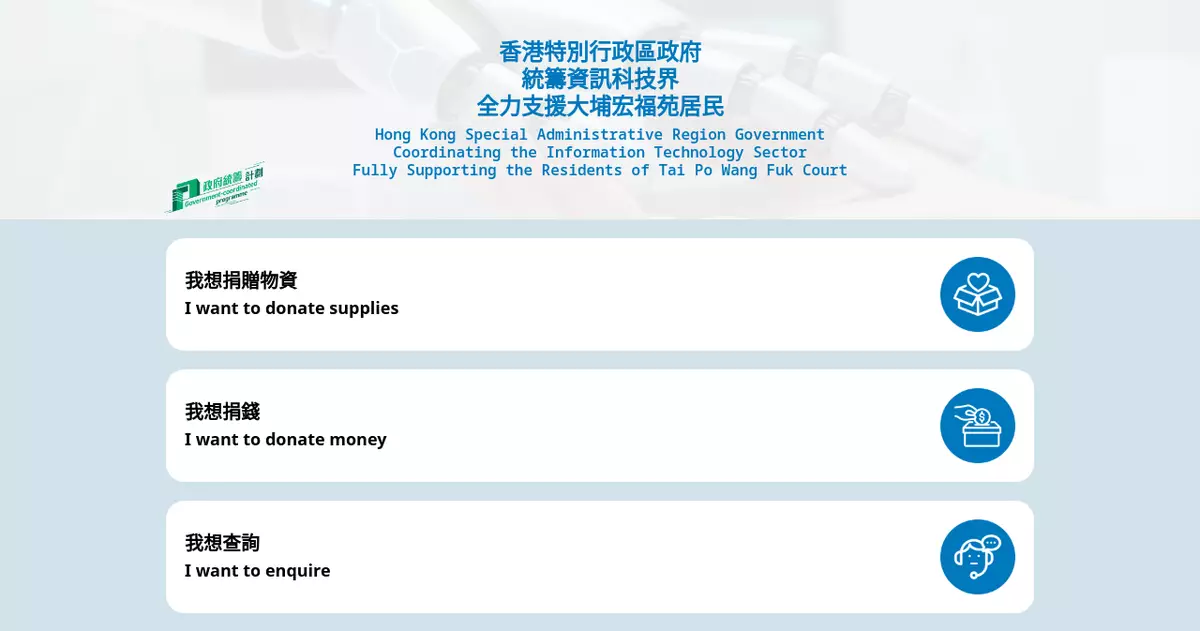
Thesupplies donation online platform, established by the Government and the information technology sector, continues to operate, facilitating the registration of supplies donations from organisations and the public. The Government has so far received over 1 800 registrations, of which approximately 30 per cent were submitted by organisations, whereas the others were contributed by the public. The various registered donation items include food and beverages, clothing, daily necessities, bedding, and electrical appliances. The Government is actively assessing residents' actual needs through the relevant policy bureau, government departments, and service organisations for the matching of donated supplies in order to distribute appropriate items in phases to places in need. So far, about 23 000 donation items covering various categories have been distributed to different places. The matching and distribution of supplies will continue.
Regulation and inspection work
----------------------------------
The Development Bureau (DEVB) announced on December 11 a new mechanism for sampling and testing scaffold nets for external walls in Hong Kong. The DEVB is moving ahead in full steam the supporting arrangements to ensure that there are sufficient designated laboratories and a suitable site for off-site sampling work.
Source: AI-found images