When a BNSF freight train carrying six cars of liquefied petroleum gas derailed near Manuelito, New Mexico, in 2024, the resulting fire shut down more than 100 miles of an interstate highway.
The train carried enough flammable material to send a column of fire and black smoke high into the thin, dry air — but not enough to qualify as a “high-hazard flammable train” under federal rules.
That meant the train was not obligated to follow federal safety rules that require high-hazard flammable trains, or HHFTs, to operate at slower speeds, and use safer braking systems and tank cars.
It also meant BNSF was not obligated to include the train in federally-mandated reports to New Mexico emergency management officials estimating the movement of HHFTs through the state.
Federal safety investigators and some lawmakers want to change that. For more than a decade, the National Transportation Safety Board, which investigates major train accidents, has tried and failed to convince federal regulators to make HHFT safety rules apply to a much larger number of trains. In an investigation report on the Manuelito disaster released in June, the NTSB again called for changes.
The current definition of an HHFT only covers trains carrying large quantities of flammable liquids, such as crude oil or alcohol. The safety board wants to expand the definition to include liquefied petroleum gas and other flammable gases.
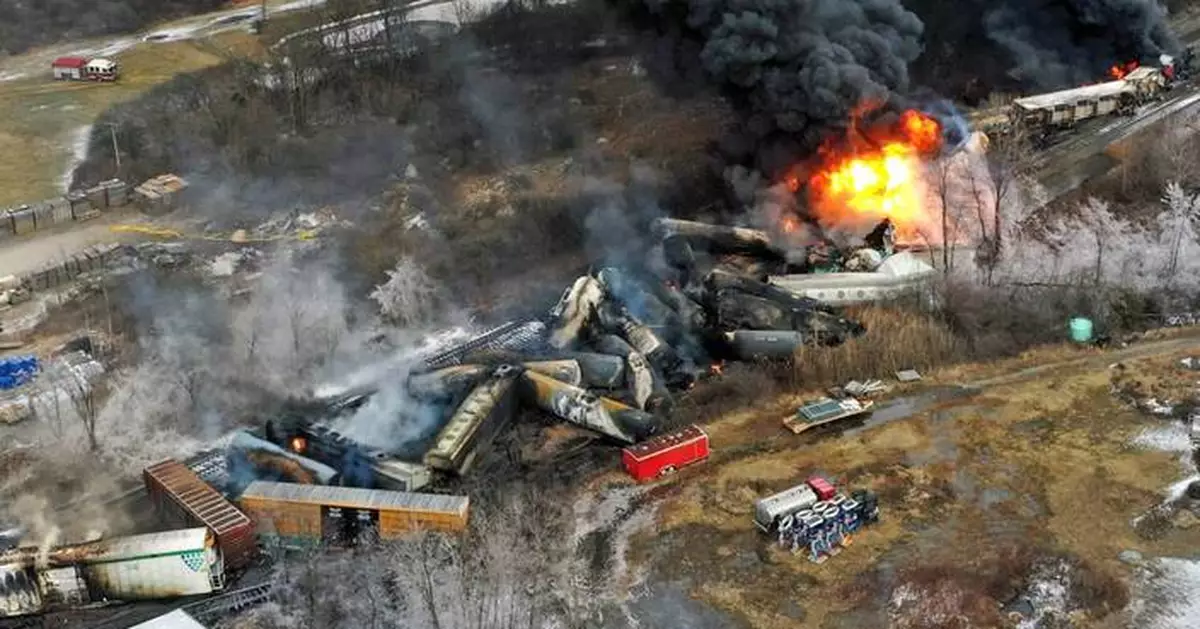
The issue generated intense interest from lawmakers following the catastrophic derailment of a Norfolk Southern train that caught fire, resulting in the release of a toxic plume of vinyl chloride — a flammable gas — over East Palestine, Ohio, in 2023. The train wasn’t classified as an HHFT, even though it was carrying three loaded tank cars of flammable liquid. That’s because the federal definition requires a train to carry at least 35 loaded cars of flammable liquid — or at least 20 cars in a row – to qualify.
In the wake of that accident, some members of Congress filed legislation that overlaps with the NTSB recommendation and goes one step further. The DERAIL Act, introduced by Rep. Chris Deluzio, D-Pa., would define an HHFT as one carrying even a single car of a flammable gas or a flammable liquid.
“I think what we saw in the East Palestine derailment is a pretty blunt reality that even just a single train carrying something flammable and toxic — say, like vinyl chloride — can cause a lot of harm to people who live near the tracks,” said Deluzio, whose Pennsylvania district sits just across the border from East Palestine.
The bill stalled in the House after being introduced in 2023, but Deluzio reintroduced it in January. Supporters say the legislation, which has not moved in Congress, could provide U.S. communities with a more accurate picture of risk from train derailments.
That’s because there are many more trains carrying small amounts of flammable material than there are trains carrying large amounts, according to a Howard Center for Investigative Journalism analysis of data that details the precise movement of freight trains.
Federal transportation officials have recognized rail as the “safest land-based method of moving large quantities of chemicals over long distances” when compared with movement on trucks.
The Association of American Railroads — an industry lobbyist and trade group with significant sway over rail safety practices — “has concerns with a number of the provisions in (the DERAIL Act) and similar bills,” spokesperson Jessica Kahanek said. The industry follows its own protocol that limits the speed of trains carrying more than 20 cars of hazardous material, she noted.
The association is open to discussing the HHFT definition, but changes “must be driven by an assessment of actual risk,” Kahanek said, and must allow railroads “to continue safely delivering the goods Americans depend on each day.”
Railroads closely protect real-time and location-specific information about the movement of freight trains carrying hazardous materials, saying public disclosure presents a public safety risk.
To analyze the potential impact of the proposed change to the definition of HHFTs, the Howard Center relied on data from RailState LLC, a company that independently captures detailed information on train movements.
The company has placed optical sensors on private land at key locations across the North American rail network. The sensors take pictures of each passing train. They use artificial intelligence to extract information about the cargo, identifying hazardous materials by reading warning placards displayed on rail cars.
The firm sells its information to government agencies in the U.S. and Canada, as well as to shippers and other clients.
Only the railroads — and not the U.S. government — know the precise number and real-time location of HHFTs. It’s not possible, even with RailState’s data, to precisely compare the number of trains that meet the current definition to the number of HHFTs that would meet the proposed definition.
One major reason: both definitions only consider loaded tank cars, and RailState’s data cannot automatically determine whether a tank car is loaded — or only contains chemical residue.
What is clear from the RailState data, however, is that there are many more trains with a smaller number of cars with hazmat placards indicating the presence of a flammable gas or a flammable/combustible liquid than there are trains carrying a large number of cars with placards for a flammable/combustible liquid.
The Howard Center counted trains that passed RailState sensors over the last six months with at least one car with a hazmat placard indicating it carried a flammable gas or a flammable/combustible liquid. Then the Howard Center counted the number of trains with at least 35 cars bearing a placard for a flammable/combustible liquid, and compared the two numbers.
At RailState sensors located near the East Palestine accident site, the data captured six times as many trains with at least one car of flammable gases or flammable/combustible liquids.
At the sensor closest to the Manuelito crash site, there were five times as many trains.
At the company’s U.S.-Canadian border sensor in Blaine, Washington, there was a 16-fold difference.
Across the RailState sensor network, the smallest difference observed by the Howard Center was a three-fold difference — at a sensor near the U.S.-Mexico border in Laredo, Texas.
While RailState does not monitor the entire U.S. rail system, the analysis showed a tenfold difference, on average, across its sensors in the United States. The company has nearly 100 U.S. sensors located in 18 states, along with more than 150 across Canada.
In Custer, Washington, along a stretch of rail just south of RailState’s Canadian-border sensor in Blaine, Jennifer Reich was cleaning the kitchen floor of her art studio in December 2020 when she saw a black smoke plume emerge from the railroad tracks across the street from her shop.
A BNSF train carrying 106 cars of petroleum crude oil derailed near the end of its trip from the Bakken oil fields in North Dakota to a refinery in nearby Cherry Point, Washington. Nearly 30,000 gallons (113,000 liters) of oil caught fire and burned uncontrolled for two hours, according to the NTSB, prompting Reich and her neighbors to evacuate.
The derailment caused at least $1.5 million in damages, according to the NTSB, but no one was injured.
“That was very lucky because it could have been a whole lot worse,” said Reich, the owner of Whimsy Glass Art Studio.
Over the last decade, at least six trains that met the HHFT classification derailed — including the incident in Custer, a Howard Center review of federal accident data found.
— A BNSF train on Sept. 19, 2015, spilled nearly 50,000 gallons (190,000 liters) of ethanol near Lesterville, South Dakota, after it derailed on a small bridge. The train carried 96 loaded cars of ethanol, according to investigation reports.
— A Union Pacific train with 96 loaded tank cars derailed in Fort Worth, Texas, on April 24, 2019, and leaked around 65,000 gallons (246,000 liters) of denatured ethanol, which ignited and formed pool fires. Some of the denatured ethanol entered a tributary of the Trinity River, according to investigation reports.
— On Feb. 13, 2020, a mudslide led to a CSX Transportation train derailment near Draffin, Kentucky, and released more than 38,000 gallons (144,000 liters) of denatured ethanol, which combined with diesel fuel from the derailed locomotives and ignited. The train carried 96 loaded tank cars, according to the investigation report.
— On January 8, 2022, 37 tank cars of a BNSF train derailed and 28 of them released around 601,000 gallons (2.27 million liters) of denatured ethanol in Oklaunion, Texas. The leaked ethanol resulted in a pool fire that burned for around four hours, according to investigation reports.
— On March 10, 2017, a Union Pacific train derailed carrying 98 loaded tank cars, releasing 322,000 gallons (1.25 million liters) of ethanol that caught fire near Graettinger, Iowa.
The U.S. Pipeline and Hazardous Materials Safety Administration proposed a federal regulation classifying HHFTs in 2014, a year after one of the worst rail disasters in modern North American history.
In 2013, a train carrying more than 70 cars of flammable Bakken crude oil derailed in Lac-Mégantic, Quebec, Canada, killing 47 people and leveling dozens of buildings.
The accident helped popularize the nickname safety and environmental activists use to describe the movement of large quantities of flammable liquid by rail: “bomb trains.”
Alaysia Ezzard, Ijeoma Opara, Molecule Jongwilai, Tiasia Saunders, Natalie Weger and Marijke Friedman of the Howard Center for Investigative Journalism contributed to this story.
The Howard Center for Investigative Journalism at the University of Maryland is funded by a grant from the Scripps Howard Foundation in honor of newspaper pioneer Roy W. Howard.
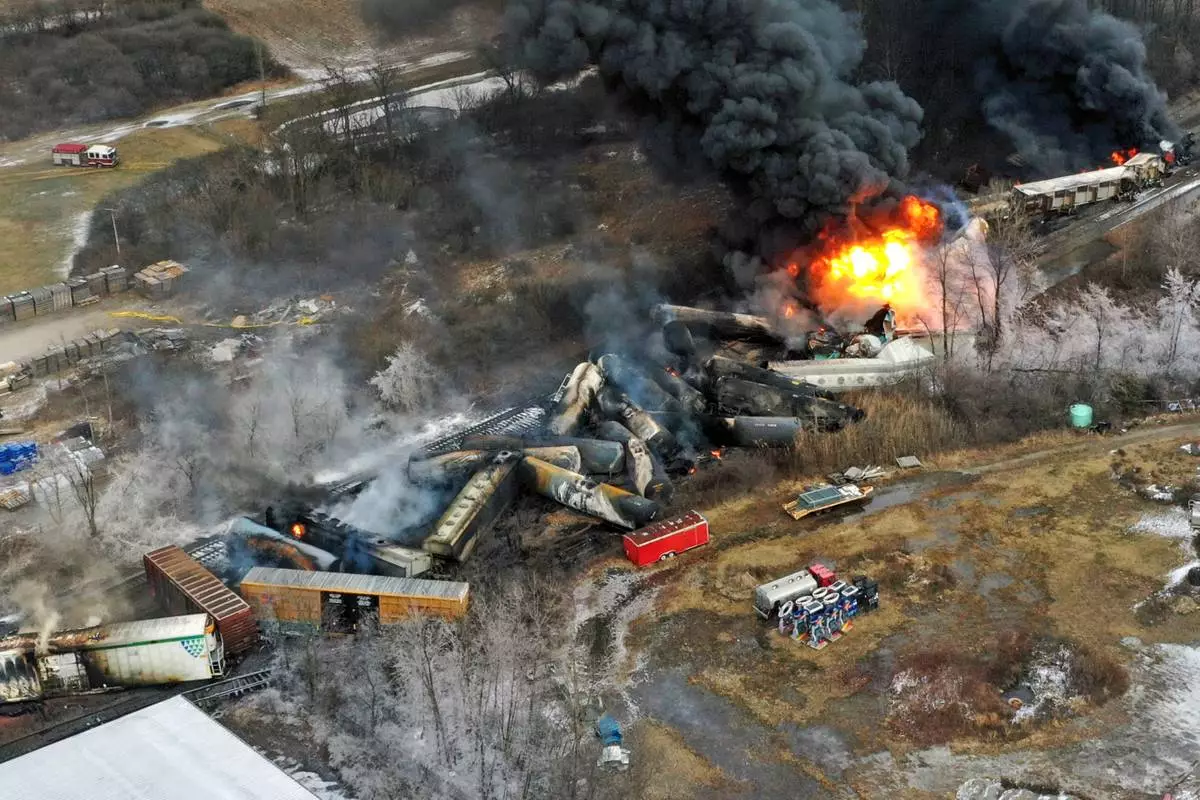
FILE - In this photo taken with a drone, portions of a Norfolk Southern freight train that derailed in East Palestine, Ohio, remain on fire, Feb. 4, 2023. (AP Photo/Gene J. Puskar, File)
The U.N. Security Council scheduled an emergency meeting Thursday to discuss Iran's deadly protests at the request of the United States, even as President Donald Trump left unclear what actions he would take against the Islamic state.
Tehran appeared to make conciliatory statements in an effort to defuse the situation after Trump threatened to take action to stop further killing of protesters, including the execution of anyone detained in Tehran’s bloody crackdown on nationwide protests.
Iran’s crackdown on the demonstrations has killed at least 2,615, the U.S.-based Human Rights Activists News Agency reported. The death toll exceeds any other round of protest or unrest in Iran in decades and recalls the chaos surrounding the country’s 1979 Islamic Revolution.
The sound of gunfire faded Thursday in the capital, Tehran. The country closed its airspace to commercial flights for hours without explanation early Thursday and some personnel at a key U.S. military base in Qatar were advised to evacuate. The U.S. Embassy in Kuwait also ordered its personnel to “temporary halt” travel to the multiple military bases in the small Gulf Arab country.
Here is the latest:
Abdul Malik al-Houthi, leader of the Iran-backed Yemeni rebel group, said on Thursday that “criminal gangs” were responsible for the situation in Iran, accusing them of carrying out an “American-Israeli” scheme.
“Criminal gangs in Iran killed Iranian citizens, security forces and burned mosques,” he said without providing evidence. “What’s being committed by criminal gangs in Iran is horrific, bearing an American stamp as it includes slaughter and burning some people alive.”
He also said that the U.S. imposed economic sanctions on Iran to create a crisis leading to the current issues in the country with the end goal of controlling Iran.
Yet he said the U.S. has “failed in Iran” and that Iranians “will not yield to America.”
The president of the European Union’s executive arm says the 27-member bloc is looking to strengthen sanctions against Iran as ordinary Iranians continue their protests against Iran’s theocratic government.
Commission President Ursula von der Leyen said Thursday following a meeting of the EU’s commissioners in Limassol, Cyprus that current sanctions against Iran are “weakening the regime.”
Von der Leyen said that the EU is looking to sanction individual Iranians —apart from those who belong to Iran’s Islamic Revolutionary Guard — who “are responsible for the atrocities.”
She added that the people of Iran who are “bravely fighting for a change” have the EU’s “full political support.”
Canada’s foreign minister says a Canadian citizen has died in Iran “at the hands of the Iranian authorities.”
“Peaceful protests by the Iranian people — asking that their voices be heard in the face of the Iranian regime’s repression and ongoing human rights violations — has led the regime to flagrantly disregard human life,” Canadian Foreign Affairs Minister Anita Anand posted on social media Thursday.
“This violence must end. Canada condemns and calls for an immediate end to the Iranian regime’s violence,” she added.
Anand said consular officials are in contact with the victim’s family in Canada. She did not provide details.
The International Federation of Red Cross and Red Crescent Societies announced Thursday that a local staff member was killed and several others were wounded during the deadly protests in Iran over the weekend.
Amir Ali Latifi, an Iranian Red Crescent Society worker, was working in the country’s Gillan province on Jan. 10 when he was killed “in the line of duty,” the organization said in a statement.
“The IFRC is deeply concerned about the consequences of the ongoing unrest on the people of Iran and is closely monitoring the situation in coordination with the Iranian Red Crescent Society,” the statement continued.
U.S. President Donald Trump has hailed as “good news” reports that the death sentence has been lifted for an Iranian shopkeeper arrested in a violent crackdown on protests.
Relatives of 26-year-old Erfan Soltani had said he faced imminent execution.
Trump posed Thursday on his Truth Social site: “FoxNews: ‘Iranian protester will no longer be sentenced to death after President Trump’s warnings. Likewise others.’ This is good news. Hopefully, it will continue!”
Iranian state media denied Soltani had been condemned to death. Iranian judicial authorities said Soltani was being held in a detention facility outside of the capital. Alongside other protesters, he has been accused of “propaganda activities against the regime,” state media said.
Trump sent tensions soaring this week by pledging that “help is on its way” to Iranian protesters and urging them to continue demonstrating against authorities in the Islamic Republic.
On Wednesday Trump signaled a possible de-escalation, saying he had been told that “the killing in Iran is stopping.”
In a joint statement, the foreign ministers of Canada, France, Germany, Italy, Japan, the United Kingdom, the United States and the European Union’s main foreign policy chief said the G7 members were “gravely concerned” by the developments surrounding the protests, and that they “strongly oppose the intensification of the Iranian authorities’ brutal repression of the Iranian people.”
The statement, published on the EU’s website Thursday, said the G7 were “deeply alarmed at the high level of reported deaths and injuries” and condemned “the deliberate use of violence” by Iranian security forces against protesters.
The G7 members “remain prepared to impose additional restrictive measures if Iran continues to crack down on protests and dissent in violation of international human rights obligations,” the statement said.
China’s Foreign Minister Wang Yi has spoken with his counterpart in Iran, who said the situation was “now stable,” China’s Ministry of Foreign Affairs said.
Abbas Araghchi said “he hoped China will play a greater role in regional peace and stability” during the talks, according to the statement from the ministry.
“China opposes imposing its will on other countries, and opposes a return to the ‘law of the jungle’,” Wang said.
“China believes that the Iranian government and people will unite, overcome difficulties, maintain national stability, and safeguard their legitimate rights and interests,” he added. “China hopes all parties will cherish peace, exercise restraint, and resolve differences through dialogue. China is willing to play a constructive role in this regard.”
“We are against military intervention in Iran,” Turkish Foreign Minister Hakan Fidan told journalists in Istanbul on Thursday. “Iran must address its own internal problems… They must address their problems with the region and in global terms through diplomacy so that certain structural problems that cause economic problems can be addressed.”
Ankara and Tehran enjoy warm relations despite often holding divergent interests in the region.
Fidan said the unrest in Iran was rooted in economic conditions caused by sanctions, rather than ideological opposition to the government.
Iranians have been largely absent from an annual pilgrimage to Baghdad, Iraq, to commemorate the death of Imam Musa al-Kadhim, one of the twelve Shiite imams.
Many Iranian pilgrims typically make the journey every year for the annual religious rituals.
Streets across Baghdad were crowded with pilgrims Thursday. Most had arrived on foot from central and southern provinces of Iraq, heading toward the shrine of Imam al-Kadhim in the Kadhimiya district in northern Baghdad,
Adel Zaidan, who owns a hotel near the shrine, said the number of Iranian visitors this year compared to previous years was very small. Other residents agreed.
“This visit is different from previous ones. It lacks the large numbers of Iranian pilgrims, especially in terms of providing food and accommodation,” said Haider Al-Obaidi.
Europe’s largest airline group said Thursday it would halt night flights to and from Tel Aviv and Jordan's capital Amman for five days, citing security concerns as fears grow that unrest in Iran could spiral into wider regional violence.
Lufthansa — which operates Swiss, Austrian Airlines, Brussels Airlines and Eurowings — said flights would run only during daytime hours from Thursday through Monday “due to the current situation in the Middle East.” It said the change would ensure its staff — which includes unionized cabin crews and pilots -- would not be required to stay overnight in the region.
The airline group also said its planes would bypass Iranian and Iraqi airspace, key corridors for air travel between the Middle East and Asia.
Iran closed its airspace to commercial flights for several hours early Thursday without explanation.
A spokesperson for Israel’s Airport Authority, which oversees Tel Aviv’s Ben Gurion Airport, said the airport was operating as usual.
Iranian state media has denied claims that a young man arrested during Iran’s recent protests was condemned to death. The statement from Iran’s judicial authorities on Thursday contradicted what it said were “opposition media abroad” which claimed the young man had been quickly sentenced to death during a violent crackdown on anti-government protests in the country.
State television didn’t immediately give any details beyond his name, Erfan Soltani. Iranian judicial authorities said Soltani was being held in a detention facility outside of the capital. Alongside other protesters, he has been accused of “propaganda activities against the regime,” state media said.
New Zealand’s Foreign Minister Winston Peters said Thursday that his government was “appalled by the escalation of violence and repression” in Iran.
“We condemn the brutal crackdown being carried out by Iran’s security forces, including the killing of protesters,” Peters posted on X.
“Iranians have the right to peaceful protest, freedom of expression, and access to information – and that right is currently being brutally repressed,” he said.
Peters said his government had expressed serious concerns to the Iranian Embassy in Wellington.
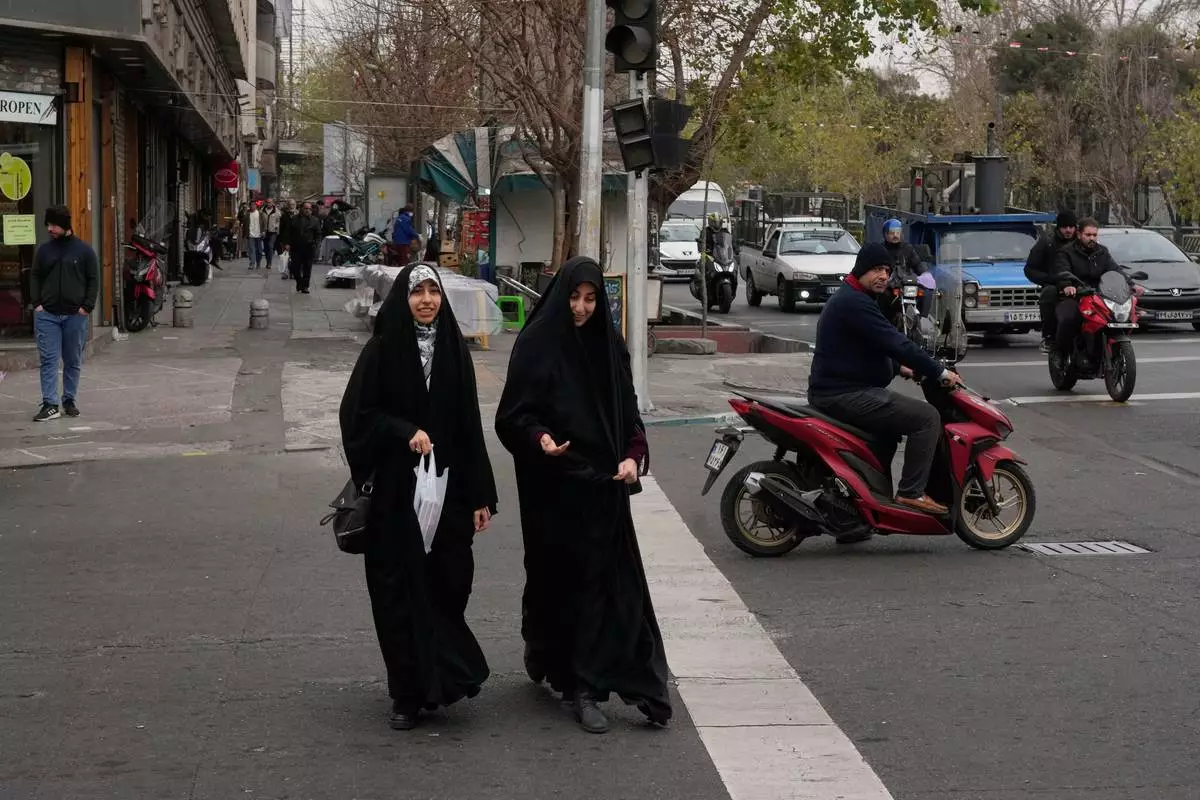
Women cross an intersection in downtown Tehran, Iran, Thursday, Jan. 15, 2026. (AP Photo/Vahid Salemi)
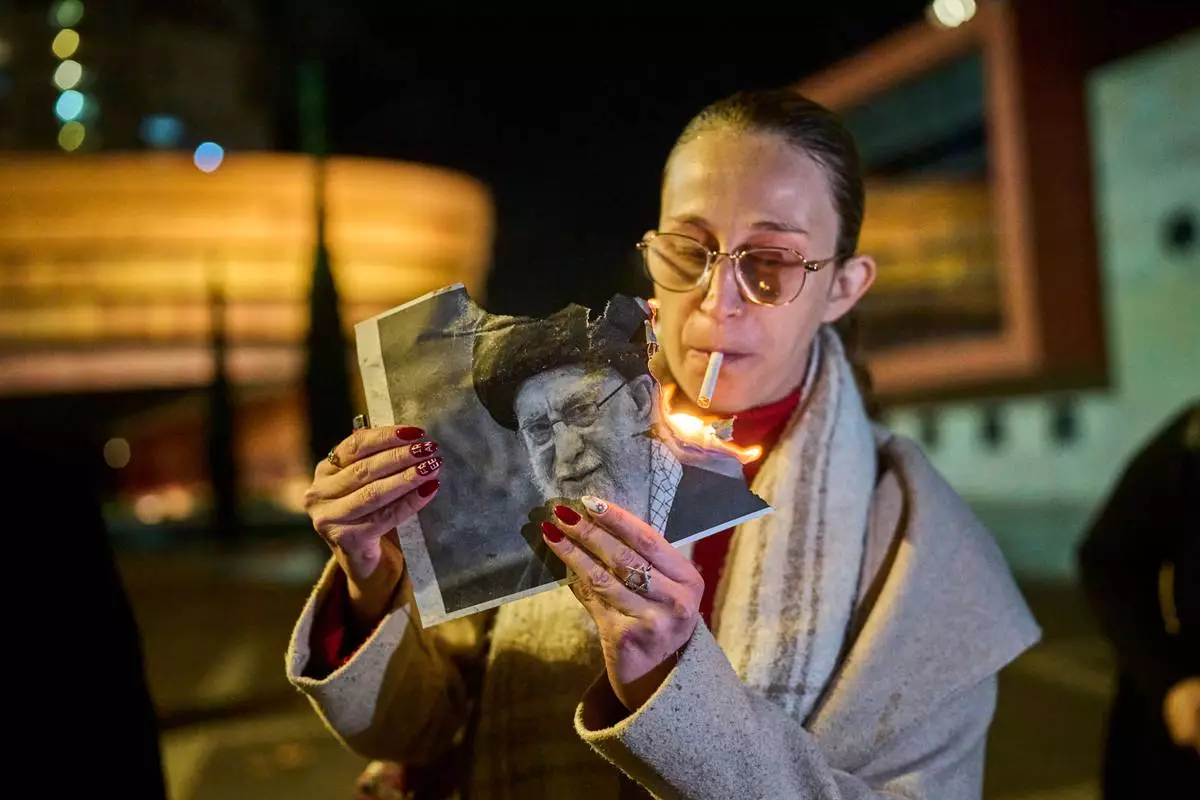
A demonstrator lights a cigarette with a burning poster depicting Supreme Leader Ayatollah Ali Khamenei during a rally in support of Iran's anti-government protests, in Holon, Israel, Wednesday, Jan. 14, 2026. (AP Photo/Ohad Zwigenberg)
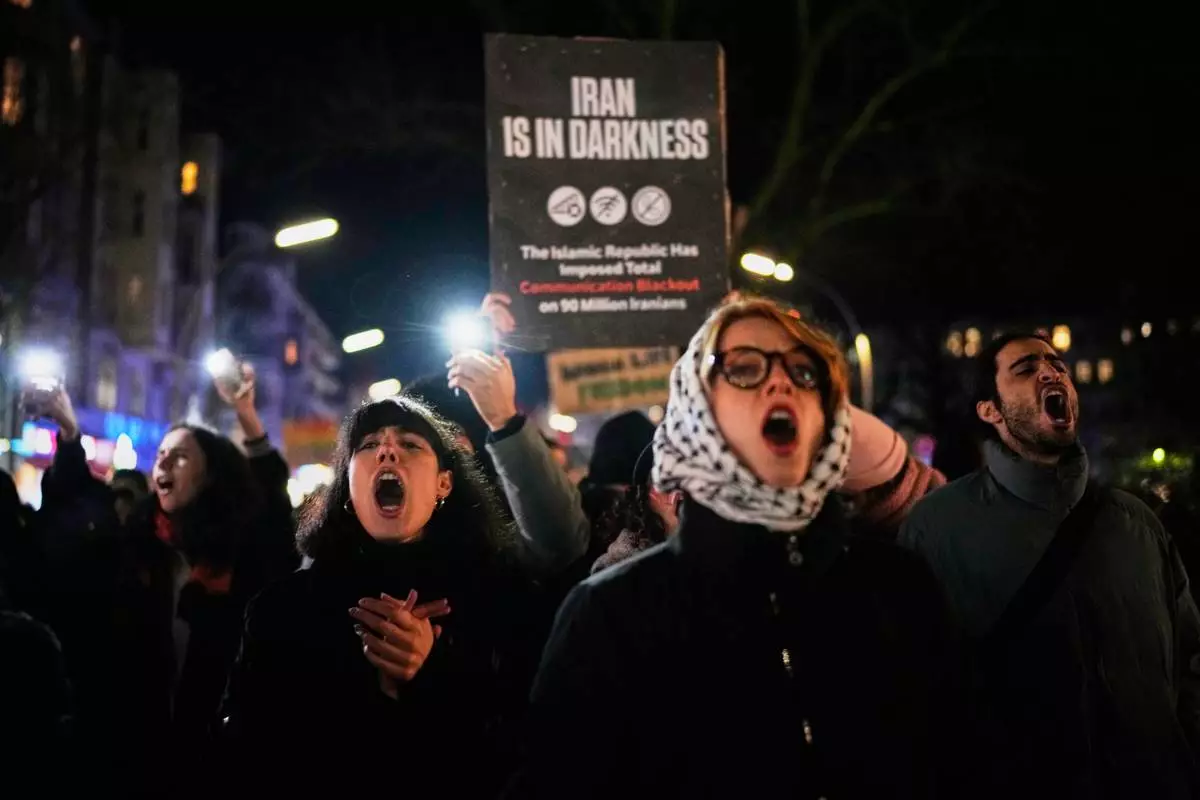
Protesters participate in a demonstration in support of the nationwide mass protests in Iran against the government, in Berlin, Germany, Wednesday, Jan. 14, 2026. (AP Photo/Ebrahim Noroozi)
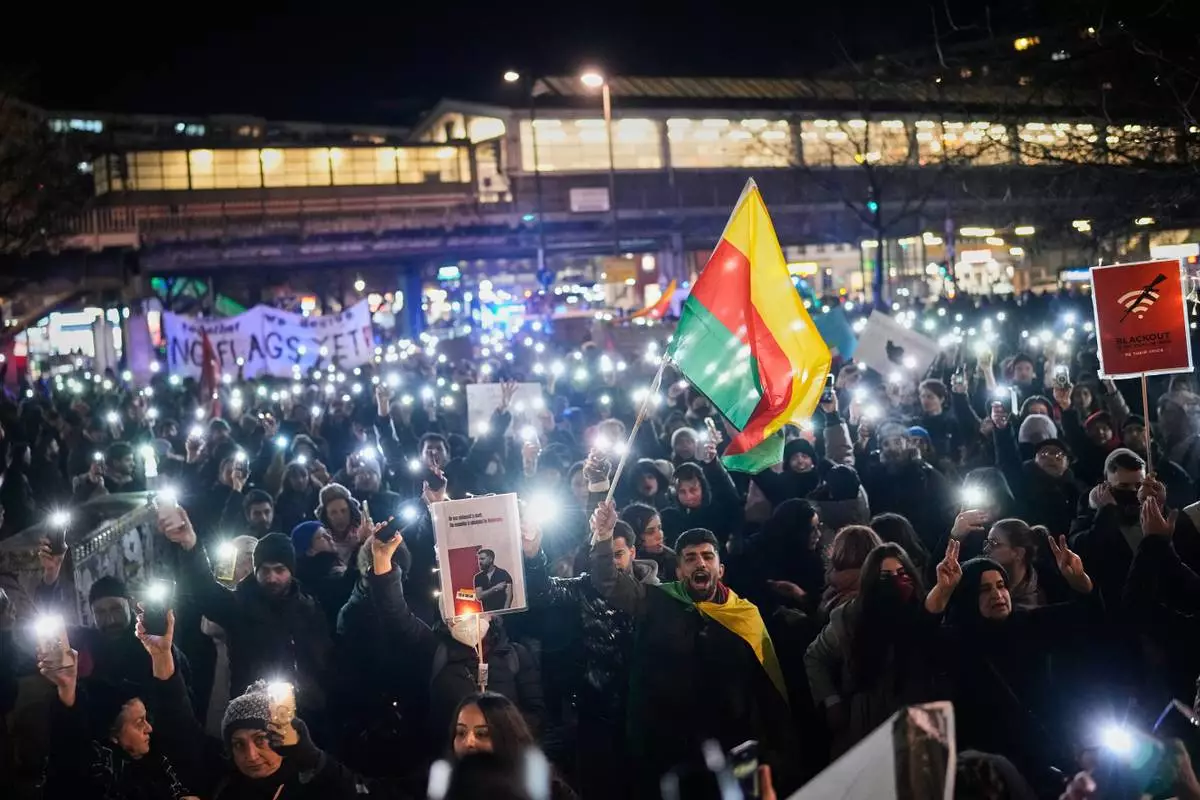
Protesters participate in a demonstration in support of the nationwide mass protests in Iran against the government, in Berlin, Germany, Wednesday, Jan. 14, 2026. (AP Photo/Ebrahim Noroozi)