Skip to Content Facebook Feature Image

Democrats hope a blue wave washes over Wisconsin and gives them total control of battleground state

News

Democrats hope a blue wave washes over Wisconsin and gives them total control of battleground state
News

News

Democrats hope a blue wave washes over Wisconsin and gives them total control of battleground state

2026-01-16 00:21 Last Updated At:00:40

MADISON, Wis. (AP) — Talk to any Wisconsin Democrat about their hopes for 2026 and it's not long before the T-word comes up.

No, not Trump.

Trifecta.

Democrats think new district boundaries in the Senate and Assembly ordered by the liberal-controlled state Supreme Court, an open race for governor and a favorable midterm election cycle this year may allow them to take back total control in the Statehouse for the first time in 16 years.

That would be a dramatic shift in a perennial battleground state that served as a focal point for the nation's conservative movement in the 2010s, when Wisconsin slashed taxes, reduced the power of labor unions and started requiring voters to show identification at the polls.

Republicans acknowledge that Democrats have a clear shot at running the table, which would allow them to expand Medicaid, increase funding for public schools and restore collective bargaining for public workers.

“It’s a difficult time in national politics," Assembly Minority Leader Greta Neubauer told The Associated Press, “but we’re hopeful about the future and have been working for many years to be in a position where a Democratic trifecta is possible in Wisconsin and our state is able to go in a new direction.”

Republicans solidified political control in the state in 2010, when they gained majorities in the state legislature and Scott Walker was elected governor.

The ascendence began what became known as the “Cheesehead Revolution,” with Wisconsin natives Reince Priebus leading the Republican National Committee from 2011 to 2017 and Paul Ryan becoming U.S. House speaker from 2015 to 2019.

Walker championed conservative policies in the state, helped by state legislative maps that tilted the playing field in Republicans' favor. He was briefly seen as a frontrunner to be the party's presidential candidate, but he bowed out of the race before any primary votes were cast as Donald Trump bulldozed his way to the 2016 nomination.

Now Republicans could see their work undone.

“If there’s a Democratic trifecta, Republicans in Wisconsin have to be ready for all kinds of things that they fought for for decades to be long gone,” said Brian Reisinger, who worked on one of Walker's campaigns.

Democratic candidates for governor are optimistic about their party's chances.

“Let’s finally get a blue trifecta in Wisconsin in 2026!” Mandela Barnes, one of the leading Democratic candidates and a former lieutenant governor and 2022 U.S. Senate candidate, said in a December fundraising plea.

Current Lt. Gov. Sara Rodriguez, another leading candidate, struck a similar chord in a social media post.

“Wisconsin has a real shot at a Democratic trifecta next year,” she posted on X. “Let’s go win it.”

Wisconsin remains a fiercely contested battleground state, and Trump won there in 2016 and 2024. However, Democrats hope that a strong showing this year will give them momentum before the 2028 presidential race. Republican U.S. Sen. Ron Johnson's term is also up that year.

Reisinger, who has also worked for Johnson, said “the reality is that the electorate is going to remain evenly divided for a long time.” Right now the governor, Tony Evers, is a Democrat, but Republicans have a majority in the Assembly and Senate.

Liberals are also voicing concerns about winning back the Statehouse.

“A lot of the ingredients for success are there, but there’s no guarantees,” said strategist Melissa Baldauff, who formerly worked for Evers . “It’s not going to be just the nature of things lining up for this to be a good year for Democrats. That doesn’t guarantee anything. It takes a lot of hard work, it takes good candidates.”

Liberals have already gained a majority on the Wisconsin Supreme Court and are looking to increase their hold on it in an April election. In another sign of Democratic momentum, the liberal candidate this week reported raising 10 times as much as her Republican-backed opponent.

The November race for governor is open for the first time since 2010 after Evers decided against seeking a third term. Democrats have never held the Wisconsin governor’s office for more than eight years in a row.

The crowded field on the Democratic side features Barnes and Rodriguez, plus two current lawmakers, the top elected official in Milwaukee County, the former state economic development director and Evers’ former top aide.

Barnes, who lost the 2020 Senate race to Republican Sen. Ron Johnson by just under 27,000 votes, is seen by many to be the frontrunner.

Rodriguez, the first candidate to get into the race in July, reported Thursday that she raised $650,000 for the year. Barnes was expected to report his fundraising totals later Thursday.

Presumptive Republican frontrunner U.S. Rep. Tom Tiffany, a staunch supporter of Trump, said he has raised more than $2 million since getting in to the race in September.

He faces Josh Schoemann, the Washington County executive, in the Republican primary. Schoemann, who is far less known and has a smaller base of support than Tiffany, raised $1 million last year.

The November election is the first where all the legislative seats are under district boundary lines in new maps ordered by the state Supreme Court to replace more Republican-friendly ones.

Democrats need to flip two seats in the Senate and five in the Assembly to take the majority.

Republican Assembly Speaker Robin Vos, whose job it is to recruit and support candidates to maintain the majority, expressed confidence even if it’s a year when there is “wind at our face.” He also faulted Democrats for spending too much time focused on “anti-Trumpism" and not what they would do if elected.

“Their issues are all focusing on fighting what Donald Trump is delivering on,” Vos said.

Longtime Wisconsin liberal activist Scot Ross encouraged Democrats to put forward a plan for "real substantial change to get people excited.”

“Trifecta isn’t a strategy and it’s not a message,” he said. “I love that Dems in Wisconsin want to talk aggressively about getting power, but people have to believe you will use that power to actually make your lives better.”
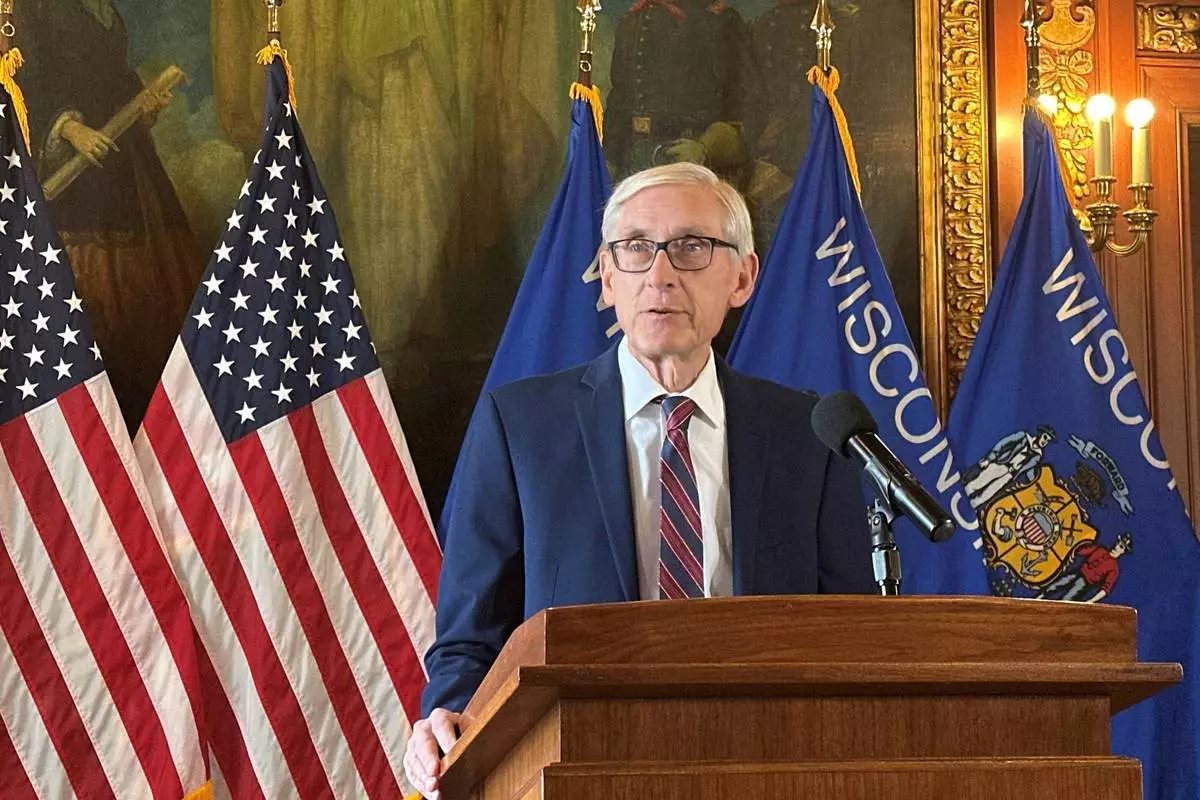
Wisconsin's Democratic Gov. Tony Evers discusses his call on the Republican-controlled Legislature to act on a broad array of his priorities in his final year in office on Monday, Jan. 12, 2026, in Madison, Wis. (AP Photo/Scott Bauer)

Wisconsin's Democratic Gov. Tony Evers discusses his call on the Republican-controlled Legislature to act on a broad array of his priorities in his final year in office on Monday, Jan. 12, 2026, in Madison, Wis. (AP Photo/Scott Bauer)
HAVANA (AP) — Cuban soldiers wearing white gloves marched out of a plane on Thursday carrying urns with the remains of the 32 Cuban officers killed during a stunning U.S. attack on Venezuela as trumpets and drums played solemnly at Havana's airport.

Nearby, thousands of Cubans lined one of Havana’s most iconic streets to await the bodies of colonels, lieutenants, majors and captains as the island remained under threat by the administration of U.S. President Donald Trump.

The soldiers' shoes clacked as they marched stiff-legged into the headquarters of the Ministry of the Armed Forces, next to Revolution Square, with the urns and placed them on a long table next to the pictures of those killed so people could pay their respects.

Thursday’s mass funeral was only one of a handful that the Cuban government has organized in almost half a century.

Hours earlier, state television showed images of more than a dozen wounded people described as “combatants” accompanied by Cuban Foreign Minister Bruno Rodríguez arriving Wednesday night from Venezuela. Some were in wheelchairs.

Those injured and the remains of those killed arrived as tensions grow between Cuba and the U.S., with Trump recently demanding that the Caribbean country make a deal with him before it is “too late.” He did not explain what kind of deal.

Trump also has said that Cuba will no longer live off Venezuela's money and oil. Experts warn that the abrupt end of oil shipments could be catastrophic for Cuba, which is already struggling with serious blackouts and a crumbling power grid.

Officials unfurled a massive flag at Havana's airport as President Miguel Díaz-Canel, clad in military garb as commander of Cuba's Armed Forces, stood silent next to former President Raúl Castro, with what appeared to be the relatives of those killed looking on nearby.

Cuban Interior Minister Lázaro Alberto Álvarez Casa said Venezuela was not a distant land for those killed, but a “natural extension of their homeland.”

“The enemy speaks to an audience of high-precision operations, of troops, of elites, of supremacy,” Álvarez said in apparent reference to the U.S. “We, on the other hand, speak of faces, of families who have lost a father, a son, a husband, a brother.”

Álvarez called those slain “heroes,” saying that they were an example of honor and “a lesson for those who waver.”

“We reaffirm that if this painful chapter of history has demonstrated anything, it is that imperialism may possess more sophisticated weapons; it may have immense material wealth; it may buy the minds of the wavering; but there is one thing it will never be able to buy: the dignity of the Cuban people,” he said.

Thousands of Cubans lined a street where motorcycles and military vehicles thundered by with the remains of those killed.

“They are people willing to defend their principles and values, and we must pay tribute to them,” said Carmen Gómez, a 58-year-old industrial designer, adding that she hopes no one invades given the ongoing threats.

When asked why she showed up despite the difficulties Cubans face, Gómez replied, “It’s because of the sense of patriotism that Cubans have, and that will always unite us.”

Cuba recently released the names and ranks of 32 military personnel — ranging in age from 26 to 60 — who were part of the security detail of Venezuelan President Nicolás Maduro during the raid on his residence on January 3. They included members of the Revolutionary Armed Forces and the Ministry of the Interior, the island’s two security agencies.

Cuban and Venezuelan authorities have said that the uniformed personnel were part of protection agreements between the two countries.

A demonstration was planned for Friday across from the U.S. Embassy in an open-air forum known as the Anti-Imperialist Tribune. Officials have said they expect the demonstration to be massive.

“People are upset and hurt. There’s a lot of talk on social media; but many do believe that the dead are martyrs” of a historic struggle against the United States, analyst and former diplomat Carlos Alzugaray told The Associated Press.

In October 1976, then-President Fidel Castro led a massive demonstration to bid farewell to the 73 people killed in the bombing of a Cubana de Aviación civilian flight financed by anti-revolutionary leaders in the U.S. Most of the victims were Cuban athletes.

In December 1989, officials organized “Operation Tribute” to honor the more than 2,000 Cuban combatants who died in Angola during Cuba’s participation in the war that defeated the South African army and ended the apartheid system. In October 1997, memorial services were held following the arrival of the remains of guerrilla commander Ernesto “Che” Guevara and six of his comrades, who died in 1967.

The latest mass burial is critical to honor those slain, said José Luis Piñeiro, a 60-year-old doctor who lived four years in Venezuela.

“I don’t think Trump is crazy enough to come and enter a country like this, ours, and if he does, he’s going to have to take an aspirin or some painkiller to avoid the headache he’s going to get,” Piñeiro said. “These were 32 heroes who fought him. Can you imagine an entire nation? He’s going to lose.”

A day before the remains of those killed arrived in Cuba, the U.S. announced $3 million in additional aid to help the island recover from the catastrophic Hurricane Melissa.

The first flight took off on Wednesday, and a second flight was scheduled for Friday. A commercial vessel also will deliver food and other supplies.

Jeremy Lewin, the State Department official in charge of foreign assistance, said the U.S. was working with Cuba’s Catholic Church to distribute aid.

“There’s nothing political about cans of tuna and rice and beans and pasta,” he said Thursday, warning that the Cuban government should not intervene or divert supplies. “We will be watching, and we will hold them accountable.”

Lewin said he saw no contradiction between cutting off Venezuelan oil and offering aid, saying that “the Cuban regime was taking illegitimate profits from the narco-terrorists.”

He said the U.S. hopes that delivering aid via the Catholic Church will be part of a new and broader push to deliver assistance directly to the Cuban people.

“Ultimately, the regime has to make a choice," Lewin said. “Step down or better provide towards people.”

Lewin added that “if there was no regime,” the U.S. would provide “billions and billions of dollars” in assistance, as well as investment and development: “That’s what lies on the other side of the regime for the Cuban people.”

The announcement riled Cuban Foreign Minister Bruno Rodríguez.

“The U.S. government is exploiting what appears to be a humanitarian gesture for opportunistic and politically manipulative purposes,” he said in a statement. “As a matter of principle, Cuba does not oppose assistance from governments or organizations, provided it benefits the people and the needs of those affected are not used for political gain under the guise of humanitarian aid.”

Coto contributed from San Juan, Puerto Rico.

Follow AP’s coverage of Latin America and the Caribbean at https://apnews.com/hub/latin-america

Military members pay their last respects to Cuban officers who were killed during the U.S. operation in Venezuela that captured Venezuelan President Nicolas Maduro, at the Ministry of the Revolutionary Armed Forces where the urns containing the remains are displayed during a ceremony in Havana, Cuba, Thursday, Jan. 15, 2026. (AP Photo/Ramon Espinosa)

Military members pay their last respects to Cuban officers who were killed during the U.S. operation in Venezuela that captured Venezuelan President Nicolas Maduro, at the Ministry of the Revolutionary Armed Forces where the urns containing the remains are displayed during a ceremony in Havana, Cuba, Thursday, Jan. 15, 2026. (AP Photo/Ramon Espinosa)

A motorcade transports urns containing the remains of Cuban officers, who were killed during the U.S. operation in Venezuela that captured Venezuelan President Nicolas Maduro, through Havana, Cuba, Thursday, Jan. 15, 2026. (AP Photo/Ramon Espinosa)

A motorcade transports urns containing the remains of Cuban officers, who were killed during the U.S. operation in Venezuela that captured Venezuelan President Nicolas Maduro, through Havana, Cuba, Thursday, Jan. 15, 2026. (AP Photo/Ramon Espinosa)

Soldiers carry urns containing the remains of Cuban officers, who were killed during the U.S. operation in Venezuela that captured Venezuelan President Nicolas Maduro, at the Ministry of the Revolutionary Armed Forces in Havana, Cuba, Thursday, Jan. 15, 2026. (Adalberto Roque /Pool Photo via AP)

Soldiers carry urns containing the remains of Cuban officers, who were killed during the U.S. operation in Venezuela that captured Venezuelan President Nicolas Maduro, at the Ministry of the Revolutionary Armed Forces in Havana, Cuba, Thursday, Jan. 15, 2026. (Adalberto Roque /Pool Photo via AP)

A motorcade transports urns containing the remains of Cuban officers, who were killed during the U.S. operation in Venezuela that captured Venezuelan President Nicolas Maduro, through Havana, Cuba, Thursday, Jan. 15, 2026. (AP Photo/Ramon Espinosa)

A motorcade transports urns containing the remains of Cuban officers, who were killed during the U.S. operation in Venezuela that captured Venezuelan President Nicolas Maduro, through Havana, Cuba, Thursday, Jan. 15, 2026. (AP Photo/Ramon Espinosa)

A motorcade transports urns containing the remains of Cuban officers, who were killed during the U.S. operation in Venezuela that captured Venezuelan President Nicolas Maduro, through Havana, Cuba, Thursday, Jan. 15, 2026. (AP Photo/Ramon Espinosa)

A motorcade transports urns containing the remains of Cuban officers, who were killed during the U.S. operation in Venezuela that captured Venezuelan President Nicolas Maduro, through Havana, Cuba, Thursday, Jan. 15, 2026. (AP Photo/Ramon Espinosa)

People line the streets of Havana, Cuba, Thursday, Jan. 15, 2026, to watch the motorcade carrying urns containing the remains of Cuban officers killed during the U.S. operation in Venezuela that captured Venezuelan President Nicolas Maduro. (AP Photo/Ramon Espinosa)

People line the streets of Havana, Cuba, Thursday, Jan. 15, 2026, to watch the motorcade carrying urns containing the remains of Cuban officers killed during the U.S. operation in Venezuela that captured Venezuelan President Nicolas Maduro. (AP Photo/Ramon Espinosa)

Workers fly the Cuban flag at half-staff at the Anti-Imperialist Tribune near the U.S. Embassy in Havana, Cuba, Monday, Jan. 5, 2026, in memory of Cubans who died two days before in Caracas, Venezuela during the capture of Venezuelan President Nicolas Maduro by U.S. forces. (AP Photo/Ramon Espinosa)

Workers fly the Cuban flag at half-staff at the Anti-Imperialist Tribune near the U.S. Embassy in Havana, Cuba, Monday, Jan. 5, 2026, in memory of Cubans who died two days before in Caracas, Venezuela during the capture of Venezuelan President Nicolas Maduro by U.S. forces. (AP Photo/Ramon Espinosa)

Recommended Articles