WASHINGTON (AP) — Defense Secretary Pete Hegseth has fired a general whose agency’s initial intelligence assessment of U.S. damage to Iranian nuclear sites angered President Donald Trump, according to two people familiar with the decision and a White House official.
Lt. Gen. Jeffrey Kruse will no longer serve as head of the U.S. Defense Intelligence Agency, according to the people, who spoke Friday on condition of anonymity because they were not authorized to discuss it publicly.
Hegseth also fired Vice Adm. Nancy Lacore, who is chief of the Navy Reserve, as well as Rear Adm. Milton Sands, a Navy SEAL officer who oversees Naval Special Warfare Command, another U.S. official said.
No reasons were given for their firings, the latest in a series of steps targeting military leaders, intelligence officials and other perceived critics of Trump, who has demanded loyalty across the government. The administration also stripped security clearances this week from additional current and former national security officials.
Taken together, the moves could chill dissent and send a signal against reaching conclusions at odds with Trump’s interests.
Kruse's firing comes two months after details of a preliminary assessment of U.S. airstrikes against Iran leaked to the media. It found that Iran’s nuclear program has been set back only a few months by the military effort, contradicting assertions from Trump and Israeli Prime Minister Benjamin Netanyahu.
The Republican president, who had pronounced the Iranian program “completely and fully obliterated," rejected the report. His oft-repeated criticism of the DIA analysis built on his long-running distrust of intelligence assessments, including one published in 2017 that said Russia interfered on his behalf in the 2016 election.
The Office of the Director of National Intelligence — which is responsible for coordinating the work of 18 intelligence agencies, including the DIA — has been declassifying years-old documents meant to cast doubt on those previous findings.
Following the June strikes on three Iranian nuclear sites, Hegseth lambasted the press for focusing on the preliminary assessment but did not offer any direct evidence of the destruction of the facilities.
“You want to call it destroyed, you want to call it defeated, you want to call it obliterated — choose your word. This was a historically successful attack,” Hegseth said at a news conference at the time.
While the Pentagon has offered no details on the firings, Democrats in Congress have raised alarm over the precedent that Kruse's ouster sets for the intelligence community.
“The firing of yet another senior national security official underscores the Trump administration’s dangerous habit of treating intelligence as a loyalty test rather than a safeguard for our country,” said Sen. Mark Warner of Virginia, vice chairman of the Senate Intelligence Committee.
Rep. Jim Himes of Connecticut, the top Democrat on the House Intelligence Committee, called on the administration to show why Kruse was fired or “otherwise, we can only assume that this is another politically motivated decision intended to create an atmosphere of fear” within the intelligence community.
Trump has a history of removing government officials whose data and analysis he disagrees with. Earlier this month, after a lousy jobs report, he fired the official in charge of the data. His administration also has stopped posting reports on climate change, canceled studies on vaccine access and removed data on gender identity from government sites.
The new firings culminate a week of broad Trump administration changes to the intelligence community and new shake-ups to military leadership.
The Office of the Director of National Intelligence announced this week that it would slash its staff and budget and revoked more security clearances, a tactic the administration uses against those it sees as foes. The Pentagon also said the Air Force’s top uniformed officer, Gen. David Allvin, planned to retire two years early.
Hegseth and Trump have been aggressive in dismissing top military officials, often without formal explanation.
The administration has fired Air Force Gen. CQ Brown Jr. as the chairman of the Joint Chiefs of Staff, as well as the Navy’s top officer, the Air Force’s second highest-ranking officer, and the top lawyers for three military service branches.
In April, Hegseth dismissed Gen. Tim Haugh as head of the National Security Agency and Vice Adm. Shoshana Chatfield, who was a senior official at NATO.
No public explanations have been offered by the Pentagon for any of the firings, though some of the officers were believed by the administration to endorse diversity, equity and inclusion programs. Trump has demanded government agencies purge DEI efforts.
The ousters of Kruse, Lacore and Sands were reported earlier by The Washington Post.

Defense Secretary Pete Hegseth meet with members of the National Guard at Union Station in Washington, Wednesday, Aug. 20, 2025. (Alexander Drago/Pool via AP)

FILE - Lt. Gen. Jeffrey Kruse, director of the Defense Intelligence Agency, speaks during a hearing on Capitol Hill, Thursday, May 2, 2024, in Washington. (AP Photo/Mark Schiefelbein, File)
SEOUL, South Korea (AP) — A South Korean court sentenced former President Yoon Suk Yeol to five years in prison Friday in the first verdict from eight criminal trials over the martial law debacle that forced him out of office and other allegations.
Yoon was impeached, arrested and dismissed as president after his short-lived imposition of martial law in December 2024 triggered huge public protests calling for his ouster.
The most significant criminal charge against him alleges that his martial law enforcement amounted to a rebellion, and the independent counsel has requested the death sentence in the case that is to be decided in a ruling next month.
Yoon has maintained he didn’t intend to place the country under military rule for an extended period, saying his decree was only meant to inform the people about the danger of the liberal-controlled parliament obstructing his agenda. But investigators have viewed Yoon’s decree as an attempt to bolster and prolong his rule, charging him with rebellion, abuse of power and other criminal offenses.
In Friday’s case, the Seoul Central District Court sentenced Yoon for defying attempts to detain him, fabricating the martial law proclamation, and sidestepping a legally mandated full Cabinet meeting and thus depriving some Cabinet members who were not convened of their due rights to deliberate on his decree.
Judge Baek Dae-hyun said in the televised ruling that imposing “a grave punishment” was necessary because Yoon hasn’t shown remorse and has only repeated “hard-to-comprehend excuses.” The judge also restoring legal systems damaged by Yoon’s action was necessary.
Yoon’s defense team said they will appeal the ruling, which they believe was “politicized” and reflected “the unliberal arguments by the independent counsel.” Yoon’s defense team argued the ruling “oversimplified the boundary between the exercise of the president’s constitutional powers and criminal liability.”
Prison sentences in the multiple, smaller trials Yoon faces would matter if he is spared the death penalty or life imprisonment at the rebellion trial.
Park SungBae, a lawyer who specializes in criminal law, said there is little chance the court would decide Yoon should face the death penalty in the rebellion case. He said the court will likely issue a life sentence or a sentence of 30 years or more in prison.
South Korea has maintained a de facto moratorium on executions since 1997 and courts rarely hand down death sentences. Park said the court would take into account that Yoon’s decree didn’t cause casualties and didn’t last long, although Yoon hasn’t shown genuine remorse for his action.
South Korea has a history of pardoning former presidents who were jailed over diverse crimes in the name of promoting national unity. Those pardoned include strongman Chun Doo-hwan, who received the death penalty at a district court over his 1979 coup, the bloody 1980 crackdowns of pro-democracy protests that killed about 200 people, and other crimes.
Some observers say Yoon will likely retain a defiant attitude in the ongoing trials to maintain his support base in the belief that he cannot avoid a lengthy sentence but could be pardoned in the future.
On the night of Dec. 3, 2024, Yoon abruptly declared martial law in a televised speech, saying he would eliminate “anti-state forces” and protect “the constitutional democratic order.” Yoon sent troops and police officers to encircle the National Assembly, but many apparently didn’t aggressively cordon off the area, allowing enough lawmakers to get into an assembly hall to vote down Yoon’s decree.
No major violence occurred, but Yoon's stunt caused the biggest political crisis in South Korea and rattled its diplomacy and financial markets. For many, his decree, the first of its kind in more than four decades in South Korea, brought back harrowing memories of past dictatorships in the 1970s and 1980s, when military-backed leaders used martial law and emergency measures to deploy soldiers and tanks on the streets to suppress demonstrations.
After Yoon's ouster, his liberal rival Lee Jae Myung became president via a snap election last June. After taking office, Lee appointed three independent counsels to look into allegations involving Yoon, his wife and associates.
Yoon's other trials deal with charges like ordering drone flights over North Korea to deliberately inflame animosities to look for a pretext to declare martial law. Other charges accuse Yoon of manipulating the investigation into a marine’s drowning in 2023 and receiving free opinion surveys from an election broker in return for a political favor.

A supporter of former South Korean President Yoon Suk Yeol shouts slogans outside Seoul Central District Court, in Seoul, South Korea, Friday, Jan. 16, 2026. (AP Photo/Lee Jin-man)

Supporters of former South Korean President Yoon Suk Yeol hold signs and flags outside Seoul Central District Court, in Seoul, South Korea, Friday, Jan. 16, 2026. (AP Photo/Lee Jin-man)
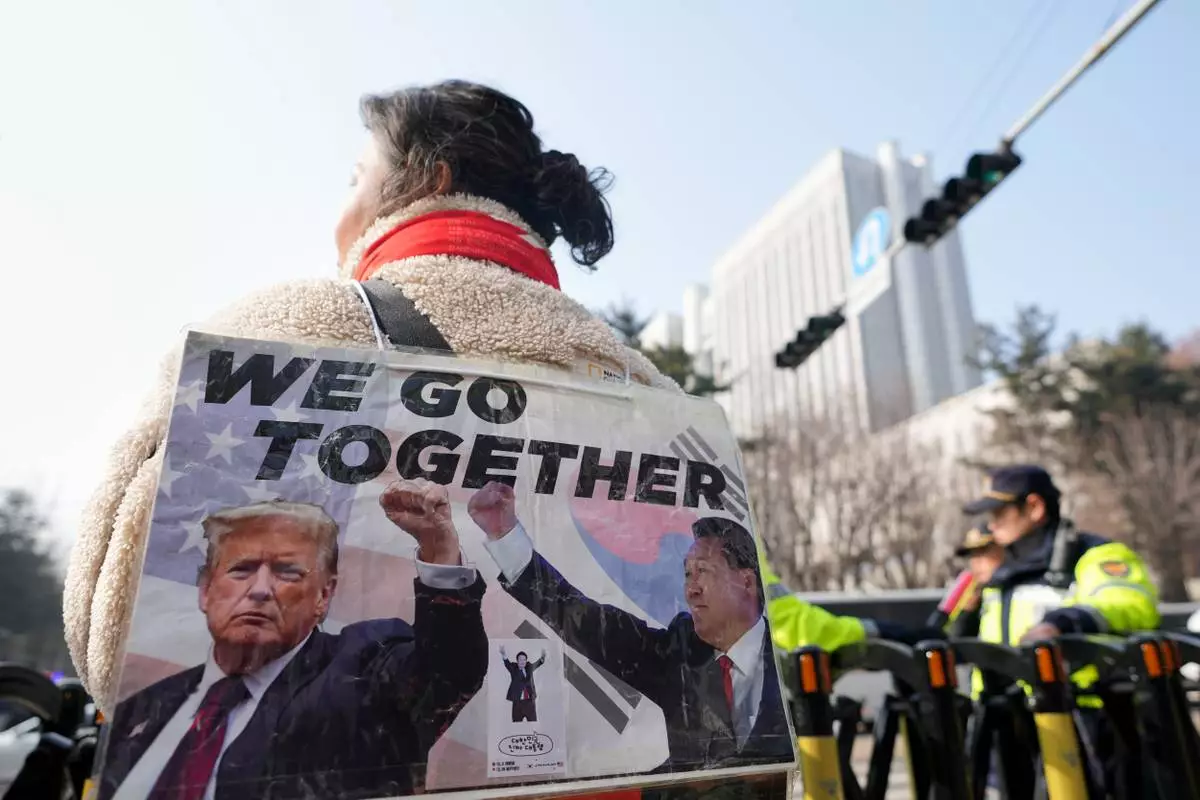
A supporter of former South Korean President Yoon Suk Yeol waits for a bus carrying former South Korean President Yoon Suk Yeol outside Seoul Central District Court, in Seoul, South Korea, Friday, Jan. 16, 2026. (AP Photo/Lee Jin-man)
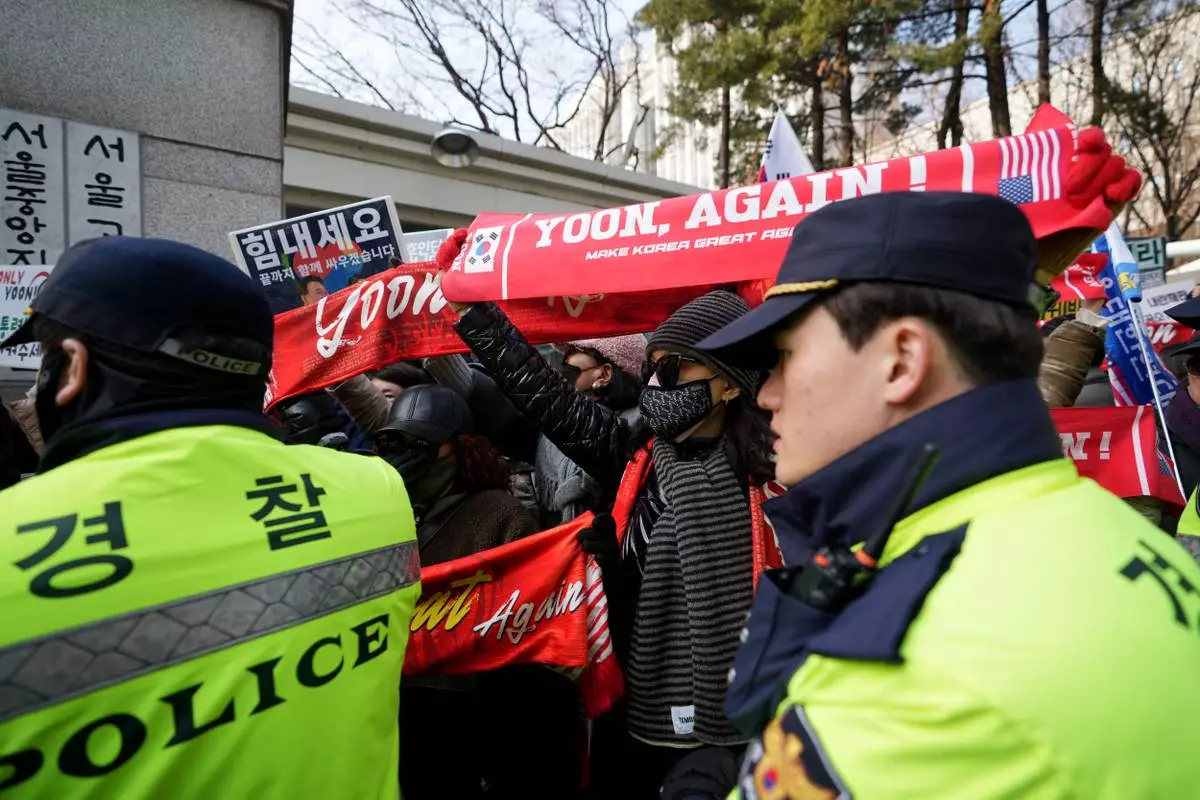
Supporters of former South Korean President Yoon Suk Yeol hold signs as police officers stand guard outside Seoul Central District Court, in Seoul, South Korea, Friday, Jan. 16, 2026. (AP Photo/Lee Jin-man)
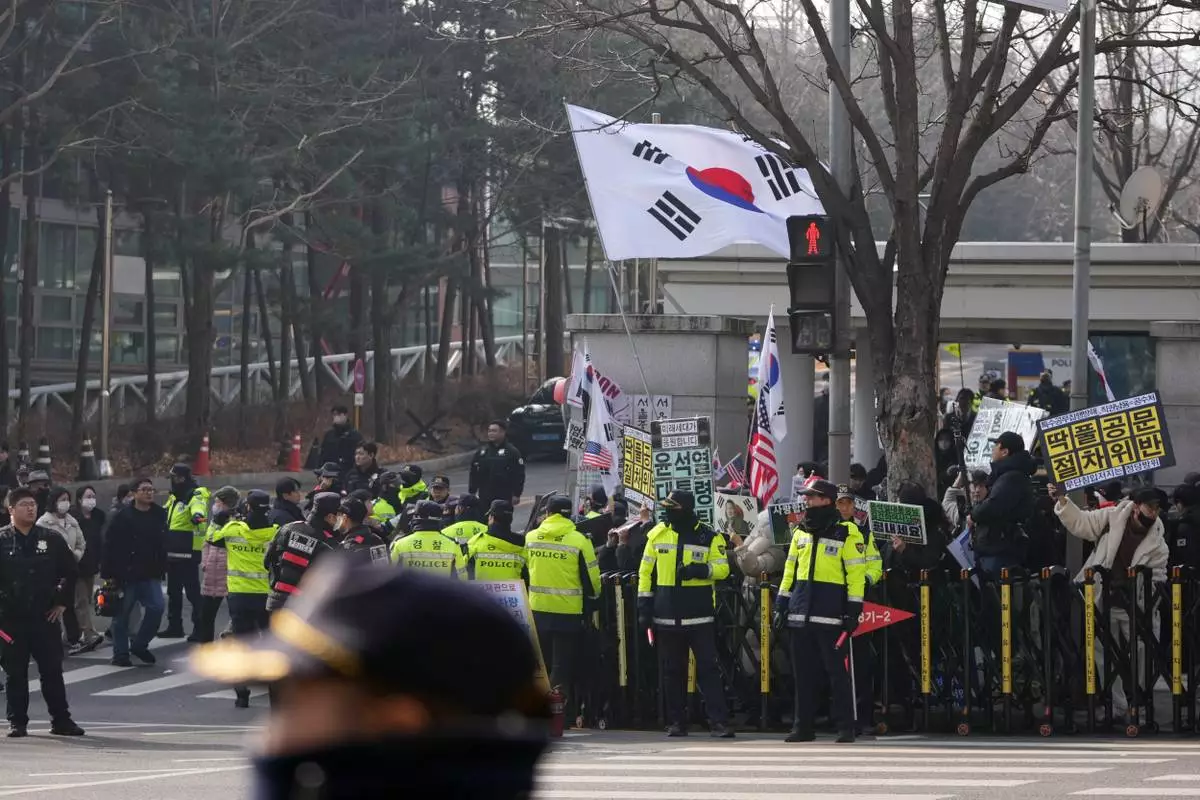
Supporters of former South Korean President Yoon Suk Yeol hold signs and flags outside Seoul Central District Court, in Seoul, South Korea, Friday, Jan. 16, 2026. (AP Photo/Lee Jin-man)
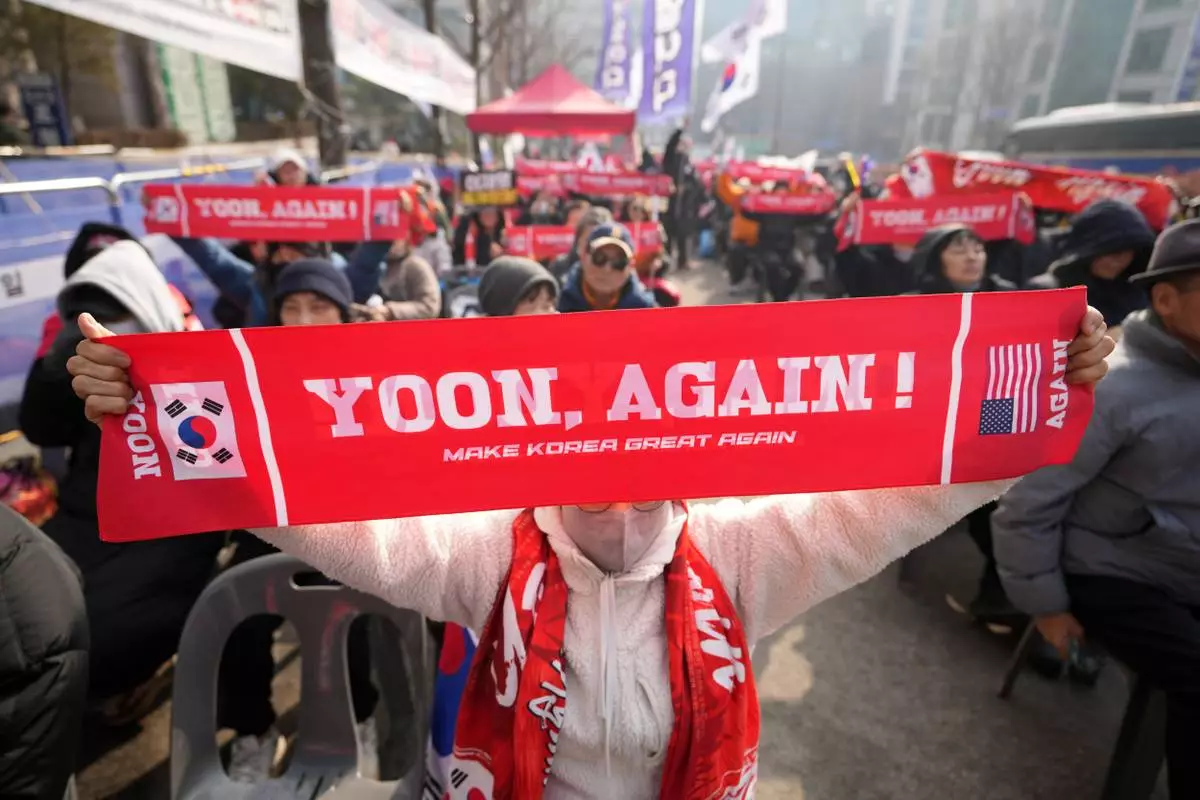
Supporters of former South Korean President Yoon Suk Yeol hold signs outside Seoul Central District Court, in Seoul, South Korea, Friday, Jan. 16, 2026. (AP Photo/Lee Jin-man)
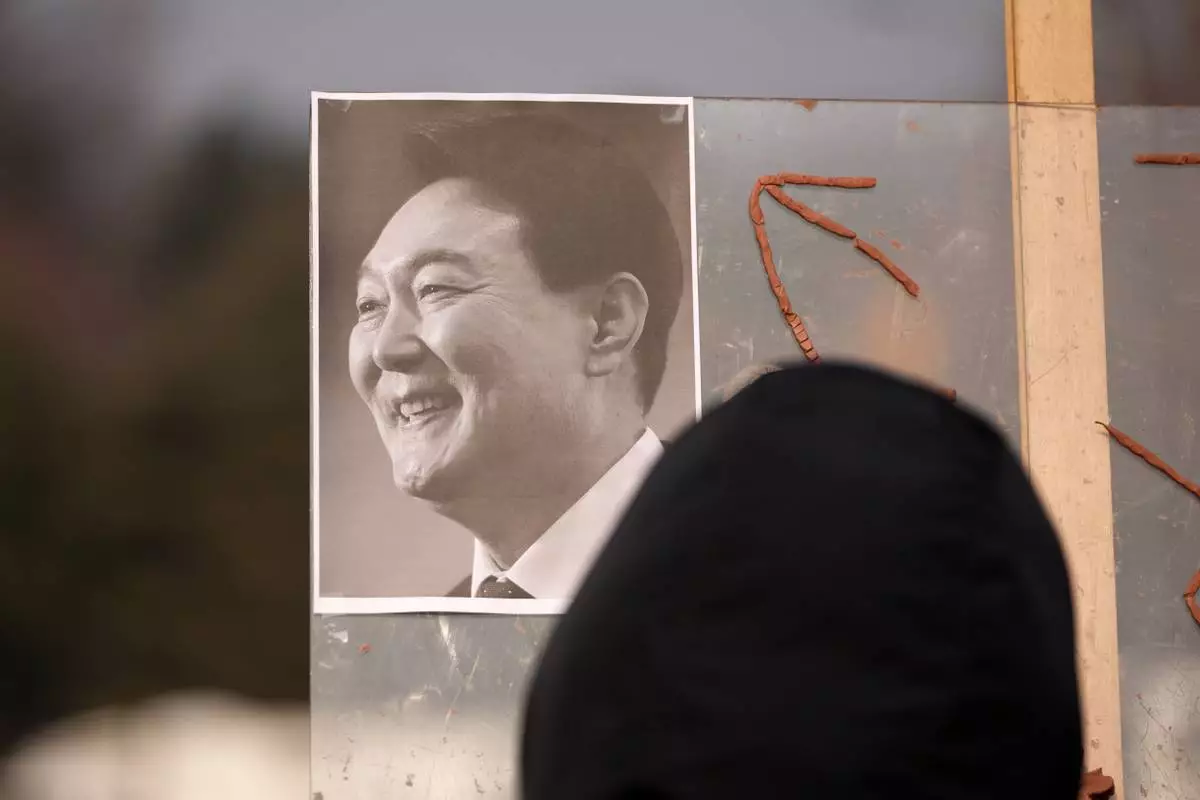
A picture of former South Korean President Yoon Suk Yeol is placed on a board as supporters gather outside Seoul Central District Court, in Seoul, South Korea, Friday, Jan. 16, 2026. (AP Photo/Lee Jin-man)