Over 400 guests from more than 30 countries witnessed smart mining operations at an open-pit mine in Hulunbuir of Inner Mongolia Autonomous Region in north China on Friday, describing the scenes as those in sci-fi movies.
The visitors were impressed by China's efforts in advancing zero-carbon smart mining.
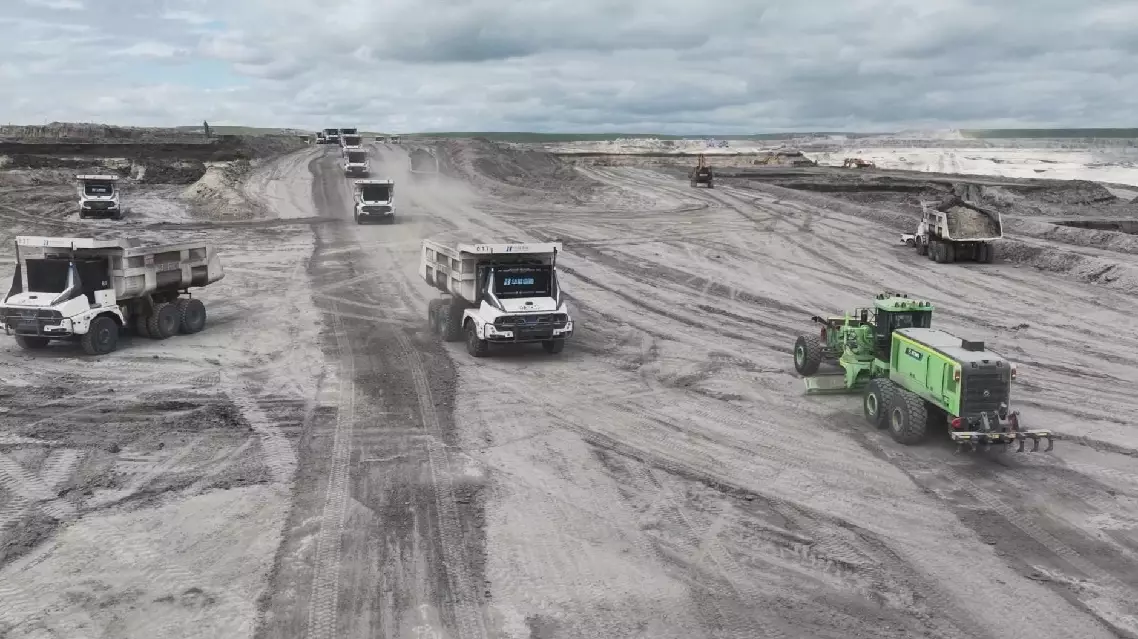
The coal mine has put over 100 unmanned electric haul trucks into operation since May, which is the largest fleet of unmanned electric haul trucks now in the world.
These huge trucks look like spacecraft mining on other planets in sci-fi movies, working alongside electric excavators and loaders, improving efficiency while reducing emissions.
Industry experts said green, smart mining is becoming a global consensus, and to see them in operation on such a large scale is impressive.
"We were just hearing things about this, but it seems that it's real, it's working. It's like a sci-fi movie actually, but the future becomes reality right now, and it's very impressive for us," said Ufuk Uysal, a mining industry professional from Turkey.
"[It's impressive] to see a hundred trucks working without operators efficiently, without any accident or fear of accidents. Productivity is high. We are looking to implement such technology in Saudi Arabia," said Ali Hakami, a mining industry professional from Saudi Arabia.
For Chinese companies, the focus is on developing safer, smarter, and low-carbon solutions with global applicability.
"The mining industry is under pressures of safety, environmental protection, and costs, along with challenges brought by supply chain traceability," said Yang Dongsheng, chairman of Xuzhou Construction Machinery Group.
Miners are happy about the new technology. Improving open-pit mine safety means there could be fewer workers on site, and unmanned transportation is the fastest way to achieve this.
"The truck is truly driverless. When workers first started their operation, they were somewhat astonished as they saw no cabin on the truck with only a battery unit at the front," said Wu Rongzhen, deputy director of Unmanned Vehicle Operations, Huaneng Yimin Mine.
Guests also exchanged views on sustainable development and signed over 20 cooperation agreements.
They stated that from this mine to projects worldwide, China is helping shape an intelligent, zero-carbon mining for the future.
Around 2,500 unmanned haul trucks in total were deployed in open-pit mines across China in 2024, and the figure is expected to reach 5,000 this year, representing a market size of 20 billion yuan (about 2.78 billion U.S. dollars), according to the China National Coal Association.
Inner Mongolia mine displays smart mining technology
The Exhibition Hall of Evidence of Crimes Committed by Unit 731 of the Japanese Imperial Army in northeast China's Harbin released on Thursday a 38-minute video of a former member of Unit 731, a notorious Japanese germ-warfare unit during World War II (WWII).
In the footage, former Unit 731 member Tsuruo Nishijima detailed how the unit used meteorological data to carry out bacterial dispersal and frostbite experiments.
The video was recorded in 1997 by Japanese scholar Fuyuko Nishisato and donated to the exhibition hall in 2019, according to the hall, which was built on the former site of the headquarters of Unit 731 in Harbin, capital city of Heilongjiang Province.
Nishijima joined Unit 731 in October 1938 and served in the unit's meteorological squad. The squad was not a simple observation section but rather an auxiliary force supporting the unit's human experiments in the field by measuring wind direction, wind speed and other conditions to ensure optimal experimental results.
Nishijima confirmed in the footage that "the meteorological squad had to be present at every field experiment." He testified to the "rainfall experiments" conducted by Unit 731, which involved aircraft releasing bacterial agents at extremely low altitudes.
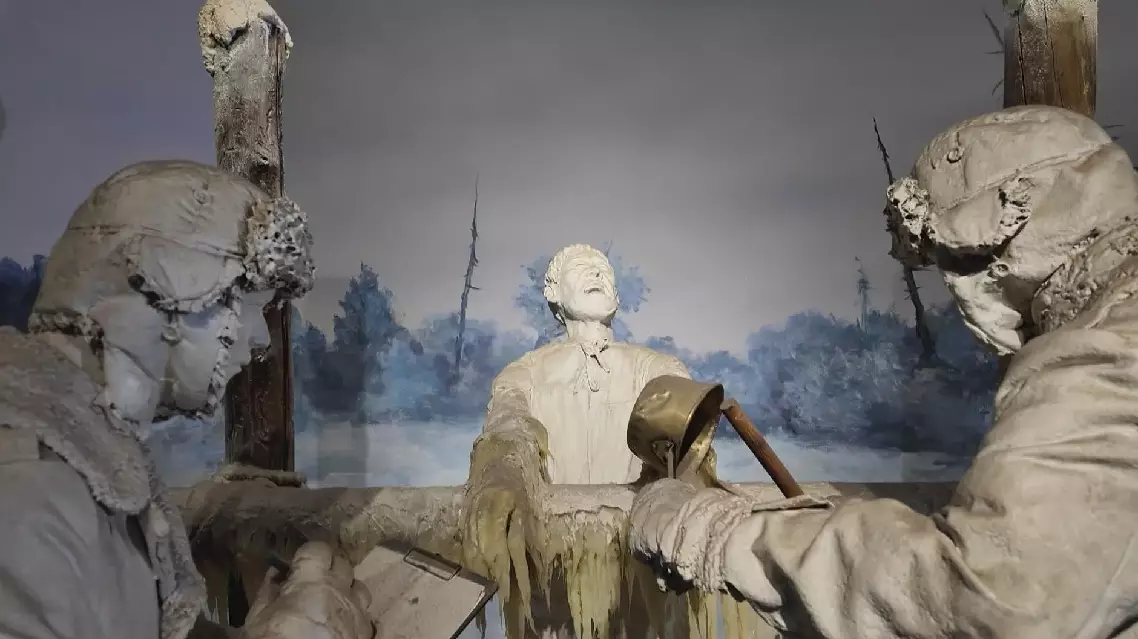
At a field-testing site in Anda City, Heilongjiang, Unit 731 aircraft descended to about 50 meters above the ground and sprayed bacterial culture liquids onto "maruta" -- human test subjects -- who were tied to wooden stakes. Each experiment involved about 30 people, spaced roughly 5 meters apart. After the experiments, the victims were loaded into sealed trucks and transported back to the unit, where their symptoms and disease progression were recorded over a period of several days.
Nishijima also revealed that a Japanese military doctor once died after removing the mask and becoming infected during an experiment, indirectly proving the extreme virulence of the bacterial agents.
The video further disclosed details of the meteorological squad's involvement in frostbite experiments. To study wartime needs in frigid regions, the invading Japanese army forced the victims to expose their bodies for five to ten minutes in temperatures ranging from minus 20 to minus 35 degrees Celsius and observed their physical reactions.
"For example, during frostbite experiments, we would be sent outside to observe the weather. They wouldn't bring many people out at once, only two or three, who would be forced to take off their upper garments or all their clothes. In fact, it was already quite tough to stay out there for five to ten minutes, because it was too cold," Nishijima said.
According to the exhibition hall, Unit 731 had a separate frostbite laboratory, with Hisato Yoshimura serving as the leader of the unit's frostbite study squad from 1938 to 1945.
In a paper on frostbite published in 1941, Yoshimura recorded data from live human experiments to study the occurrence of frostbite and pathological changes in the human body under different conditions.
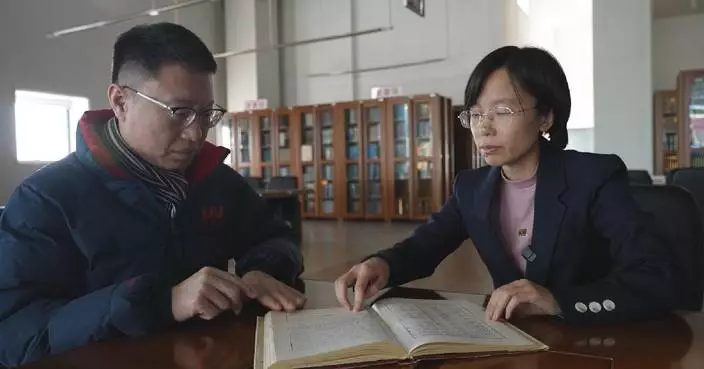
"This is a form from the paper. Titled 'The Severity and Process of Frostbite,' it divides frostbite into three stages. The symptoms of the first-degree frostbite are redness and swelling. Blisters appear in the second stage. And the third-degree frostbite features necrosis and ulceration. It says here that, in the third stage, from the 50th to the 60th day, toes and fingers detached. There is no doubt that these data were obtained through numerous human experiments," said Tan Tian, a researcher of the exhibition hall.
Nishijima's video, a piece of oral history from a perpetrator's perspective, further reconstructs the criminal chain of Unit 731 and once again demonstrates that the invading Japanese army's biological warfare crime was systematic and inhumane, and was an undeniable historical truth, according to the exhibition hall.
"Unit 731's frostbite experiments were essentially conducted to prevent and treat frostbite during combat in cold environments. However, for the so-called prevention and treatment of frostbite, they caused frostbite on living people for experiments and data analysis. So in nature, it still serves the purpose of war," said Jin Shicheng, director of the Department of Publicity, Education and Exhibition at the hall.
Unit 731 was a top-secret biological and chemical warfare research base established in Harbin as the nerve center for Japanese biological warfare in China and Southeast Asia during WWII.
At least 3,000 people were used for human experiments by Unit 731, and more than 300,000 people in China were killed by Japan's biological weapons.
Video offers new evidence of Japan's wartime germ-warfare crimes in northeast China