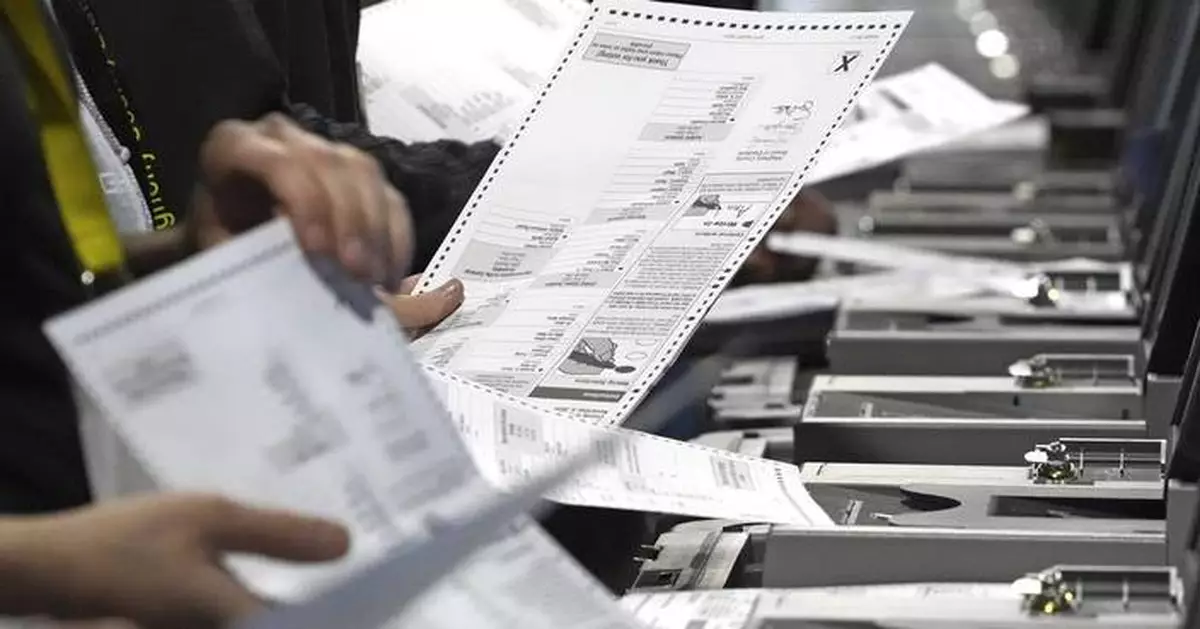
HARRISBURG, Pa. (AP) — A federal appeals court on Tuesday ruled that it is unconstitutional for the presidential battleground state of Pennsylvania to throw out mail-in ballots simply because the voter didn't write an accurate date on the return envelope.
The unanimous decision by the 3rd U.S. Circuit Court of Appeals ordered Pennsylvania to stop throwing out such ballots and upheld the decision earlier this year by a federal judge in Pittsburgh.
In its 55-page opinion, the three-judge panel said it had to weigh the state's interest in throwing out the ballots against the constitutional right to vote.
The panel wrote that it was “unable to justify” the practice of discarding such ballots “that has resulted in the disqualification of thousands of presumably proper ballots.”
Under Pennsylvania law, voters are required to write the date on the return envelope for their mail ballot. However, thousands of voters, confused by the request to write the date, might skip it or write another date, such as their birth date.
Tuesday's decision marks the latest instance in more than a half-dozen cases where a court has instructed election officials in Pennsylvania to count such ballots.
However, higher courts have always reinstated the requirement in the heavily litigated matter that has pitted Democrats and their allies in trying to get rid of the requirement against Republicans who defend it. For Tuesday's ruling to be reversed, the U.S. Supreme Court would need to take up the issue.
Asked whether they might appeal, the state and national Republican parties said in a joint statement that they were considering their next steps in the case.
Democratic Gov. Josh Shapiro of Pennsylvania supported the lawsuit against the provision and, in a statement Tuesday, said it is “disenfranchisement and unconstitutional” to throw out a voter's ballot over the handwritten date. His administration's lawyers had argued that “meaningless errors shouldn’t cost you your right to vote in Pennsylvania,” he said.
Democrats typically cast more mail-in ballots than Republicans, perhaps a result of President Donald Trump's demonization of mail-in voting and baseless allegations that it is rife with fraud. As recently as last week, Trump claimed there is “MASSIVE FRAUD” due to mail voting, when in fact voting fraud in the U.S. is rare.
The decision affects a small percentage of votes typically cast in the state. However, it also results in thousands of mail-in ballots being thrown out in every election and, in the politically divided state, every vote truly counts in statewide races. Last fall's U.S. Senate race came down to about 15,000 votes.
Tuesday's decision was a victory for the groups that sued, including the American Federation of Teachers of Pennsylvania. They were supported by the Black Political Empowerment Project, Common Cause Pennsylvania, the League of Women Voters of Pennsylvania and the Pennsylvania State Conference of the NAACP, among others.
In a statement, AFT Pennsylvania's president, Wendy Coleman, called the decision a “victory for Pennsylvania voters and our democracy.”
The campaign arms of Democrats in the U.S. House and the U.S. Senate accused Republicans of trying to disenfranchise voters across the country ahead of 2026's elections and vowed to be "united in the fight to ensure every legal vote is counted.”
The Republican parties said that the groups fighting to overturn the state law “are essentially fighting to count illegal ballots. That’s unacceptable.”
Republicans contend that the date requirement is a matter of election security and have pushed for the strictest possible interpretation of state law to disqualify ballots. Still, election officials have told courts that the requirement to write a date on the return envelope has no practical use and no effect on how they determine whether the ballot is valid or received on time.
In its opinion, the appeals court panel said accepting ballots whose envelope has a missing or incorrect date “will have no effect on fraud detection.”
“Discarding thousands of ballots every election is not a reasonable trade-off in view of the date requirement’s extremely limited and unlikely capacity to detect and deter fraud,” the appeals court panel wrote.
On top of that, it said, the requirement “seems to hamper rather than facilitate election efficiency.”
The state Supreme Court announced earlier this year that it will consider the issue. That was after the court put off ruling on a pending case before last year’s presidential election and dismissed another last fall on a technicality.
Follow Marc Levy on X at: https://x.com/timelywriter
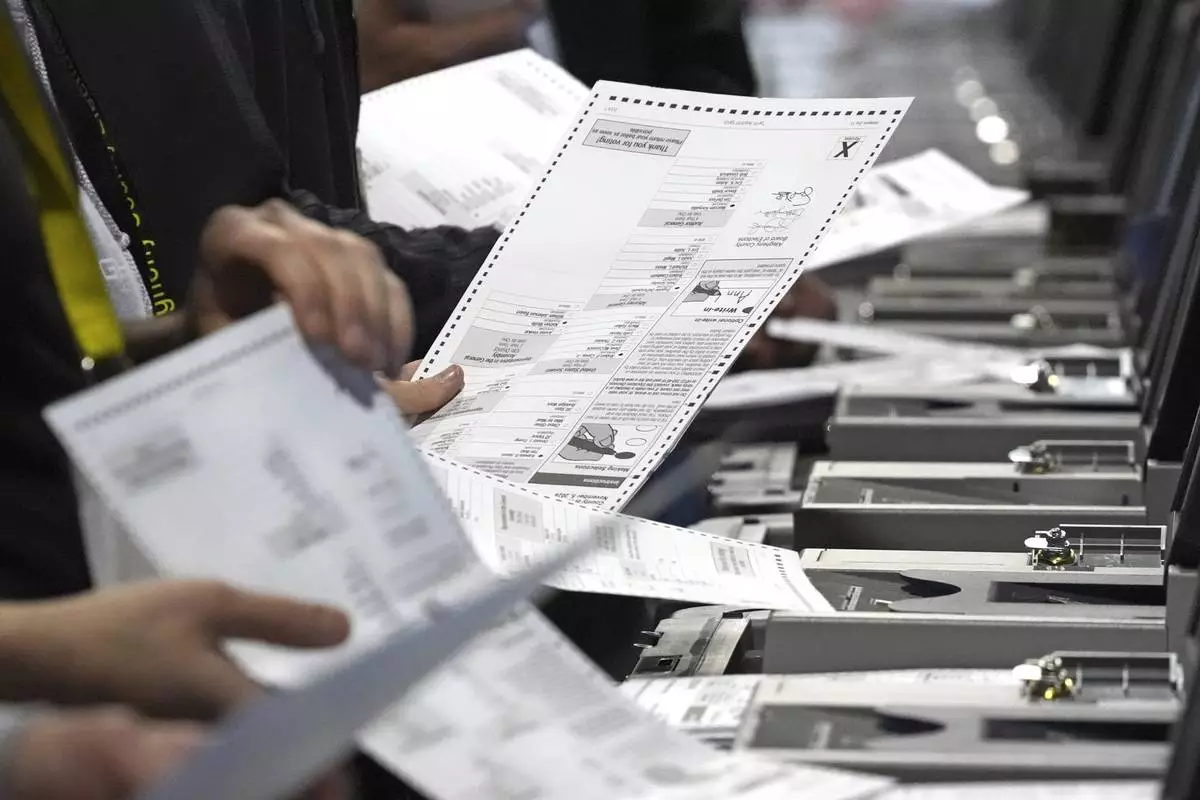
FILE - Election workers recount ballots from the recent Pennsylvania Senate race at the Allegheny County Election Division warehouse on the Northside of Pittsburgh, Wednesday, Nov. 20, 2024. (AP Photo/Gene J. Puskar, File)
After a frenetic few months of congressional redistricting efforts, President Donald Trump’s plan to reshape voting districts for partisan advantage ahead of this year’s midterm elections stands at an important juncture.
Will Republican- and Democratic-led states ramp up their remapping of U.S. House districts as new legislative sessions get underway? Or will the mid-decade redistricting frenzy fade away following Indiana’s resounding rejection of Trump’s pressure-packaged campaign?
“We’re at a crossroads to see if the mid-decade redistricting movement gains more speed or was simply an attempt by Donald Trump to impact elections that in many states fizzled,” said Jeffrey Wice, director of the Elections, Census and Redistricting Institute at New York Law School.
Virginia and Florida are two key states to watch. Democrats who lead Virginia and Republicans who lead Florida could try to swing multiple seats in their party’s favor by an aggressive redistricting. Virginia’s legislative session begins Wednesday. Florida Gov. Ron DeSantis plans to call a special session in April on congressional redistricting.
What happens next in Democratic-led Illinois and Maryland and in Kansas' Republican-led Legislature also could affect the GOP’s ability to maintain a narrow House majority in the face of political headwinds that typically favor the party out of power in midterm elections. Key lawmakers in all three of those states remain opposed to redistricting.
Trump kick-started an unusual redistricting plan in July by calling on Texas Republicans to redraw their congressional map to create more favorable districts for the party — even though there was no new census data to base it upon. That triggered a mid-decade redistricting battle the likes of which has not been common since the late 1800s.
Texas, Missouri and North Carolina all approved new Republican-friendly House districts. Ohio, which had to redistrict because of its state constitution, used the opportunity to enact a more favorable House map for Republicans.
But Ohio’s action on Oct. 31 marked a turning point. That same day, Virginia’s Democratic-led legislature took a first step toward redistricting. Then in November, California voters approved new House districts helping Democrats, Kansas Republicans dropped plans for a special session on redistricting, and a Utah judge adopted a new House map that benefits Democrats.
Trump suffered a stunning setback Dec. 11, when Indiana’s Republican-led Senate defeated a redistricting plan that could have helped the GOP win all nine of the state’s U.S. House seats, up from their current seven.
The net result from the 2025 jockeying could be three additional seats for Republicans. But even that is in question, because legal challenges remain in some states, and there is no guarantee that parties will win the districts they redrew.
When the Virginia General Assembly begins its annual session, the agenda will include a proposed constitutional amendment allowing mid-decade redistricting in response to other states.
The amendment, which received first-round approval in the fall, would also need to pass a statewide vote before the new districts could be implemented. Quick action would be necessary to get all that accomplished in time for candidates to run in redrawn districts later this year.
Democrats, who currently hold six of the state’s 11 U.S. House seats, have not unveiled what those new districts would look like. But some have talked of trying to gain as many as four additional seats.
Virginia Gov.-elect Abigail Spanberger has embraced the redistricting effort but has not committed to a particular plan.
“I will look at any map that is kind of reasonable and keeping communities compact and together,” Spanberger, a Democrat, told The Associated Press. “But ultimately, it’s up to the people of Virginia to choose whether or not to move forward with the referendum.”
Republicans currently hold 20 of Florida’s 28 U.S. House seats. That advantage could grow if districts are reshaped during a special session.
Although Florida’s regular legislative session starts Tuesday, DeSantis said he is waiting until April to call a special redistricting session to allow time for a possible U.S. Supreme Court ruling on a key provision of the federal Voting Rights Act. If the court rules in a Louisiana case that race cannot be the predominant factor in creating voting districts, it could open the way for several Republican-led states to redraw districts represented by Black or Hispanic lawmakers who are Democrats.
DeSantis said the high court's ruling could affect “at least one or two” Florida districts.
But any redistricting that aids Republicans could face a court challenge. A voter-approved Florida constitutional provision prohibits drawing district boundaries to favor or disfavor a political party or incumbent.
Some Democrats seeking to counter Trump have urged lawmakers in Illinois and Maryland to redraw their already heavily Democratic districts to try to gain one additional seat in each state. But the plans appear to lack traction as legislative sessions begin this week in both states.
Illinois House Speaker Pro Tem Kam Buckner said “there is no active push” for congressional redistricting.
“There is no appetite to reopen something that will consume enormous time, energy and, frankly, political capital without a compelling justification,” Buckner, a Democrat, told the AP.
Democratic Maryland Gov. Wes Moore has created a special commission to recommend a new congressional map. But Democratic Senate President Bill Ferguson remains opposed and insists that a majority of residents also do not want new districts.
In Kansas, some Republicans want to redraw U.S. House districts to try to gain an additional seat. But House Republicans have failed to gain the two-thirds support needed to override a likely veto by Democratic Gov. Laura Kelly.
House Speaker Dan Hawkins told reporters that he has no plans to hold a vote on congressional redistricting during the annual legislative session that starts Monday.
“I do not have the votes,” Hawkins said.
Associated Press reporters Olivia Diaz, John Hanna, Mike Schneider and Brian Witte contributed to this story.

President Donald Trump points to the crowd as he walks off stage after speaking to House Republican lawmakers during their annual policy retreat, Tuesday, Jan. 6, 2026, in Washington. (AP Photo/Evan Vucci)
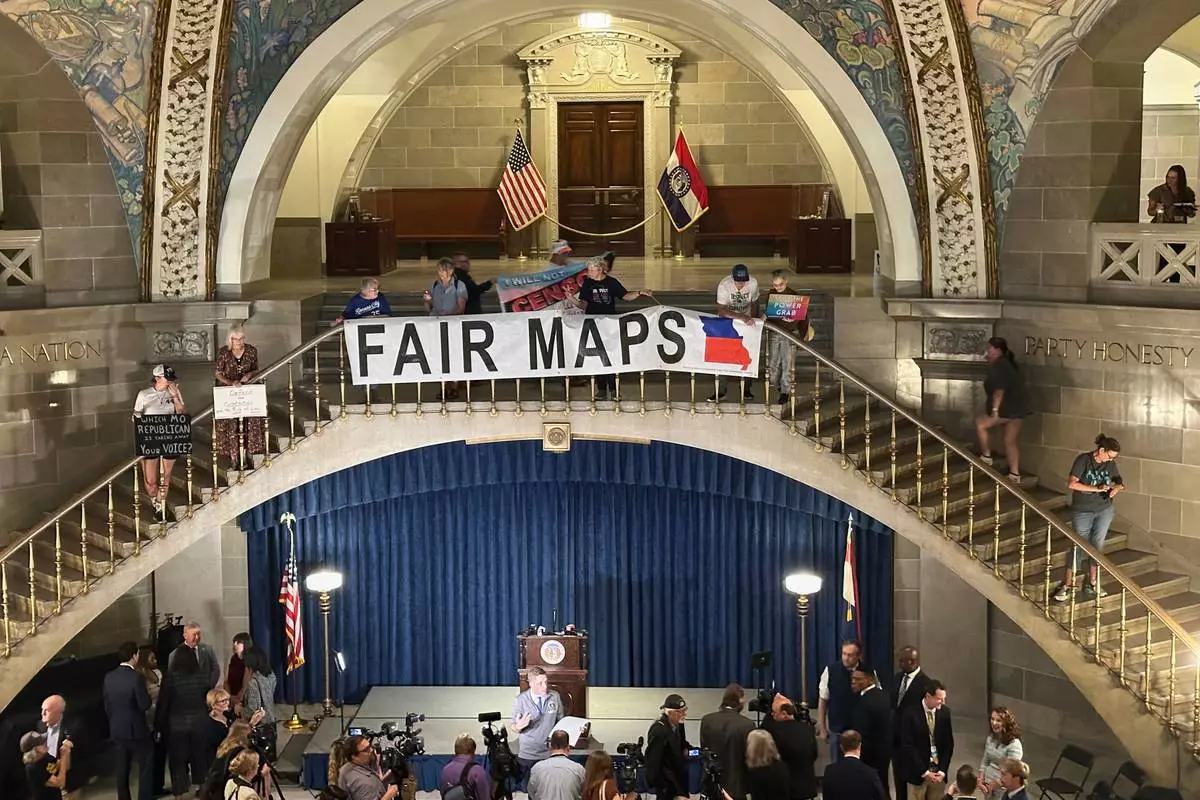
FILE - Opponents of Missouri's Republican-backed congressional redistricting plan display a banner in protest at the State Capitol in Jefferson City, Missouri, Sept. 10, 2025. (AP Photo/David A. Lieb, File)

FILE - ndiana Lt. Gov. Micah Beckwith announces the results of a vote to redistrict the state's congressional map, Dec. 11, 2025, at the Statehouse in Indianapolis. (AP Photo/Michael Conroy, File)
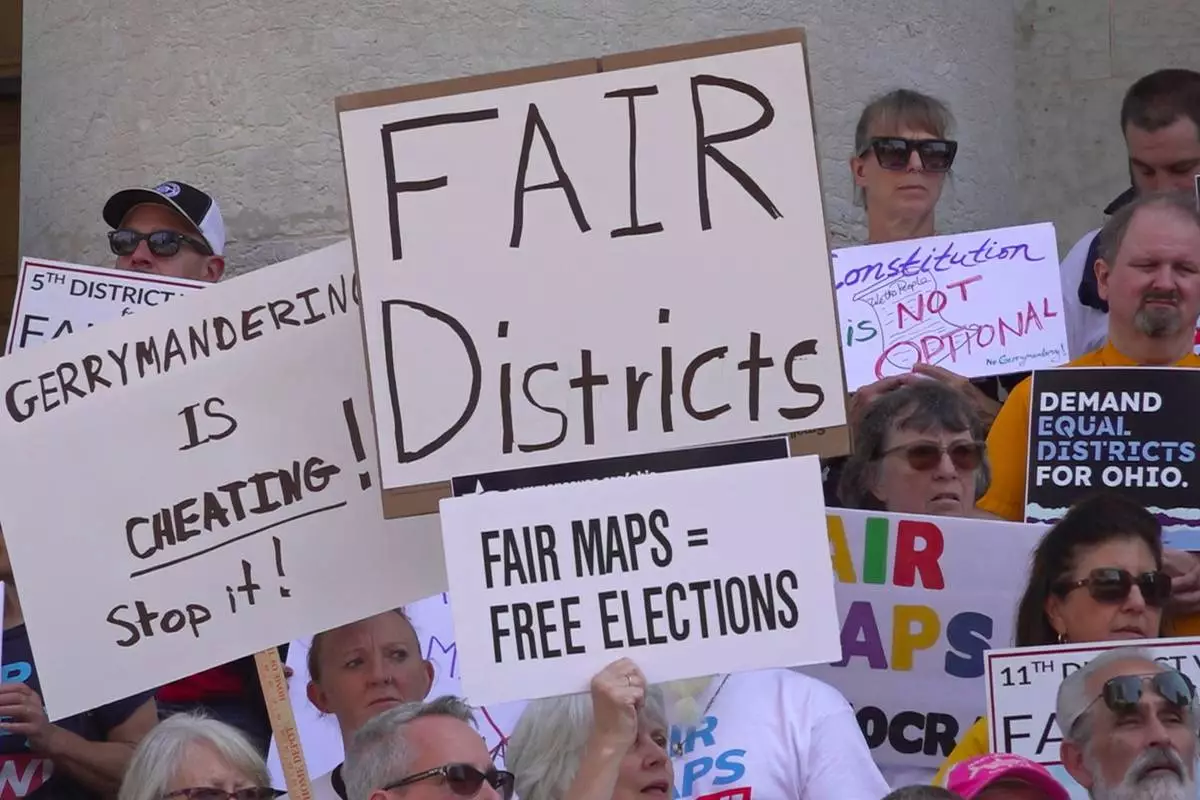
FILE - This photo taken from video shows organizers rallying outside of the Ohio Statehouse to protest gerrymandering and advocate for lawmakers to draw fair maps in Columbus, Ohio, Sept. 17, 2025. (AP Photo/Patrick Aftoora-Orsagos, File)