Cracker Barrel said late Tuesday it's returning to its old logo after critics — including President Donald Trump — protested the company's plan to modernize.
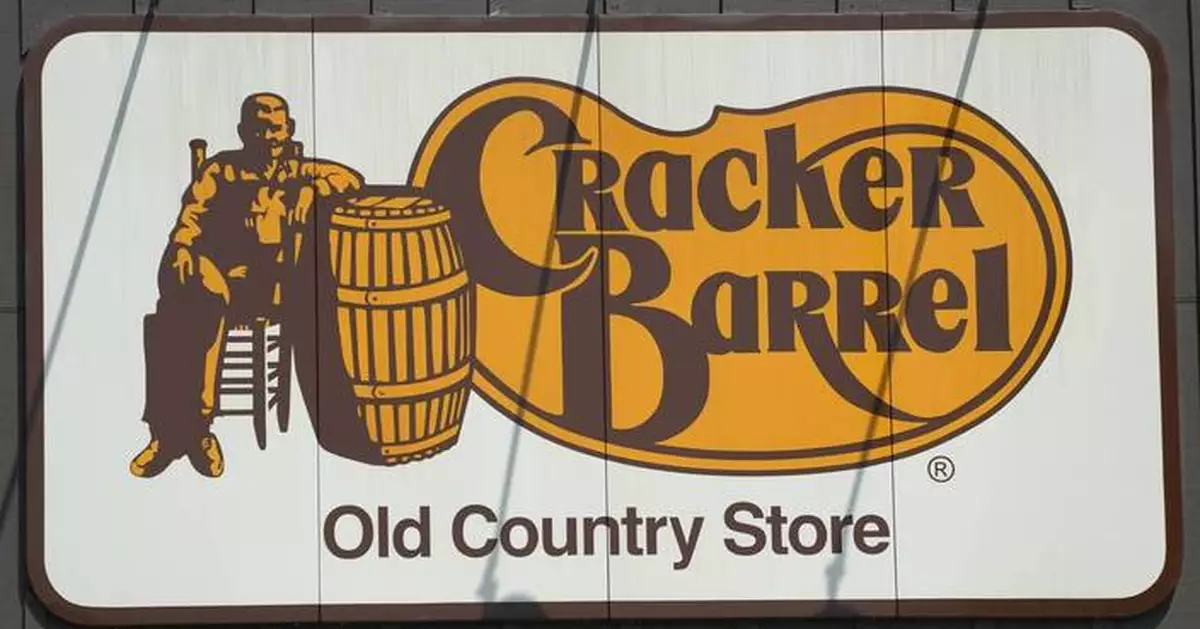
In a post on its website, Cracker Barrel said it will retain its old logo, which features an older man in overalls sitting next to a barrel and the words “Old Country Store.”
“We thank our guests for sharing your voices and love for Cracker Barrel,” the company said in a statement. “Our new logo is going away and our ‘Old Timer’ will remain.”
The tempest over the logo began last week, when the company announced plans for a simplified design featuring only the company's name. Lebanon, Tennessee-based Cracker Barrel, which has 660 restaurants in 43 states, made the change as part of a wider plan to modernize its restaurants and appeal to younger customers.
The chain's sales have been slipping as it faces growing competition from breakfast chains and others. In its 2024 fiscal year, Cracker Barrel's same-store sales, or sales at locations open at least a year, dropped 0.1% despite a 4.9% increase in menu prices. Same-store retail sales at its shops fell 5.5%.
But many protested the change. On Monday, Cracker Barrel put out an apologetic statement, saying it "could have done a better job sharing who we are and who we’ll always be.”
At that point, Cracker Barrel didn't say it would change the logo, but said it would listen to its customers and keep many of the things they have come to love about the restaurant, like the rocking chairs on its front porches. The company said it would continue to honor Uncle Herschel — the older man in its logo, who represents the uncle of Cracker Barrel’s founder — on its menu and on items sold in its stores.
But the controversy continued. On Tuesday morning, Trump said via Truth Social that Cracker Barrel “should go back to the old logo, admit a mistake based on customer response (the ultimate Poll), and manage the company better than ever before.” Cracker Barrel's shares rose after more than a week of declines.
By Tuesday evening, Cracker Barrel had made its decision and scrapped the new logo.
“At Cracker Barrel, it’s always been – and always will be – about serving up delicious food, warm welcomes, and the kind of country hospitality that feels like family,” the company said. "As a proud American institution, our 70,000 hardworking employees look forward to welcoming you to our table soon.”
Trump was among those celebrating the move.
“Good luck into the future. Make lots of money and, most importantly, make your customers happy again!” Trump said via Truth Social.
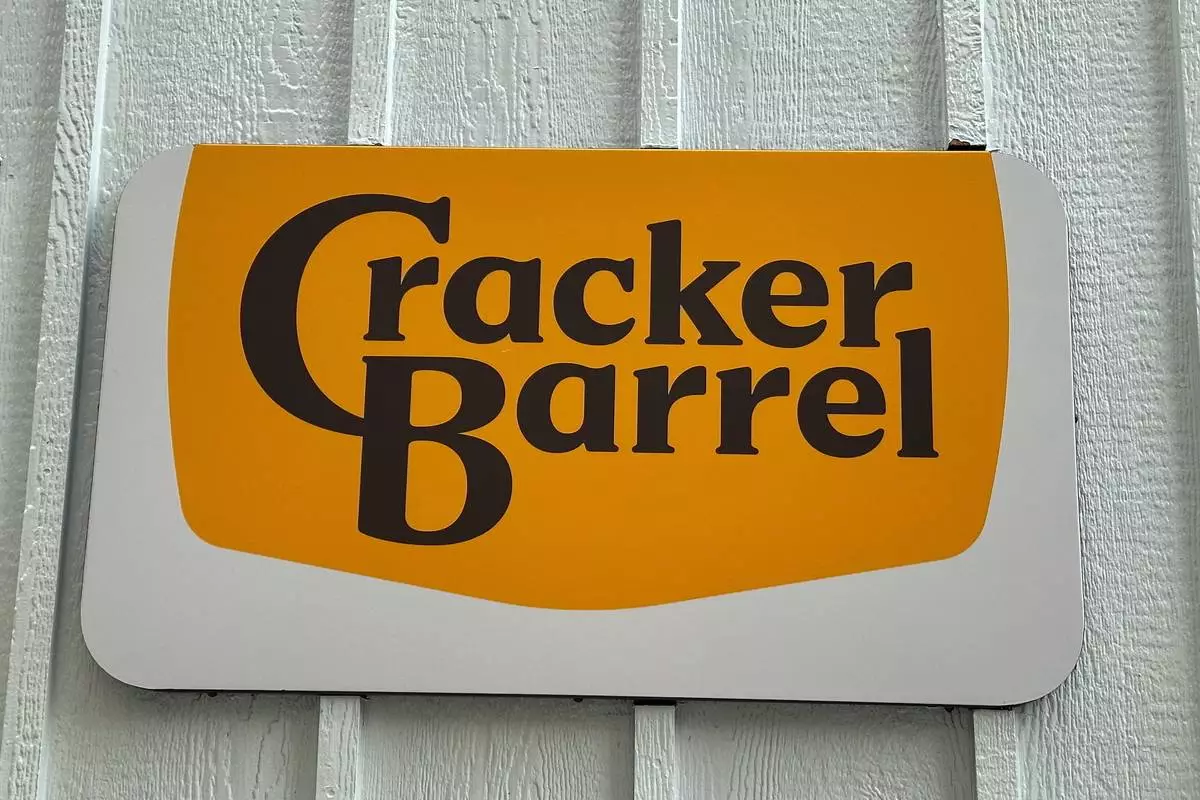
The new Cracker Barrel logo is displayed on Thursday, Aug. 21, 2025, in New York. (AP Photo/Wyatte Grantham-Philips)
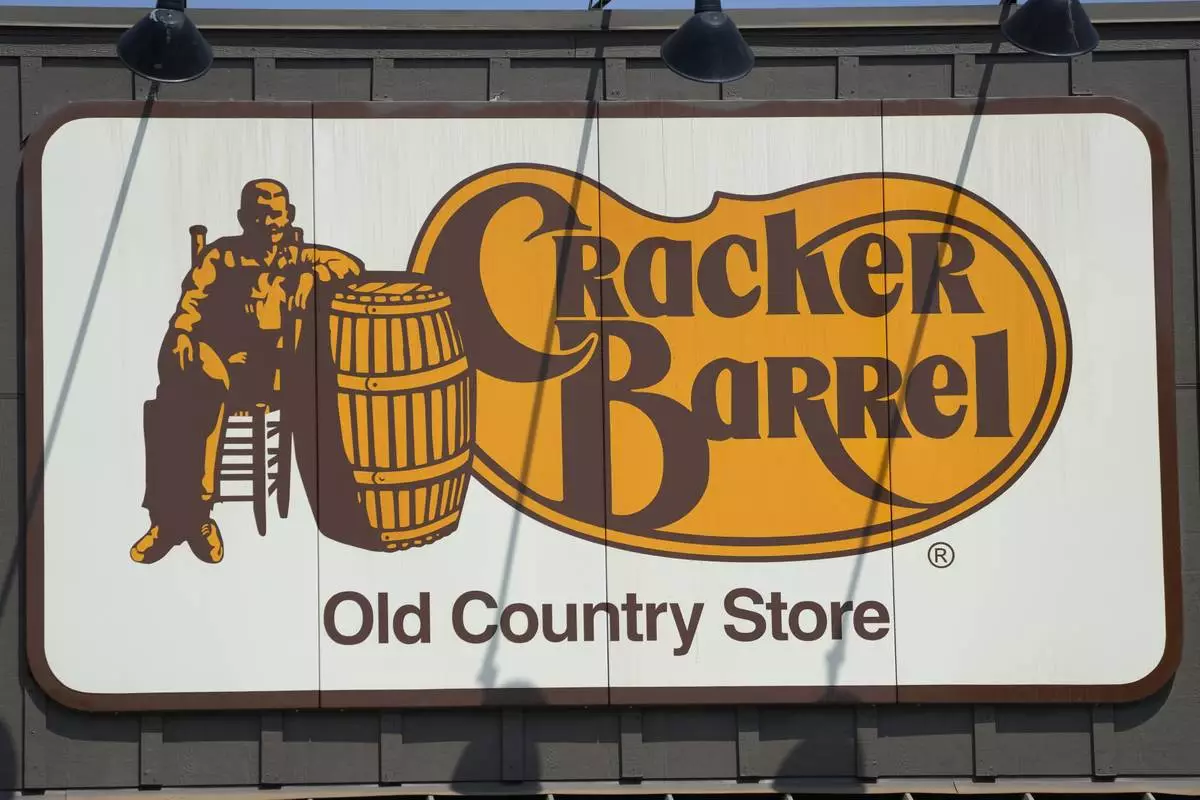
FILE - The Cracker Barrel Old Country Store logo in Pearl, Miss., is photographed, Sept. 12, 2023. (AP Photo/Rogelio V. Solis, File)
KAMPALA, Uganda (AP) — Uganda’s presidential election was plagued by widespread delays Thursday in addition to a days-long internet shutdown that has been criticized as an anti-democratic tactic in a country where the president has held office since 1986.
Some polling stations remained closed for up to four hours after the scheduled 7 a.m. start time due to “technical challenges," according to the nation's electoral commission, which asked polling officers to use paper registration records to ensure the difficulties did not “disenfranchise any voter.”
President Yoweri Museveni, 81, faces seven other candidates, including Robert Kyagulanyi, a musician-turned-politician best known as Bobi Wine, who is calling for political change.
The East African country of roughly 45 million people has 21.6 million registered voters. Polls are expected to close at 4 p.m. Thursday, according to the electoral commission. Results are constitutionally required to be announced in 48 hours.
Impatient crowds gathered outside polling stations expressing concerns over the delays Thursday morning. Umaru Mutyaba, a polling agent for a parliamentary candidate, said it was “frustrating” to be waiting outside a station in the capital Kampala.
“We can’t be standing here waiting to vote as if we have nothing else to do," he said.
Wine alleged there was electoral fraud occurring, noting that biometric voter identification machines were not working at polling places and claiming there was “ballot stuffing.”
“Our leaders, including Deputy President for Western Region, arrested. Many of our polling agents and supervisors abducted, and others chased off polling stations,” Wine wrote in a post on social media platform X.
Museveni told journalists he was notfied biometric machines were inoperable at some stations and he supported the electoral body's decision to revert to paper registration records. He did not comment on the allegation of fraud.
Ssemujju Nganda, a prominent opposition figure and lawmaker seeking reelection in Kira municipality, told The Associated Press he had been waiting in line to vote for three hours.
Nganda also noted biometric machines were malfunctioning, in addition to the late arrival of balloting materials, and predicted the delays likely would lead to apathy and low turnout in urban areas where the opposition has substantial support.
"It’s going to be chaos,” he said Thursday morning.
Nicholas Sengoba, an independent analyst and newspaper columnist, said delays to the start of voting in urban, opposition areas favored the ruling party.
Uganda has not witnessed a peaceful transfer of presidential power since independence from British colonial rule six decades ago.
Museveni has served the third-longest term of any African leader and is seeking to extend his rule into a fifth decade. Some critics say removing him through elections remains difficult, but the aging president’s authority has become increasingly dependent on the military led by his son, Muhoozi Kainerugaba.
Museveni and Wine are reprising their rivalry from the previous election in 2021, when Wine appealed to mostly young people in urban areas. With voter turnout of 59%, Wine secured 35% of the ballots against Museveni’s 58%, the president’s smallest vote share since his first electoral campaign three decades ago.
The lead-up to Thursday's election produced concerns about transparency, the possibility of hereditary rule, military interference and opposition strategies to prevent vote tampering at polling stations.
Uganda's internet was shut down Tuesday by the government communications agency, which cited misinformation, electoral fraud and incitement of violence. The shutdown has affected the public and disrupted critical sectors such as banking.
There has been heavy security leading up to voting, including military units deployed on the streets this week.
Amnesty International said security forces are engaging in a “brutal campaign of repression,” citing a Nov. 28 opposition rally in eastern Uganda where the military blocked exits and opened fire on supporters, killing one person.
Museveni urged voters to come out in large numbers during his final rally Tuesday.
“You go and vote, anybody who tries to interfere with your freedom will be crushed. I am telling you this. We are ready to put an end to this indiscipline,” he said.
The national electoral commission chairperson, Simon Byabakama, urged tolerance among Ugandans as they vote.
“Let us keep the peace that we have,” Byabakama said late Wednesday. “Let us be civil. Let us be courteous. Let’s be tolerant. Even if you know that this person does not support (your) candidate, please give him or her room or opportunity to go and exercise his or her constitutional right."
Authorities also suspended the activities of several civic groups during the campaign season. That Group, a prominent media watchdog, closed its office Wednesday after the interior ministry alleged in a letter that the group was involved in activities “prejudicial to the security and laws of Uganda.”
Veteran opposition figure Kizza Besigye, a four-time presidential candidate, remains in prison after he was charged with treason in February 2025.
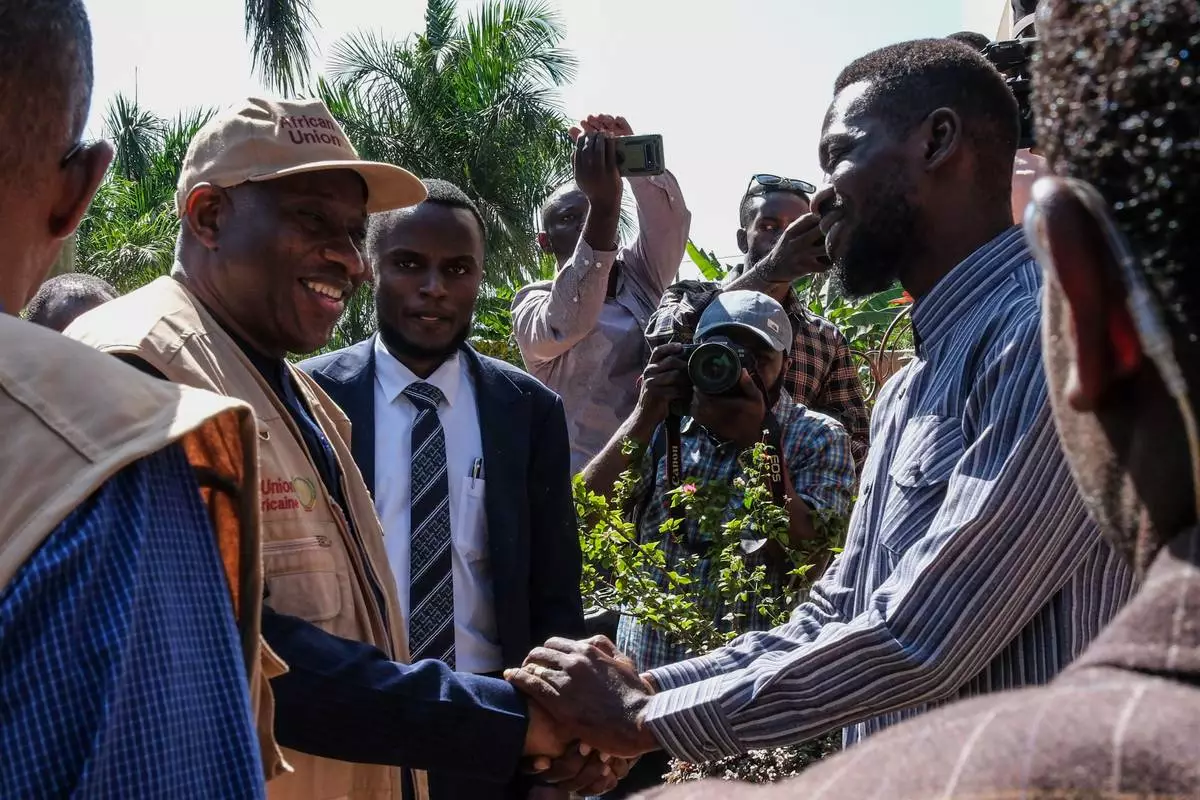
Uganda opposition presidential candidate Robert Kyagulanyi Ssentamu, known as Bobi Wine, right, greets election observers, including former Nigerian President Goodluck Jonathan, at his home in Magere village on the outskirts of Kampala, Uganda, Wednesday, Jan. 14, 2026. (AP Photo/Hajarah Nalwadda)
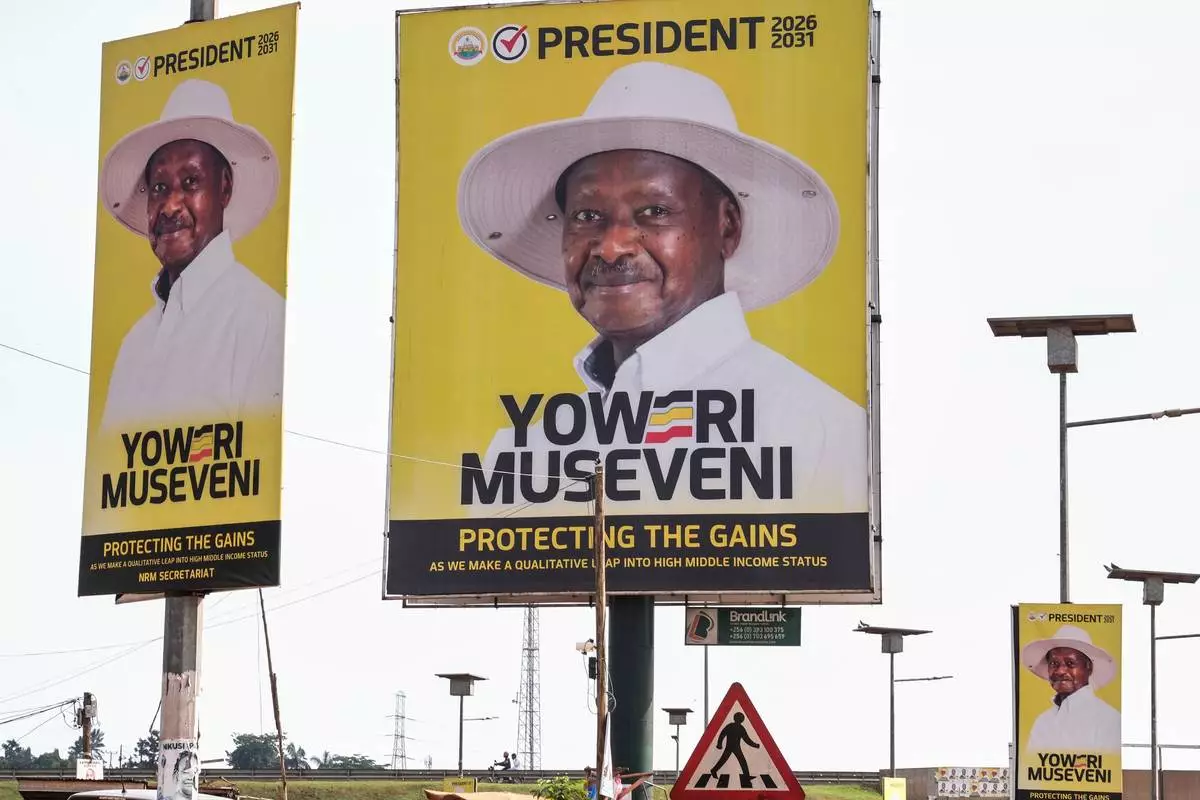
Billboards of Uganda President and National Resistance Movement (NRM) presidential candidate Yoweri Museveni are seen in Kampala, Uganda, Tuesday, Jan. 13, 2026. (AP Photo/Samson Otieno)
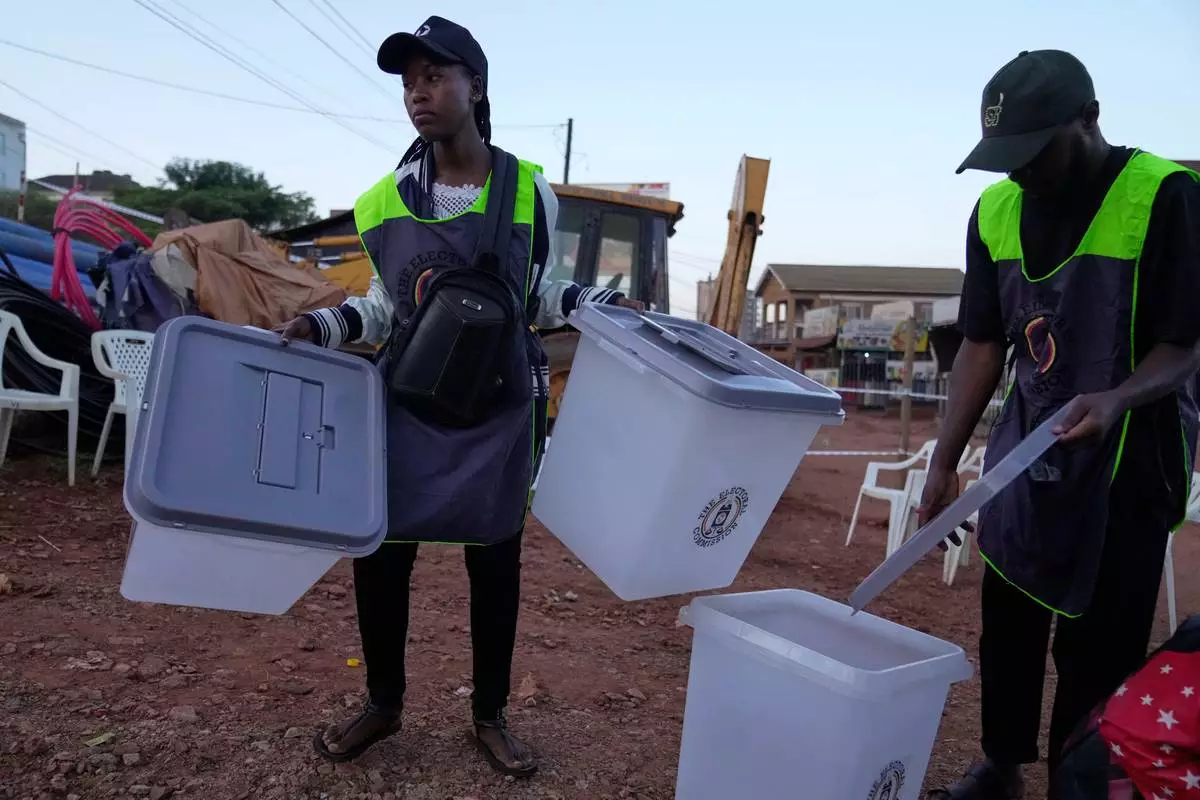
Electoral workers deliver ballot boxes to a polling station during presidential election in Kampala, Uganda, Thursday, Jan. 15, 2026. (AP Photo/Brian Inganga)
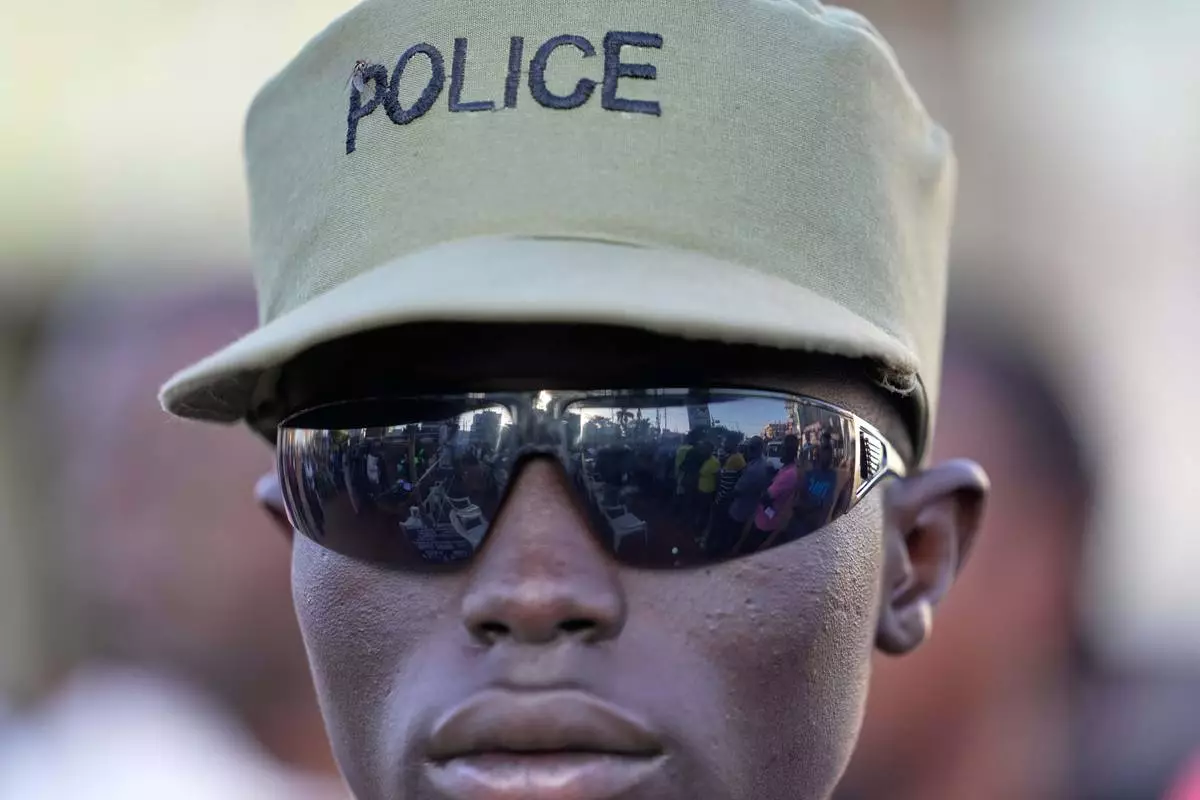
Voters are reflected in a police officer's sunglasses as they wait in line after voting failed to start on time due to system failures during presidential election in Kampala, Uganda, Thursday, Jan. 15, 2026. (AP Photo/Brian Inganga)
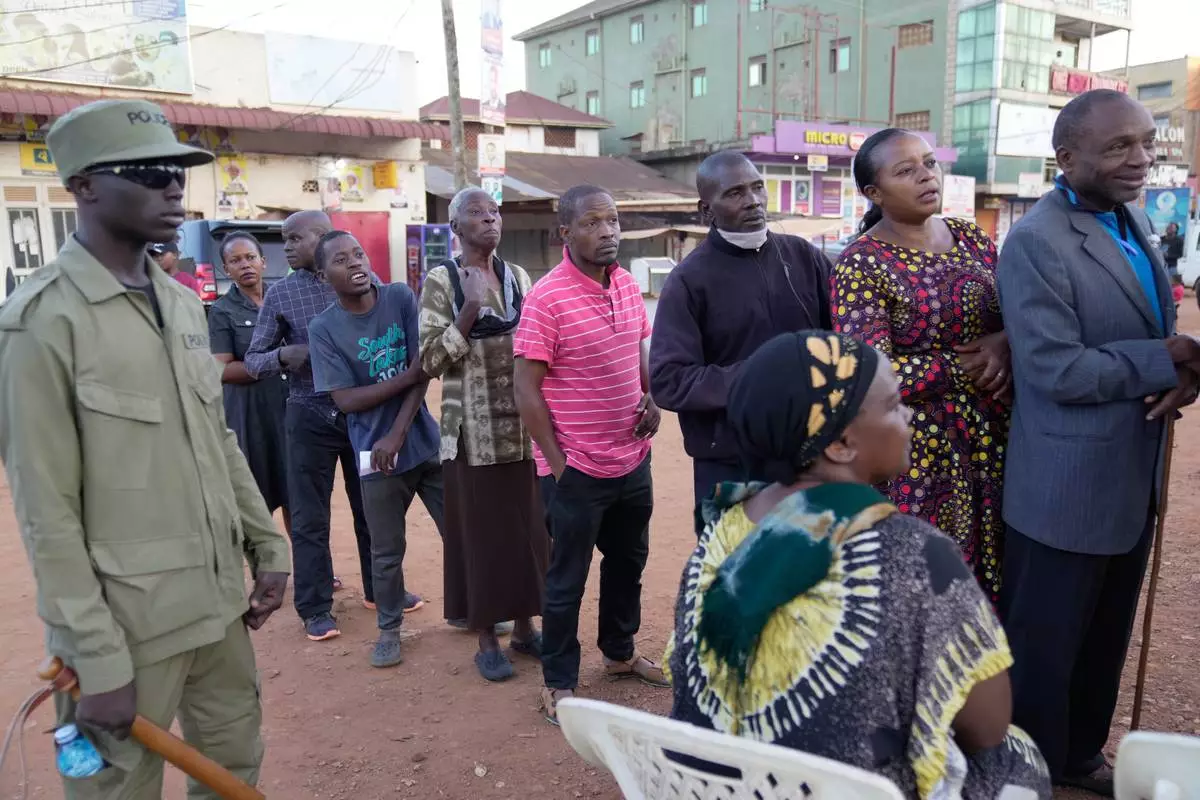
Voters wait to cast their ballots during the presidential election in Kampala, Uganda, Thursday, Jan. 15, 2026. (AP Photo/Brian Inganga)