WASHINGTON (AP) — Louisiana on Wednesday abandoned its defense of a political map that elected two Black members of Congress and instead called on the Supreme Court to reject any consideration of race in redistricting in a case that could bring major changes to the Voting Rights Act.
Appealing to a conservative-dominated court that has been skeptical of the use of race, Louisiana is advancing a position that could allow it and other Republican-led states in the South to draw new maps that eliminate virtually all majority Black districts, which have been Democratic strongholds, voting rights experts said.
“If Louisiana’s argument prevailed at the Supreme Court, it would almost certainly lead to a whiter and less representative Congress, as well as significantly less minority representation across the country in legislatures, city councils, and across other district-based bodies,” UCLA law professor Richard Hasen said in an email.
The state's high court filing was in response to the justices' call for new briefing and arguments in the Louisiana case, which they first heard earlier this year. Arguments will take place on Oct. 15.
“Race-based redistricting is fundamentally contrary to our Constitution,” Louisiana Attorney General Elizabeth Murrill wrote.
Voting rights groups defending the second Black majority district urged the court to reject the state's constitutional challenge.
A second round of arguments is a rare occurrence at the Supreme Court, and sometimes presages a major change by the high court. The Citizens United decision in 2010 that led to dramatic increases in independent spending in U.S. elections came after it was argued a second time.
When the court first heard the Louisiana case in March, several of the court’s conservative justices suggested they could vote to throw out the map and make it harder, if not impossible, to bring redistricting lawsuits under the Voting Rights Act.
The case involves the interplay between race and politics in drawing political boundaries.
Just two years ago, the court, by a 5-4 vote, affirmed a ruling that found a likely violation of the Voting Rights Act in a similar case over Alabama’s congressional map. Chief Justice John Roberts and Justice Brett Kavanaugh joined their three more liberal colleagues in the outcome.
That decision led to new districts in both states that sent two more Black Democrats to Congress.
Now, though, the court has asked the parties to answer a potentially big question: “Whether the state’s intentional creation of a second majority-minority congressional district violates the Fourteenth or Fifteenth Amendments to the U. S. Constitution.”
Those amendments, adopted in the aftermath of the Civil War, were intended to bring about political equality for Black Americans and gave Congress the authority to take all necessary steps. Nearly a century later, Congress passed the Voting Rights Act of 1965, called the crown jewel of the civil rights era, to finally put an end to persistent efforts to prevent Black people from voting in the former states of the Confederacy.
While the high court has pared back the law in the past dozen years, it has sustained the provision that allows challenges to political districts that can be shown to deprive minority voters of the chance to elect representatives of their choice.
In the arguments in March, Louisiana defended the congressional map as an effort to comply with court rulings and preserve districts held by powerful Republicans, including House Speaker Mike Johnson.
The court fight over Louisiana’s congressional districts has lasted three years. Two maps were blocked by lower courts, and the Supreme Court has intervened twice. Most recently, the court ordered the new map to be used in the 2024 election.
The state’s Republican-dominated legislature drew a new congressional map in 2022 to account for population shifts reflected in the 2020 Census. But the changes effectively maintained the status quo of five Republican-leaning majority white districts and one Democratic-leaning majority Black district.
Civil rights advocates won a lower court ruling that the districts likely discriminated against Black voters.
The state eventually drew a new map. But white Louisiana voters claimed in their separate lawsuit that race was the predominant factor driving it. A three-judge court agreed, leading to the current high court case.
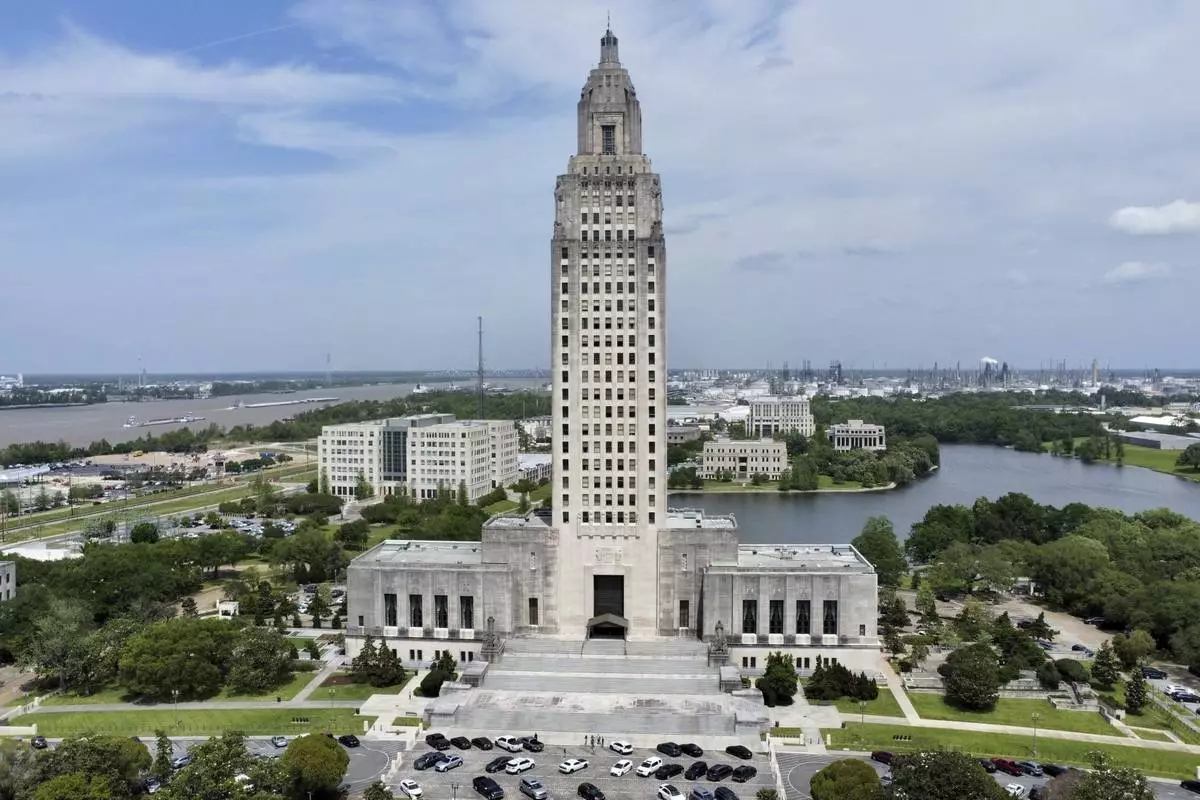
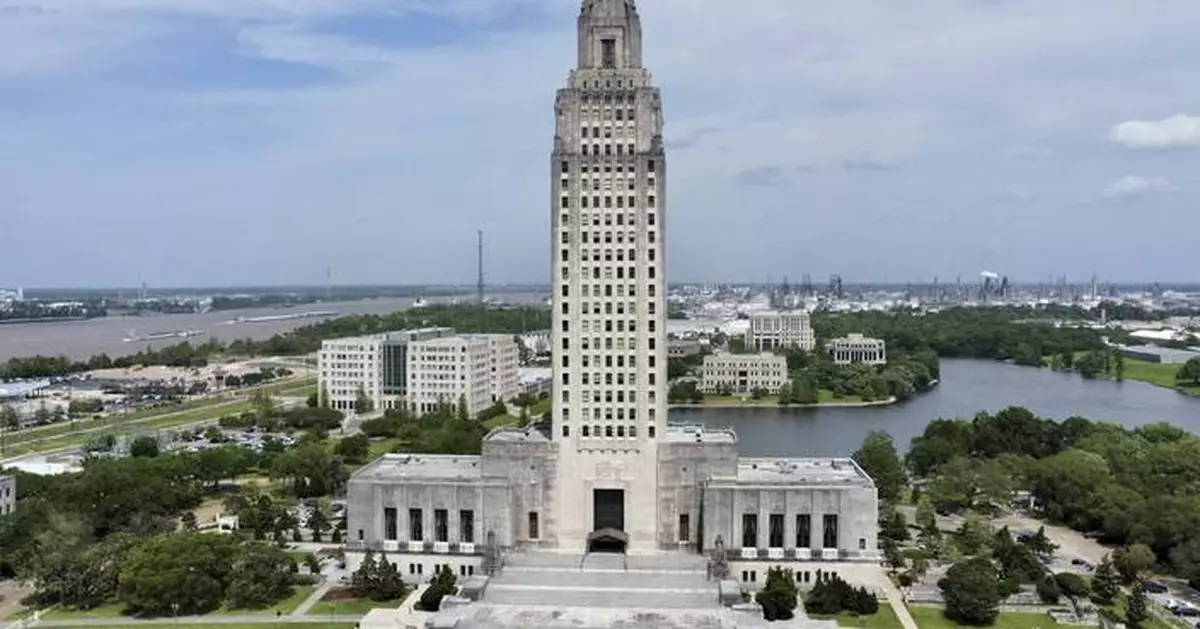
FILE - The Louisiana state Capitol stands on April 4, 2023, in Baton Rouge, La. (AP Photo/Stephen Smith, File)
WASHINGTON (AP) — Most American presidents aspire to the kind of greatness that prompts future generations to name important things in their honor.
Donald Trump isn't leaving it to future generations.
As the first year of his second term wraps up, his administration and allies have put the president’s name on the U.S. Institute of Peace, the Kennedy Center performing arts venue and a new class of battleships.
That’s on top of the “Trump Accounts” for tax-deferred investments, the TrumpRx government website soon to offer direct sales of prescription drugs, the “Trump Gold Card” visa that costs at least $1 million and the Trump Route for International Peace and Prosperity, a transit corridor included in a deal his administration brokered between Armenia and Azerbaijan.
On Friday, he plans to attend a ceremony in Florida where local officials will dedicate a 4-mile (6-kilometer) stretch of road from the airport to his Mar-a-Lago estate as President Donald J. Trump Boulevard.
It’s unprecedented for a sitting president to embrace tributes of that number and scale, especially those proffered by members of his administration. And while past sitting presidents have typically been honored by local officials naming schools and roads after them, it's exceedingly rare for airports, federal buildings, warships or other government assets to be named for someone still in power.
“At no previous time in history have we consistently named things after a president who was still in office,” said Jeffrey Engel, the David Gergen Director of the Center for Presidential History at Southern Methodist University in Dallas. “One might even extend that to say a president who is still alive. Those kind of memorializations are supposed to be just that — memorials to the passing hero.”
White House spokeswoman Liz Huston said the TrumpRx website linked to the president's deals to lower the price of some prescription drugs, along with “overdue upgrades of national landmarks, lasting peace deals, and wealth-creation accounts for children are historic initiatives that would not have been possible without President Trump’s bold leadership.”
"The Administration’s focus isn’t on smart branding, but delivering on President Trump’s goal of Making America Great Again," Huston said.
The White House pointed out that the nation's capital was named after President George Washington and the Hoover Dam was named after President Herbert Hoover while each was serving as president.
For Trump, it’s a continuation of the way he first etched his place onto the American consciousness, becoming famous as a real estate developer who affixed his name in big gold letters on luxury buildings and hotels, a casino and assorted products like neckties, wine and steaks.
As he ran for president in 2024, the candidate rolled out Trump-branded business ventures for watches, fragrances, Bibles and sneakers — including golden high tops priced at $799. After taking office again last year, Trump's businesses launched a Trump Mobile phone company, with plans to unveil a gold-colored smartphone and a cryptocurrency memecoin named $TRUMP.
That’s not to be confused with plans for a physical, government-issued Trump coin that U.S. Treasurer Brandon Beach said the U.S. Mint is planning.
Trump has also reportedly told the owners of Washington’s NFL team that he would like his name on the Commanders’ new stadium. The team’s ownership group, which has the naming rights, has not commented on the idea. But a White House spokeswoman in November called the proposed name “beautiful” and said Trump made the rebuilding of the stadium possible.
The addition of Trump’s name to the Kennedy Center in December so outraged independent Sen. Bernie Sanders of Vermont that he introduced legislation this week to ban the naming or renaming of any federal building or land after a sitting president — a ban that would retroactively apply to the Kennedy Center and Institute of Peace.
“I think he is a narcissist who likes to see his name up there. If he owns a hotel, that’s his business,” Sanders said in an interview. “But he doesn’t own federal buildings.”
Sanders likened Trump's penchant for putting his name on government buildings and more to the actions of authoritarian leaders throughout history.
“If the American people want to name buildings after a president who is deceased, that’s fine. That’s what we do,” Sanders said. “But to use federal buildings to enhance your own position very much sounds like the ‘Great Leader’ mentality of North Korea, and that is not something that I think the American people want.”
Although some of the naming has been suggested by others, the president has made clear he’s pleased with the tributes.
Three months after the announcement of the Trump Route for International Peace and Prosperity, a name the White House says was proposed by Armenian officials, the president gushed about it at a White House dinner.
“It’s such a beautiful thing, they named it after me. I really appreciate it. It’s actually a big deal,” he told a group of Central Asian leaders.
Engel, the presidential historian, said the practice can send a signal to people "that the easiest way to get access and favor from the president is to play to his ego and give him something or name something after him.”
Some of the proposals for honoring Trump include legislation in Congress from New York Republican Rep. Claudia Tenney that would designate June 14 as “Trump’s Birthday and Flag Day," placing the president with the likes of Martin Luther King Jr., George Washington and Jesus Christ, whose birthdays are recognized as national holidays.
Florida Republican Rep. Greg Steube has introduced legislation that calls for the Washington-area rapid transit system, known as the Metro, to be renamed the “Trump Train.” North Carolina Republican Rep. Addison McDowell has introduced legislation to rename Washington Dulles International Airport as Donald J. Trump International Airport.
McDowell said it makes sense to give Dulles a new name since Trump has already announced plans to revamp the airport, which currently is a tribute to former Secretary of State John Foster Dulles.
The congressman said he wanted to honor Trump because he feels the president has been a champion for combating the scourge of fentanyl, a personal issue for McDowell after his brother’s overdose death. But he also cited Trump’s efforts to strike peace deals all over the world and called him “one of the most consequential presidents ever.”
“I think that’s somebody that deserves to be honored, whether they’re still the president or whether they’re not," he said.
More efforts are underway in Florida, Trump’s adopted home.
Republican state lawmaker Meg Weinberger said she is working on an effort to rename Palm Beach International Airport as Donald J. Trump International Airport, a potential point of confusion with the Dulles effort.
The road that the president will see christened Friday is not the first Florida asphalt to herald Trump upon his return to the White House.
In the south Florida city of Hialeah, officials in December 2024 renamed a street there as President Donald J. Trump Avenue.
Trump, speaking at a Miami business conference the next month, called it a “great honor” and said he loved the mayor for it.
“Anybody that names a boulevard after me, I like,” he said.
He added a few moments later: “A lot of people come back from Hialeah, they say, ‘They just named a road after you.' I say, ‘That’s OK.’ It’s a beginning, right? It’s a start.”
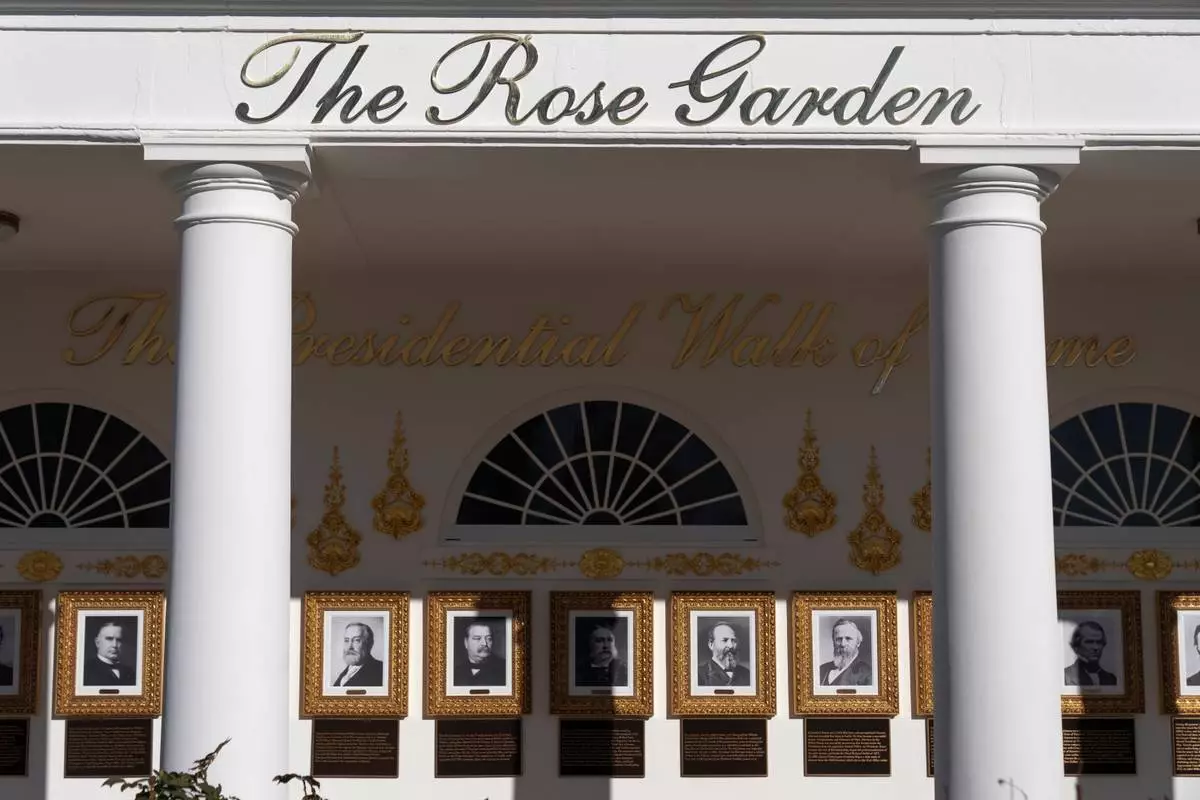
FILE - A sign for the Rose Garden is seen near the Presidential Walk of Fame on the Colonnade at the White House, Jan. 13, 2026, in Washington. (AP Photo/Mark Schiefelbein, File)
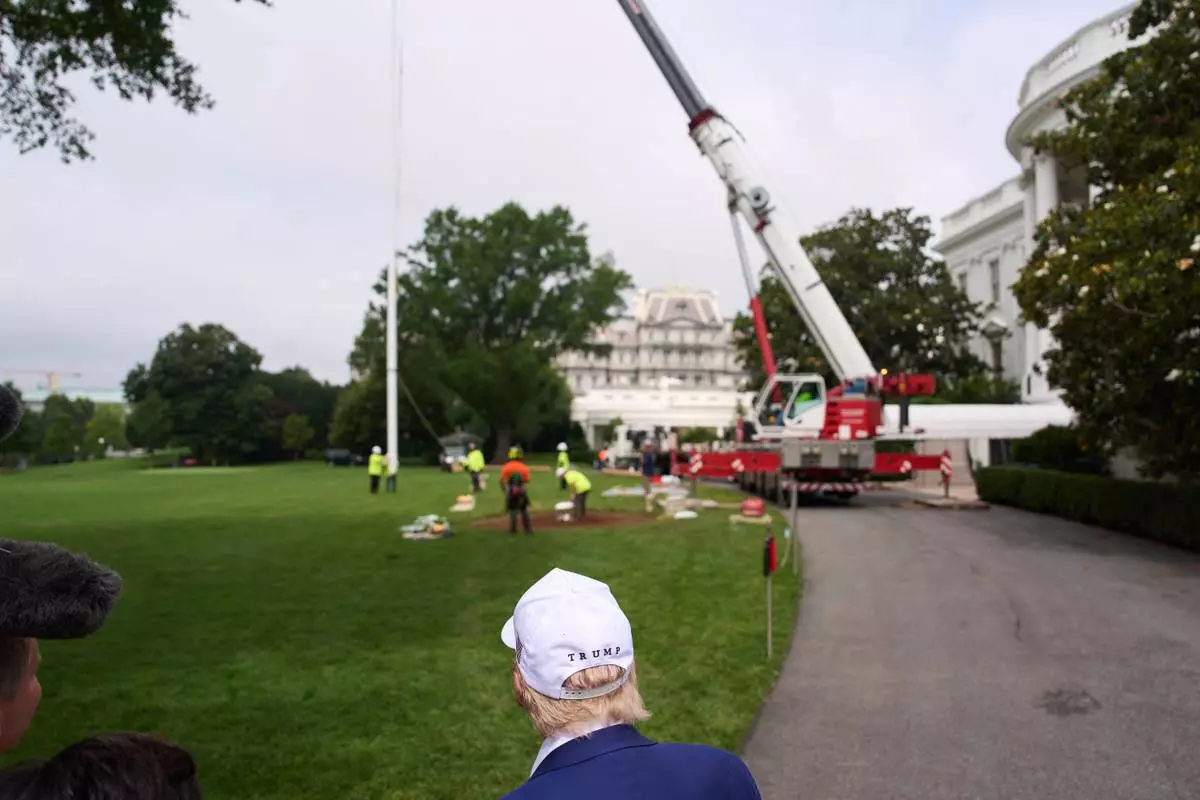
FILE - President Donald Trump speaks with reporters as a flag pole is installed on the South Lawn of the White House, June 18, 2025, in Washington. (AP Photo/Evan Vucci, File)
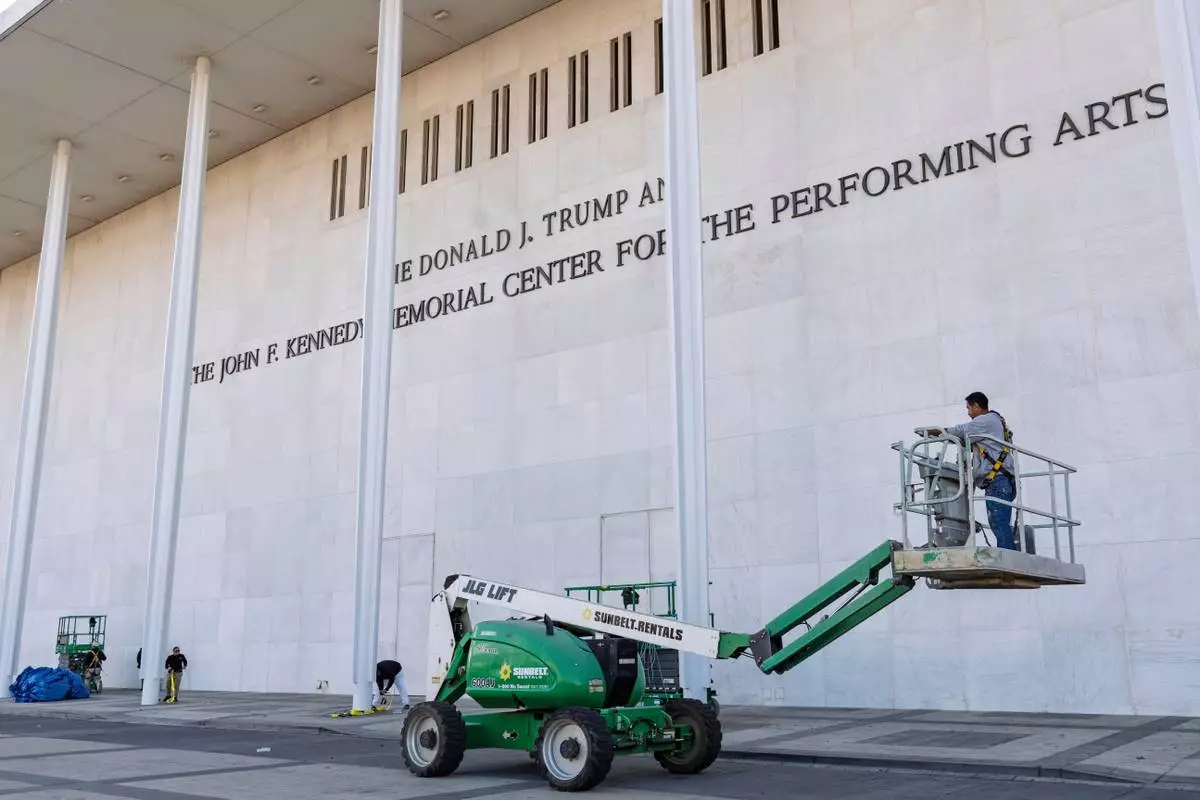
FILE - Workers add President Donald Trump's name to the John F. Kennedy Memorial Center for the Performing Arts, after a Trump-appointed board voted to rename the institution, in Washington, Dec. 19, 2025. (AP Photo/J. Scott Applewhite, File)
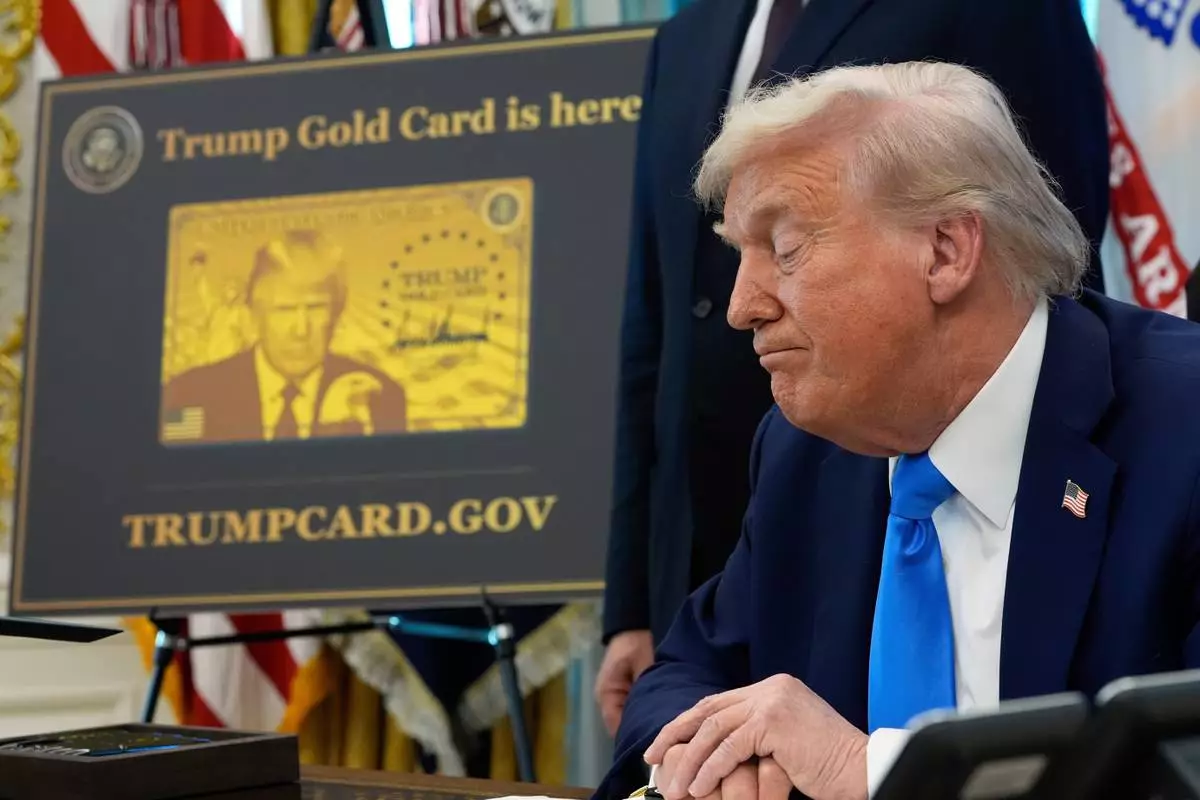
FILE - A poster showing the Trump Gold Card is seen as President Donald Trump signs executive orders in the Oval Office of the White House, Sept. 19, 2025, in Washington. (AP Photo/Alex Brandon, file)