The spirit of the Flying Tigers, the legendary group of American volunteer pilots who fought alongside China during the Chinese People's War of Resistance Against Japanese Aggression, continues to inspire friendship and deepen mutual understanding between China and the U.S., eight decades after Japan's surrender in World War II.
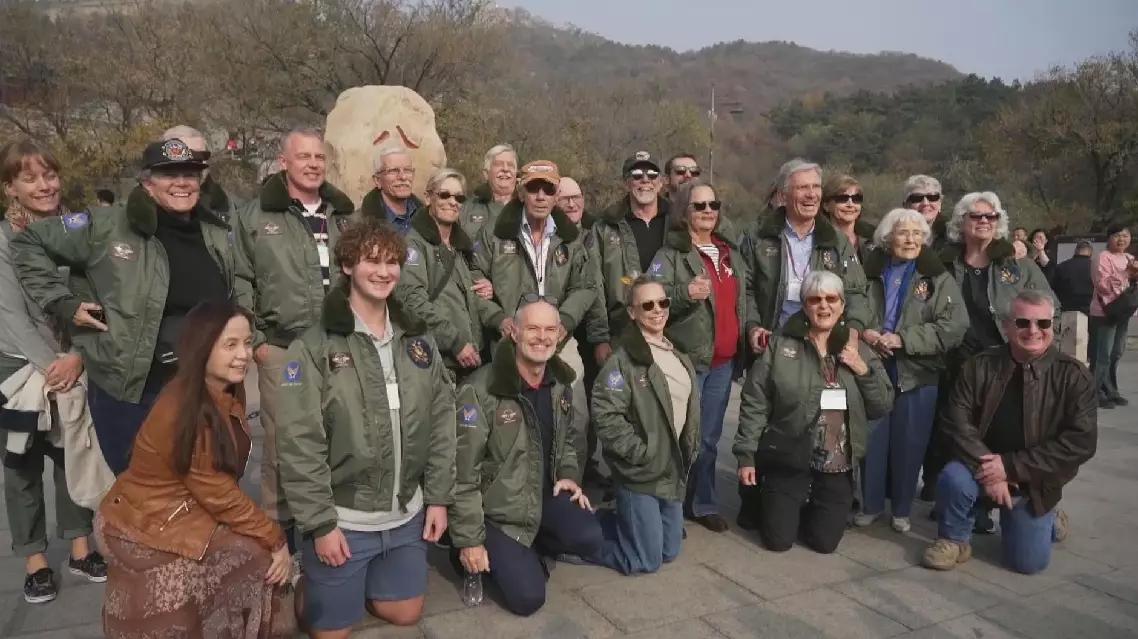
As this year marks the 80th anniversary of the victory in the Chinese People's War of Resistance against Japanese Aggression and the World Anti-Fascist War, Jeffrey Greene, chairman of the Sino-American Aviation Heritage Foundation, led a delegation to retrace the footsteps of the Flying Tigers through various places in China this summer.
Founded in 1998, the foundation has since worked to explore, promote and commemorate the shared history of U.S.-China wartime cooperation. Over the years, the non-profit organization has sponsored nearly 500 veterans and hundreds of their families and descendants to visit China. Many emotional and inspiring stories have emerged from these exchanges.
"I just have admired the Chinese people ever since I came over in 1944 and worked with Flying Tigers. I think you just come into China, and its people -- it's like entering a room that you've been in forever. And it's very easy to be with them. And it flows into you, it doesn't flow out, it flows into me," said a Flying Tigers veteran Harry Moyer.
In 2023, Greene, Moyer and Flying Tigers veteran Mel McMullen jointly wrote a letter to Chinese President Xi Jinping, in which they introduced the efforts of the foundation and Flying Tigers veterans in helping promote China-U.S. friendly exchanges, and expressed their willingness to inherit and carry forward the precious spirit of China-U.S. cooperation.
Xi replied to a letter, saying that he hopes the spirit of Flying Tigers will be carried on from generation to generation among Chinese and American peoples.
"I was pleased and I was honored. I'm going to treasure that (Xi's letter) and pass it on to future generations," said McMullen.
The Flying Tigers, officially known as the American Volunteer Group of the Chinese Air Force, was formed in 1941 by U.S. General Claire Lee Chennault to help China in its fight against invading Japanese forces.
The Flying Tigers, officially known as the American Volunteer Group of the Chinese Air Force, was formed in 1941 by U.S. General Claire Lee Chennault. With a 2,000-plus death toll, the Flying Tigers pilots shot down over 2,600 Japanese fighter planes, greatly assisting the fight against Japanese aggression.
The Chinese people also provided American pilots with assistance at all costs. More than 200 pilots in distress were rescued, with thousands of Chinese people giving their lives during the rescue operations.
One such rescue took place in Yongle Village of Jietou Town in Tengchong City in southwest China's Yunnan Province. In February 1945, U.S. pilot William Findley was forced to make an emergency landing in a field in the village.
"This is exactly where William's plane landed on Feb 14, 1945. Back then, we called this field 'Yishuangkuai', and the plane touched down right at the far end," said Huang Yingfa, a local villager.
Wang Caiting, who was a child at the time, still remembers the day vividly.
"I was just over ten. I remember it clearly. He was flying from Namhkan to Bhamo [in Myanmar] to bomb Japanese forces, helping China fight the invaders. But there was thick fog, and he couldn't land. He circled in and out of the fog to reach our village, finally landing right in front of our home -- a plane that has three heads and two fuselages (Lockheed P-38 Lightning). This is William. His name is William. And this is Lisa, his daughter," Wang said while showing the photos of William and his daughter.
"My father was based in Myitkyina, in Upper Burma (Myanmar). And when he landed in Tengchong County, he didn't know where he was," said Lisa.
The villagers, though unable to communicate verbally, quickly realized the pilot was an American ally.
"The villagers gathered around, curious to see the foreigner with blue eyes and yellow hair, but they couldn't communicate with him. Finally, an elder from the village, Huang Wenju, who knew a few English words, stepped forward and began to communicate with him," said villager Huang Yingfa.
Huang Yingmao, great-grandson of Huang Wenju, explained the communication methods.
"My great-grandfather's name was Huang Wenju. He was a private tutor. Using simple words and writing, he communicated with the pilot, learned that he was an American who had come to help China fight the Japanese invaders. Then my great-grandfather helped him locate his superiors and reconnect with his unit," said Huang Yingmao.
With the villagers' help, William safely returned to his base.
The damaged aircraft, deemed beyond repair, was dismantled. Its parts were preserved by local families, and one piece was used to make a bell for the Jietou Township Elementary School. The bell was named the "Bell of Peace and Progress", according to locals.
In 2002, Lisa Findley began supporting the school in various ways. In recognition of her contributions, she was named honorary principal of the school.
She said her father's wartime experience changed his life forever.
He came to deeply appreciate the kindness shown to him by the local people -- people who had so little, yet gave so much. That experience also led him to realize in times of hardship, we all need each another, said Lisa.
Flying Tigers' legacy lives on, symbolizing wartime bond between China, US