SAO PAULO (AP) — Brazil’s labor court on Friday ordered Volkswagen to pay 165 million reais (about $30 million) for collective moral damages after workers were subjected to slave-like conditions at a company-owned farm in the Amazon during the 1970s and 1980s. Prosecutors said it is the largest such reparation in the country’s history.
The Labor Prosecutor’s Office launched an investigation in 2019 after obtaining extensive documentation from a local priest who had tracked the case for decades. Following further inquiries and witness testimony, prosecutors formally charged Volkswagen in 2024.
The court accepted the charges that hundreds of workers were subjected to degrading conditions between 1974 and 1986 at a farm in Para state, owned by Volkswagen through a subsidiary. The farm was used for cattle ranching and logging.
According to court filings, about 300 workers were hired under irregular contracts to clear the forest and prepare pastures. They were monitored by armed guards, lived in precarious housing, received insufficient food and were forced to stay on the farm under a system of debt bondage. No medical care was provided, even to those who contracted malaria.
“These practices constituted one of the largest cases of slave labor exploitation in Brazil’s recent history,” the Labor Prosecutor’s Office said in a statement.
In his ruling, Judge Otavio Bruno da Silva Ferreira said evidence confirmed the farm belonged to Volkswagen and that conditions met the legal definition of slave labor.
“Slavery is a ‘present past,’ because its marks remain in Brazilian society, especially in labor relations,” Ferreira wrote. He added that the legacy of Brazil’s colonial slave system continues to shape social structures and that recovering this memory is essential to understanding current realities and guiding antidiscrimination judgments.
Volkswagen’s Brazilian headquarters said in a statement it will appeal the decision. The company said that in its 72 years of operation in Brazil, it has “consistently defended the principles of human dignity and strictly complied with all applicable labor laws and regulations.”
“Volkswagen reaffirms its unwavering commitment to social responsibility, which is intrinsically linked to its conduct as a legal entity and employer,” the company said.
Brazil enslaved more people from Africa than any other country, according to estimates from the Trans-Atlantic Slave Trade database. It was the last country in the Western Hemisphere to abolish slavery, in 1888.
Follow AP’s coverage of Latin America and the Caribbean at https://apnews.com/hub/latin-america

FILE - The logo of German car manufacturer Volkswagen is pictured at Volkswagen's transparent factory in Dresden, Germany, on May 14, 2025. (AP Photo/Matthias Schrader, File)
WASHINGTON (AP) — Two senators from opposite parties are joining forces in a renewed push to ban members of Congress from trading stocks, an effort that has broad public support but has repeatedly stalled on Capitol Hill.
Democratic Sen. Kirsten Gillibrand of New York and Republican Sen. Ashley Moody of Florida on Thursday plan to introduce legislation, first shared with The Associated Press, that would bar lawmakers and their immediate family members from trading or owning individual stocks.
It's the latest in a flurry of proposals in the House and the Senate to limit stock trading in Congress, lending bipartisan momentum to the issue. But the sheer number of proposals has clouded the path forward. Republican leaders in the House are pushing their own bill on stock ownership, an alternative that critics have dismissed as watered down.
“There’s an American consensus around this, not a partisan consensus, that members of Congress and, frankly, senior members of administrations and the White House, shouldn’t be making money off the backs of the American people,” Gillibrand said in an interview with the AP on Wednesday.
Trading of stock by members of Congress has been the subject of ethics scrutiny and criminal investigations in recent years, with lawmakers accused of using the information they gain as part of their jobs — often not known to the public — to buy and sell stocks at significant profit. Both parties have pledged to stop stock trading in Washington in campaign ads, creating unusual alliances in Congress.
The bill being introduced by Gillibrand and Moody is a version of a House bill introduced last year by Reps. Chip Roy, a Republican from Texas, and Seth Magaziner, a Democrat from Rhode Island. That proposal, which has 125 cosponsors, would ban members of Congress from buying or selling individual stocks altogether.
Republican Rep. Anna Paulina Luna of Florida tried to bypass party leadership and force a vote on the bill. Her push with a discharge petition has 79 of the 218 signatures required, the majority of them Democrats.
House Republican leaders are supporting an alternative bill that would prohibit members of Congress and their spouses from buying individual stocks but would not require lawmakers to divest from stocks they already own. It would mandate public notice seven days before a lawmaker sells a stock. The bill advanced in committee Wednesday — which Luna called “a win” — but its prospects are unclear.
Magaziner and other House Democrats, including Rep. Alexandria Ocasio-Cortez of New York, wrote in a joint statement Wednesday that they “are disappointed that the bill introduced by Republican leadership today fails to deliver the reform that is needed.”
The Senate bill from Gillibrand and Moody would give lawmakers 180 days to divest their individual stock holdings after the bill takes effect, while newly elected members would have 90 days from being sworn in to divest. Lawmakers would be prohibited from trading and owning certain other financial assets, including securities, commodities and futures.
“The American people must be able to trust that their elected officials are focused on results for the American people and not focused on profiting from their positions,” Moody wrote in response to a list of questions from the AP.
The legislation would exempt the president and vice president, a carveout likely to draw criticism from some Democrats. Similar objections were raised last year over a bill that barred members of Congress from issuing certain cryptocurrencies but did not apply to the president.
Gillibrand said the president “should be held to the same standard” but described the legislation as “a good place to start.”
“I don’t think we have to allow the perfect to be the enemy of the good,” Gillibrand said. “There’s a lot more I would love to put in this bill, but this is a consensus from a bipartisan basis and a consensus between two bodies of Congress.”
Moody, responding to written questions, wrote that Congress has the “constitutional power of the purse” so it's important that its members don't have “any other interests in mind, financial or otherwise.”
“Addressing Members of Congress is the number one priority our constituents are concerned with,” she wrote.
It remains to be seen if the bill will reach a vote in the Senate. A similar bill introduced by Gillibrand and GOP Sen. Josh Hawley of Missouri in 2023 never advanced out of committee.
Still, the issue has salience on the campaign trail. Moody is seeking election to her first full term in Florida this year after being appointed to her seat when Marco Rubio became secretary of state. Gillibrand chairs the Senate Democrats’ campaign arm.
“The time has come," Gillibrand said. “We have consensus, and there’s a drumbeat of people who want to get this done.”
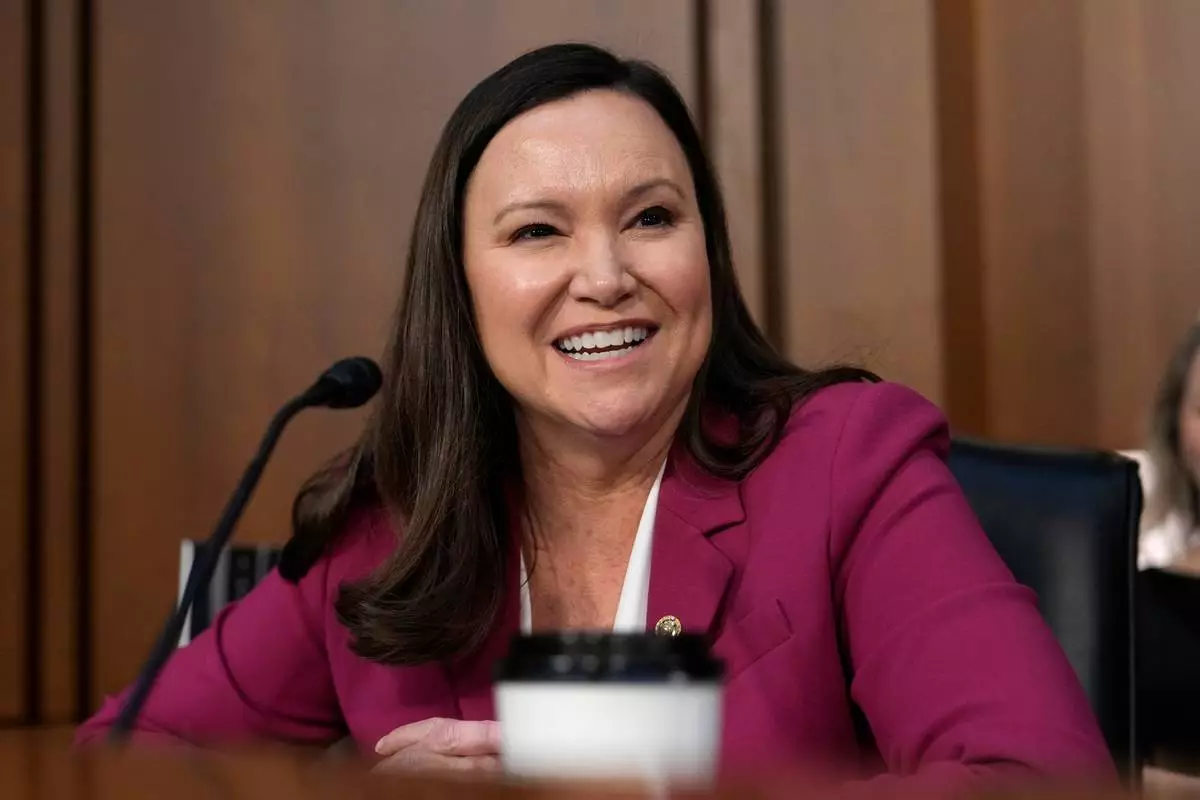
FILE -Sen. Ashley Moody, R-Fla., speaks during the confirmation hearing before the Senate Judiciary Committee for Kash Patel, President Donald Trump's choice to be director of the FBI, at the Capitol in Washington, Jan. 30, 2025. (AP Photo/Ben Curtis, File)
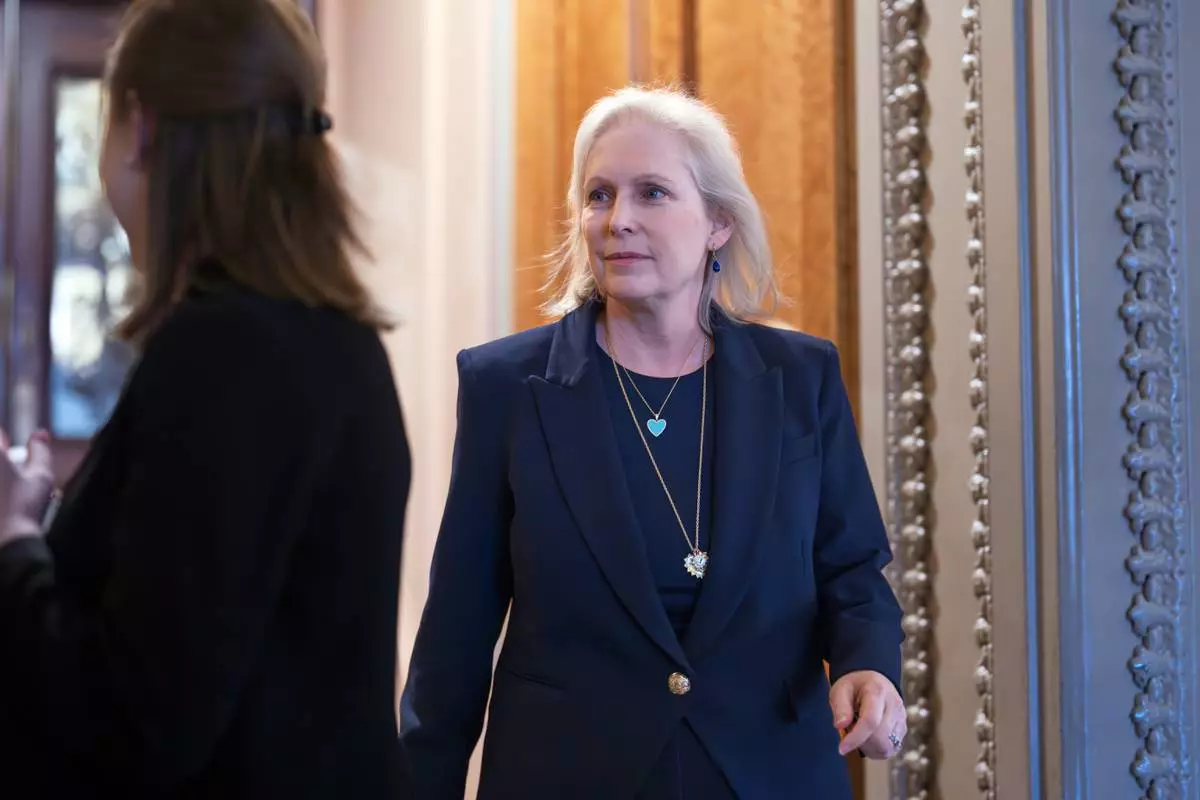
FILE - Sen. Kirsten Gillibrand, D-N.Y., leaves the Senate chamber after voting on a government funding bill at the Capitol in Washington, March 14, 2025. (AP Photo/J. Scott Applewhite, File)