The diverse range of films released during China's summer holiday season catering to varying audience tastes have helped draw out more and more moviegoers, leading to impressive box office earnings of nearly 12 billion yuan (around 1.68 billion U.S. dollars).
The China Film Administration (CFA) announced on Monday that the country's total summer box office has reached just over 11.96 billion yuan, surpassing last year's summer total, as the country's movie sector enjoys encouraging growth.
China's summer movie season officially runs from June 1 through Aug. 31 and is traditionally viewed as one of the country's most lucrative film periods. More than 100 films spanning a wide range of genres, including history, animation, comedy, action and suspense, were released in China during this period, attracting a total of 321 million moviegoers, according to the CFA.
The top-grossing title of the summer is "Dead to Rights," a film charting the horrifying events of the 1937 Nanjing Massacre in east China during World War II -- which has raked in 2.89 billion yuan since its July 25 release.
Other top-performing films include "Nobody," a spin-off of the acclaimed "Yao-Chinese Folktales" animation series; "The Shadow's Edge," a crime action flick starring Jackie Chan; "The Lychee Road," a bittersweet drama set during the Tang Dynasty (618-907) and starring comedian Da Peng; and Universal's "Jurassic World Rebirth."
Film fans have been impressed by the many different offerings being screened in theaters across the country.
"This year offers a wide variety of choices, with many different genres available," said a moviegoer in Shanghai.
"There is quite a rich variety, catering to all kinds of different tastes," said another.
In addition to robust box office sales, related cultural and creative products are also thriving, with sales of memorabilia and other items performing well.
"We have also developed some commemorative stamps, postcards, and movie posters for the most popular films," said Zhang Yan, assistant general manager of the Shanghai Film Art Center.
Sun Jiashan, a researcher at Central Academy of Culture and Tourism Administration, emphasized that these rising box office earnings represent more than just financial success for the film industry, highlighting the knock-on effect across other sectors.
"From the Spring Festival holiday to the summer season, we have witnessed how Chinese cinema has taken the lead in sounding the clarion call for the recovery of the film industry on a global scale. For our country, the film industry plays a particularly important role, as box office earnings extend beyond the industry itself and have a significant impact on the overall economic and social development," said Sun.
The positive reception to such movies has also been seen on the stock market. For example, between June and August, the China Film Group and Omnijoi Media Corporation, the two entertainment firms which invested in “Dead To Rights,” saw double-digit growth in their share prices.

Diverse film offerings drive China's summer box office success
The three astronauts of China's recently-returned Shenzhou-20 mission on Friday shared the experiences of their dramatic 204-day space mission, including detailing the emergency procedures which were implemented to bring them safely home after their return capsule was struck by space debris.
The trio -- Chen Dong, Chen Zhongrui, and Wang Jie -- met with the press in Beijing on Friday afternoon, marking their first public appearance since returning to Earth in November.
When detailing the emergency response mechanisms which were enacted prior to their scheduled return, the astronauts explained that upon discovering a triangular crack on the spacecraft's viewport window, they immediately took photos for documentation and transmitted them to the ground team, who swiftly activated an emergency plan to get the trio home safely.
Experienced mission commander Chen Dong explained how the crew had complete faith in their colleagues on the ground to find a solution to these unforeseen circumstances which led to their return being delayed.
"First, we must trust the ground team, who would anticipate everything and develop the safest return plan for us. Second, we must believe in ourselves; as well-trained astronauts, we have the ability to manage various unexpected failures. I believe that with the collaboration of astronauts and researchers on the ground, our space home will surely go farther, more steadily, and for a longer time," he said.
Following their extended stay in space as a result of the debris incident, the Shenzhou-20 crew spent a total 204 days in orbit, setting a new record for the longest duration by a single group of Chinese astronauts.
During their mission, they completed multiple payload operations, conducted extensive scientific experiments, and carried out four extravehicular activities.
"Our crew worked together with the ground team in unity and coordination, completing four extravehicular activities, several payload entry and exit tasks, and a large number of scientific experiments. It was a fulfilling yet challenging mission. The path to exploring the heavens is long and arduous, but I firmly believe that China's space missions will succeed," said Chen Zhongrui, a former air force pilot who was making his first spaceflight during the mission.
"From the ground to space, from learning to application, I have deeply felt the solid progress of Chinese space endeavors and the quiet dedication of countless personnel behind the scenes. In the future, I will accomplish each mission with full commitment, living up to the trust of the motherland and the people," said fellow astronaut Wang Jie, who was also making his debut spaceflight.
After returning to Earth on Nov 14, the trio successfully completed their isolation recovery and rehabilitation and will now resume normal training following health assessments.
The crew's return, originally scheduled for Nov 5, was postponed due to safety concerns, with the astronauts later using the return capsule belonging to their successor crew of the Shenzhou-21 mission to get back to Earth. China later launched the unmanned Shenzhou-22 spacecraft which will serve the future return of the crew now aboard the Tiangong Space Station.
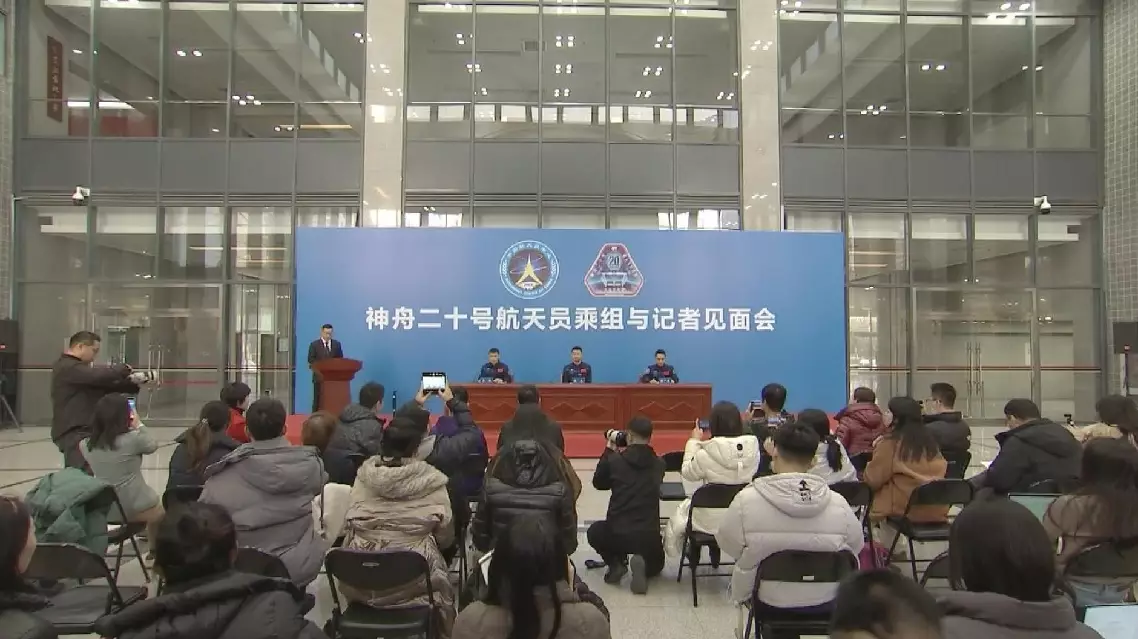
Shenzhou-20 astronauts share experiences after safely returning from debris incident