Skip to Content Facebook Feature Image

Pentagon authorizes up to 600 military lawyers to serve as temporary immigration judges

News

Pentagon authorizes up to 600 military lawyers to serve as temporary immigration judges
News

News

Pentagon authorizes up to 600 military lawyers to serve as temporary immigration judges

2025-09-03 07:04 Last Updated At:07:10

WASHINGTON (AP) — Defense Secretary Pete Hegseth has approved sending up to 600 military lawyers to the Justice Department to serve as temporary immigration judges, according to a memo reviewed by The Associated Press.

The military will begin sending groups of 150 attorneys — both military and civilians — to the Justice Department “as soon as practicable,” and the military services should have the first round of people identified by next week, according to the Aug. 27 memo.

The effort comes as the Trump administration more regularly turns to the military as it cracks down on illegal immigration through ramped-up arrests and deportations. Its growing role in the push includes troops patrolling the U.S.-Mexico border, National Guard members being sent into U.S. cities to support immigration enforcement efforts, housing people awaiting deportation on military bases and using military aircraft to carry out deportations.

The administration's focus on illegal immigration has added strain to the immigration courts, which were already dealing with a massive backlog of roughly 3.5 million cases that has ballooned in recent years. An organization for immigration lawyers called the new directive a “destructive” move meant to undermine the courts.

At the same time, more than 100 immigration judges have been fired or left voluntarily after taking deferred resignations offered by the Trump administration, their union says. In the most recent round of terminations, the International Federation of Professional and Technical Engineers said in July that at least 17 immigration judges had been fired “without cause” in courts across the country.

That has left about 600 immigration judges, union figures show, meaning the Pentagon move would double their ranks.

The Justice Department, which oversees the immigration courts, requested the assistance from the Defense Department, according to the memo sent by the Pentagon’s executive secretary to his DOJ counterpart. The military lawyers' duties as immigration judges will initially last no more than 179 days but can be renewed, it said.

A DOJ spokesperson referred questions about the plan to the Defense Department, where officials directed questions to the White House.

A White House official said Tuesday that the administration is looking at a variety of options to help resolve the significant backlog of immigration cases, including hiring additional immigration judges. The official, who was not authorized to comment publicly and spoke on condition of anonymity, said the matter should be “a priority that everyone — including those waiting for adjudication — can rally around.”

The head of the American Immigration Lawyers Association decried bringing in temporary judges who lack expertise in immigration law, saying “it makes as much as sense as having a cardiologist do a hip replacement.”

“Expecting fair decisions from judges unfamiliar with the law is absurd. This reckless move guts due process and further undermines the integrity of our immigration court system,” said Ben Johnson, the organization’s executive director.

The memo stressed that the additional attorneys are contingent on availability and that mobilizing reserve officers may be necessary. Plus, the document said DOJ would be responsible for ensuring that anyone sent from the Pentagon does not violate the federal prohibition on using the military as domestic law enforcement, known as the Posse Comitatus Act.

The administration faced a setback on its efforts to use troops in unique ways to combat illegal immigration and crime, with a court ruling Tuesday that it “willfully” violated federal law by sending National Guard troops to Los Angeles in early June.

It is not immediately clear what impact shifting that number of military attorneys would have on the armed forces' justice system. The attorneys, called judge advocates, have a range of duties much like civilian lawyers, from carrying out prosecutions, acting as a defense attorney or offering legal advice.

Pentagon officials did immediately offer details on where any of the 600 attorneys will be drawn from and whether they will come from active duty or the reserves.

Until she was abruptly fired in July, former supervising judge Jennifer Peyton administered the intensive training that all judges in Chicago undergo before working in some of the busiest immigration courts in the country. After the weekslong training, new judges are paired with an experienced mentor and have a two-year probationary period.

Peyton doubted that military attorneys would be able to master the complexities of immigration law without that rigorous process. She also said it wasn’t clear how they would handle the hundreds, or sometimes thousands, of cases on just a Chicago immigration judge’s docket each year.

“Six months is barely enough time to start to figure out the firehose of information and training,” she said.

Peyton also was concerned that Trump’s move didn’t supply more administrative workers, including translators, whom judges rely on to make decisions. The stakes, she said, were life or death for people who would come before the new judges.

“None of it makes sense unless you were intentionally trying to weaken the immigration courts,” Peyton said.

Associated Press writers Safiyah Riddle in Montgomery, Alabama, and Will Weissert, Rebecca Santana and Eric Tucker in Washington contributed to this report.

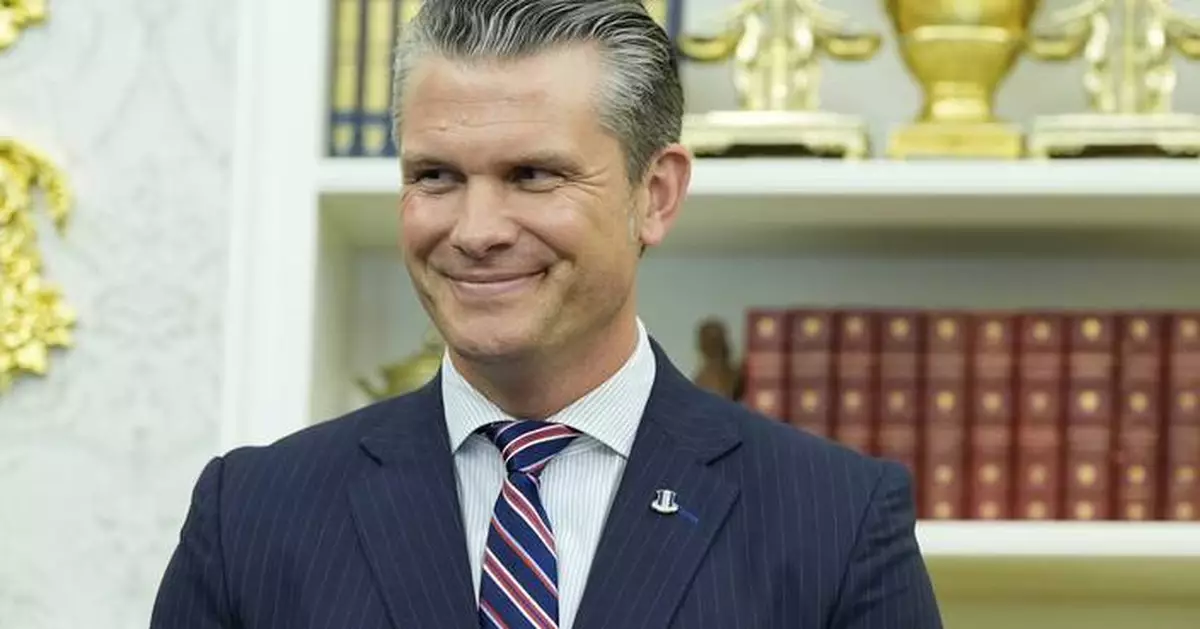
Defense Secretary Pete Hegseth listens as President Donald Trump speaks during an event signing a proclamation honoring the fourth anniversary of the attack at Abbey Gate in Afghanistan, in the Oval Office of the White House, Monday, Aug. 25, 2025, in Washington. (AP Photo/Alex Brandon)


Defense Secretary Pete Hegseth listens as President Donald Trump speaks during an event signing a proclamation honoring the fourth anniversary of the attack at Abbey Gate in Afghanistan, in the Oval Office of the White House, Monday, Aug. 25, 2025, in Washington. (AP Photo/Alex Brandon)
BERLIN (AP) — The eight European countries targeted by U.S. President Donald Trump for a 10% tariff for opposing American control of Greenland blasted the move Sunday, warning that the American leader's threats “undermine transatlantic relations and risk a dangerous downward spiral.”

In an unusual and very strong joint statement coming from major U.S. allies, Denmark, Norway, Sweden, France, Germany, the United Kingdom, the Netherlands and Finland on Sunday said troops sent to Greenland for the Danish military training exercise “Arctic Endurance” pose “no threat to anyone.”

Trump's Saturday announcement sets up a potentially dangerous test of U.S. partnerships in Europe. The Republican president appeared to indicate that he was using the tariffs as leverage to force talks over the status of Greenland, a semiautonomous territory of NATO ally Denmark that he regards as critical to U.S. national security.

“We stand in full solidarity with the Kingdom of Denmark and the people of Greenland," the group said. “Building on the process begun last week, we stand ready to engage in a dialogue based on the principles of sovereignty and territorial integrity that we stand firmly behind. Tariff threats undermine transatlantic relations and risk a dangerous downward spiral.”

There are immediate questions about how the White House could try to implement the tariffs because the EU is a single economic zone in terms of trading. It was unclear, too, how Trump could act under U.S. law, though he could cite emergency economic powers that are currently subject to a U.S. Supreme Court challenge.

European Union foreign policy chief Kaja Kallas said China and Russia will benefit from the divisions between the U.S. and Europe. She added in a post on social media: “If Greenland’s security is at risk, we can address this inside NATO. Tariffs risk making Europe and the United States poorer and undermine our shared prosperity."

Trump's move was also panned domestically.

U.S. Sen. Mark Kelly, a former U.S. Navy pilot and Democrat who represents Arizona, posted that Trump’s threatened tariffs on U.S. allies would make Americans “pay more to try to get territory we don’t need.”

“Troops from European countries are arriving in Greenland to defend the territory from us. Let that sink in,” he wrote on social media. “The damage this President is doing to our reputation and our relationships is growing, making us less safe. If something doesn’t change we will be on our own with adversaries and enemies in every direction.”

Six of the countries targeted are part of the 27-member EU, which operates as a single economic zone in terms of trading. It was not immediately clear if Trump's tariffs would impact the entire bloc. EU envoys scheduled emergency talks for Sunday evening to determine a potential response.

The tariff announcement even drew blowback from Trump's populist allies in Europe.

Italy’s right-wing premier, Giorgia Meloni, considered one of Trump’s closest allies on the continent, said Sunday she had spoken to him about the tariffs, which she described as “a mistake.”

The deployment to Greenland of small numbers of troops by some European countries was misunderstood by Washington, Meloni told reporters. She said the deployment was not a move against the U.S. but aimed to provide security against “other actors” that she didn’t name.

French President Emmanuel Macron wrote on social media that “no intimidation or threats will influence us, whether in Ukraine, Greenland or anywhere else in the world when we are faced with such situations." He added that "tariff threats are unacceptable and have no place in this context.”

Jordan Bardella, president of Marine Le Pen’s far-right National Rally party in France and also a European Parliament lawmaker, posted that the EU should suspend last year’s tariff deal with the U.S., describing Trump’s threats as “commercial blackmail.”

Trump also achieved the rare feat of uniting Britain’s main political parties — including the hard-right Reform UK party — all of whom criticized the tariff threat.

“We don’t always agree with the U.S. government and in this case we certainly don’t. These tariffs will hurt us,” Reform UK leader Nigel Farage, a longtime champion and ally of Trump, wrote on social media. He stopped short of criticizing Trump's designs on Greenland.

Meanwhile, U.K. Prime Minister Keir Starmer, who leads the center-left Labour Party, said the tariffs announcement was “completely wrong” and his government would “be pursuing this directly with the U.S. administration.”

The foreign ministers of Denmark and Norway are also expected to address the crisis Sunday in Oslo during a news conference.

__

Leicester reported from Paris and Cook from Brussels. Associated Press writers Jill Lawless in London, Barry Hatton in Lisbon, Portugal, Aamer Madhani in Washington and Josh Boak in West Palm Beach, Florida, contributed to this report.

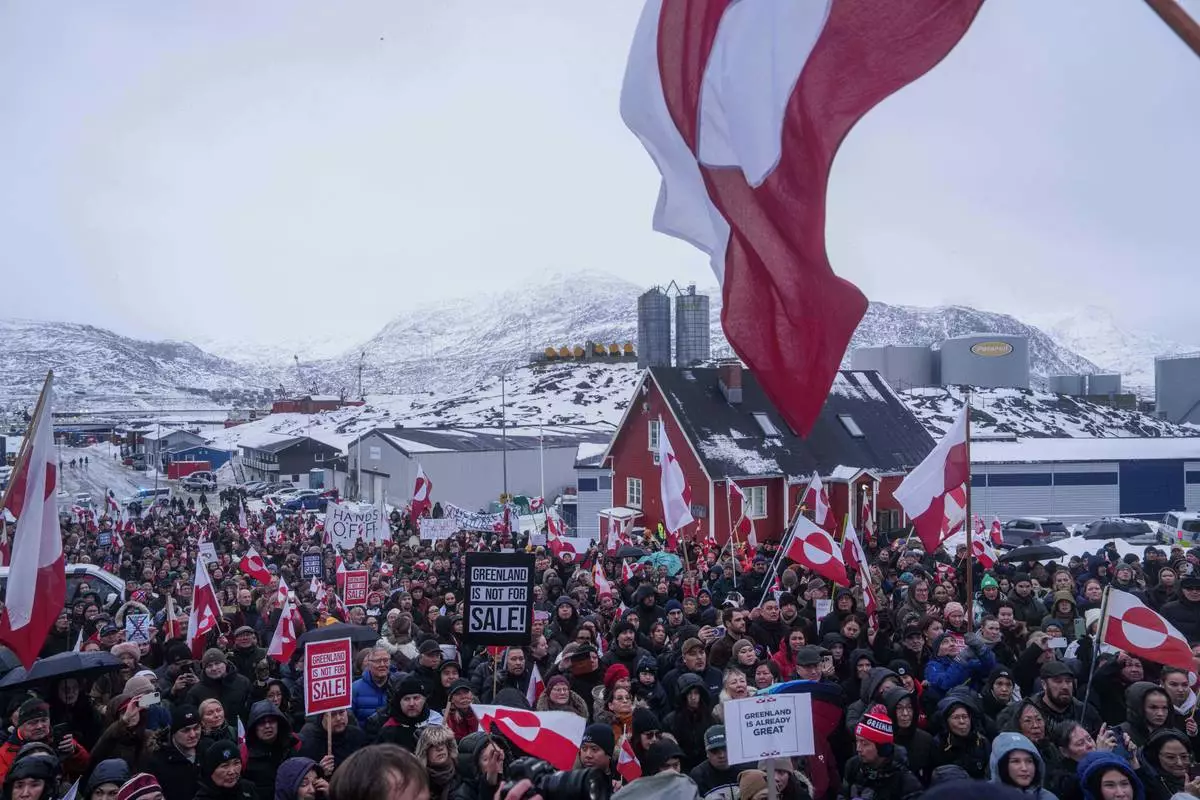
A crowd walks to the US consulate to protest against Trump's policy towards Greenland in Nuuk, Greenland, Saturday, Jan. 17, 2026. (AP Photo/Evgeniy Maloletka)

A crowd walks to the US consulate to protest against Trump's policy towards Greenland in Nuuk, Greenland, Saturday, Jan. 17, 2026. (AP Photo/Evgeniy Maloletka)

A boy holds a crossed out map of Greenland topped by a hairpiece symbolizing U.S. President Donald Trump, during a protest against Trump's policy towards Greenland in front of the US consulate in Nuuk, Greenland, Saturday, Jan. 17, 2026. (AP Photo/Evgeniy Maloletka)

A boy holds a crossed out map of Greenland topped by a hairpiece symbolizing U.S. President Donald Trump, during a protest against Trump's policy towards Greenland in front of the US consulate in Nuuk, Greenland, Saturday, Jan. 17, 2026. (AP Photo/Evgeniy Maloletka)

People protest against Trump's policy towards Greenland in front of the US consulate in Nuuk, Greenland, Saturday, Jan. 17, 2026. (AP Photo/Evgeniy Maloletka)

People protest against Trump's policy towards Greenland in front of the US consulate in Nuuk, Greenland, Saturday, Jan. 17, 2026. (AP Photo/Evgeniy Maloletka)

Recommended Articles