Over 100 Chinese-made military aircraft roared over Tian'anmen Square in a grand V-Day military parade in Beijing on Wednesday.
The eight aircraft echelons, composing of front-line combat models that are all in active service, represented cutting-edge equipment for high-end warfare. They flew in integrated combat formations, bringing together early-warning and command, strategic projection, and anti-surface capabilities from the Army, Navy and Air Force.
First flying past was the early-warning and command aircraft echelon. Early-warning aircraft KongJing-500A, escorted by J-16 fighter jets, and KongJing-600, escorted by aircraft carrier-based fighter jets J-15T passed over Tian'anmen Square in turn for inspection. The development and deployment of the latest, domestically made early warning aircraft have remarkably improved the Chinese People's Liberation Army (PLA)'s capacities in command and control, early warning and detection, and coordinated strike.
Next approaching was the echelon of special-purpose aircraft. Under the escort of J-16 fighters, Y-9 anti-submarine patrol aircraft, electronic reconnaissance aircraft and radar jamming aircraft formed three V-formations. The deployment of the various types of special-purpose aircraft has significantly increased the PLA's abilities in maritime and air reconnaissance, patrol and surveillance, and electro-magnetic neutralization.
The third was the echelon of transport aircraft. Y-20A and Y-20B transporters flied past in a combat mode. The new-type, multifunctional transport aircraft, equipped with new, domestically made engines, are capable of flying long distances at great speed with heavy loads. They have carried out many key missions at home and abroad, and are capable of long-range strategic delivery.
The fourth echelon flying over was China's strategic bombers H-6N. Also showcased in the parade were H-6K and H-6J. These bombers are the PLA's air-based long-range strike forces. As a major force in long-range strike, the aircraft are capable of long-distance raid, large-area patrolling and beyond-defense zone strikes.
In the echelon of refueling and receiver aircraft, three YY-20A, or YunYou-20A, airborne refueling tankers were ready to refuel H-6N bombers, J-16 fighters and J-20 fighters. The deployment of domestically made refueling tankers has enabled China's fighter jets to operate long-distance flights.
Then the fighter jet echelon roared over the sky. J-16D, J-20, J-35A, J-20S and J-20A formed two formations. China's J-fighter family are fast replenished as various new stealth fighters are deployed. They brook no violation of China's airspace.
The carrier-based aircraft echelon then took center stage in the sky. Compared to dancers on the edge of a sword, J-15DH, J-15DT, J-35 and J-15T formed two V-shaped formations. China's carrier-based aircraft have undergone leapfrog development from conventional ski-jump takeoff to taking off via catapult, and from a single-model combat to multi-model coordination.
Last flying past was the echelon of trainer aircraft. Seven J-10 aerobatics planes staged an aerial display of 14 colored smoke trails, symbolizing the 14 years of the War of Resistance Against Japanese Aggression and the bright prospects of 1.4 billion Chinese people striving for national rejuvenation.
Wednesday's parade marks the 80th anniversary of the victory in the Chinese People's War of Resistance Against Japanese Aggression and World Anti-Fascist War. It has two parts -- a military review by President Xi Jinping and a march-past of troops in Tian'anmen Square.
The theme of the parade is to reaffirm Chinese people's commitment to peace and the armed forces' unwavering resolve to defend it.
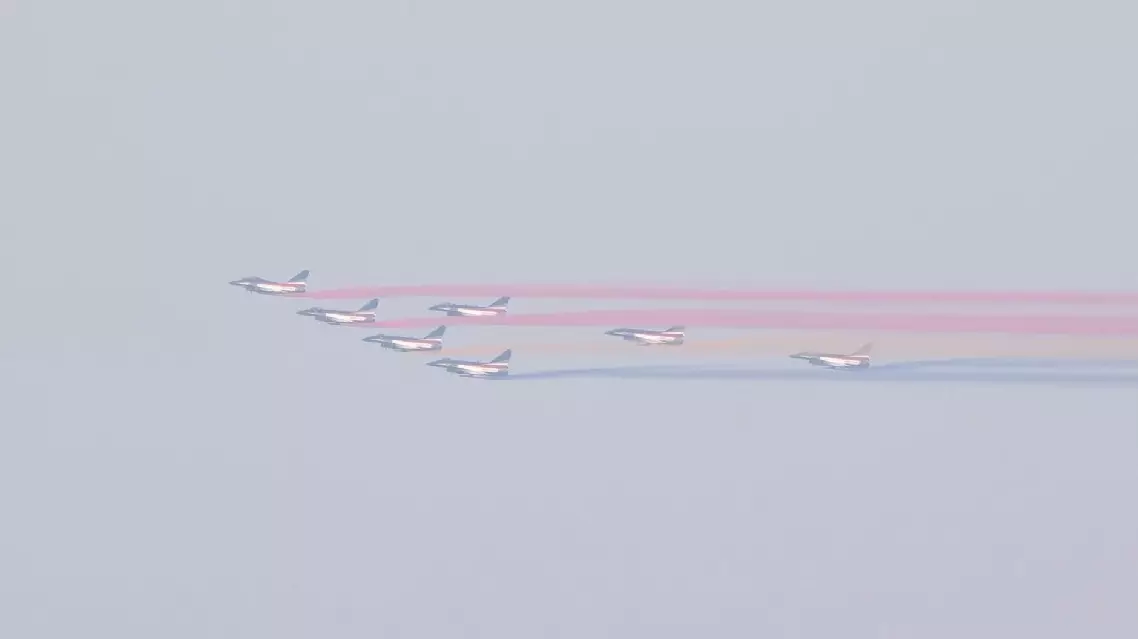
Cutting-edge aircraft fly in integrated combat formations during China’s V-Day military parade
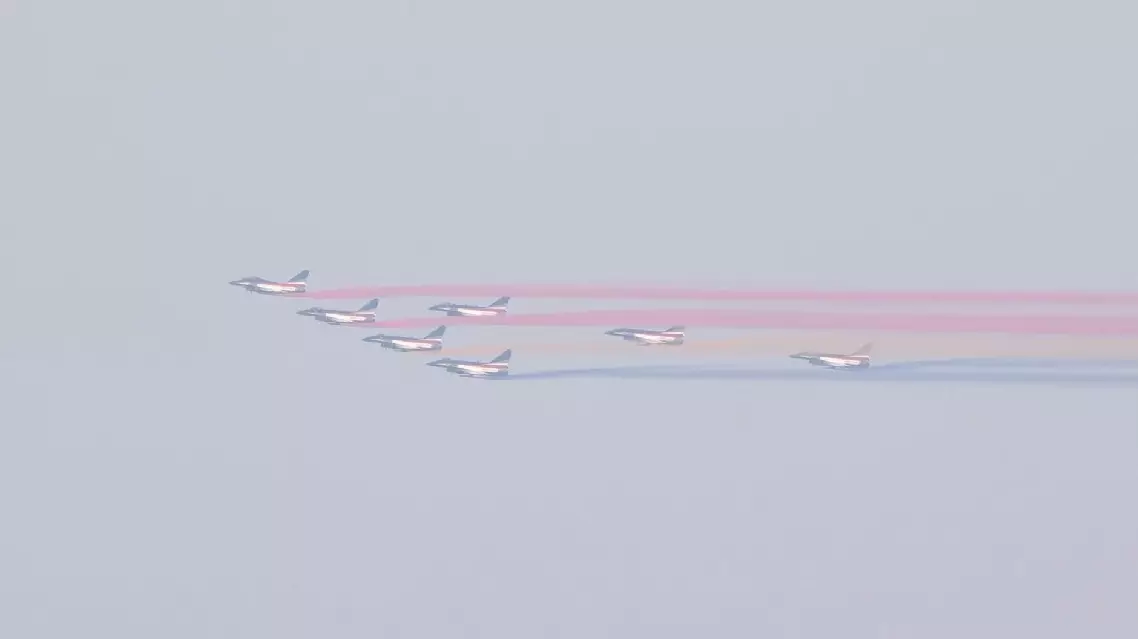
Cutting-edge aircraft fly in integrated combat formations during China’s V-Day military parade