CHAPIN, S.C. (AP) — Federal officials on Friday said they are taking steps that will give state and federal prisons the right to jam the signals of cellphones smuggled to inmates, devices they argue allow prisoners to plot violence and carry out crimes.
FCC Chairman Brendan Carr said Friday during a news conference in Arkansas that his agency would vote at its Sept. 30 meeting on a proposal to lift a restriction in place that prohibits state and federal prisons from jamming signals of phones that prisoners aren’t allowed to have.
The debate over using technology to make the devices — often smuggled behind bars and even delivered over prison fences by drones and hollowed-out footballs — has been ongoing for years, with prison officials saying these actions allow inmates to run criminal enterprises while incarcerated.
“It may not be a silver bullet, it may not be the right fit for every facility, but there are certainly lots and lots of facilities around this country where this type of solution will and can make a significant difference,” Carr said. “Every single day that goes by, we’re leaving the American public exposed, and we’re going to close that loophole.”
Officials said smuggled phones allowed inmates to orchestrate a 2018 gang-related siege that raged for more than seven hours at a South Carolina prison, killing seven inmates in the worst U.S. prison riot in 25 years.
They've also, according to officials, been used to orchestrate violence outside prisons. Robert Johnson, who worked as an anti-contraband officer at one of South Carolina’s most violent prisons, survived six shots to the stomach and chest as he prepared to head to work in 2010, becoming an advocate for the use of jamming technology.
Many incremental moves on the issue have involved South Carolina, whose former state prisons director Bryan Stirling became a national advocate for the use of jamming technology. In 2016, Stirling hosted then-FCC Chairman Ajit Pai to tour South Carolina prisons and hold a field hearing in the state.
In 2019, federal officials oversaw a test of jamming technology at a South Carolina prison. The state was also first to apply for a permit after the FCC in 2021 adopted a ruling that would allow state prison systems to apply for permits to identify and turn off illegal cell signals, but action on the application stalled.
Prosecutors from around the country have called on Congress to change a nearly century-old federal communications law that currently prevents state prisons from using jamming technology to nullify illicit cell signals, but those efforts have also failed. On Friday, Carr said that his agency's upcoming vote would technically “deauthorize the lawful use of contraband cell phones” in prisons, something he said would mean current federal law “is no longer a prohibition to jamming” them.
In a statement, officials with CTIA, a wireless industry group that opposes jamming, said providers are “committed to addressing the serious issue of contraband phones while fulfilling the longstanding Congressional mandate to protect legitimate communications, including vital public safety services, from interference.”
According to Carr, using jamming wouldn't be mandatory for any prison. Officials currently use other methods to keep out illegal phones, like scans and even netting put up along prison borders, to deter people from throwing phones over fencing.
In the 15 years since he was shot, Johnson said he's endured 36 surgeries due to the attack, but is thankful to see advancements he hopes will protect others.
“I could have died, but the beginning of the end, hopefully, has started,” he said, of the upcoming vote. “I really thought I would never see this day.”
Meg Kinnard can be reached at http://x.com/MegKinnardAP
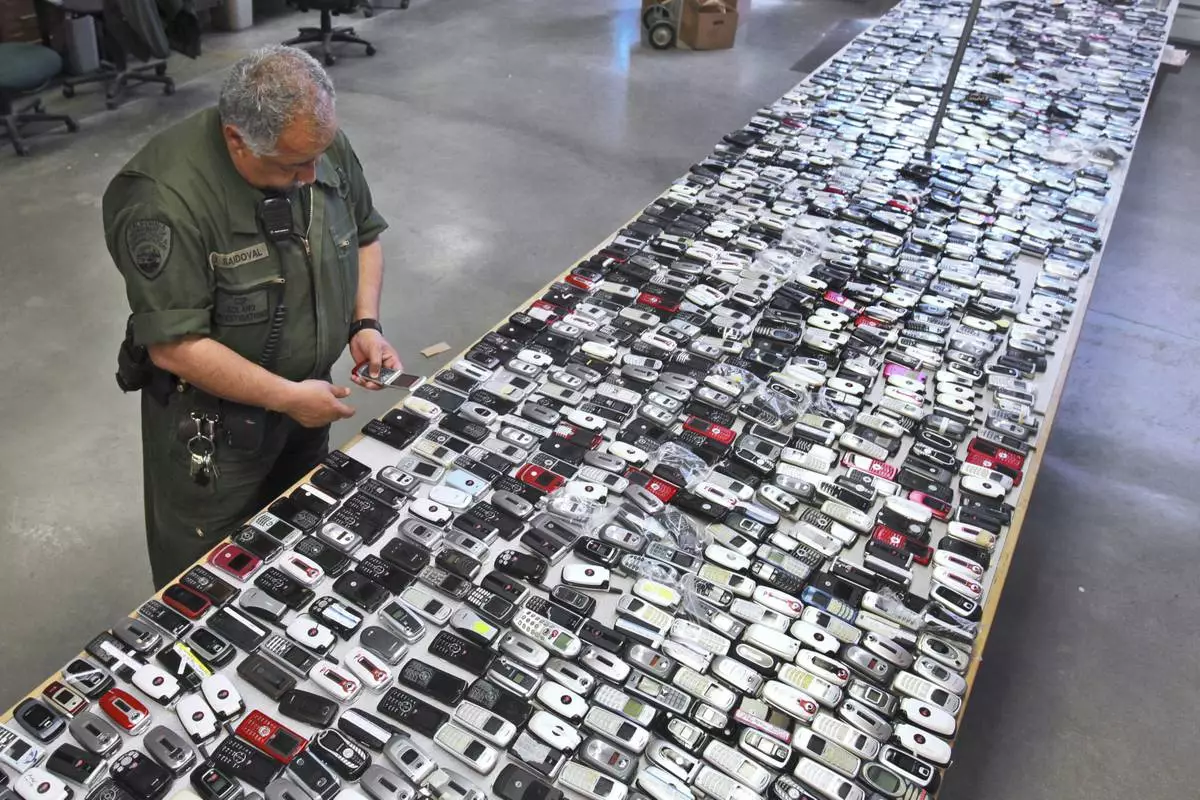
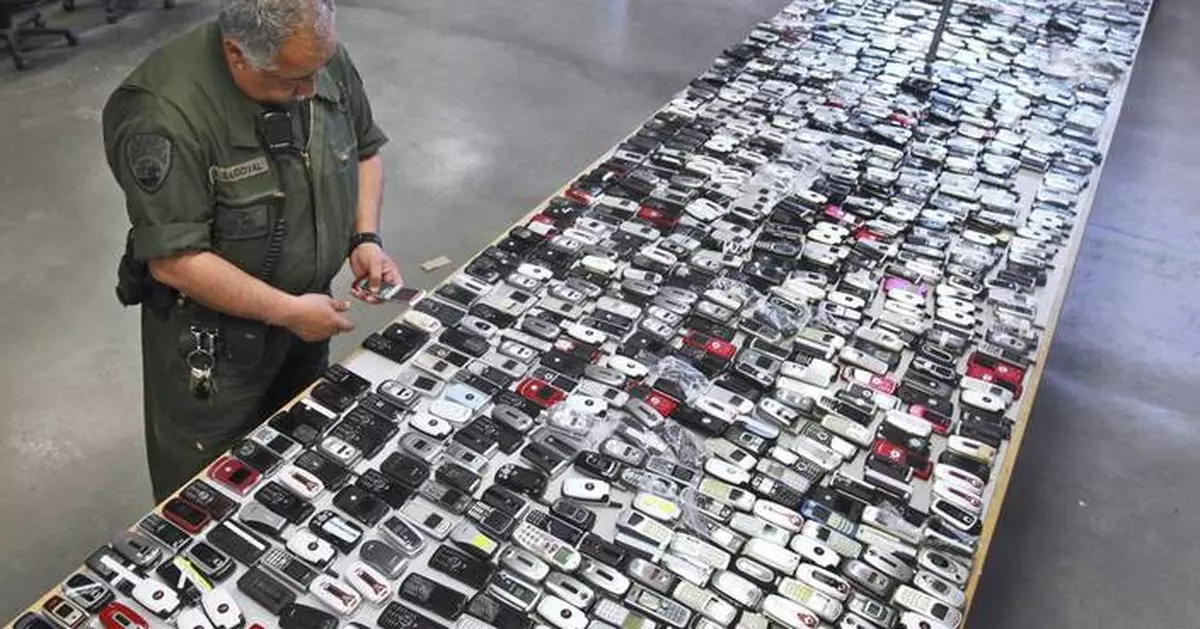
FILE - Correctional Officer Jose Sandoval inspects one of the more than 2,000 cell phones confiscated from inmates at California State Prison, Solano in Vacaville, Calif., April 10, 2009. (AP Photo/Rich Pedroncelli, File)
NEW YORK (AP) — Christine Baranski was in the playground outside St. Matthew’s Church in Bedford, New York, about three years ago when she came across Matthew Guard, artistic director of the Grammy-nominated Skylark Vocal Ensemble.
“I love choral music,” she told him.
An Emmy- and Tony-Award winning actor, Baranski went on to attend some of his concerts.
“I was a fangirl basically,” she recalled. “And I think we just said, `Wouldn’t it be fun to do something together?’”
Baranski agreed to narrate a music-and-spoken word version of Charles Dickens’ “A Christmas Carol” last December at The Morgan Library & Museum in New York, which owns the original manuscript of the 1843 classic. A recording was made last June at the Church of the Redeemer in Chestnut Hill, Massachusetts, and released Dec. 4 on the LSO Live label.
She will perform it again with the group on Thursday night at the Morgan, which is displaying the manuscript through Jan. 11, and again the following night at The Breakers in Newport, Rhode Island, where she will again portray the acerbic Agnes van Rhijn when Season 4 of HBO’s “The Gilded Age” starts filming season four on Feb. 23.
“I have this thing about keeping language alive, keeping beautiful, well-written language,” she said. “Dickens, Stoppard, Shakespeare. We’re getting awfully lazy in our use of the English language.”
She compliments Julian Fellowes, creator of “The Gilded Age” and “Downton Abbey,” for distinguished prose.
“I think he’d play Agnes if he could,” she said. “He gives her the witty stuff.”
Baranski leaned on the skills that earned her an Emmy for “Cybill” and Tonys for “The Real Thing” and “Rumors.”
“You get to bring to life a lot of different characters, none the least of which is Ebenezer,” she said at the library this month. “It’s wonderful for an actor to differentiate in as subtle a way as possible these different characters. As an acting piece, it’s wonderful. And not many women have done it. It’s been done by Alistair Cooke and Patrick Stewart and Patrick Page and all these great actors — but I get to do it with a chorus.”
Guard weaves in underscoring by composer Benedict Sheehan with Baranski’s words and 10 carols that include “Silent Night” and “Deck the Halls” plus “Auld Lang Syne.”
Reciting the entire story would have created a Wagnerian-length evening.
“This manuscript itself is about 30,000 words and we needed about 5,000 to make it a concert length,” Guard said. “I tried to create space in the narrative for obvious musical exclamation points or emotional feelings, almost like arias in an opera.”
Sheehan had worked together with Guard on a 2020 recording “Once Upon a Time” that weaved together the Brothers Grimm’s “Snow White and the Seven Dwarves” and Hans Christian Andersen’s “The Little Mermaid.”
“I said why don’t you commission me to write choral underscoring for the narrative that can kind of stitch together these different choral pieces?” Sheehan said.
Baranski got narration experience in 2023 when she replaced Liev Schreiber with the Orpheus Chamber Orchestra at Carnegie Hall for Beethoven’s “Egmont.”
“I could do this the rest of my career,” she thought at the time. “Just put me in a concert hall surrounded by great musicians.”
After working with dialect coach Howard Samuelsohn, Baranski practiced on Zoom to hone a 19th-century voice and avoid cliché.
“I said this is a good warm up for Aunt Agnes because it’s that kind of speech we were taught at Juilliard,” the 73-year-old Baranski said, recalling lessons from Edith Skinner decades ago.
“Sometimes it’s just a question of modulating your voice, just different rhythms and staccato or legato,” she said. “I want the voice of the Ghost of Christmas past to be disembodied… ethereal.”
She didn’t have an urge to join in on the carols.
“We take from each other,” she said. “When the chorus first heard my version of it, I think it subtly influenced the feeling of it and I take from the mood of the carol and bring it into my interpretation.”
“It’s a really exciting back-and-forth actually,” Guard said. “It’s not really totally clear who’s driving the bus at times.”
Baranski hopes the project has a future.
“We want to film this someday in the Morgan,” she said. “Make this a yearly event at the Morgan, because here’s the manuscript and people. It’s just one of those things like Handel’s `Messiah’ or `The Nutcracker.’”
She’s going to gift the CD to her grandchildren, four boys ranging from ages 2 to 12. Among her previous holiday experiences was portraying Martha May Whovier in the 2000 movie “Dr. Seuss’ How the Grinch Stole Christmas.”
“They’re curiously not interested in my even being Martha May in `The Grinch,’” Baranski explained. “Their friends sometimes say: `That’s your grandmother.’ But I just want to be their grandma — do you know what I mean — and not somebody?”
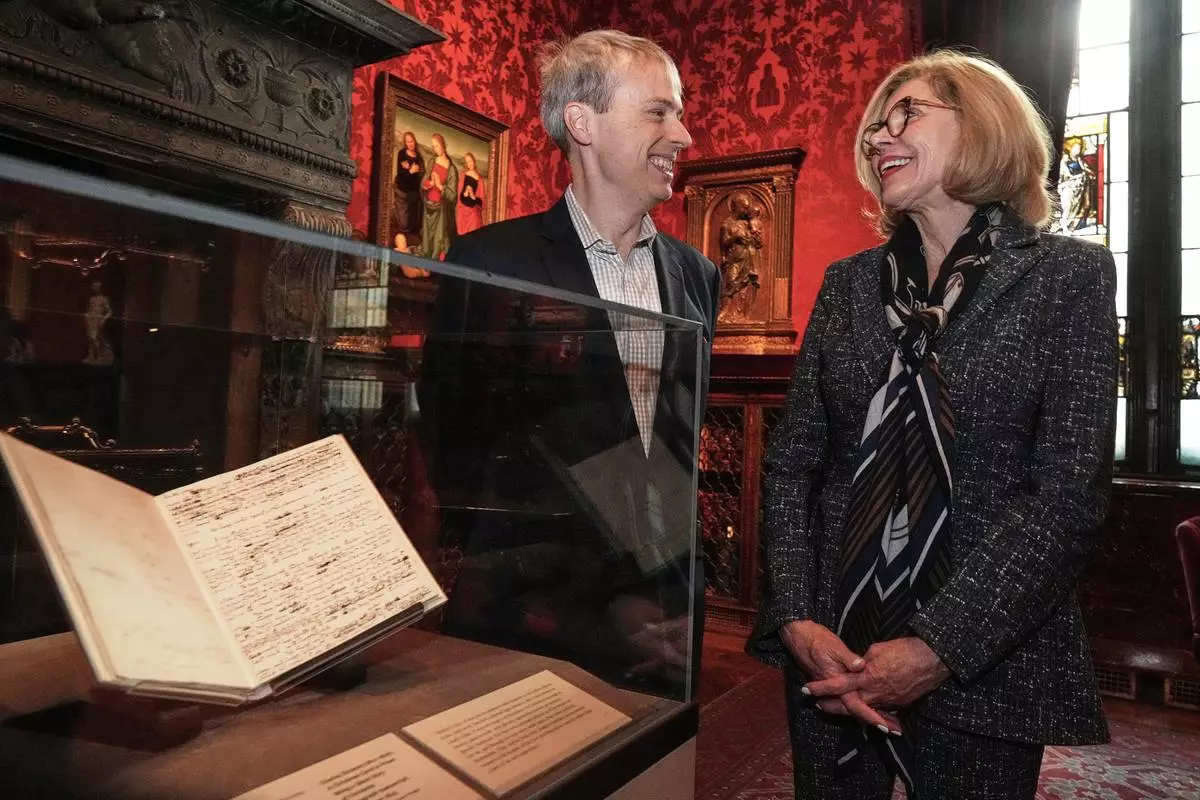
Skylark Artistic Director Matthew Guard and Christine Baranski are interviewed beside "A Christmas Carol In Prose; Being a Ghost Story of Christmas" by Charles Dickens, Dec. 1843," at The Morgan Library & Museum, in New York, Monday, Dec. 1, 2025. (AP Photo/Richard Drew)
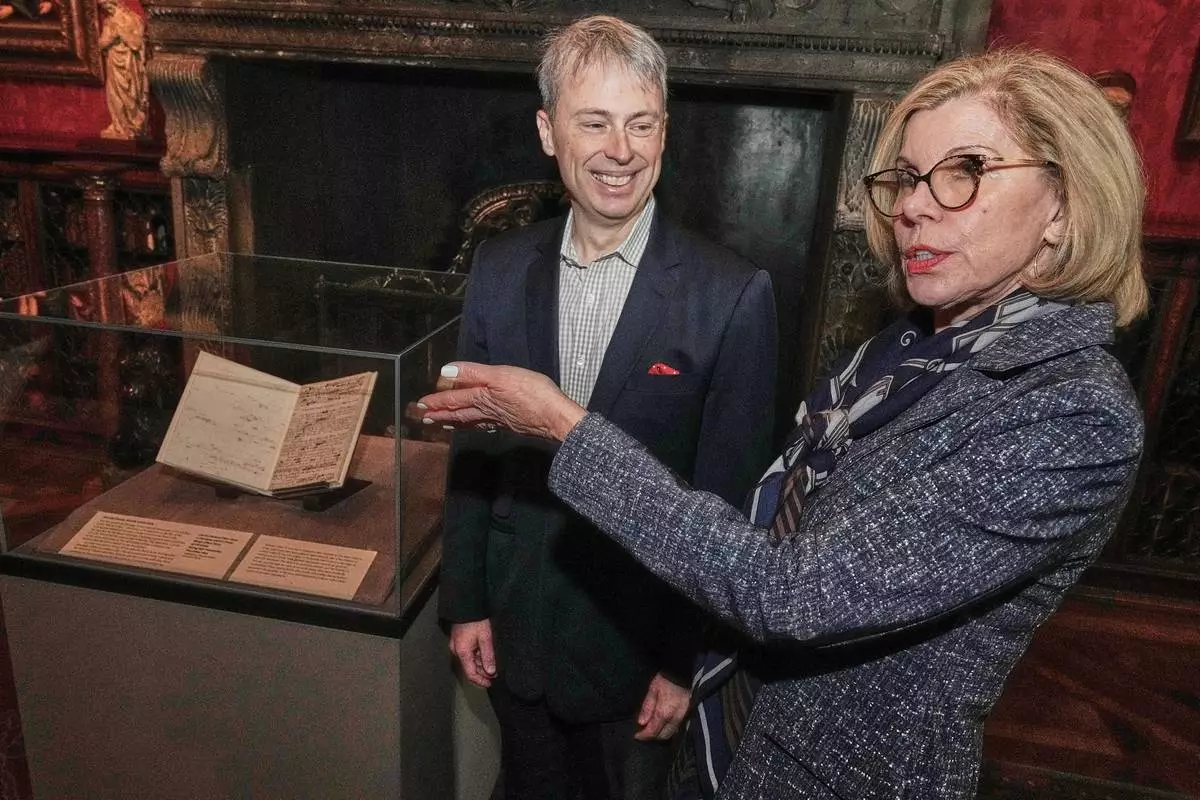
Skylark Artistic Director Matthew Guard and Christine Baranski are interviewed beside "A Christmas Carol In Prose; Being a Ghost Story of Christmas" by Charles Dickens, Dec. 1843," at The Morgan Library & Museum, in New York, Monday, Dec. 1, 2025. (AP Photo/Richard Drew)
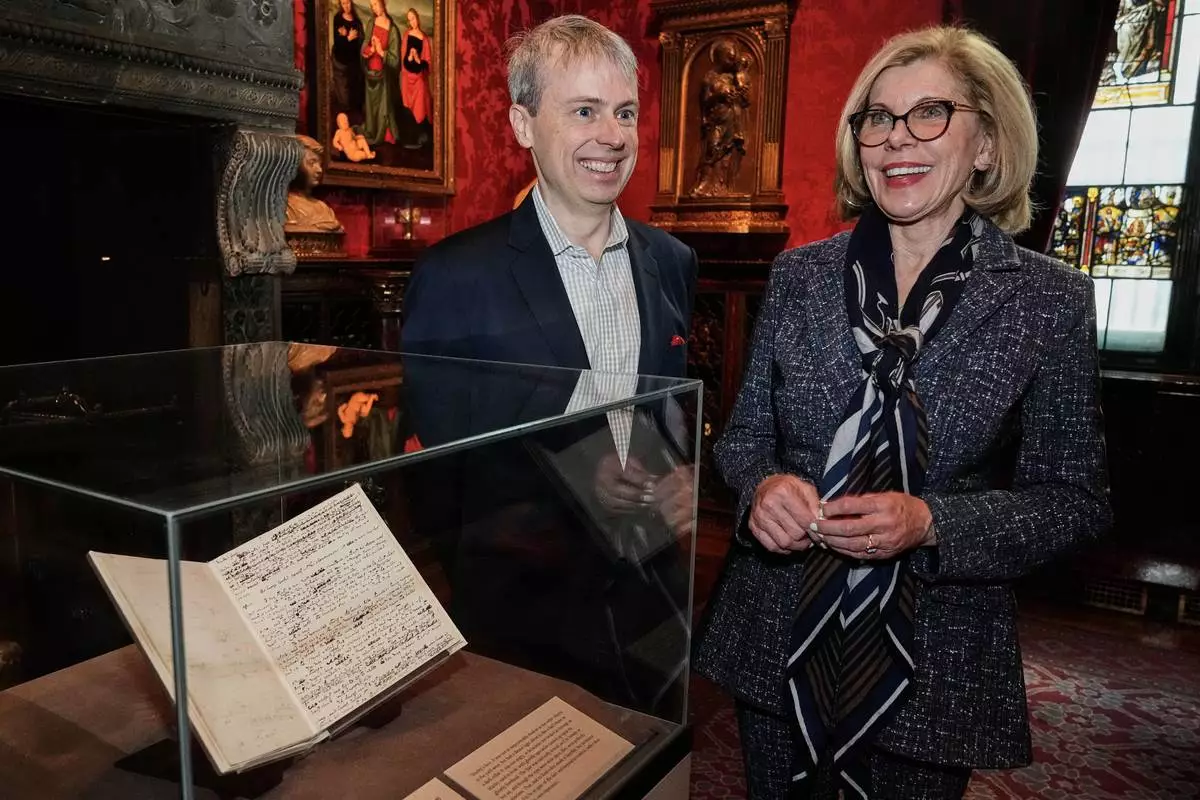
Skylark Artistic Director Matthew Guard and Christine Baranski are interviewed beside "A Christmas Carol In Prose; Being a Ghost Story of Christmas" by Charles Dickens, Dec. 1843," at The Morgan Library & Museum, in New York, Monday, Dec. 1, 2025. (AP Photo/Richard Drew)