JALALABAD, Afghanistan (AP) — Ahmad Khan Safi had a good life in Afghanistan. The farmer raised livestock in the Dewagal Valley of Kunar Province, and people traveled from across the country to visit the area. Tourists marveled at its verdant landscape, winding paths and formidable slopes. The valley appeared untouched.
It was hard to reach, so inaccessible that people had to change cars four times from the city of Jalalabad, in neighboring Nangarhar province, and walk the rest of the way for several hours or ride a mule.
Safi had built a 10-room house from mud and stone because wood and cement were too expensive and impractical to transport. The home collapsed as soon as a major earthquake that killed at least 2,000 people struck on Aug. 31. His shock was quickly replaced by fear and panic.
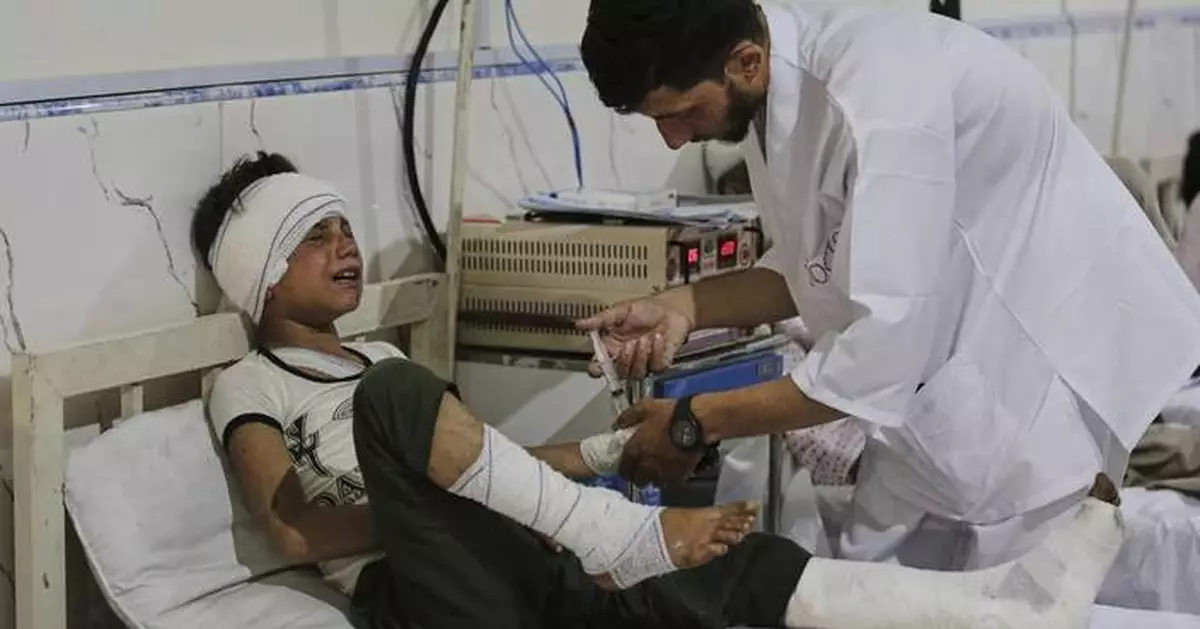
“I was trapped in the mud and couldn’t breathe,” he told The Associated Press from a Jalalabad hospital. “I struggled a lot to get out, but was hit by rocks and fell so hard that my leg was injured.” He spent the night under the rubble, not knowing if his family was alive or dead.
Help came the following morning, around 10 a.m., when people arrived on foot from other districts.
The devastating quake was not the strongest or deadliest in Afghanistan’s recent history. But remote and rugged Kunar has defied rescue efforts. The ruling Taliban authorities have deployed helicopters or airdropped army commandos to evacuate survivors.
There is no helicopter landing site in Dewagal Valley and no path for vehicles, let alone heavy machinery. Many of the injured died because there was no way to reach them, said Safi, who was carried to safety on people’s shoulders. A stream of homemade stretchers trickled down to more hospitable terrain.
“There was not a single household without dead or wounded people, and not a single home was left standing. Some 130 people died in our area. The earthquake killed 22 members of my family — children, nephews, nieces, and my elder brother — and injured 17.”
Entire families were wiped out, he added.
The death toll from this disaster exceeds 2,000, although this figure could rise as more bodies are recovered from villages that were razed to the ground and are now piles of dust.
“Now I think about it, whatever wealth and savings we had from our grandfather’s time have all gone, and now we have nothing,” said Safi. “My family lost about 300 cows, sheep and goats in this earthquake. All the people in the village were farmers and livestock keepers.
"We have no other source of income. I don’t know what to do or where to go because our homes collapsed. Not even a wall is left. What are we going to do with this life?”
The U.N. estimates that the quake has affected up to 500,000 people, more than half of them children, and that the communities hit include those where Afghans forcibly returned from neighboring countries had begun rebuilding their lives.
Roads and bridges were damaged. Dozens of water sources have been destroyed, increasing health risks for survivors.
Rain, triggering landslides and floods, has worsened conditions. Schools and health facilities have vanished. With so many buildings destroyed, there is little shelter left. People live and sleep under open skies.
The steep slopes of Kunar resemble a war zone. Houses that took years to build were decimated in an instant. An assessment by the Islamic Relief charity said just 2% of homes in Kunar remain intact.
Ghulam Rahman, from Chawkay District in the central part of Kunar Province, lost his wife and five of his children in the earthquake. He was trapped in the wreckage for half an hour, next to his wife as she took her last breath.
“Dust and small stones were in my mouth so I couldn’t speak properly,” he said. “I heard her praying.”
Some of his family’s bodies were recovered on the first day after the quake. The rest remained under the debris for a further 24 hours. Only two of his seven children survived. One was staying at a religious school. The other had been sleeping on the rooftop.
Rocks tumbled onto Rahman's home from houses at a higher altitude and the mountain, even as the ground opened beneath him. He said scores of people in his village died.
Rahman offered a piece of his family’s farmland for their burial.
“We had everything, and now it’s destroyed. We want the government to give us flat land. We can’t spend the night in the mountains anymore. I can’t go there because I see dead family members, and life there is difficult. I am afraid of that place.”
Associated Press writer Abdul Qahar Afghan contributed to this report from Jalalabad, Afghanistan.

Civil defense workers, locals, and army soldiers prepare to evacuate injured victims of an earthquake that killed hundreds and destroyed numerous villages in eastern Afghanistan, in Mazar Dara, Kunar province, Monday, Sept. 1, 2025. (AP Photo/Hedayat Shah)
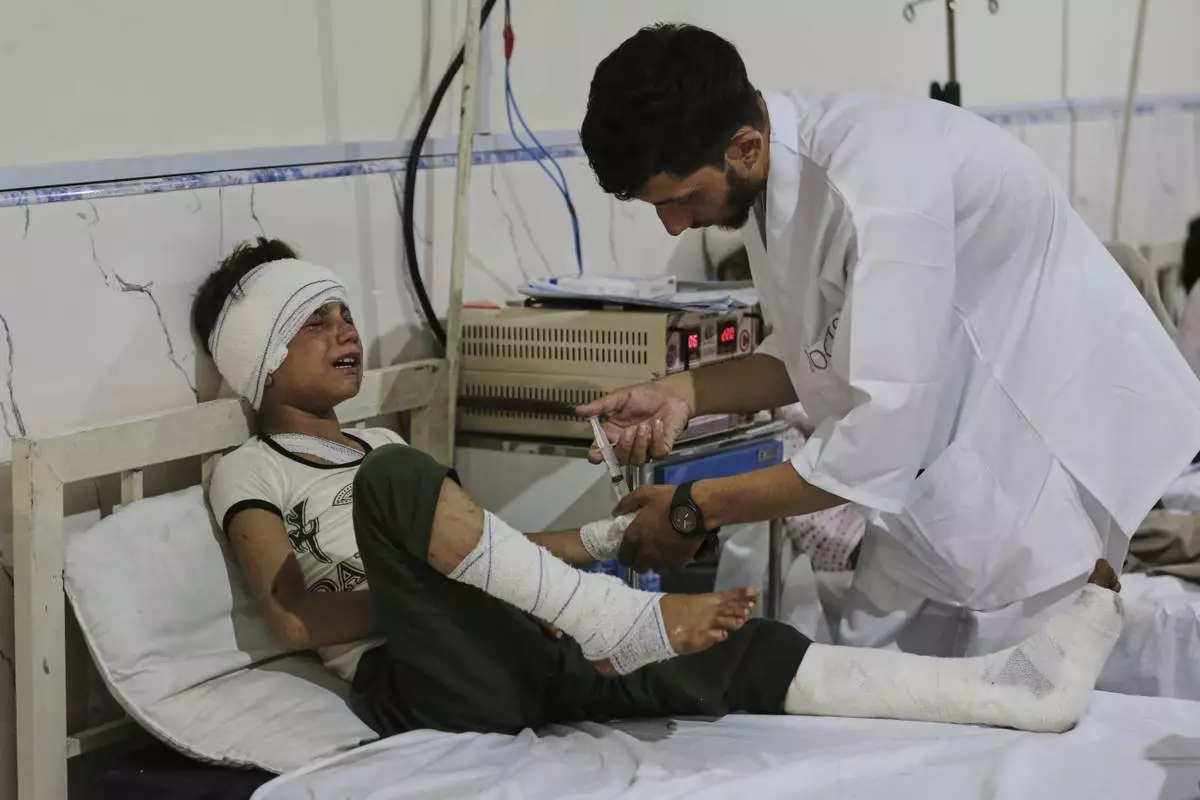
An Afghan boy injured in a powerful earthquake that struck eastern Afghanistan on Sunday receives treatment at Nangarhar Regional Hospital in Jalalabad, Afghanistan, Wednesday, Sept. 3, 2025. (AP Photo/Siddiqullah Alizai)
JUNEAU, Alaska (AP) — Alaska U.S. Senate candidate Dan Sullivan acknowledges that sharing a name and party affiliation with the incumbent Republican gives him “an instant megaphone" in the crowded primary race. But Sullivan said his campaign isn't a sham or something Democrats put him up to doing.
He said friends for years have jokingly referred to him as senator and asked if he has ever thought about running. He said he’s been considering it for more than a decade.
“This is my choice,” Sullivan, who lives in the small fishing community of Petersburg, said in a telephone interview Monday.
Last week, Sen. Dan Sullivan accused the challenger Sullivan of “trying to trick” voters to help his main rival in the race, Democratic former U.S. Rep. Mary Peltola. The senator suggested the other Sullivan's entrance in the August primary was part of a coordinated effort by Democrats and Peltola's campaign to confuse voters, an accusation they deny. He threatened litigation to get to the bottom of it.
The issue is of national concern to Republicans because they are seeking to hold onto their majority in the U.S. Senate in what is expected to be a difficult midterm election year for the party in power. Sullivan, the challenger, dismissed claims that his candidacy is a merely a ruse to undermine the senator's reelection chances.
He said he has had no contact with Peltola's campaign — “zero, none, zilch” — and said “no” when asked if anyone from the state Democratic Party or any national Democratic operatives had contacted him to run.
A Peltola spokesperson, Harry Child, has said the campaign “has no involvement with either Sullivan campaign.” The executive director of the Alaska Democratic Party, Jenny-Marie Stryker, said her organization “is in no way affiliated with either Dan Sullivan.” A Democratic Senatorial Campaign Committee spokesperson, Monica Robinson, replied “no” when asked if the group had been involved in urging the challenger Sullivan to run.
Sullivan called sharing a name with the Alaska's incumbent U.S. senator “a matter of fate” and said he had done nothing wrong.
“I have every right to run for whatever office I'm qualified for, and I’m qualified for this office,” the challenger said, adding: “I think I’m doing what most Americans would think would be a patriotic thing to do when you’re unsatisfied with the status quo. You stand up and say, I’m going to fight for things I believe that are going to make my community better.”
Ballots in prior years in Alaska have not identified the incumbent, but the Alaska Division of Elections’ current candidate list online does. It also distinguishes the candidates using a middle initial — Dan S. Sullivan for the senator and Dan J. Sullivan for the challenger.
Alaska has open primaries in which the top four vote-getters, regardless of party, advance to the ranked choice general election in November. Sen. Sullivan's campaign worries having two Dan Sullivans on the ballot could confuse voters.
Sen. Sullivan's campaign, in a statement Monday, said, “Alaskans deserve a fair and honest election — not political games meant to manipulate the ballot and benefit Democrats.”
The challenger said he was registered with the limited government-leaning Alaskan Independence Party for decades, until the party's dissolution late last year. Election officials had said voters registered with the party could change their affiliation but if they did not, they'd be shown as “undeclared.” Sullivan said he then was listed as undeclared until filing to run for office, when he registered as Republican.
He said he was motivated in part by his late father, whom he described as a “true, compassionate, conservative Republican.” He said if he had to label himself, it would be “a pragmatic Republican centrist” — similar to Alaska's senior U.S. senator, Lisa Murkowski, but “with touches of a Rand Paul Republican in there.”
He said he grew up in the Chicago area but was drawn to Alaska and put down roots nearly 50 years ago in Petersburg. The fishing community of about 3,400 in southeast Alaska's Tongass National Forest is known as “Little Norway” for its many residents with Scandinavian roots. He worked for the U.S. Forest Service before changing careers and becoming a teacher. He has since retired.
Like most communities in Alaska, Petersburg isn't connected to the state's main road system and is accessible only by air or water. Juneau, the nearest city, is about 45 minutes away by plane.
Petersburg sits on Mitkof Island, which is distinguished by mountains, thick stands of forest and boggy areas called muskeg. Sea lions hauled up on buoys and humpback whales and orcas are common sights off its shores.
Sullivan, who will turn 69 this weekend, passed on an interview request last Friday, he said, because the king salmon were running and he wanted to fish.
As far as his run for office, the challenger said he plans to do some fundraising and hopes to campaign in the state's larger cities, including Anchorage and Juneau, but he so far has no firm plans to do so and is working on the details.
He finds the current dustup over his Senate run — and the incumbent's reaction — a bit surprising.
“I guess my thought would be, ‘Dude, why don’t you just run your campaign?’ If you’ve got a strong record, run on your record. People will love you for it and you’ll be swept back into office,” he said Monday. “Why would he be concerned that a guy out of Petersburg is this huge threat?”
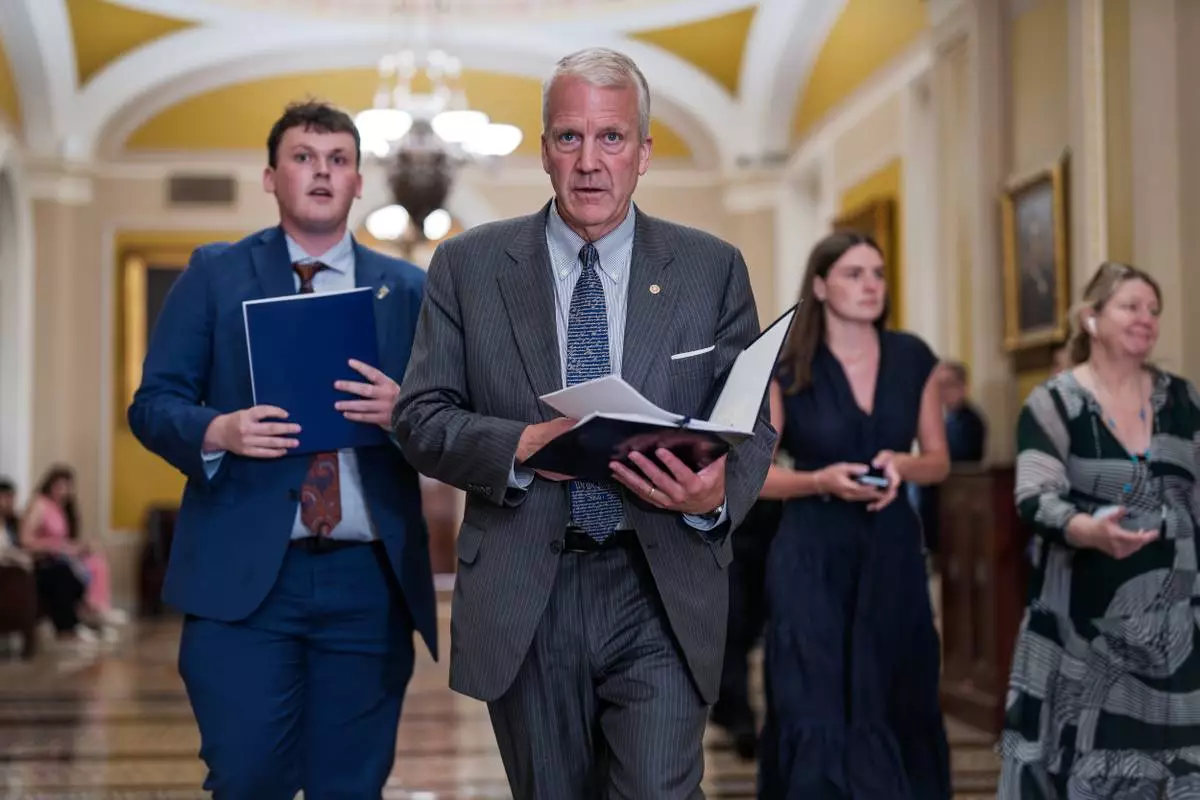
Sen. Dan Sullivan, R-Alaska, heads to a closed-door meeting with fellow Republicans, at the Capitol in Washington, Tuesday, June 2, 2026. (AP Photo/J. Scott Applewhite)