SEOUL, South Korea (AP) — North Korea said Tuesday it had conducted the final ground test of a solid-fuel rocket engine for a long-range ballistic missile in its latest advancement toward having an arsenal that could viably threaten the continental United States.
The test Monday observed by leader Kim Jong Un was the ninth of the engine built with carbon fiber and capable of producing 1,971 kilonewtons of thrust, more powerful than past models, according to the North’s official Korean Central News Agency. The report came a week after Kim visited the research institute that developed the engine, which North Korea then said will be used for future intercontinental ballistic missles, including a system called Hwasong-20.
Some analysts say that North Korea may conduct another ICBM test around the end of the year, showcasing its military strength ahead of a major ruling party congress expected in early 2026, where Kim will likely issue his new directions in domestic and foreign policies.
North Korea in recent years has flight-tested a variety of ICBMs that demonstrated potential range to reach the U.S. mainland, including those with built-in solid propellants that are easier to move and conceal and can be prepared for launch more quickly than the North’s previous liquid-fuel missiles.
Kim has called for further advancements in North Korea’s long-range weapons, including the development of multi-warhead systems that would improve their chances of defeating missile defenses. Some experts say North Korea’s efforts to build more efficient rocket engines could also be aimed at developing smaller ICBMs that can be launched from a wider range of vehicles or submarines, a capability Kim is also pursuing.
All of North Korea’s ICBM tests so far have been conducted at steeper-than-normal trajectories to avoid neighboring territories, and experts say the country may not yet have perfected the technology needed to ensure its warheads survive the harsh conditions of atmospheric re-entry.
KCNA said Kim expressed satisfaction after Monday’s test, calling the “eye-opening” development of the new rocket engine a “significant change” in his effort to expand North Korea’s nuclear forces.
Lee Sung Joon, spokesperson for South Korea’s Joint Chiefs of Staff, said South Korea and the United States are closely monitoring North Korea’s weapons development but did not provide a specific assessment of the new rocket engine.
“If they complete (a new ICBM), they will test it, and then we will need to make additional assessments of that,” Lee said.
Kim has stepped up testing activities since the collapse of nuclear talks with the U.S. in 2019 under President Donald Trump ’s first term, demonstrating weapons of various ranges designed to strike U.S. allies in Asia and the U.S. mainland. Analysts say Kim’s nuclear push is aimed at eventually pressuring Washington to accept the idea of the North as a nuclear power and to negotiate economic and security concessions from a position of strength.
Kim is also trying to bolster his leverage by strengthening his cooperation with traditional allies Russia and China, in an emerging partnership aimed at undercutting U.S. influence.
Kim has sent thousands of troops and large quantities of military equipment to Russia to help fuel President Vladimir Putin’s war on Ukraine. He visited Beijing last week, sharing the spotlight with Chinese President Xi Jinping and Putin at a massive military parade marking the 80th anniversary of the end of World War II and China’s fight against Japanese aggression. Experts say Kim’s rare foreign trip was likely intended to boost his leverage ahead of a potential resumption of talks with the United States.
In a separate report, KCNA said Xi sent a letter to Kim on North Korea’s founding anniversary, which fell on Tuesday, and called for strengthened “strategic communication” between the countries.

In this photo provided by the North Korean government, North Korean leader Kim Jong Un, right, watches a test of a new rocket engine at an undisclosed location, North Korea, Monday, Sept. 8, 2025. Independent journalists were not given access to cover the event depicted in this image distributed by the North Korean government. The content of this image is as provided and cannot be independently verified. (Korean Central News Agency/Korea News Service via AP)

A TV screen shows an image of North Korean leader Kim Jong Un, second from right, supervising a test of a new rocket engine during a news program at the Seoul Railway Station in Seoul, South Korea, Tuesday, Sept. 9, 2025. (AP Photo/Ahn Young-joon)
NUUK, Greenland (AP) — Troops from several European countries continued to arrive in Greenland on Thursday in a show of support for Denmark as talks between representatives of Denmark, Greenland and the U.S. highlighted “fundamental disagreement” over the future of the Arctic island.
Denmark announced it would increase its military presence in Greenland on Wednesday as foreign ministers from Denmark and Greenland were preparing to meet with White House representatives in Washington. Several European partners — including France, Germany, the U.K., Norway, Sweden and the Netherlands — started sending symbolic numbers of troops already on Wednesday or promised to do so in the following days.
The troop movements were intended to portray unity among Europeans and send a signal to President Donald Trump that an American takeover of Greenland is not necessary as NATO together can safeguard the security of the Arctic region amid rising Russian and Chinese interest.
“The first French military elements are already en route” and “others will follow,” French President Emmanuel Macron announced Wednesday, as French authorities said about 15 soldiers from the mountain infantry unit were already in Nuuk for a military exercise.
Germany will deploy a reconnaissance team of 13 personnel to Greenland on Thursday, the Defense Ministry said.
On Thursday, Danish Defense Minister Troels Lund Poulsen said the intention was “to establish a more permanent military presence with a larger Danish contribution,” according to Danish broadcaster DR. He said soldiers from several NATO countries will be in Greenland on a rotation system.
Danish Foreign Minister Lars Løkke Rasmussen, flanked by his Greenlandic counterpart Vivian Motzfeldt, said Wednesday that a “fundamental disagreement” over Greenland remains with Trump after they held highly anticipated talks at the White House with Vice President JD Vance and Secretary of State Marco Rubio.
Rasmussen added that it remains “clear that the president has this wish of conquering over Greenland” but that dialogue with the U.S. would continue at a high level over the following weeks.
Inhabitants of Greenland and Denmark reacted with anxiety but also some relief that negotiations with the U.S. would go on and European support was becoming visible.
Greenland's Prime Minister Jens-Frederik Nielsen welcomed the continuation of “dialogue and diplomacy.”
“Greenland is not for sale,” he said Thursday. “Greenland does not want to be owned by the United States. Greenland does not want to be governed from the United States. Greenland does not want to be part of the United States.”
In Greenland’s capital, Nuuk, local residents told The Associated Press they were glad the first meeting between Greenlandic, Danish and American officials had taken place but suggested it left more questions than answers.
Several people said they viewed Denmark’s decision to send more troops, and promises of support from other NATO allies, as protection against possible U.S. military action. But European military officials have not suggested the goal is to deter a U.S. move against the island.
Maya Martinsen, 21, said it was “comforting to know that the Nordic countries are sending reinforcements” because Greenland is a part of Denmark and NATO.
The dispute, she said, is not about “national security” but rather about “the oils and minerals that we have that are untouched.”
On Wednesday, Poulsen announced a stepped-up military presence in the Arctic “in close cooperation with our allies,” calling it a necessity in a security environment in which “no one can predict what will happen tomorrow.”
“This means that from today and in the coming time there will be an increased military presence in and around Greenland of aircraft, ships and soldiers, including from other NATO allies,” Poulsen said.
Asked whether the European troop movements were coordinated with NATO or what role the U.S.-led military alliance might play in the exercises, NATO referred all questions to the Danish authorities. However, NATO is currently studying ways to bolster security in the Arctic.
The Russian embassy in Brussels on Thursday lambasted what it called the West's “bellicose plans” in response to “phantom threats that they generate themselves”. It said the planned military actions were part of an “anti-Russian and anti-Chinese agenda” by NATO.
“Russia has consistently maintained that the Arctic should remain a territory of peace, dialogue and equal cooperation," the embassy said.
Rasmussen announced the creation of a working group with the Americans to discuss ways to work through differences.
“The group, in our view, should focus on how to address the American security concerns, while at the same time respecting the red lines of the Kingdom of Denmark,” he said.
Commenting on the outcome of the Washington meeting on Thursday, Poulsen said the working group was “better than no working group” and “a step in the right direction.” He added nevertheless that the dialogue with the U.S. did not mean “the danger has passed.”
Speaking on Thursday, Danish Prime Minister Mette Frederiksen said the American ambition to take over Greenland remains intact despite the Washington meeting, but she welcomed the creation of the working group.
The most important thing for Greenlanders is that they were directly represented at the meeting in the White House and that “the diplomatic dialogue has begun now,” Juno Berthelsen, a lawmaker for the pro-independence Naleraq opposition party, told AP.
A relationship with the U.S. is beneficial for Greenlanders and Americans and is “vital to the security and stability of the Arctic and the Western Alliance,” Berthelsen said. He suggested the U.S. could be involved in the creation of a coastguard for Greenland, providing funding and creating jobs for local people who can help to patrol the Arctic.
Line McGee, 38, from Copenhagen, told AP that she was glad to see some diplomatic progress. “I don’t think the threat has gone away,” she said. “But I feel slightly better than I did yesterday.”
Trump, in his Oval Office meeting with reporters, said: “We’ll see how it all works out. I think something will work out.”
Niemann reported from Copenhagen, Denmark, and Ciobanu from Warsaw, Poland.
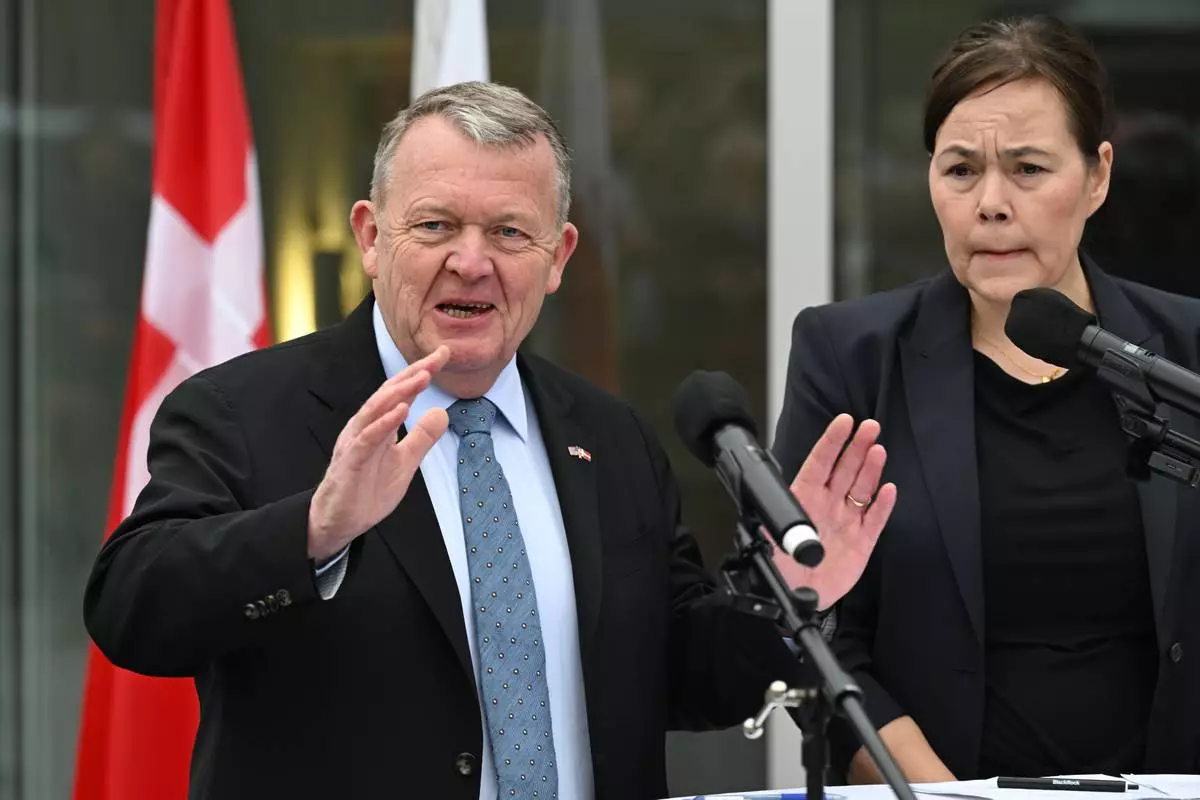
Denmark's Foreign Minister Lars Løkke Rasmussen and Greenland's Foreign Minister Vivian Motzfeldt speak at a news conference at the Embassy of Denmark, Wednesday, Jan. 14, 2026, in Washington. (AP Photo/John McDonnell)

People walk on a street in Nuuk, Greenland, Wednesday, Jan. 14, 2026. (AP Photo/Evgeniy Maloletka)
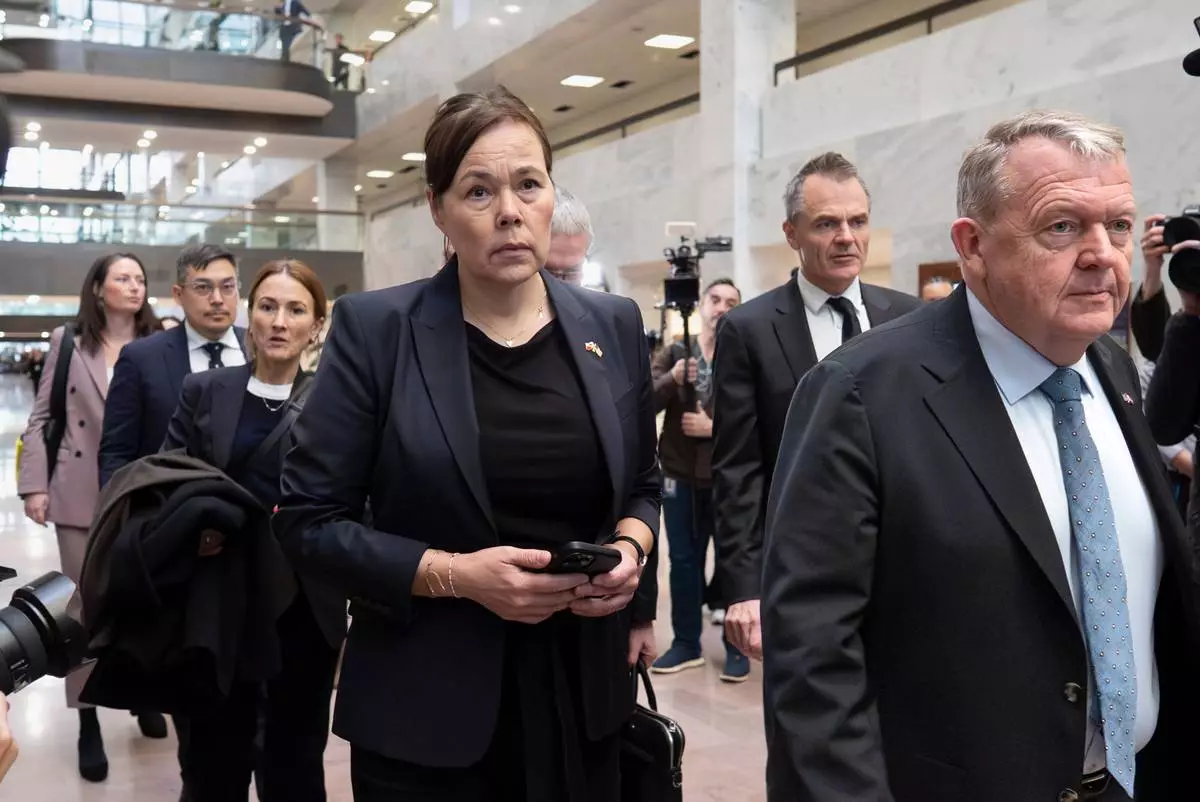
From center to right, Greenland Foreign Minister Vivian Motzfeldt, Denmark's Ambassador Jesper Møller Sørensen, rear, and Danish Foreign Minister Lars Løkke Rasmussen, right, arrive on Capitol Hill to meet with senators from the Arctic Caucus, in Washington, Wednesday, Jan. 14, 2026. (AP Photo/J. Scott Applewhite)

An Airbus A400M transport aircraft of the German Air Force taxis over the grounds at Wunstorf Air Base in the Hanover region, Germany, Thursday, Jan. 15, 2026 as troops from NATO countries, including France and Germany, are arriving in Greenland to boost security. (Moritz Frankenberg/dpa via AP)

Fishermen load fishing lines into a boat in the harbor of Nuuk, Greenland, Wednesday, Jan. 14, 2026. (AP Photo/Evgeniy Maloletka)
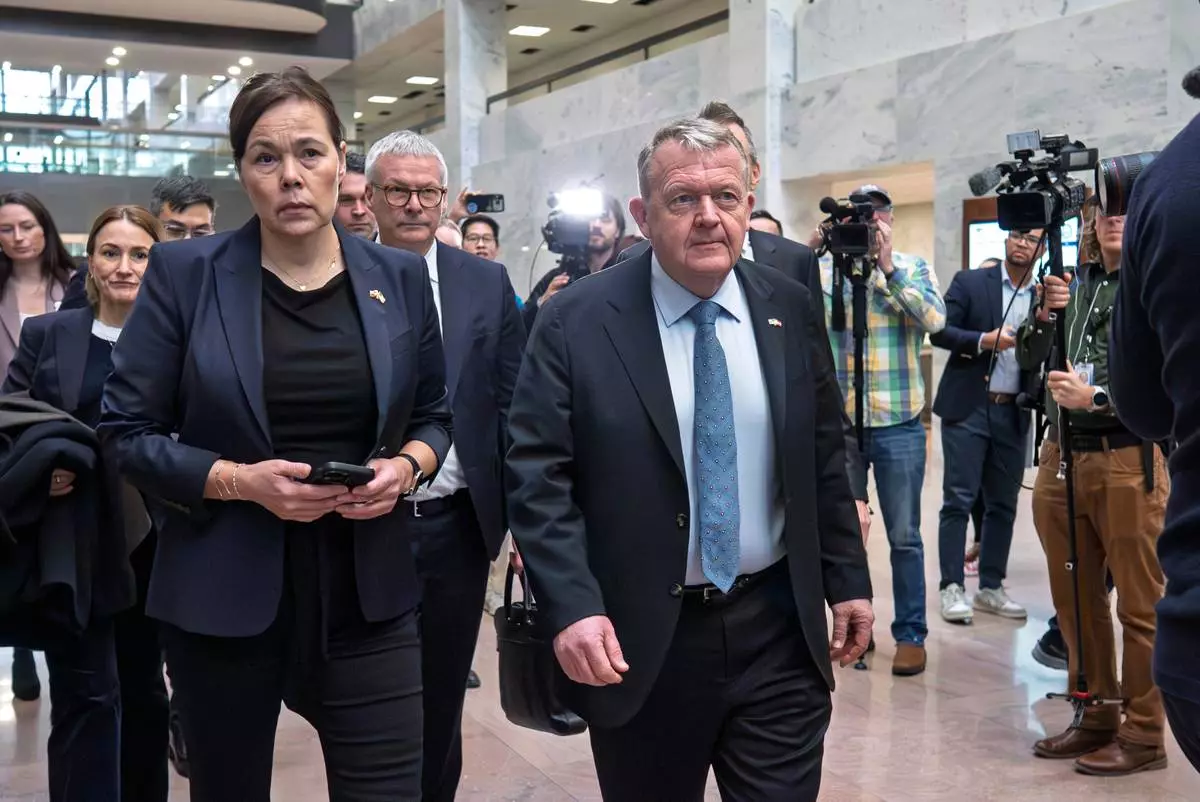
Greenland Foreign Minister Vivian Motzfeldt, left, and Danish Foreign Minister Lars Løkke Rasmussen, arrive on Capitol Hill to meet with members of the Senate Arctic Caucus, in Washington, Wednesday, Jan. 14, 2026. (AP Photo/J. Scott Applewhite)