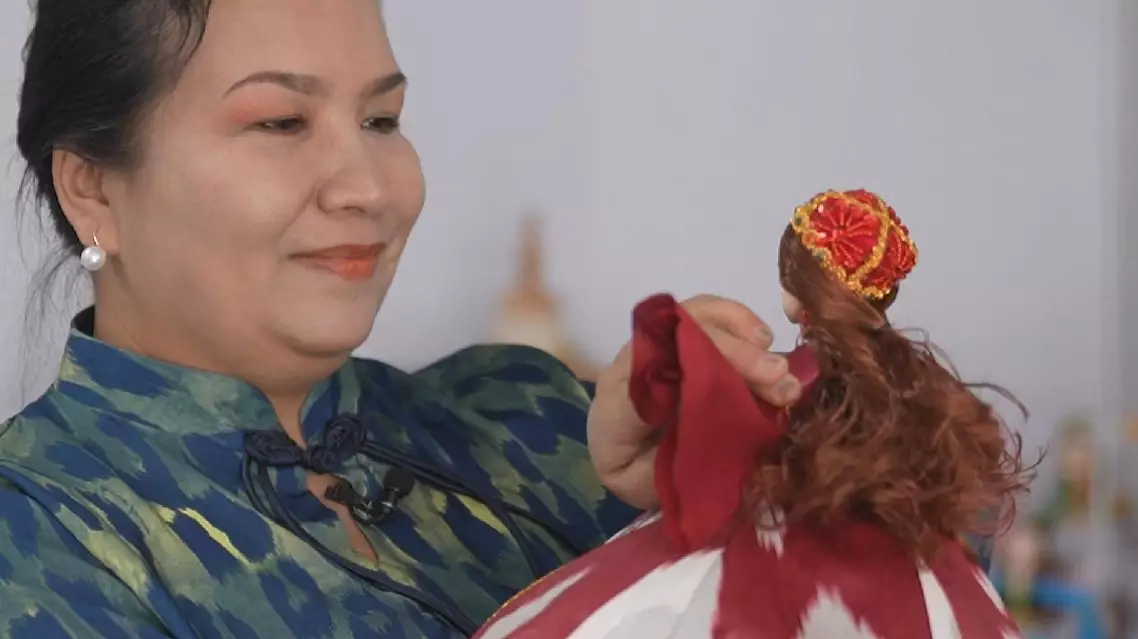
A fashion designer from Kashgar in northwest China's Xinjiang Uygur Autonomous Region is dedicated to promoting women's entrepreneurship through her creation: the Gul cultural dolls.
The "Gul Dolls", a creation of Parida Turdi, are more than just toys, but vibrant symbols of Xinjiang's diverse culture. Crafted primarily from Atlas, a type of silk unique to the region that is soft in texture and brilliant in color with ever-changing patterns, each doll is a unique piece.
"Gul dolls are made from Atlas silk, which is the material of the main fabric, and designed with our local characteristics. We can say that each single doll is an one-of-a-kind handmade piece. When we first created these dolls, we wanted to incorporate elements of Xinjiang's local culture and unique features into the design to deliver the vibes of Xinjiang's fascinating lifestyle to more people," said Parida.
Some of the designs were inspired by different cultures, including the French culture, according to Parida.
"These dolls feature a new design integrating the French Court Style into our local Atlas silk fabric. One of the characteristics of the Atlas silk is its bright colors. And many of the patterns are symmetrical," Parida said.
Parida's journey of pursuing entrepreneurship was deeply rooted in a desire to uplift her community. During her study in Beijing, she returned home for holidays and found that many women had no other options in addition to focusing on childcare and housework, thus sparking her idea to make a change through doll making.
Thanks to the financial support from local women's federation, Parida was able to realize her dream and open a workshop.
"Our workshop has a total area of 1,200 square meters, and the majority of the employees are women. We have about 80 to 100 employees. If their children are too young or it is inconvenient for them to leave home, then they can consider to take on our handicraft assignments, which can be done at home. We can make 30,000 to 50,000 Gul dolls every year. This gives them their own livelihood, which considerably improves their financial status," said Parida.
Beyond financial gains, Parida said the "Gul Doll" project has been transformative for the women's self-esteem.
"When we have newcomers to the factory, we would encourage them to get on camera for some behind-the-scenes clips. We encourage them to design and make their own clothes, and then wear these clothes and walk on the runway like in a fashion show. They would realize how great they look and how photogenic they are watching these clips, and it also greatly boosts their confidence," she said.
Witnessing the day-by-day changes in her employees, Parida felt gratified and hoped that more and more women could be inspired with such empowerment.
"I'm so proud to witness my employees' growth every day, both in their mindset and work performance. This progress reinforces my belief that all the sacrifices I made to pursue entrepreneurship in my hometown, such as forgoing a career in the city, were worth it. I hope each and every one of my employees will become a pioneer in pursuing prosperity and inspire more women to find their own path to a prosperous life," said Parida.
Xinjiang fashion designer empowers women entrepreneurship through cultural dolls
The three astronauts of China's recently-returned Shenzhou-20 mission on Friday shared the experiences of their dramatic 204-day space mission, including detailing the emergency procedures which were implemented to bring them safely home after their return capsule was struck by space debris.
The trio -- Chen Dong, Chen Zhongrui, and Wang Jie -- met with the press in Beijing on Friday afternoon, marking their first public appearance since returning to Earth in November.
When detailing the emergency response mechanisms which were enacted prior to their scheduled return, the astronauts explained that upon discovering a triangular crack on the spacecraft's viewport window, they immediately took photos for documentation and transmitted them to the ground team, who swiftly activated an emergency plan to get the trio home safely.
Experienced mission commander Chen Dong explained how the crew had complete faith in their colleagues on the ground to find a solution to these unforeseen circumstances which led to their return being delayed.
"First, we must trust the ground team, who would anticipate everything and develop the safest return plan for us. Second, we must believe in ourselves; as well-trained astronauts, we have the ability to manage various unexpected failures. I believe that with the collaboration of astronauts and researchers on the ground, our space home will surely go farther, more steadily, and for a longer time," he said.
Following their extended stay in space as a result of the debris incident, the Shenzhou-20 crew spent a total 204 days in orbit, setting a new record for the longest duration by a single group of Chinese astronauts.
During their mission, they completed multiple payload operations, conducted extensive scientific experiments, and carried out four extravehicular activities.
"Our crew worked together with the ground team in unity and coordination, completing four extravehicular activities, several payload entry and exit tasks, and a large number of scientific experiments. It was a fulfilling yet challenging mission. The path to exploring the heavens is long and arduous, but I firmly believe that China's space missions will succeed," said Chen Zhongrui, a former air force pilot who was making his first spaceflight during the mission.
"From the ground to space, from learning to application, I have deeply felt the solid progress of Chinese space endeavors and the quiet dedication of countless personnel behind the scenes. In the future, I will accomplish each mission with full commitment, living up to the trust of the motherland and the people," said fellow astronaut Wang Jie, who was also making his debut spaceflight.
After returning to Earth on Nov 14, the trio successfully completed their isolation recovery and rehabilitation and will now resume normal training following health assessments.
The crew's return, originally scheduled for Nov 5, was postponed due to safety concerns, with the astronauts later using the return capsule belonging to their successor crew of the Shenzhou-21 mission to get back to Earth. China later launched the unmanned Shenzhou-22 spacecraft which will serve the future return of the crew now aboard the Tiangong Space Station.
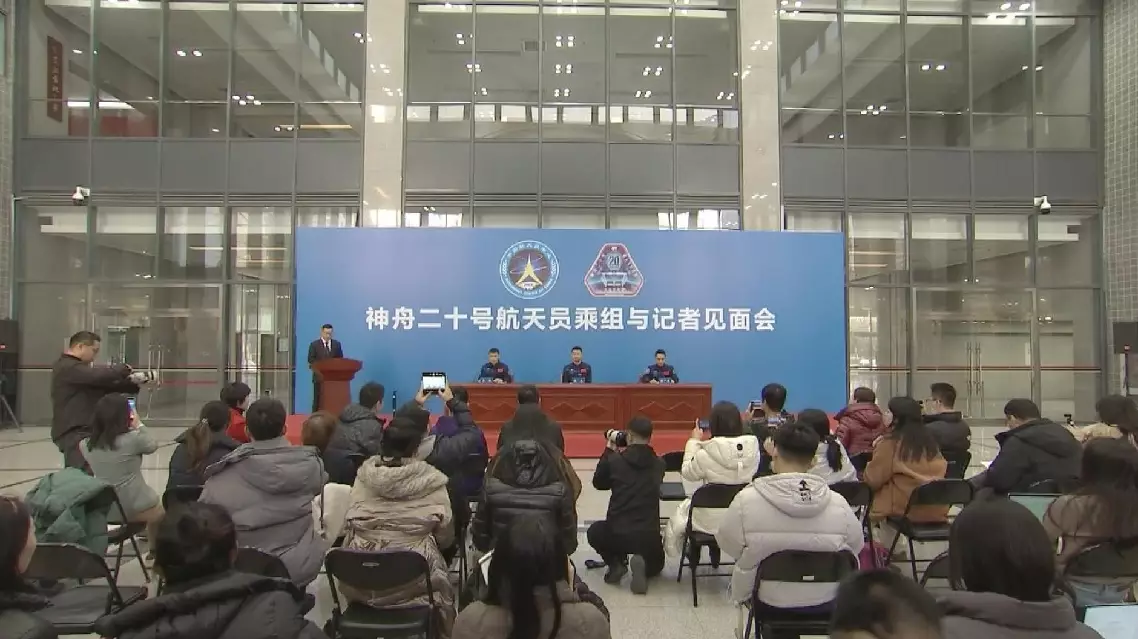
Shenzhou-20 astronauts share experiences after safely returning from debris incident