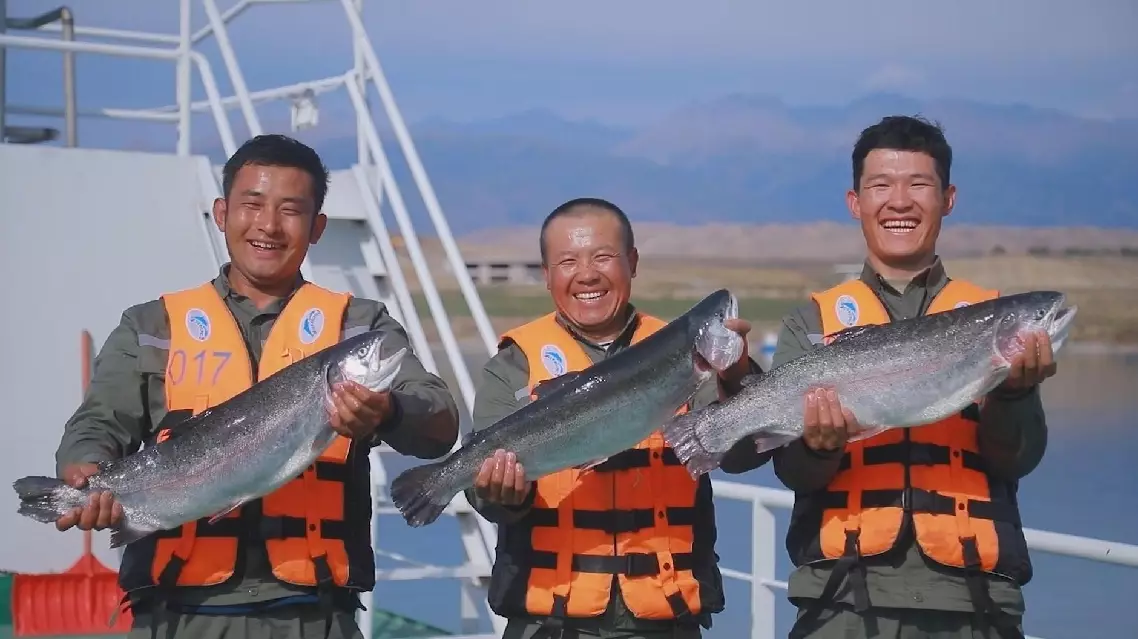
Despite being located in a deep inland zone thousands of kilometers away from the sea, a previously little-known reservoir in northwest China’s Xinjiang Uygur Autonomous Region is quietly emerging as an unexpected new hub for the salmon industry.
In the Jilintai Reservoir, a little northwest of Nilka County, melting snow from Xinjiang’s towering Tianshan Mountains continuously flows into this water source, providing an ideal environment for cold-water fish with its consistent water temperature.
"The water sources in this reservoir originate from melting snow on the Tianshan Mountains by way of the 113 gullies upstream in Nilka County. The water temperature here consistently ranges between 8 to 12 degrees Celsius, which is the ideal environment for salmon to thrive," said Ayhen Baghdaulet, a former local herder and now a fisherman.
In 2021, an organic agriculture company introduced salmon farming to this area,creating a new growth driver for the local economy and fresh job opportunities. Among those to seize the chance was Baghdaulet, who made a dramatic career shift.
"Back in December 2021, I joined Xinjiang Tianyun Organic Agriculture Company. Before that, I was a regular herdsman. I used to graze livestock out on the open land, and I had little knowledge about this industry. When I first arrived here, I was actually scared of the water, but I gradually overcame my fear," he said.
Recalling his first days as a fisherman, Baghdaulet said: "The first time when I went up to the net cage, I took a boat out there wearing a life jacket. When I looked down at the net cage, I saw so many fish, but they were very tiny. Then I asked my instructor how to feed them, and he handed me a bowl, saying: “This is your job.” Then I started to throw out the fish feed with the bowl. At first, I couldn’t scatter it evenly. After a few days, I got the hang of it, but my arms were so sore that I could barely lift them. That experience left a deep impression on me. However, I saw those little fish swimming around in the water, and they looked so cute! "
He explained the long process that takes the salmon from hatchery to harvest.
"Imported fish roes are brought to our hatchery, where they hatch and are then cultivated. After that, the young fish are moved to our juvenile fish net cages. When the fish grow bigger, we sort them by size. When the fish reach around 150 grams each, we use a fish sorter to divide them into three sizes: large, medium, and small. As the fish pass through the sorter, the chute narrows down according to the size of the fish. This allows the fish to be sorted accurately. By this stage, the fish have already been sorted. After sorting, we can even count the fish fry. Each one is counted individually. The sorted fish then pass through these three tubes, being delivered to different areas. After being sorted here, the fish will be moved to our larger net cages for further cultivation, and eventually prepared for harvesting. It takes three years from hatchery to harvest, which is the longest part of the process," he said.
Since joining the fish farming base, Baghdaulet has not only seen his income rise steadily but also gained knowledge and joy from his new profession.
"What I’ve gained here is not only income, which is of course important, but I’ve also enriched my knowledge and broadened my vision. It has brought significant changes for us. Those who have contributed to the company, including frontline fish farmers like me, have been allocated new residences," he said.
"Xinjiang is primarily engaged in livestock grazing, with very few fishermen. I have transitioned from being a herder to a fisherman, and I’ve been in the fish farming industry for four years now. This industry has brought me a lot of joy and a deep emotional connection [to our land]. Now the first batch of grown fish has been delivered to the market. The fish we’ve cultivated are finally ready to be served on dining tables or sold in the market. This is a recognition of our hard work, and it’s a moment of great joy for us," he added.
Inland Xinjiang emerges as China’s new salmon farming hub