Skip to Content Facebook Feature Image

US consumer sentiment weakens in September

China

China

China

US consumer sentiment weakens in September

2025-09-13 13:43 Last Updated At:09-14 01:07

Preliminary survey data released by the University of Michigan (UM) on Friday showed that the U.S. Consumer Sentiment Index for September slipped down over tariff, inflation, and job market fears.

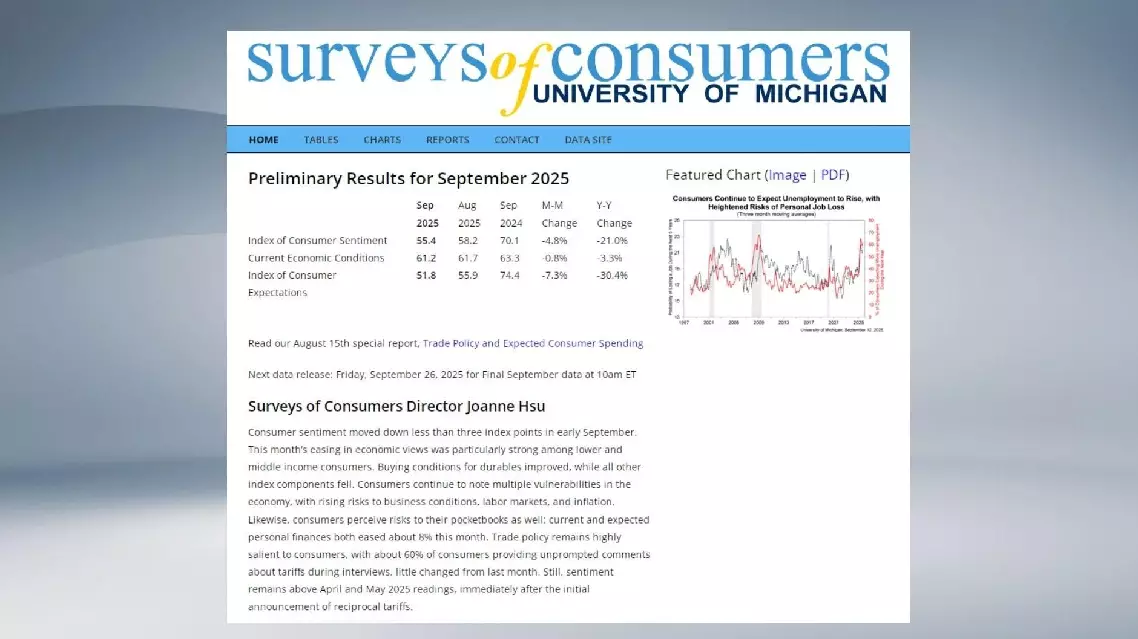
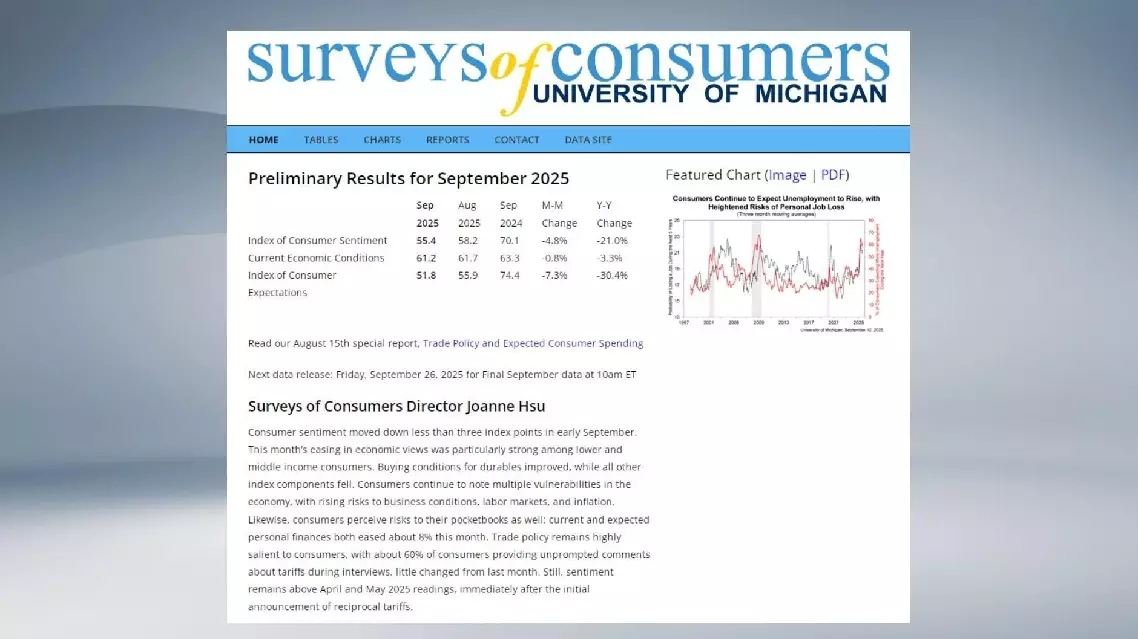
The UM's Survey of Consumers, which measures U.S. consumer attitudes towards personal finances, business conditions and economic activity, released its latest survey results on Friday, indicating that the Consumer Sentiment Index dropped to 55.4 for September, a decline of 4.8 percent from the previous month and 21 percent year on year.

The survey showed that the country's Current Economic Conditions Index for September was 61.2, a month-on-month decline of 0.8 percent and a year-on-year decrease of 3.3 percent. And the Index of Consumer Expectations stood at 51.8, showing a month-on-month drop of 7.3 percent and a year-on-year decline of 30.4 percent.

The survey indicated that American consumers continue to focus on multiple vulnerabilities in the economy, expressing concerns over the rising risks in the business environment, labor market and inflation.

The U.S. Labor Department reported Wednesday that the producer price index (PPI) fell 0.1 percentage points in August, following a downwardly revised 0.7 percent increase in July and below market expectations for a 0.3-percent rise.

The labor department reported a day later that the U.S. consumer price index (CPI) rose 0.4 percent in August on a seasonally adjusted basis, putting the annual inflation rate at 2.9 percent. The annual inflation rate rose 0.2 percentage points from the previous month, reaching the highest level since January.

The number of Americans filing first-time claims for unemployment insurance benefits increased sharply last week, reaching its highest level since October 2021, according to a Bloomberg report following the labor department's release on Thursday that the number of seasonally adjusted initial claims increased by 27,000 to 263,000 in the week ending September 6.

Meanwhile, American consumers are aware of the risks to their personal finances, with both current and expected personal financial conditions falling by approximately eight percent in September.

The Trump administration's trade policy remains crucial for American consumers. The survey showed that about 60 percent of consumers provided "unpromoted comments about tariffs during interviews, little changed from last month."

The survey also indicated that the year-ahead inflation expectation remained stable at 4.8 percent, unchanged from August, while "long-run inflation expectations moved up for the second straight month to 3.9 percent in September."
US consumer sentiment weakens in September
US consumer sentiment weakens in September

US consumer sentiment weakens in September

US consumer sentiment weakens in September

US consumer sentiment weakens in September

US consumer sentiment weakens in September

Candlelight memorials were held across China on Saturday to honor the victims of the Nanjing Massacre during Japan's aggression against China in 1937.

The Nanjing Massacre took place when Japanese troops captured the then-Chinese capital on Dec. 13, 1937. Over the course of six weeks, they proceeded to kill approximately 300,000 Chinese civilians and unarmed soldiers in one of the most barbaric episodes of WWII.

Saturday marks the 12th National Memorial Day for Nanjing Massacre Victims.

In Nanjing, now the capital of east China's Jiangsu Province, a candlelight memorial and international peace rally was held on Saturday night, joined by around 200 participants from China and across the world.

As night fell over the city, people from different walks of life gathered at the square of the Memorial Hall of the Victims in Nanjing Massacre by Japanese Invaders to pay tribute to those killed.

Participants included representatives of inheritors of the historical memory of the Nanjing Massacre, descendants of international friends who aided China during the war, and young students. Dressed in plain attire, they took part in the solemn commemorative event.

Five representatives from various sectors passed along illuminated bouquets of Zijin grass, known as February orchid in Nanjing and radish flower in Japan, jointly forming a light display spelling out the word "Peace." Candles were also arranged into the shape of a dove, symbolizing the shared hope for lasting peace.

"This history is deeply cruel and painful, but we must remember it. Only by remembering history can we truly cherish the peace we enjoy today. When I grow up, I hope to work together with others to safeguard peace," said Yue Cen, a student from Nanjing Foreign Language School's Xianlin Campus.

A similar candlelight memorial was also held in Shenyang, the capital of northeast China's Liaoning province, where the September 18 Incident in 1931 marked the start of Japan's 14-year invasion of China.

More than 200 representatives from various sectors gathered at the 9.18 Historical Museum to pay tribute, lighting candles in memory of the Nanjing Massacre victims.

"On the National Memorial Day, the nation remembers its suffering. It reminds us to cherish the peace that was won at the cost of lives. I will study harder, strengthen my abilities, and contribute my youth to national rejuvenation," said Li Shuhang, a student from Shenyang University.

Candlelight memorials held in China for Nanjing Massacre victims

Candlelight memorials held in China for Nanjing Massacre victims

Recommended Articles