Skip to Content Facebook Feature Image

China's brain-computer interface tech makes progress in clinical applications

China

China

China

China's brain-computer interface tech makes progress in clinical applications

2025-09-15 06:03 Last Updated At:08:17

China is making strides in developing brain-computer interface (BCI) technology, marked by new progress in clinical applications.

BCI technology enable interaction between biological and machine intelligence by building information channels between the human brain and machines. The Chinese government sees it as a priority in the country's push to develop high-tech industries and has unveiled a roadmap to achieving breakthroughs in the BCI industry by 2027.

At Beijing Tiantan Hospital, which launched the country's first Brain-Computer Interface Clinical and Translational Ward earlier this year, the first patient has recently seen improvement in his condition since his treatment began.

The 50-year-old male patient used to work as a truck driver. A cerebral hemorrhage two years ago left him paralyzed on the left side of his body.

In June, he underwent a "Beinao-1" BCI procedure at Beijing Tiantan Hospital, during which doctors implanted a semi-transparent flexible electrode beneath his skull and against the dura mater surface, enabling real-time transmission of neural signals from the cerebral cortex to external decoding devices. The "Beinao-1" is semi-invasive, fully implantable wireless BCI system developed by the Chinese Institute for Brain Research and NeuCyber NeuroTech.

"Preoperative functional MRI is used to locate the target area. We place the flexible electrode epidurally over the motor cortex and continuously verify during surgery that we are receiving clear neural signals. Only then can we ensure the success of postoperative signal acquisition, decoding, and limb motor control," said Cao Yong, executive deputy director of the Neurosurgical Center at Beijing Tiantan Hospital.

During postoperative training, whenever the patient moves his limbs, the system captures the neural signals, which are decoded by algorithms to drive external devices and assist rehabilitation. After a few months, the patient's upper limb mobility showed significant improvement.

"BCI is no ordinary clinical work as it involves computational science, computing, bioscience, and clinical practice. It is a multidisciplinary collaboration. For example, we work with the Chinese Institute for Brain Research (CIBR) and chip companies across different institutions. By establishing this ward, Beijing Tiantan Hospital has created a platform that integrates expertise in technology, computing, electrophysiology, and clinical imaging, connecting the entire chain of BCI clinical trials and accelerating progress in the field," explained Zhao Jizong, a neurosurgeon and academician of the Chinese Academy of Sciences.
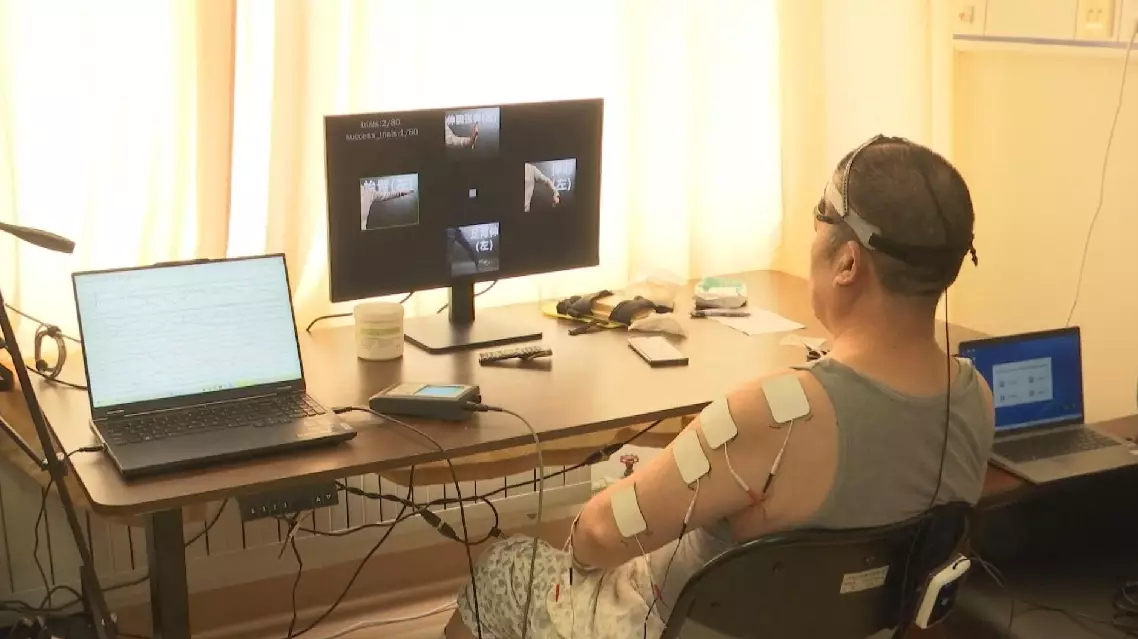
China's brain-computer interface tech makes progress in clinical applications


China's brain-computer interface tech makes progress in clinical applications

Only 24 registered survivors of the Nanjing Massacre remain alive today, as China observes another memorial day for the victims of the Nanjing Massacre on Saturday.

This Saturday marks the 12th national memorial day for the Nanjing Massacre victims, which was formally established on Feb 27, 2014, by the Standing Committee of the 12th National People's Congress, designating Dec 13 as an annual day of remembrance through legislative procedure.

The Nanjing Massacre occurred after Japanese forces captured Nanjing, then the Chinese capital, on Dec 13, 1937, initiating six weeks of slaughter that claimed the lives of more than 300,000 Chinese civilians and unarmed soldiers.

At the Memorial Hall of the Victims in Nanjing Massacre by Japanese Invaders in east China's Jiangsu Province, a wall displays photographs of 100 elderly individuals who represent some of the registered survivors of the Nanjing Massacre as of September 30, 2017.

Whenever a survivor passes away, a light on the wall is extinguished.

Now, only 24 lights remain illuminated on the wall, as eight survivors have passed away since the beginning of this year.

"Currently, only 24 registered survivors remain alive, with an average age of 95, and the oldest being 102. We provide one-on-one care for each survivor, maintaining individual files to support their daily lives. We have also mobilized hospitals, neighborhoods, and communities to assist them," said Zhou Feng, director of the memorial hall.

Xia Shuqin, one of the registered survivors, is now 96 years old but remains sharp-minded and articulate.

In 1937, during the Nanjing Massacre, seven members of her family were brutally murdered by Japanese troops.

Only she, then eight years old, and her four-year-old sister survived.

Xia was stabbed three times.

Standing before the memorial wall listing the victims' names, her eyes filled with tears as she gazed at the names with profound sorrow.

"I was only eight years old then, and my younger sister was four. I was covered in blood. When I came to consciousness, my sister was crying out, but later we couldn't find anyone," she said.

Despite her advanced age, Xia has remained steadfast on the front lines of spreading historical truth over the years.

She has participated in the national memorial ceremony many times for the victims of the Nanjing Massacre and family memorial services, sharing her personal experiences.

She has also traveled to Japan to recount the history of that era to local Japanese residents.

She hopes that her efforts will help people cherish peace.

"Our nation is prosperous and strong. I am living well now. I hope the next generation will have peace, eternal peace," said Xia.

Only 24 survivors of Nanjing Massacre remain alive today

Only 24 survivors of Nanjing Massacre remain alive today

Recommended Articles