At a time when its leadership is in question and its mission challenged, the Library of Congress has named a new U.S. poet laureate, the much-honored author and translator Arthur Sze.
The library announced Monday that the 74-year-old Sze had been appointed to a one-year term, starting this fall. The author of 12 poetry collections and recipient last year of a lifetime achievement award from the library, he succeeds Ada Limón, who had served for three years. Previous laureates also include Joy Harjo, Louise Glück and Billy Collins.
Speaking during a recent Zoom interview with The Associated Press, Sze acknowledged some misgivings when Rob Casper, who heads the library’s poetry and literature center, called him in June about becoming the next laureate. He wondered about the level of responsibilities and worried about the upheaval since President Donald Trump fired Librarian of Congress Carla Hayden in May. After thinking about it overnight, he called Casper back and happily accepted.
“I think it was the opportunity to give something back to poetry, to something that I’ve spent my life doing,” he explained, speaking from his home in Santa Fe, New Mexico. “So many people have helped me along the way. Poetry has just helped me grow so much, in every way.”
Sze’s new job begins during a tumultuous year for the library, a 200-year-old, nonpartisan institution that holds a massive archive of books published in the United States. Trump abruptly fired Hayden after conservative activists accused her of imposing a “woke” agenda, criticism that Trump has expressed often as he seeks sweeping changes at the Kennedy Center, the Smithsonian museums and other cultural institutions.
Hayden’s ouster was sharply criticized by congressional Democrats, leaders in the library and scholarly community and such former laureates as Limón and Harjo. It also led to a debate over who has the authority to decide on an interim replacement.
Although the White House announced that it had named Deputy Attorney General Todd Blanche as the acting librarian, daily operations are being run by a longtime official at the library, Robert Randolph Newlen. Events such as the annual National Book Festival have continued without interruption or revision.
Laureates are forbidden to take political positions, although the tradition was breached in 2003 when Collins publicly stated his objections to President George W. Bush’s push for war against Iraq.
Newlen is identified in Monday’s announcement as acting librarian, a position he was in line for according to the institution's guidelines. He praised Sze, whose influences range from ancient Chinese poets to Wallace Stevens, for his “distinctly American” portraits of the Southwest landscapes and for his “great formal innovation.”
“Like Emily Dickinson and Walt Whitman, Sze forges something new from a range of traditions and influences — and the result is a poetry that moves freely throughout time and space,” his statement reads in part.
Sze’s official title is poet laureate consultant in poetry, a 1985 renaming of a position established in 1937 as consultant in poetry to the Library of Congress. The mission is loosely defined as a kind of literary ambassador, to “raise the national consciousness to a greater appreciation of the reading and writing of poetry.” Initiatives have included Robert Pinsky’s “Favorite Poem Project,” for which the public would share thoughts on works of their choosing, and Limón’s “You Are Here,” which included poetry installations at national parks.
Sze wants to focus on a passion going back more than a half-century to his undergraduate years at the University of California, Berkeley — translation. He remembers reading some English-language editions of Chinese poetry, finding the work “antiquated and dated” and deciding to translate some of it himself, writing out the Chinese characters and engaging with them “on a much deeper level” than he had expected. Besides his own poetry, he has published “The Silk Dragon: Translations from the Chinese.”
“I personally learned my own craft of writing poetry through translating poetry,” he says. “I often think that people think of poetry as intimidating, or difficult, which isn’t necessarily true. And I think one way to deepen the appreciation of poetry is to approach it through translation.”
Sze is a New York City native and son of Chinese immigrants who in such collections as “Sight Lines” and “Compass Rose” explores themes of cultural and environmental diversity and what he calls “coexisting.” In a given poem, he might shift from rocks above a pond to people begging in a subway, from a firing squad in China to Thomas Jefferson’s plantation in Virginia. His many prizes include the National Book Award for “Sight Lines” and such lifetime achievement honors as the Jackson Poetry Prize and the Ruth Lilly Poetry Prize.
He loves poetry from around the world but feels at home writing in English, if only for the “richness of the vocabulary” and the wonders of its origins.
“I was just looking at the word ‘ketchup,’ which started from southern China, went to Malaysia, was taken to England, where it became a tomato-based sauce, and then, of course, to America,” he says. “And I was just thinking days ago, that’s a word we use every day without recognizing its ancestry, how it’s crossed borders, how it’s entered into the English language and enriched it.”

FILE - Arthur Sze attends the 70th National Book Awards ceremony on Nov. 20, 2019, in New York. (Photo by Greg Allen/Invision/AP, File)
NUUK, Greenland (AP) — Troops from several European countries continued to arrive in Greenland on Thursday in a show of support for Denmark as talks between representatives of Denmark, Greenland and the U.S. highlighted “fundamental disagreement” over the future of the Arctic island.
Denmark announced it would increase its military presence in Greenland on Wednesday as foreign ministers from Denmark and Greenland were preparing to meet with White House representatives in Washington. Several European partners — including France, Germany, the U.K., Norway, Sweden and the Netherlands — started sending symbolic numbers of troops already on Wednesday or promised to do so in the following days.
The troop movements were intended to portray unity among Europeans and send a signal to President Donald Trump that an American takeover of Greenland is not necessary as NATO together can safeguard the security of the Arctic region amid rising Russian and Chinese interest.
“The first French military elements are already en route” and “others will follow,” French President Emmanuel Macron announced Wednesday, as French authorities said about 15 soldiers from the mountain infantry unit were already in Nuuk for a military exercise.
Germany will deploy a reconnaissance team of 13 personnel to Greenland on Thursday, the Defense Ministry said.
On Thursday, Danish Defense Minister Troels Lund Poulsen said the intention was “to establish a more permanent military presence with a larger Danish contribution,” according to Danish broadcaster DR. He said soldiers from several NATO countries will be in Greenland on a rotation system.
Danish Foreign Minister Lars Løkke Rasmussen, flanked by his Greenlandic counterpart Vivian Motzfeldt, said Wednesday that a “fundamental disagreement” over Greenland remains with Trump after they held highly anticipated talks at the White House with Vice President JD Vance and Secretary of State Marco Rubio.
Rasmussen added that it remains “clear that the president has this wish of conquering over Greenland” but that dialogue with the U.S. would continue at a high level over the following weeks.
Inhabitants of Greenland and Denmark reacted with anxiety but also some relief that negotiations with the U.S. would go on and European support was becoming visible.
Greenland's Prime Minister Jens-Frederik Nielsen welcomed the continuation of “dialogue and diplomacy.”
“Greenland is not for sale,” he said Thursday. “Greenland does not want to be owned by the United States. Greenland does not want to be governed from the United States. Greenland does not want to be part of the United States.”
In Greenland’s capital, Nuuk, local residents told The Associated Press they were glad the first meeting between Greenlandic, Danish and American officials had taken place but suggested it left more questions than answers.
Several people said they viewed Denmark’s decision to send more troops, and promises of support from other NATO allies, as protection against possible U.S. military action. But European military officials have not suggested the goal is to deter a U.S. move against the island.
Maya Martinsen, 21, said it was “comforting to know that the Nordic countries are sending reinforcements” because Greenland is a part of Denmark and NATO.
The dispute, she said, is not about “national security” but rather about “the oils and minerals that we have that are untouched.”
On Wednesday, Poulsen announced a stepped-up military presence in the Arctic “in close cooperation with our allies,” calling it a necessity in a security environment in which “no one can predict what will happen tomorrow.”
“This means that from today and in the coming time there will be an increased military presence in and around Greenland of aircraft, ships and soldiers, including from other NATO allies,” Poulsen said.
Asked whether the European troop movements were coordinated with NATO or what role the U.S.-led military alliance might play in the exercises, NATO referred all questions to the Danish authorities. However, NATO is currently studying ways to bolster security in the Arctic.
The Russian embassy in Brussels on Thursday lambasted what it called the West's “bellicose plans” in response to “phantom threats that they generate themselves”. It said the planned military actions were part of an “anti-Russian and anti-Chinese agenda” by NATO.
“Russia has consistently maintained that the Arctic should remain a territory of peace, dialogue and equal cooperation," the embassy said.
Rasmussen announced the creation of a working group with the Americans to discuss ways to work through differences.
“The group, in our view, should focus on how to address the American security concerns, while at the same time respecting the red lines of the Kingdom of Denmark,” he said.
Commenting on the outcome of the Washington meeting on Thursday, Poulsen said the working group was “better than no working group” and “a step in the right direction.” He added nevertheless that the dialogue with the U.S. did not mean “the danger has passed.”
Speaking on Thursday, Danish Prime Minister Mette Frederiksen said the American ambition to take over Greenland remains intact despite the Washington meeting, but she welcomed the creation of the working group.
The most important thing for Greenlanders is that they were directly represented at the meeting in the White House and that “the diplomatic dialogue has begun now,” Juno Berthelsen, a lawmaker for the pro-independence Naleraq opposition party, told AP.
A relationship with the U.S. is beneficial for Greenlanders and Americans and is “vital to the security and stability of the Arctic and the Western Alliance,” Berthelsen said. He suggested the U.S. could be involved in the creation of a coastguard for Greenland, providing funding and creating jobs for local people who can help to patrol the Arctic.
Line McGee, 38, from Copenhagen, told AP that she was glad to see some diplomatic progress. “I don’t think the threat has gone away,” she said. “But I feel slightly better than I did yesterday.”
Trump, in his Oval Office meeting with reporters, said: “We’ll see how it all works out. I think something will work out.”
Niemann reported from Copenhagen, Denmark, and Ciobanu from Warsaw, Poland.
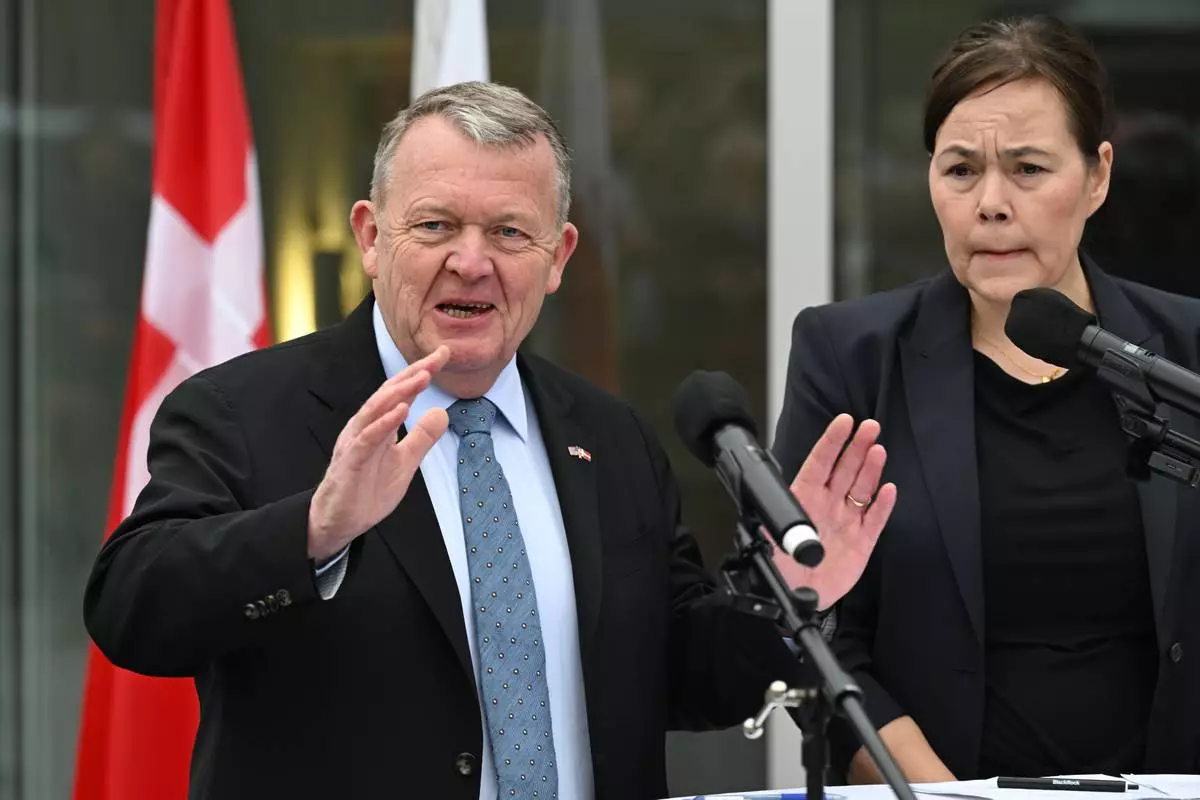
Denmark's Foreign Minister Lars Løkke Rasmussen and Greenland's Foreign Minister Vivian Motzfeldt speak at a news conference at the Embassy of Denmark, Wednesday, Jan. 14, 2026, in Washington. (AP Photo/John McDonnell)
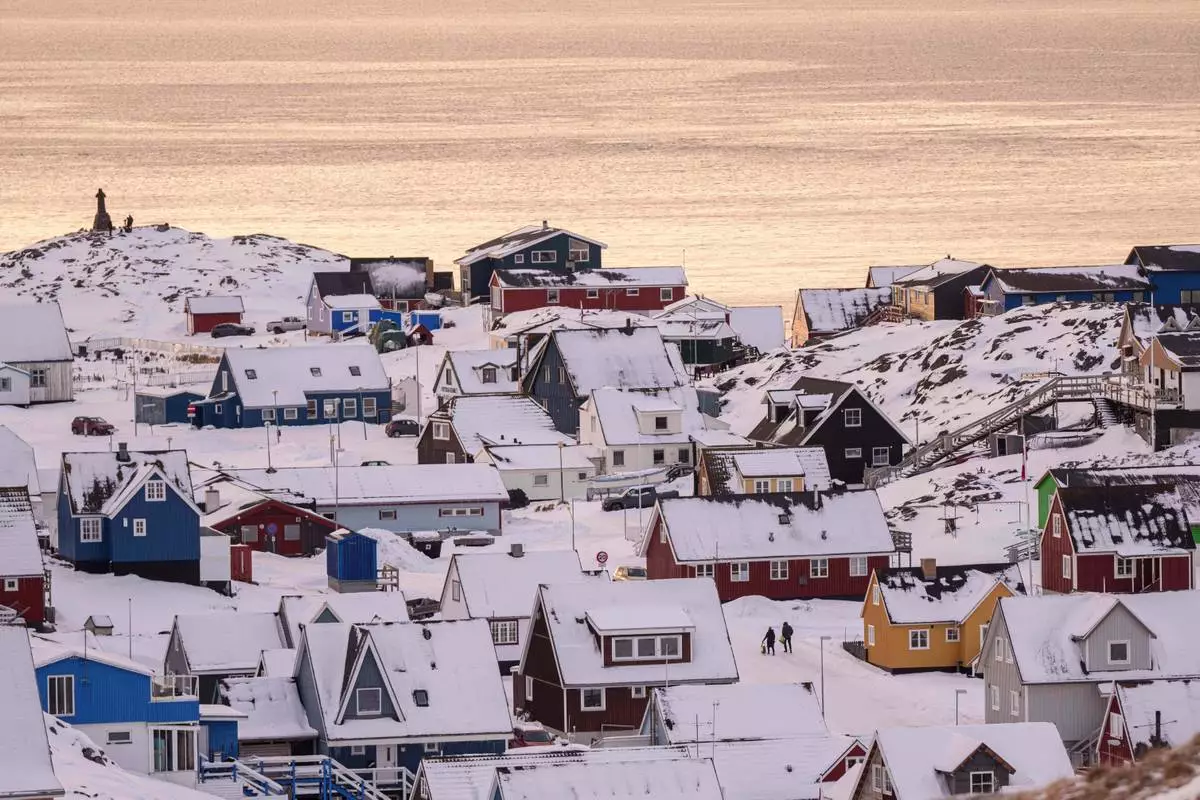
People walk on a street in Nuuk, Greenland, Wednesday, Jan. 14, 2026. (AP Photo/Evgeniy Maloletka)
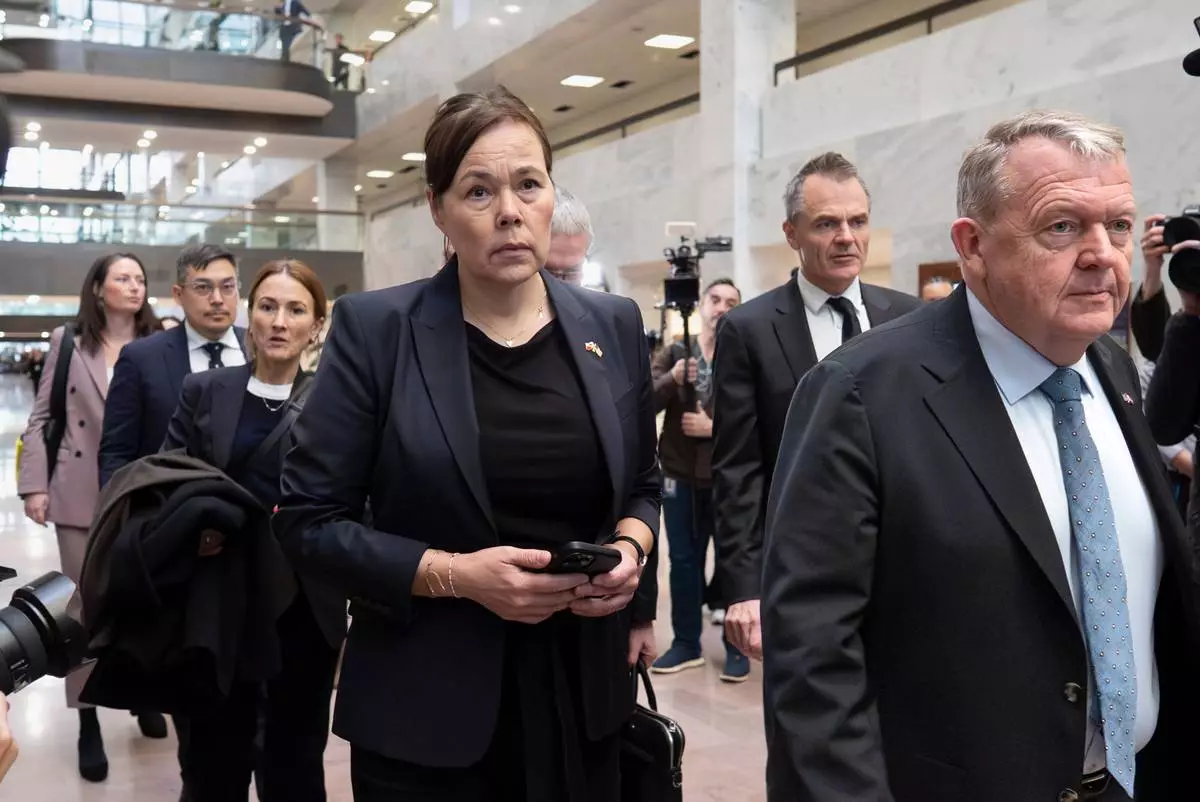
From center to right, Greenland Foreign Minister Vivian Motzfeldt, Denmark's Ambassador Jesper Møller Sørensen, rear, and Danish Foreign Minister Lars Løkke Rasmussen, right, arrive on Capitol Hill to meet with senators from the Arctic Caucus, in Washington, Wednesday, Jan. 14, 2026. (AP Photo/J. Scott Applewhite)

An Airbus A400M transport aircraft of the German Air Force taxis over the grounds at Wunstorf Air Base in the Hanover region, Germany, Thursday, Jan. 15, 2026 as troops from NATO countries, including France and Germany, are arriving in Greenland to boost security. (Moritz Frankenberg/dpa via AP)
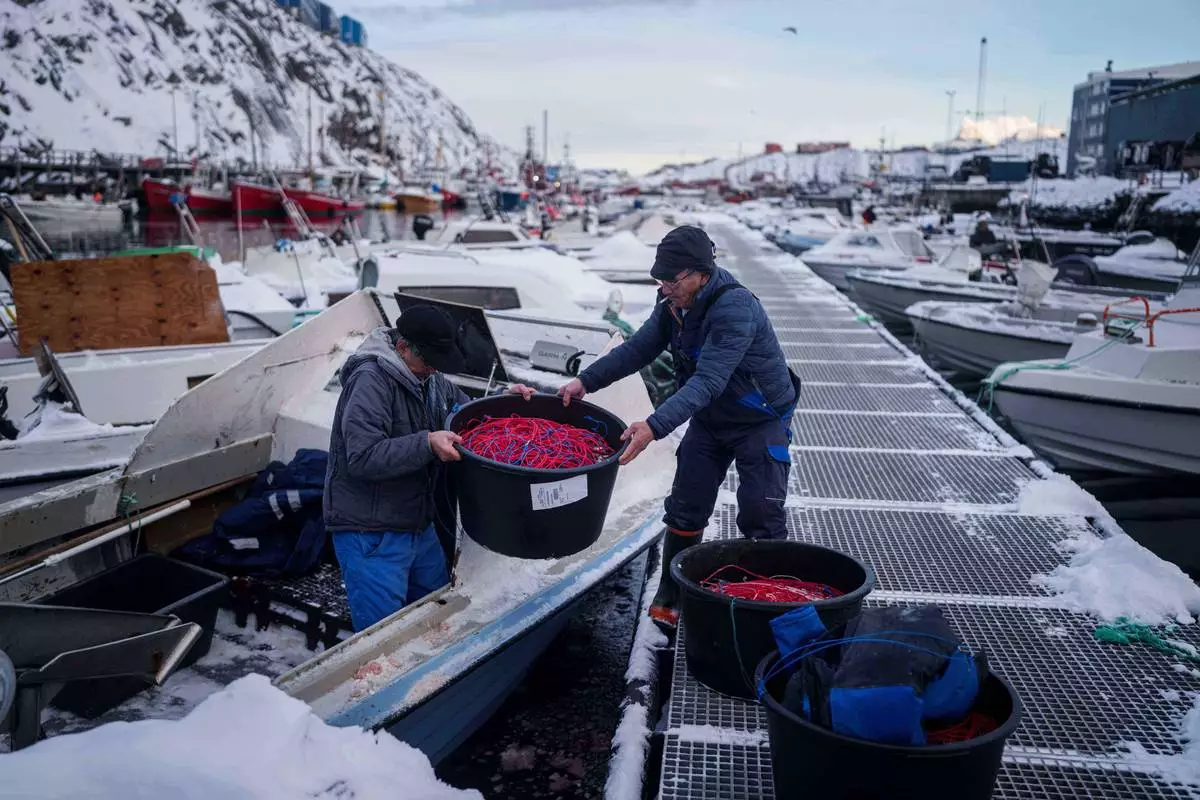
Fishermen load fishing lines into a boat in the harbor of Nuuk, Greenland, Wednesday, Jan. 14, 2026. (AP Photo/Evgeniy Maloletka)

Greenland Foreign Minister Vivian Motzfeldt, left, and Danish Foreign Minister Lars Løkke Rasmussen, arrive on Capitol Hill to meet with members of the Senate Arctic Caucus, in Washington, Wednesday, Jan. 14, 2026. (AP Photo/J. Scott Applewhite)