NEW YORK (AP) — The Federal Reserve cut its benchmark interest rate Wednesday for the first time in nine months. Since the last cut, progress on inflation has slowed while the labor market has cooled. That means Americans are dealing with both high prices and a challenging job market.
The federal funds rate, set by the Federal Reserve, is the rate at which banks borrow and lend to one another. While the rates that consumers pay to borrow money aren’t directly linked to this rate, shifts in Fed policy affect what people pay for credit cards, auto loans, mortgages, and other financial products.
Wednesday's quarter-point cut is the first since December and lowers the Fed's short-term rate to about 4.1%, down from 4.3%. The Fed projected it will cut rates two more times before the end of the year.
The Fed has two goals when it sets the rate: one, to manage prices for goods and services, and two, to encourage full employment. This is known as the “dual mandate.” Typically, the Fed might increase the rate to try to bring down inflation and decrease it to encourage faster economic growth and more hiring. The challenge now is that inflation is higher than the Fed's 2% target but the job market is weak, putting the Fed in a difficult position.
“The dual mandate is always a balancing act," said Elizabeth Renter, senior economist at personal finance site NerdWallet.
Here's what to know:
For prospective homebuyers, the market has already priced in the rate cut, which means it's “unlikely to make a noticeable difference for most consumers at the time of the announcement,” according to Bankrate financial analyst Stephen Kates.
“Much of the impact on mortgage rates has already occurred through anticipation alone,” he said. "(Mortgage) rates have been falling since January and dropped further as weaker-than-expected economic data pointed to a cooling economy.”
Still, Kates said a declining interest rate environment will provide some relief for borrowers over time.
“Whether it’s a homeowner with a 7% mortgage or a recent graduate hoping to refinance student loans and credit card debt, lower rates can ease the burden on many indebted households by opening opportunities to refinance or consolidate,” he said.
For savers, falling interest rates will slowly erode attractive yields currently on offer with certificates of deposit (CDs) and high-yield savings accounts.
Right now, the best rates on offer for each have been hovering at or above 4% for CDs and at 4.6% for high-yield savings accounts, according to DepositAccounts.com.
Those are still better than the trends of recent years, and a good option for consumers who want to earn a return on money they may want to access in the near-term. A high-yield savings account generally has a much higher annual percentage yield than a traditional savings account. The national average for traditional savings accounts is currently 0.38%.
There may be a few accounts with returns of about 4% through the end of 2025, according to Ken Tumin, founder of DepositAccounts.com, but the Fed cuts will filter down to these offerings, lowering the average yields as they do.
Americans have faced steeper auto loan rates over the last three years after the Fed raised its benchmark interest rate starting in early 2022. Those are not expected to decline any time soon. While a cut will contribute to eventual relief, it might be slow in arriving, analysts say.
“If the auto market starts to freeze up and people aren’t buying cars, then we may see lending margins start to shrink, but auto loan rates don’t move in lockstep with the Fed rate,” said Bankrate analyst Stephen Kates.
Prices for new cars have leveled off recently, but remain at historically high levels, not adjusting for inflation.
Generally speaking, an auto loan annual percentage rate can run from about 4% to 30%. Bankrate’s most recent weekly survey found that average auto loan interest rates are currently at 7.19% on a 60-month new car loan.
Interest rates for credit cards are currently at an average of 20.13%, and the Fed's rate cut may be slow to be felt by anyone carrying a large amount of credit card debt. That said, any reduction is positive news.
“While the broader impact of a rate reduction on consumers’ financial health remains to be fully seen, it could offer some relief from the persistent budgetary pressures driven by inflation,” said Michele Raneri, vice president and head of U.S. research at credit reporting agency TransUnion.
“These savings could contribute to a reduction in delinquency rates across credit card and unsecured personal loan segments,” she said.
Still, the best thing for anyone carrying a large credit card balance is to prioritize paying down high-interest-rate debt, and to seek to transfer any amounts possible to lower APR cards or negotiate directly with credit card companies for accommodation.
The Associated Press receives support from Charles Schwab Foundation for educational and explanatory reporting to improve financial literacy. The independent foundation is separate from Charles Schwab and Co. Inc. The AP is solely responsible for its journalism.

FILE - In this March 5, 2012, file photo, consumer credit cards are posed in North Andover, Mass. (AP Photo/Elise Amendola, File)
WASHINGTON (AP) — The United States said Sunday it rescued a service member missing behind enemy lines since Iran downed a fighter jet, as President Donald Trump escalated pressure on Tehran with a new looming deadline to reopen the Strait of Hormuz.
Iran showed no signs of backing down, striking economic and infrastructure targets in neighboring Gulf Arab countries.
The airman’s extraction followed a U.S. search-and-rescue operation after the Friday crash of the F-15E Strike Eagle, as Iran also promised a reward for anyone who turned in an “enemy pilot.” Trump said he was injured but in stable condition.
“This brave Warrior was behind enemy lines in the treacherous mountains of Iran, being hunted down by our enemies, who were getting closer and closer by the hour,” Trump wrote on social media.
A second crew member was rescued earlier.
The fighter jet was the first American aircraft to have crashed in Iranian territory since the U.S. and Israel launched the war, striking Iran on Feb. 28. The war has since killed thousands, shaken global markets, cut off key shipping routes and spiked fuel prices. Both sides have threatened and hit civilian targets, bringing warnings of possible war crimes.
Trump said last week that the U.S. had “decimated” Iran and would finish the war “very fast.” Two days later, Iran shot down two U.S. military planes, showing the ongoing perils of the bombing campaign and the ability of a degraded Iranian military to continue to hit back.
As Iran continues to exert control over the Strait of Hormuz, Trump, in a weekend social media post, threatened to unleash “all Hell” if it isn’t opened by Monday. He has issued such threats before and extended them when mediators have claimed progress toward ending the war on agreeable terms.
The other jet to go down was a U.S. A-10 attack aircraft. Neither the status of the crew nor exactly where it crashed was immediately known.
On Sunday, Iran’s state TV aired a video showing what it claimed were parts of American aircraft shot down by Iranian forces, along with a photo of thick, black smoke rising into the air. The broadcaster said Iran had shot down an American transport plane and two helicopters that were part of the rescue operation.
However, a regional intelligence official briefed on the mission told The Associated Press that the U.S. military blew up two transport planes due to a technical malfunction, forcing it to bring in additional aircraft to complete the rescue. The official spoke on condition of anonymity to discuss the covert mission.
Iran’s military joint command on Sunday claimed that four U.S. aircraft were destroyed during the rescue operation and warned of stepping up retaliatory attacks on regional oil and civilian infrastructure if the U.S. and Israel attacked such targets in the Islamic Republic, according to state television.
“We once again repeat: if you commit aggression again and strike civilian facilities, our responses will be more forceful,” a spokesman said in comments run by IRNA news agency.
In Kuwait, Iranian drone attacks caused significant damage to power plants and a petrochemical plant. They also put a water desalination station out of service, according to the Ministry of Electricity. No injuries were reported, the ministry said.
In Bahrain, a drone attack caused a fire at one of the national oil company’s storage facilities and a state-run petrochemical plant, the kingdom’s official news agency said.
In the United Arab Emirates, authorities responded to fires at a petrochemical plant in Ruwais that they said were caused by intercepted debris, halting operations.
The strikes came a day after Israel struck a petrochemical plant in Iran that Prime Minister Benjamin Netanyahu said generated revenue that it had used to fund the war.
The petrochemical industry is a key sector in many Gulf states. Plants in Bahrain, Kuwait, the UAE and Iran convert oil and gas into products like plastics, polymers and fertilizer, bringing in billions in export revenue.
Trump renewed his threats for Iran to open up the Strait of Hormuz by Monday or face consequences, writing Saturday in a social media post: “Remember when I gave Iran ten days to MAKE A DEAL or OPEN UP THE HORMUZ STRAIT. Time is running out — 48 hours before all Hell will reign down on them.”
The waterway is a critical chokepoint for commerical trade, especially oil and gas moving from the Persian Gulf to Europe and Asia. Disruptions there have injected volatility into the market and pushed oil and gas-importing countries to seek alternative sources.
“The doors of hell will be opened to you” if Iran’s infrastructure is attacked, Gen. Ali Abdollahi Aliabadi with the country’s joint military command said late Saturday in response to Trump’s renewed threat, state media reported. In turn, the general threatened all infrastructure used by the U.S. military in the region.
Pakistan’s Foreign Ministry spokesperson, Tahir Andrabi, told AP that his government’s efforts to broker a ceasefire are “right on track” after Islamabad last week said that it would soon host talks between the U.S. and Iran.
Mediators from Pakistan, Turkey and Egypt were working to bring the U.S. and Iran to the negotiating table, according to two regional officials.
The proposed compromise includes a cessation of hostilities to allow a diplomatic settlement, according to a regional official involved in the efforts and a Gulf diplomat briefed on the matter. They spoke on condition of anonymity to discuss closed-door diplomacy.
More than 1,900 people have been killed in Iran since the war began.
In Gulf Arab states and the occupied West Bank, more than two dozen people have died, while 19 have been reported dead in Israel and 13 U.S. service members have been killed. In Lebanon, more than 1,400 people have been killed and more than 1 million people have been displaced. Ten Israeli soldiers have died there.
This report has been corrected to show that Borealis is an Austrian company, not Australian.
Metz reported from Jerusalem and Magdy from Cairo. Jon Gambrell in Dubai, United Arab Emirates, and Munir Ahmed in Islamabad contributed to this report.
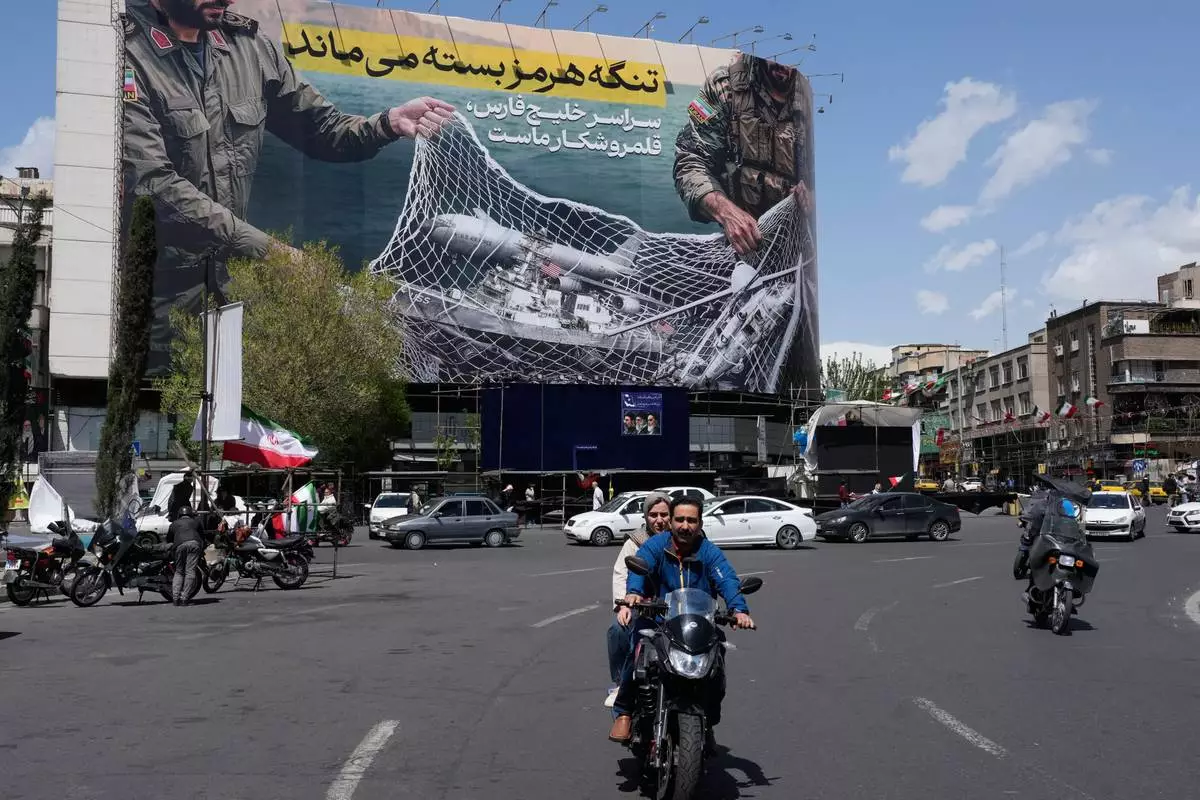
Vehicles and motorcycles move past an anti-U.S. billboard depicting the American aircrafts into the Iranian armed forces fishing net with signs that read in Farsi: "The Strait of Hormuz will remain closed, The entire Persian Gulf is our hunting ground," at the Eqelab-e-Eslami, or Islamic Revolution square in downtown Tehran, Iran, Sunday, April 5, 2026. (AP Photo/Vahid Salemi)
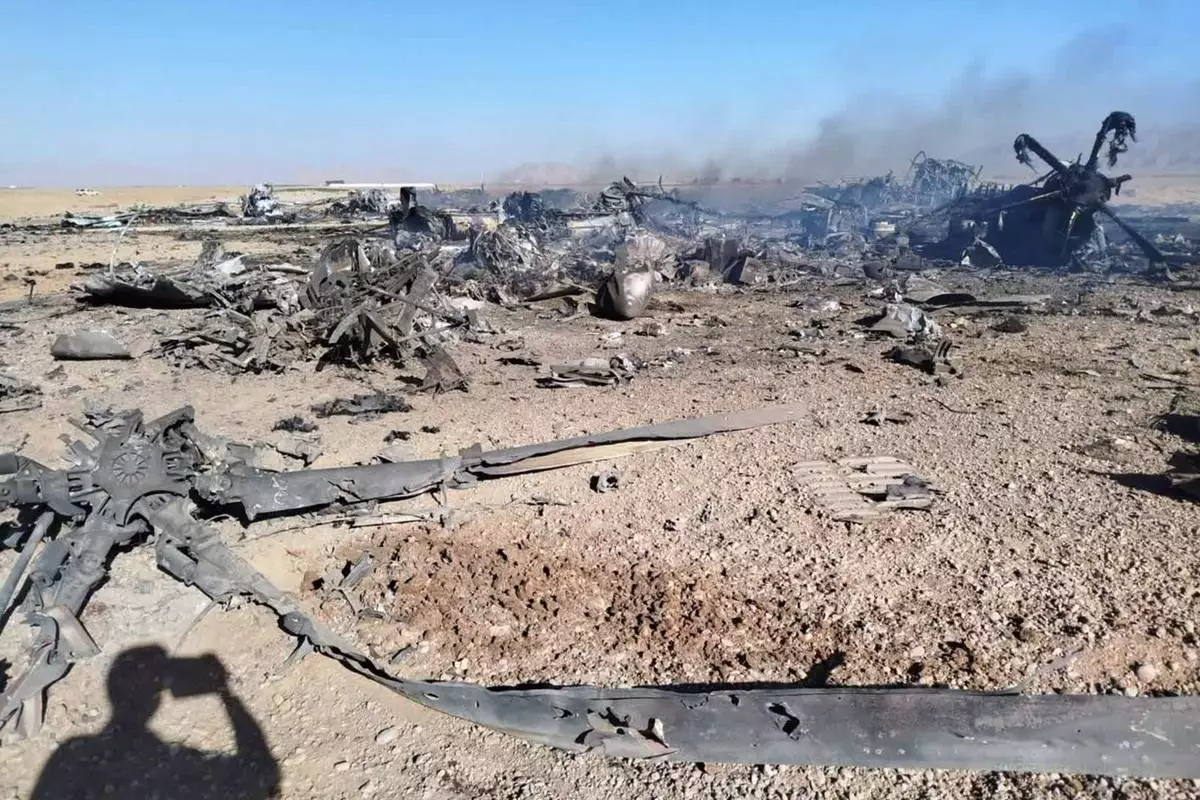
In this image provided by Sepahnews, the Iranian Revolutionary Guard's official website, wreckage is shown at what Iran's state TV claimed was the site of a downed American transport plane and two helicopters involved in a rescue operation, in Isfahan province, Iran, April, 2026. (Sepahnews via AP)
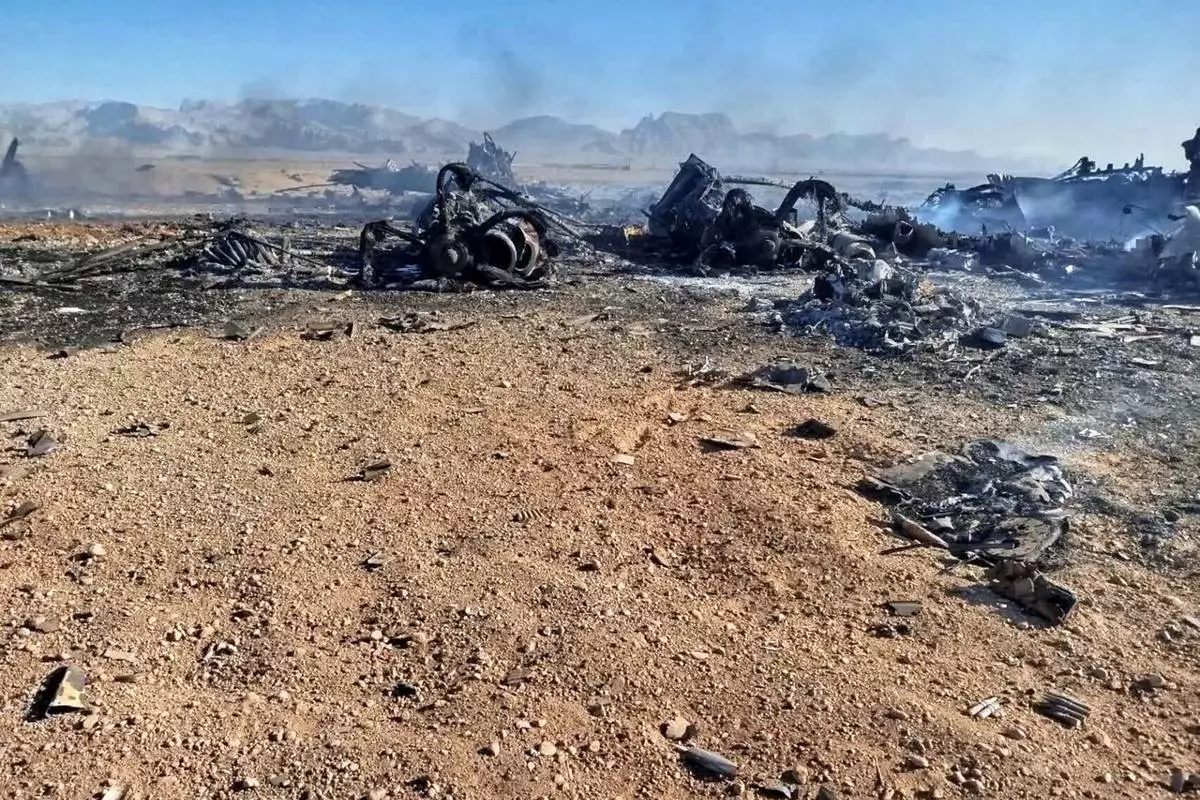
In this image provided by Sepahnews, the Iranian Revolutionary Guard's official website, wreckage is shown at what Iran's state TV claimed was the site of a downed American transport plane and two helicopters involved in a rescue operation, in Isfahan province, Iran, April, 2026. (Sepahnews via AP)
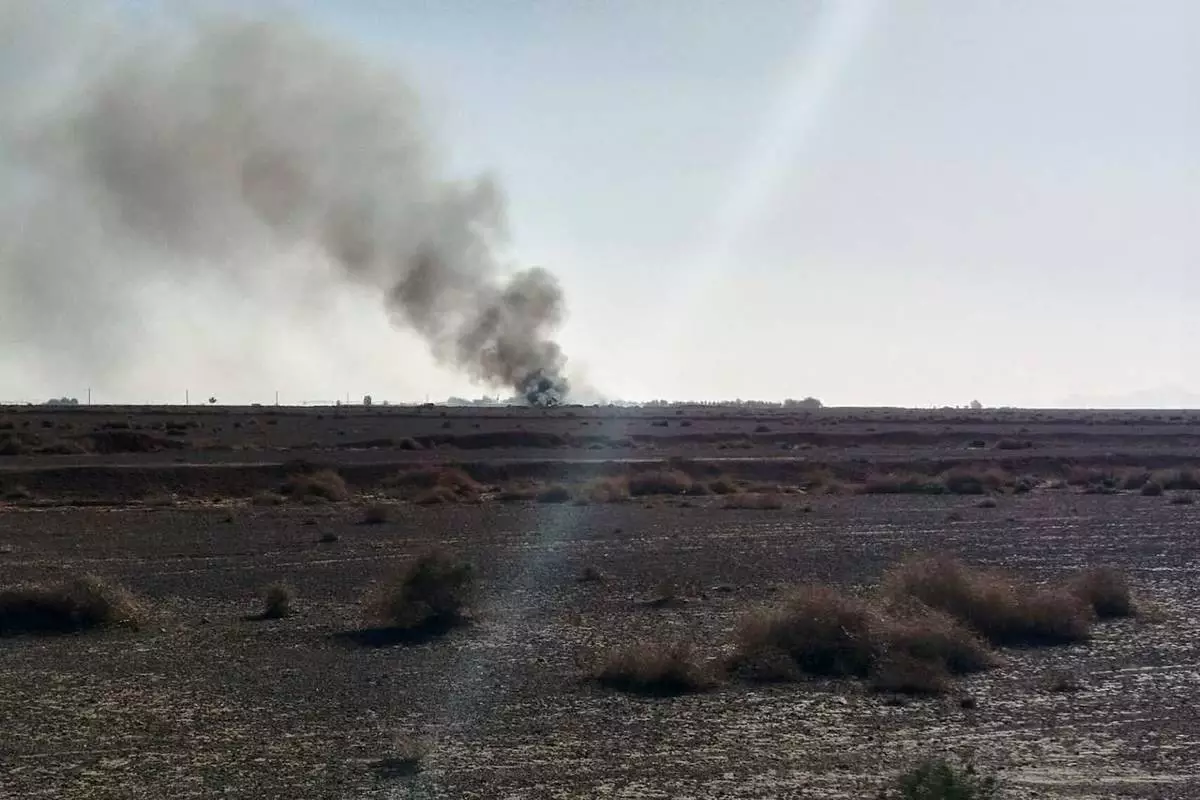
In this image provided by Sepahnews, the Iranian Revolutionary Guard's official website, black smoke rises into the air at what Iran's state TV claimed was the site where an American transport plane and two helicopters involved in a rescue operation were shot down, in Isfahan province, Iran, April, 2026. (Sepahnews via AP)
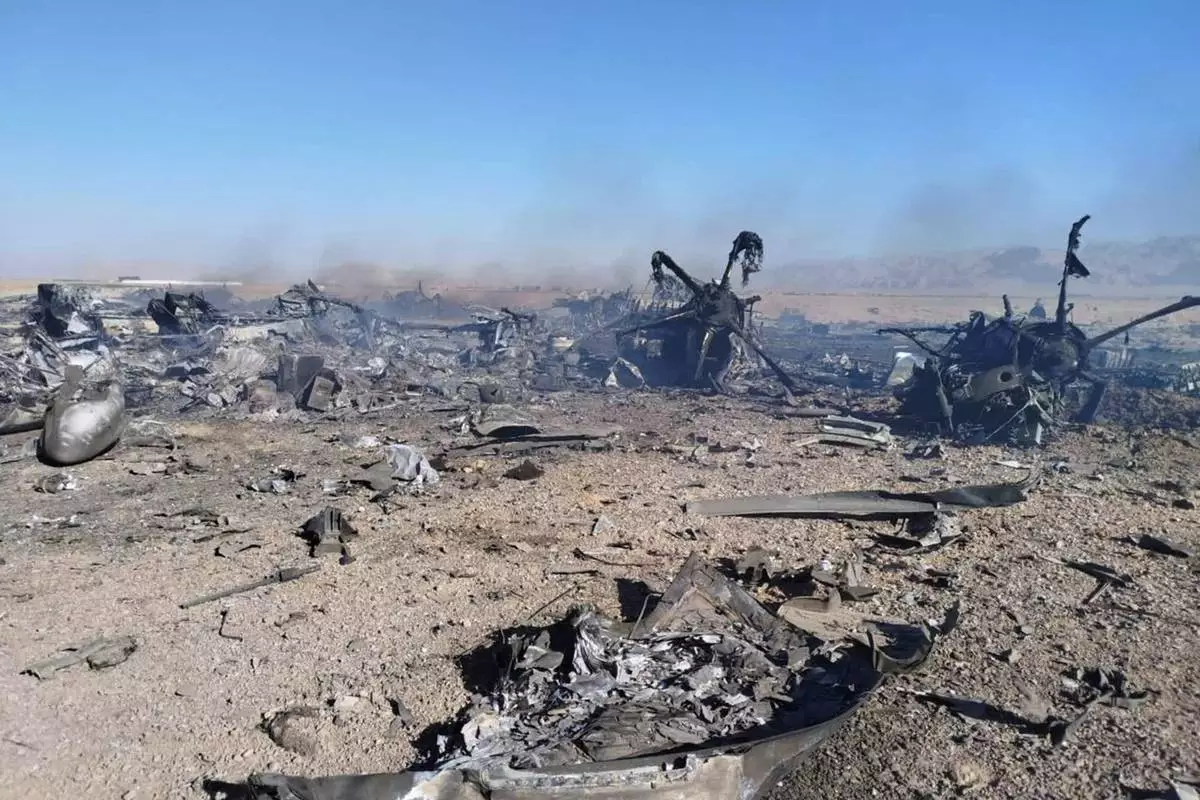
In this image provided by Sepahnews, the Iranian Revolutionary Guard's official website, wreckage is shown at what Iran's state TV claimed was the site of a downed American transport plane and two helicopters involved in a rescue operation, in Isfahan province, Iran, April, 2026. (Sepahnews via AP)
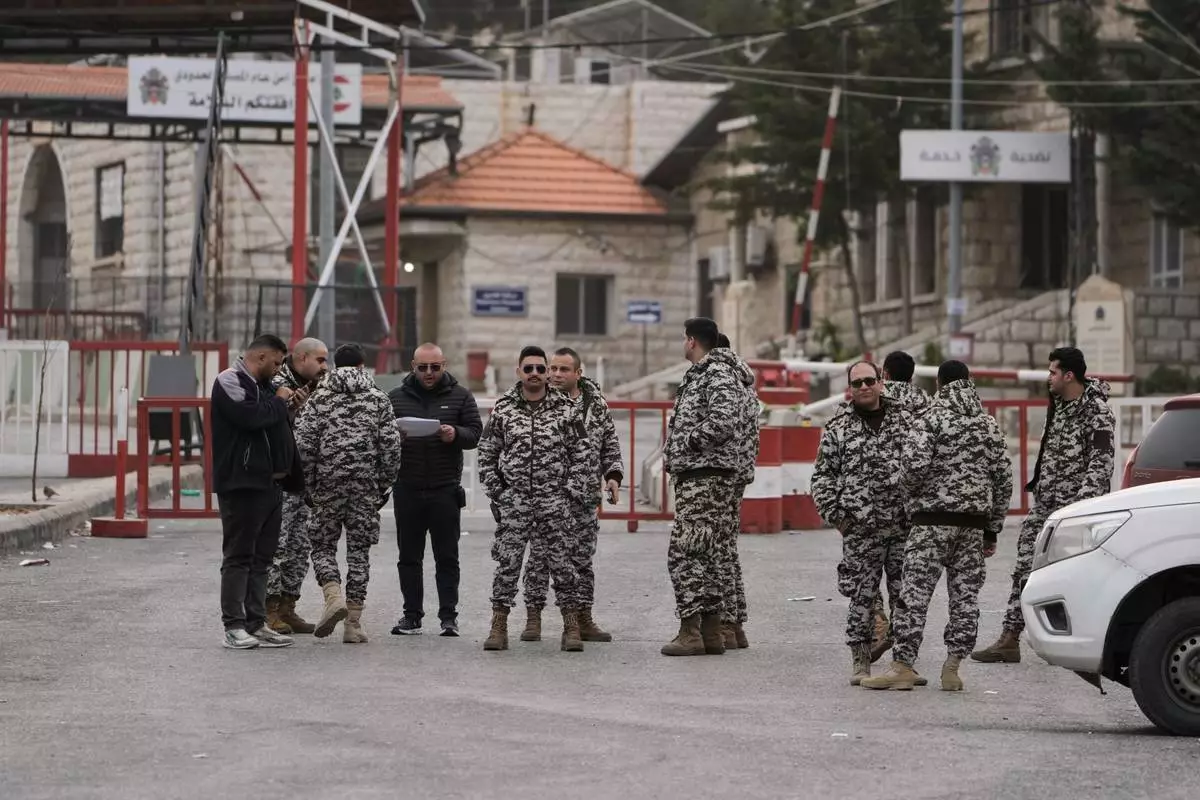
Members of Lebanon's General Security stand at the Masnaa border crossing in the Bekaa valley, eastern Lebanon, Sunday, April 5, 2026. (AP Photo/Bilal Hussein)
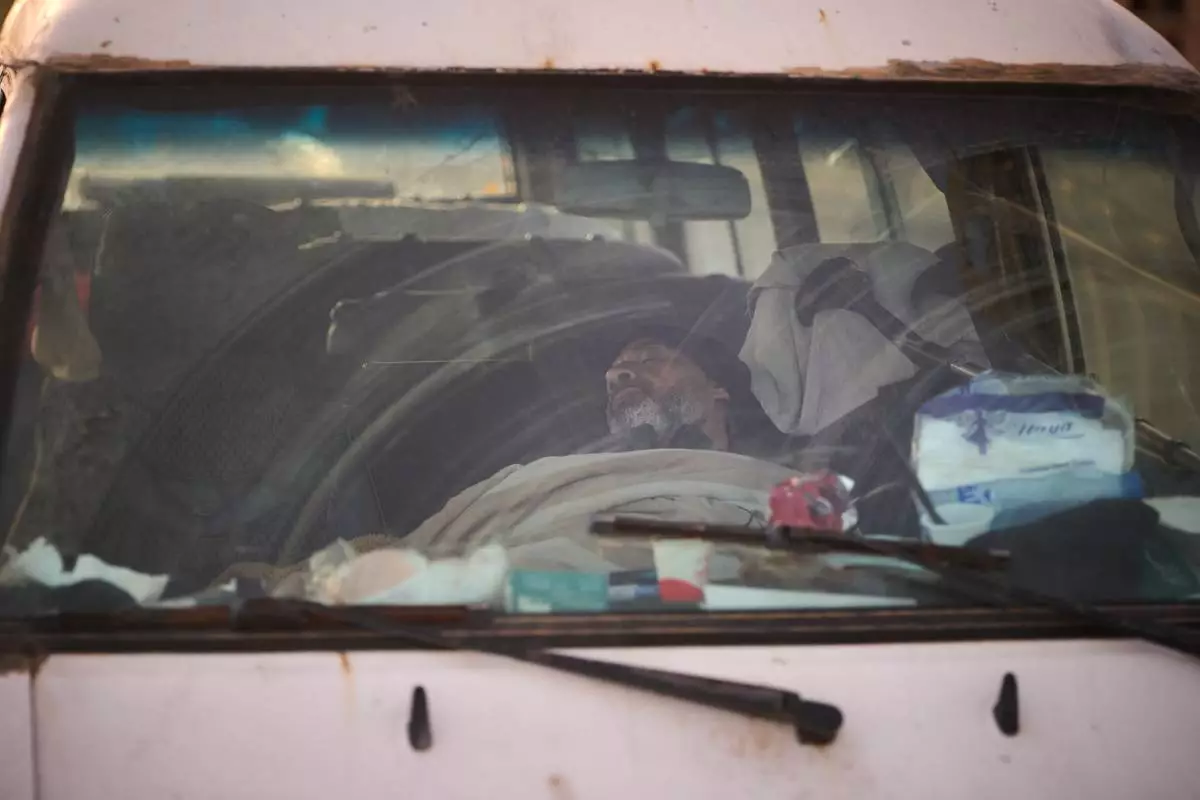
A man, who fled Israeli bombings in southern Lebanon with his family, sleeps in his car used as shelter, along a seaside promenade in downtown Beirut, Lebanon, Sunday, April 5, 2026. (AP Photo/Emilio Morenatti)
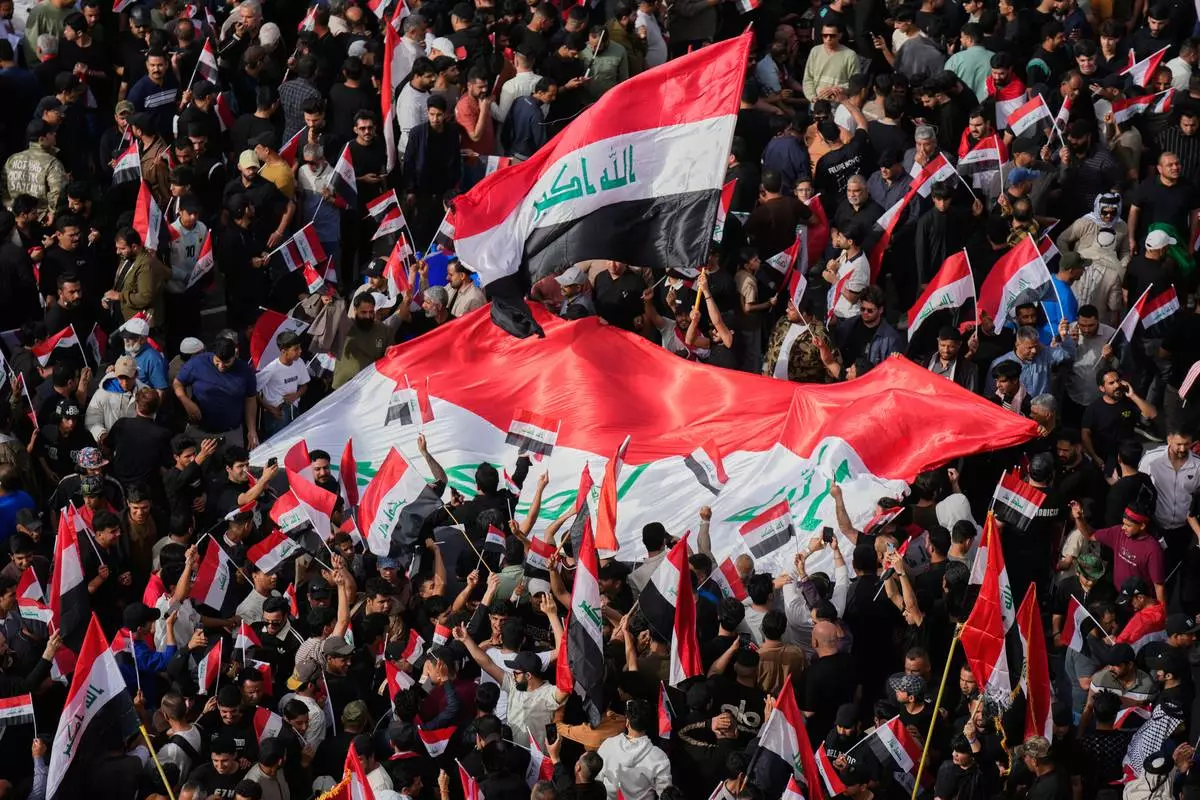
Followers of Iraq's Shiite cleric Muqtada al-Sadr chant slogans as they wave national Iraqi flag during a protest against U.S. and Israeli attacks on multiple cities across Iran, in Tahrir Square, Baghdad, Baghdad, Iraq, Saturday, April 4, 2026. (AP Photo/Hadi Mizban)
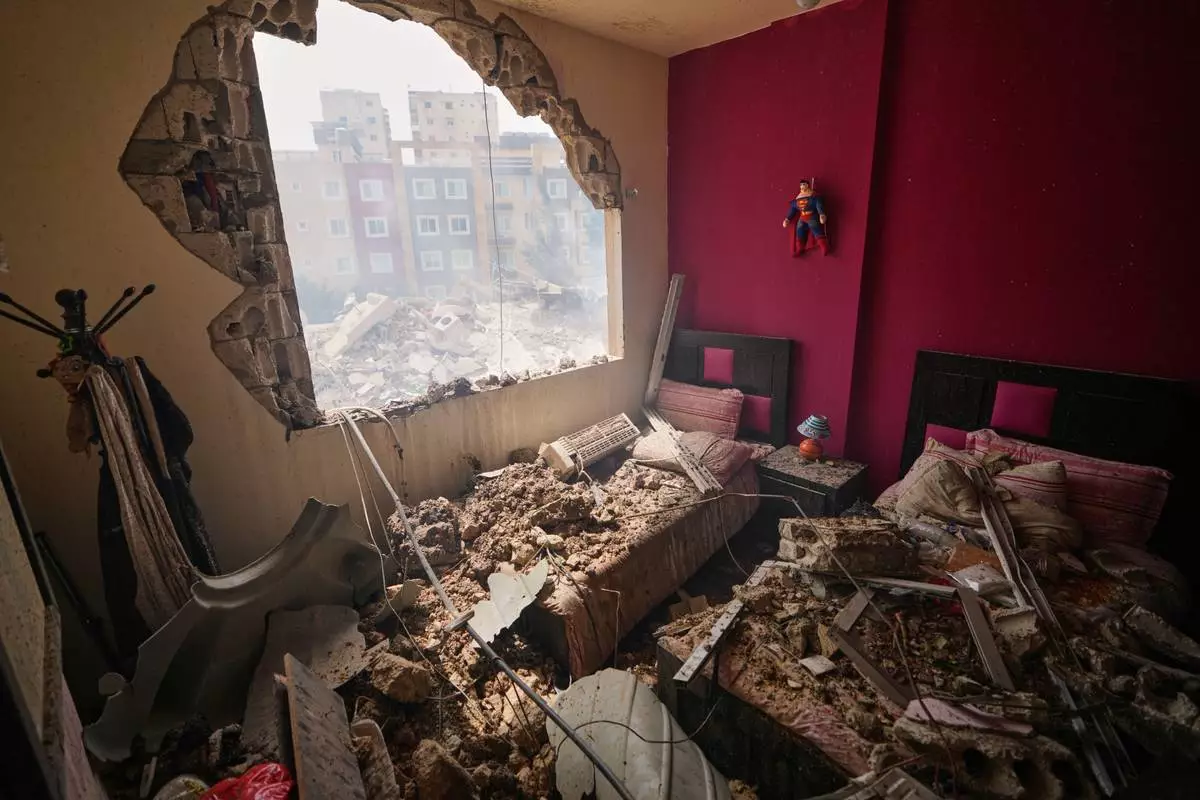
A bedroom is damaged in a building struck in an Israeli airstrike in the southern port city of Tyre, Lebanon, Saturday, April 4, 2026. (AP Photo/Mohammed Zaatari)
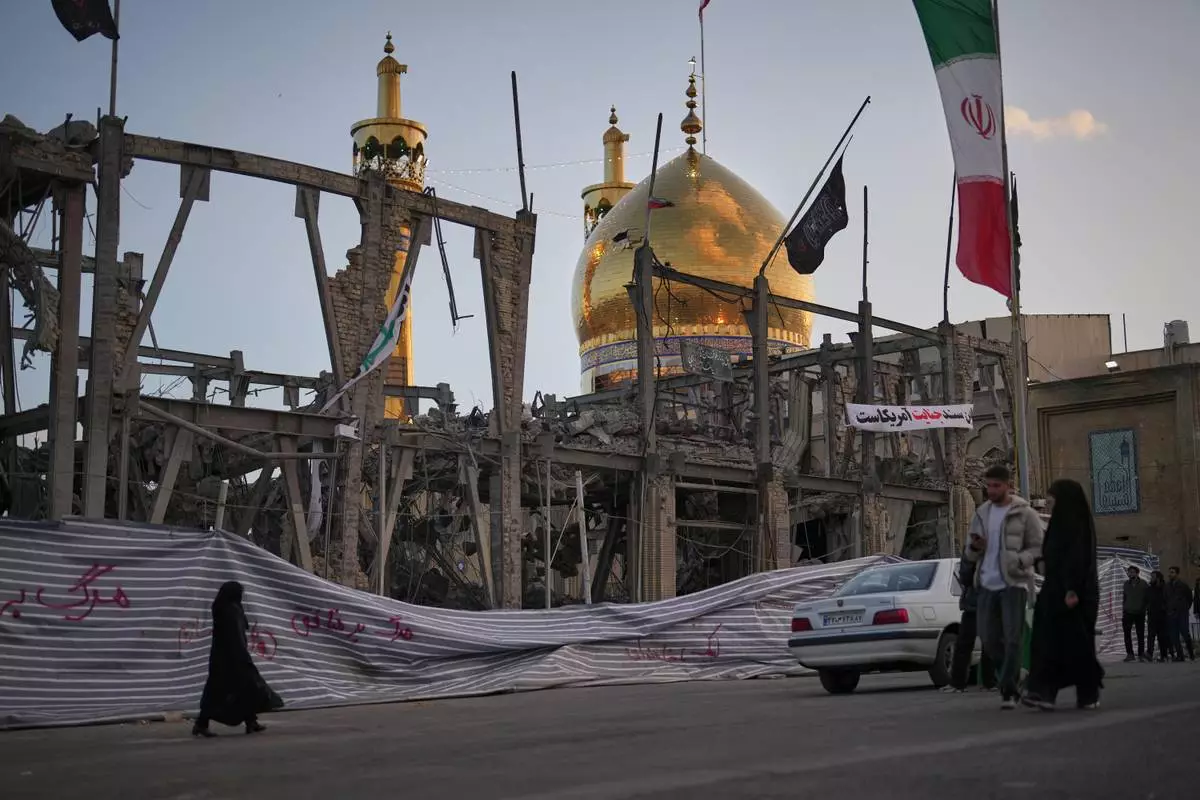
Pedetrians walk by a destroyed building within the Grand Hosseiniyeh, with the mosque visible in the background, which officials at the site say was hit by U.S.-Israeli airstrikes Tuesday, in Zanjan, Iran, Saturday, April 4, 2026. (AP Photo/Francisco Seco)

Police officers and their horses take cover in an underground parking garage as sirens warn of an incoming missile fired from Yemen in Tel Aviv, Israel, Saturday, April 4, 2026. (AP Photo/Maya Levin)
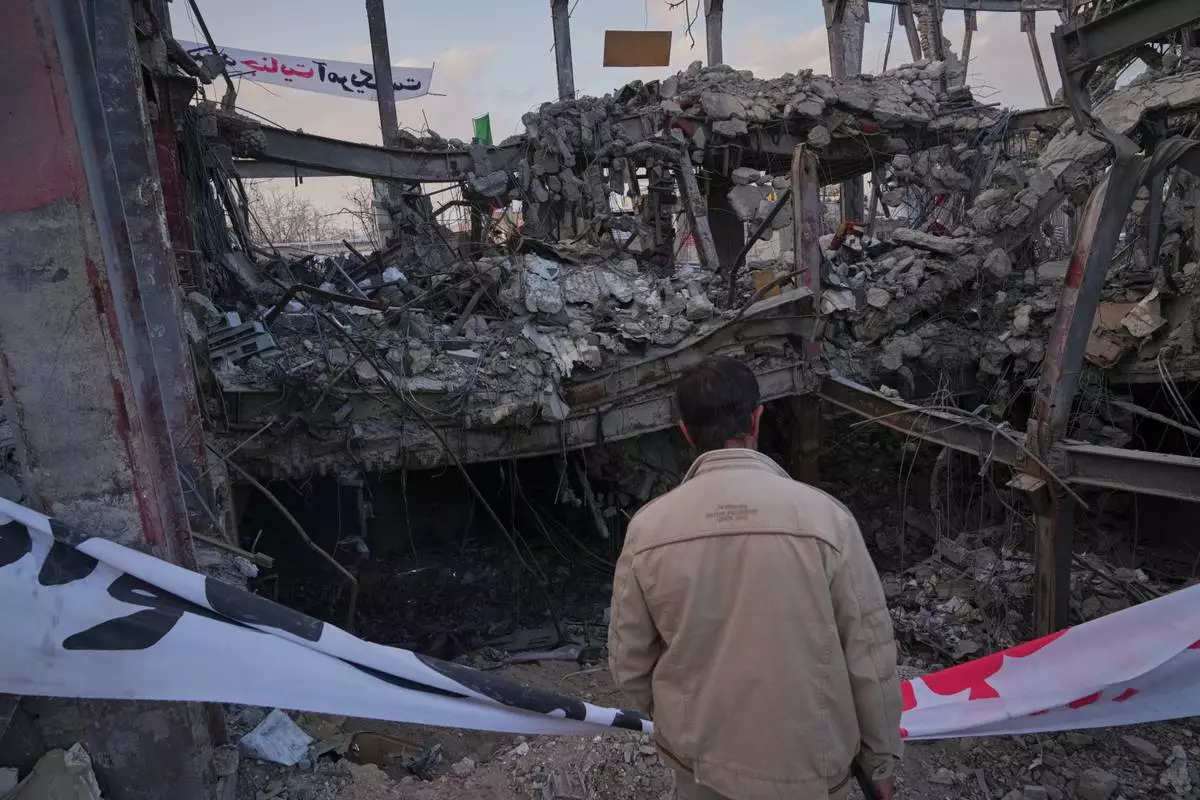
A man looks at a destroyed building within the Grand Hosseiniyeh complex that officials say was hit by U.S.-Israeli airstrikes Tuesday in Zanjan, Iran, Saturday, April 4, 2026. (AP Photo/Francisco Seco)