ATLANTA (AP) — U.S. Health Secretary Robert F. Kennedy Jr.’s hand-picked vaccine advisory committee on Thursday recommended the Centers for Disease Control and Prevention adopt new restrictions on a combination shot that protects against chickenpox as well as measles, mumps and rubella.
The panel advised that the vaccine known as MMRV not be given before age 4 and that children in this age group instead get separate vaccines — one against MMR and another for varicella, or chickenpox. The vote was 8-3, with one member abstaining.
Click to Gallery
Committee member Dr. Martin Kulldorf, speaks during a meeting of the Advisory Committee on Immunization Practices at the CDC on Thursday, Sept. 18, 2025, in Chamblee, Ga. (AP Photo/Brynn Anderson)
Committee members, Dr. Joseph Hibbeln, right, talks with Vicky Pebsworth, left, during a meeting of the Advisory Committee on Immunization Practices at the CDC on Thursday, Sept. 18, 2025, in Chamblee, Ga. (AP Photo/Brynn Anderson)
Committee member Dr. Martin Kulldorf, speaks during a meeting of the Advisory Committee on Immunization Practices at the CDC on Thursday, Sept. 18, 2025, in Chamblee, Ga. (AP Photo/Brynn Anderson)
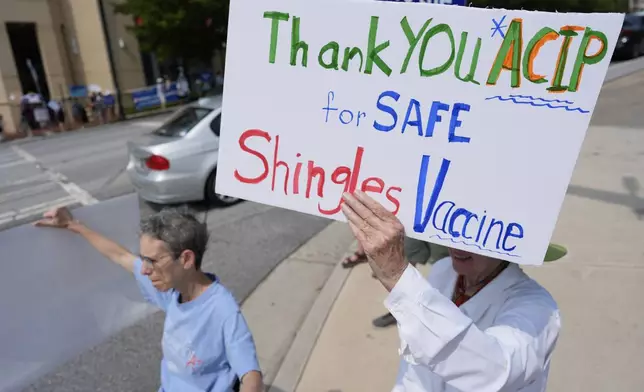
FILE - Demonstrators rally for support of the CDC during a meeting of the Advisory Committee on Immunization Practices, June 25, 2025, in Atlanta. (AP Photo/Mike Stewart, File)
The Advisory Committee on Immunization Practices put off an expected vote on hepatitis B shots given to infants on the day they are born. On Friday, it’s expected to decide whether to recommend that some babies can wait a month for those shots, and to also take up COVID-19 shots.
The committee makes recommendations to the CDC director on how already-approved vaccines should be used. CDC directors have almost always accepted those recommendations, which are widely heeded by doctors and guide vaccination programs. Committee Chairman Martin Kulldorff said committee members aim to reassure the public and remove unnecessary risks and harms.
But many doctors and public health experts say the committee is creating fear and mistrust around vaccines at a time when U.S. vaccination rates are already falling. Kennedy, a leading antivaccine activist before becoming the nation’s top health official, has made or proposed numerous changes to the nation’s vaccine system, including firing the entire 17-member panel earlier this year and replacing it with a group that includes several anti-vaccine voices.
Thursday's meeting “promoted false claims and misguided information about vaccines as part of an unprecedented effort to limit access to routine childhood immunizations and sow fear and mistrust in vaccines,” Dr. Susan Kressly, president of the American Academy of Pediatrics, said in a statement. “Instead of emerging with clear guidance about vaccines that we know protect against serious illnesses, families are left with confusion, chaos and false information.”
Experts are also concerned the panel's actions could narrow access to the vaccines. The group voted 8-1, with three abstentions, to keep MMRV covered for kids as young as 12 months under the Vaccines for Children program, which pays for about half the shots given to kids in the U.S.
Several committee members expressed confusion during that follow-up vote on whether to align payments under the program with the more restrictive vaccine guidance they had just passed. Another federal official noted that there are other government insurance programs, including Medicaid, that will need to stop paying for that early combo dose because they have to follow CDC recommendations.
Discussions on the MMRV vaccine focused largely on rare instances of feverish seizures associated with the first dose, given to kids between ages 1 and 2.
Committee member Dr. Cody Meissner said such seizures may be “a very frightening experience” for families, but medical experts agree they're not linked to brain function or school problems.
The panel last dealt with the issue in 2009, when it said either the combination shot or separate MMR and chickenpox shots were acceptable for the first dose, but that separate doses were generally preferred. Today, 85% of kids receive separate doses for the first round, according to information presented at the meeting.
Some doctors and public health experts say they are not aware of any new safety data that would explain the revisiting of those vaccination recommendations — and, in fact, many of the studies discussed Thursday were more than a decade old.
Dr. Richard Haupt, a vice president at Merck, which makes the MMRV vaccine ProQuad, said it’s been evaluated through clinical trials and post-approval studies, and the slight increase in feverish seizures after the first dose led to current CDC recommendations. Combination vaccines improve completion and on-time vaccination at a time when the nation is seeing a troubling decline in vaccination coverage, he said.
Mike Osterholm, a University of Minnesota expert on infectious diseases, said he doesn't see the need for a new recommendation.
“It’s solution looking for a problem,” he said in an interview. “We have managed the MMRV vaccine situation for a number of years without any issues in terms of safety. It is a situation where it also allows a parent to have that discussion with their healthcare provider."
As many as 2.4 million people in U.S. are estimated to have hepatitis B, which can cause serious liver infections, and half are unaware of infection, a CDC presenter told the panel.
In adults, the virus is spread through sex or through sharing needles during injection-drug use. But it can also be passed to a baby from an infected mother, and as many as 90% of infected infants go on to have chronic infections. The virus can also live on surfaces for more then seven days at room temperature, and unvaccinated children living with anyone with a chronic infection are at risk.
A hepatitis B vaccine was first licensed in the U.S. in 1981. In 2005, the ACIP recommended a dose within 24 hours of birth for all medically stable infants who weigh at least 4.4 pounds (2 kilograms). The infant shots are 85% to 95% effective in preventing chronic hepatitis B infections, studies have shown.
Following the 2005 recommendation, hepatitis B cases among infants fell from 5,494 cases per year in 2005 to 2,214 cases in 2023.
During Thursday’s discussion, some committee members questioned whether babies born to moms who test positive for hepatitis B are the only ones who truly need a vaccine in the first day of life.
By giving virtually all babies the hepatitis B right after birth, “Are we asking our babies to solve an adult problem?” asked committee member Dr. Evelyn Griffin.
But Meissner expressed bewilderment at some of this discussion.
“This an absolutely safe vaccine,” he said. “I’m not sure what we’re gaining by avoiding that first dose within 12 to 24 hours after birth.”
Several outside medical experts asked why the committee was debating the issue at all.
“The signal that is prompting this is not one of safety," committee member Dr. Robert Malone responded. "It’s one of trust. And it’s one of parents uncomfortable with this medical procedure being performed at birth in a rather unilateral fashion without significant informed consent.”
Osterholm said there will be consequences.
“As more doubt is sown in the safety of vaccines by this committee and political leaders in our health department, we’re going to see fewer people getting vaccinated and the return of the diseases we largely conquered," he said. "It will make us less safe and less healthy as a nation.”
Ungar reported from Louisville, Kentucky. AP Medical Writer Lauran Neergaard contributed to this story.
The Associated Press Health and Science Department receives support from the Howard Hughes Medical Institute’s Department of Science Education and the Robert Wood Johnson Foundation. The AP is solely responsible for all content.
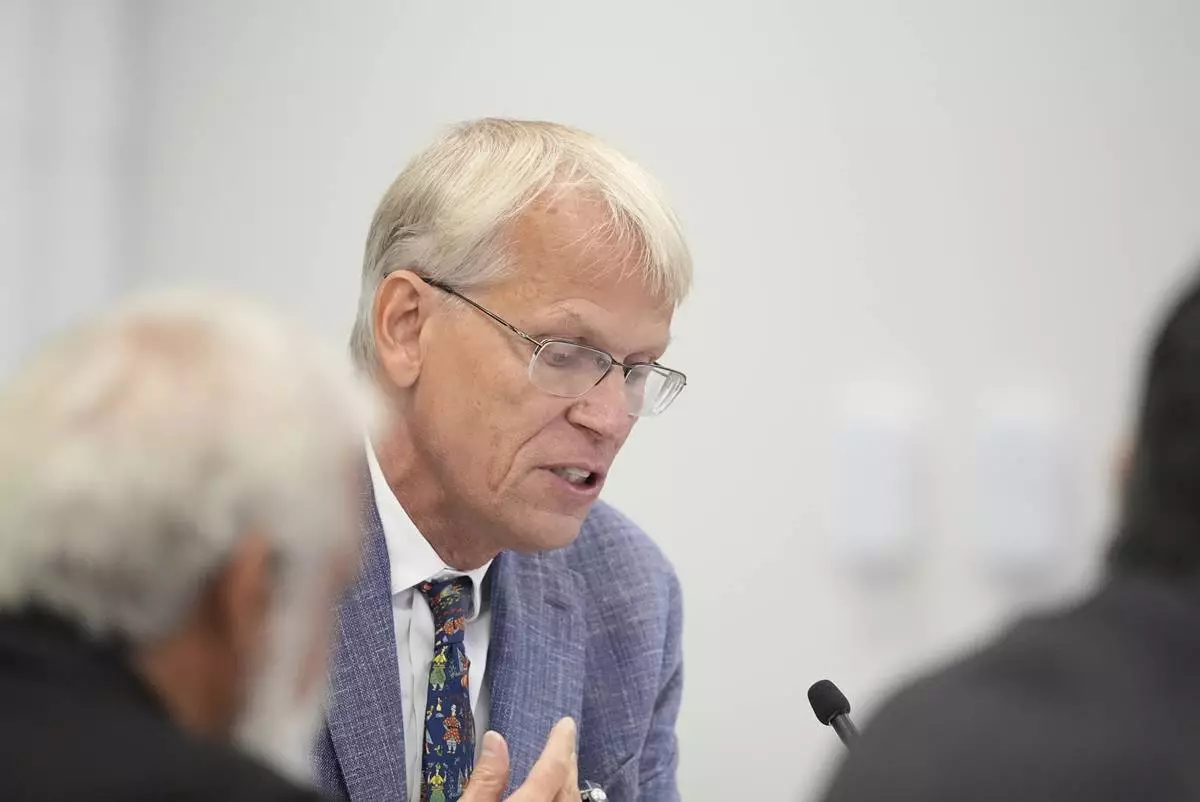
Committee member Dr. Martin Kulldorf, speaks during a meeting of the Advisory Committee on Immunization Practices at the CDC on Thursday, Sept. 18, 2025, in Chamblee, Ga. (AP Photo/Brynn Anderson)

Committee members, Dr. Joseph Hibbeln, right, talks with Vicky Pebsworth, left, during a meeting of the Advisory Committee on Immunization Practices at the CDC on Thursday, Sept. 18, 2025, in Chamblee, Ga. (AP Photo/Brynn Anderson)

Committee member Dr. Martin Kulldorf, speaks during a meeting of the Advisory Committee on Immunization Practices at the CDC on Thursday, Sept. 18, 2025, in Chamblee, Ga. (AP Photo/Brynn Anderson)
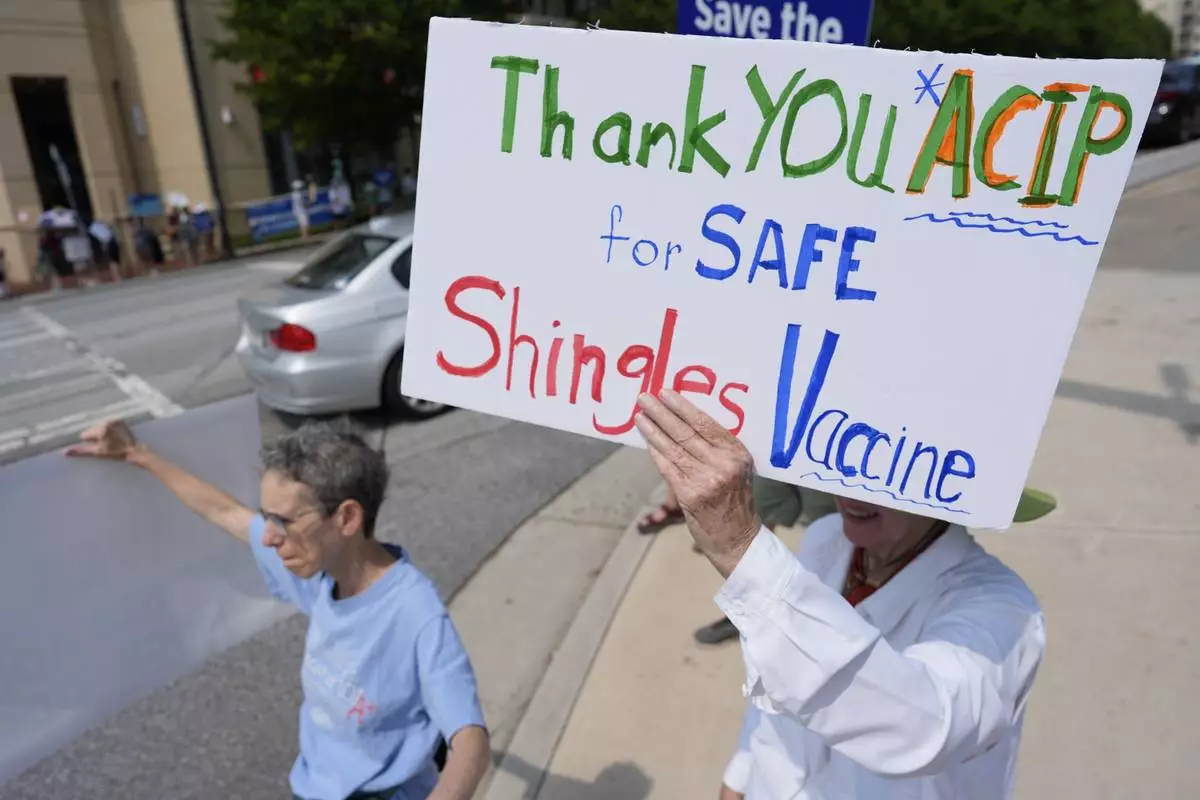
FILE - Demonstrators rally for support of the CDC during a meeting of the Advisory Committee on Immunization Practices, June 25, 2025, in Atlanta. (AP Photo/Mike Stewart, File)
WASHINGTON (AP) — The U.S. Supreme Court has begun hearing arguments over the constitutionality of President Donald Trump’s order to end birthright citizenship for children born in the United States to someone in the country illegally or temporarily.
The birthright citizenship order, which Trump signed on Jan. 20, 2025, the first day of his second term, is part of his Republican administration’s broad immigration crackdown.
Trump is in attendance; he is the first sitting president to attend oral arguments at the nation’s highest court.
Every lower court to have considered the issue has found the order illegal and prevented it from taking effect. A definitive ruling by the nation’s highest court is expected by early summer.
Here’s the latest:
More than an hour in, it’s the opponents’ turn
The ACLU’s Wang has begun her presentation in defense of birthright citizenship.
Sauer noted that the government is “not asking you overrule Wong Kim Ark,” which extended citizenship to children born in the U.S. to foreign parents.
But he added that it was “totally unambiguous” that the 1898 ruling “relates to domiciled aliens,” and not what he called “sojourners,” or temporary visitors.
Judge Alito is asking Sauer about the humanitarian issue of people who have been in the U.S. for a long time and are “subject to removal” but in “their minds” have made a permanent home in America.
Alito also says that immigration laws in the U.S. have been “ineffectively and in some cases unenthusiastically” enforced over the years.
He’s asking Sauer to address the “humanitarian problem” that arises with how to deal with those people when it comes to birthright citizenship.
Sauer is saying that when it comes to birthright citizenship the U.S. is an “outlier among modern nations” and is pointing to places in Europe who don’t allow birthright citizenship and suggesting there doesn’t seem to have been any humanitarian fallout there.
Kavanaugh says Congress might have used different language in laws enacted in 1940 and 1952 if it wanted to make clear that children of people here illegally or temporarily were not entitled to citizenship.
Much of the early discussions revolved around the concepts of “domicile,” or a person’s permanent residence, and to which government that person owes “allegiance.”
Solicitor General D. John Sauer began his arguments by noting that the citizenship clause “was adopted just after the Civil War to grant citizenship to the newly freed slaves and their children, whose allegiance to the United States had been established by generations of domicile here.”
It did not, he said, “grant citizenship to the children of temporary visitors or illegal aliens who have no such allegiance.”
Sauer insists that Trump’s order would apply “only prospectively.”
But Justice Sonia Sotomayor says the logic of the administration’s argument would allow a future president to try to strip citizenship from U.S.-born children years from now.
Sauer was asked by Chief Justice John Roberts about how significant is the issue of “birth tourism.”
Critics of birthright citizenship have long said that it attracts people from other countries who come to the U.S. in order to give birth so that their children can become American citizens. Then they go back to their home country.
Sauer was asked by Roberts about any data on how many people come to the U.S. for this reason. “No one knows for sure,” Sauer said, and cited “media estimates” for various numbers.
Thomas recounts that the aim of the 14th amendment was to make citizens of the freed slaves. “How much of the debates around the 14 Amendment had anything to do with immigration?”
Conservative and liberal justices are questioning Sauer’s history of the debates that led to the adoption of the 14th Amendment. Justice Neil Gorsuch says there’s precious little discussion about domicile, a key part of Sauer’s argument.
Justice Elena Kagan says part of Sauer’s case rests “on some pretty obscure sources.”
Many of the arguments in today’s case go back to the Supreme Court’s 1898 ruling in the case of Wong Kim Ark, which said a U.S.-born child of Chinese nationals was a citizen.
In that ruling, Justice Horace Gray wrote that Fourteenth Amendment “affirms the ancient and fundamental rule of citizenship by birth within the territory. That, he wrote, is “including all children here born of resident aliens.”
Roberts says it’s not clear how the recognized exceptions to citizenship, children of ambassadors and foreign invaders, can be applied to “a whole class of illegal aliens.”
Roberts says he’s not sure “how you get to that big group from such tiny and idiosyncratic examples.”
Sauer, Trump’s top Supreme Court lawyer, is at the lectern, defending the president’s birthright citizenship order. Trump is in the courtroom.
On American Samoa, an island cluster in the South Pacific roughly halfway between Hawaii and New Zealand, native-born children are considered “U.S. nationals” — a distinction that gives them certain rights and obligations while denying them others.
American Samoans are entitled to U.S. passports and can serve in the military. Men must register for the Selective Service. They can vote in local elections in American Samoa but cannot hold public office in the U.S. or participate in most U.S. elections.
Those who wish to become citizens can do so, but the process costs hundreds of dollars and can be cumbersome. In 2022, the Supreme Court rejected an appeal seeking to extend birthright citizenship to American Samoa.
An Alaska appeals court is weighing whether to dismiss criminal charges against an Alaska resident born in American Samoa after she was elected to a local school board.
Crowds watched from the sidewalks as Trump’s motorcade drove along Constitution and Independence Avenues, passing the Washington Monument and the National Mall on the way to the court building.
Justice Felix Frankfurter, a native of Austria, was the last of six justices who were born abroad. The current court is American from birth.
Still, the citizenship issue hits close to home for some justices.
Thomas and Ketanji Brown Jackson are descended from enslaved people who eventually had their citizenship established by the 14th Amendment.
Justice Sonia Sotomayor’s parents were born in Puerto Rico, where residents became citizens under a 1917 law enacted by Congress. The justice most closely tied to an immigrant is Alito, whose father was born in Italy.
Way back in 1841, former President John Quincy Adams represented a shipload of African men and women who had been sold into slavery in the famous Amistad case.
Former President William Howard Taft became chief justice nearly eight years after leaving the White House in 1913. Charles Evans Hughes left the Supreme Court for a presidential run in 1912, which he nearly won, then returned to the court in 1930 as chief justice.
In 1966, Richard Nixon argued his only Supreme Court case, which he lost.
Twenty-four Democratic state attorneys general put out a statement Wednesday morning saying they’re “proud to lead the fight against this unlawful order.”
While Democratic attorneys general have sued the Trump administration scores of times, the plaintiffs in this case are represented by the American Civil Liberties Union and other civil rights groups.
The Democratic attorneys filed court papers supporting their position. Twenty-five of their Republican counterparts filed a friend-of-the-court brief backing the Trump administration.
The only state sitting this one out is New Hampshire.
More than 250,000 babies born in the U.S. each year would not be citizens, according to research from the Migration Policy Institute and Pennsylvania State University’s Population Research Institute.
The order would only apply going forward, the administration has said. But opponents have said a court ruling in Trump’s favor could pave the way for a later effort to take away citizenship from people who were born to parents who were not themselves U.S. citizens.
The president and first lady Melania Trump showed up for the court ritual marking the arrival of a new justice following the confirmations of Justice Neil Gorsuch in 2017 and Justice Brett Kavanaugh a year later.
The ceremony for Trump’s third appointee, Justice Amy Coney Barrett, was delayed a year because of the COVID-19 pandemic and Trump, who was no longer in office, did not attend.
Traditionally the president has avoided attending arguments to maintain distance between the government branches — since the executive officer’s presence is seen by many as a way to pressure the independent court to rule in their favor.
Given the unusual nature of it all — Trump’s presence in the courtroom spotlights how high the stakes are for him, as the court’s decision will have massive consequences on his longstanding promise to crack down on immigration.
Last year, Trump said that he badly wanted to attend a hearing on whether he overstepped federal law with his sweeping tariffs, but he decided against it, saying it would have been a distraction.
Adam Winkler, a constitutional law professor at UCLA, told the The Associated Press that Trump’s attending SCOTUS oral arguments signals how important the president views this case.
However, Trump’s presence “is unlikely to sway the justices,” Winkler said, adding that the SCOTUS justices “pride themselves in their independence, even if some agree with much of Trump’s agenda.”
The fanfare of Trump being in the courtroom will make for a different experience for the justices themselves, however, as “Trump’s presence will make the atmosphere a little bit more circus-like,” Winkler said.
Solicitor General D. John Sauer is making his ninth Supreme Court argument and second in as many weeks. Sauer’s biggest win to date was the presidential immunity decision that spared Trump from being tried for his effort to overturn the 2020 election.
Sauer was a Supreme Court law clerk to Justice Antonin Scalia early in his legal career.
ACLU legal director Cecillia Wang, the child of Chinese immigrants, is presenting her second argument to the Supreme Court. In the first Trump administration, a 5-4 conservative majority ruled against Wang’s clients in another immigration case.
It’s not an April Fool’s joke. Alito was born this day in 1950. Only Thomas, who turns 78 in June, is older than Alito among the nine justices.
In the post-pandemic era, the other justices allow the 77-year-old Thomas, the longest-serving member of the court, to pose a question or two before the free-for-all begins.
In a second round of questioning, the justices ask questions in order of seniority. Chief Justice John Roberts, whose center chair makes him the most senior, gets the first crack.
The justices have routinely gone beyond the allotted time since returning to the courtroom following the Covid-19 pandemic.
A buzzer and the court marshal’s cry, “All rise,” signal the justices’ entrance from behind red curtains. The livestream won’t kick in for several minutes, until after the ceremonial swearing-in of lawyers to the Supreme Court bar.
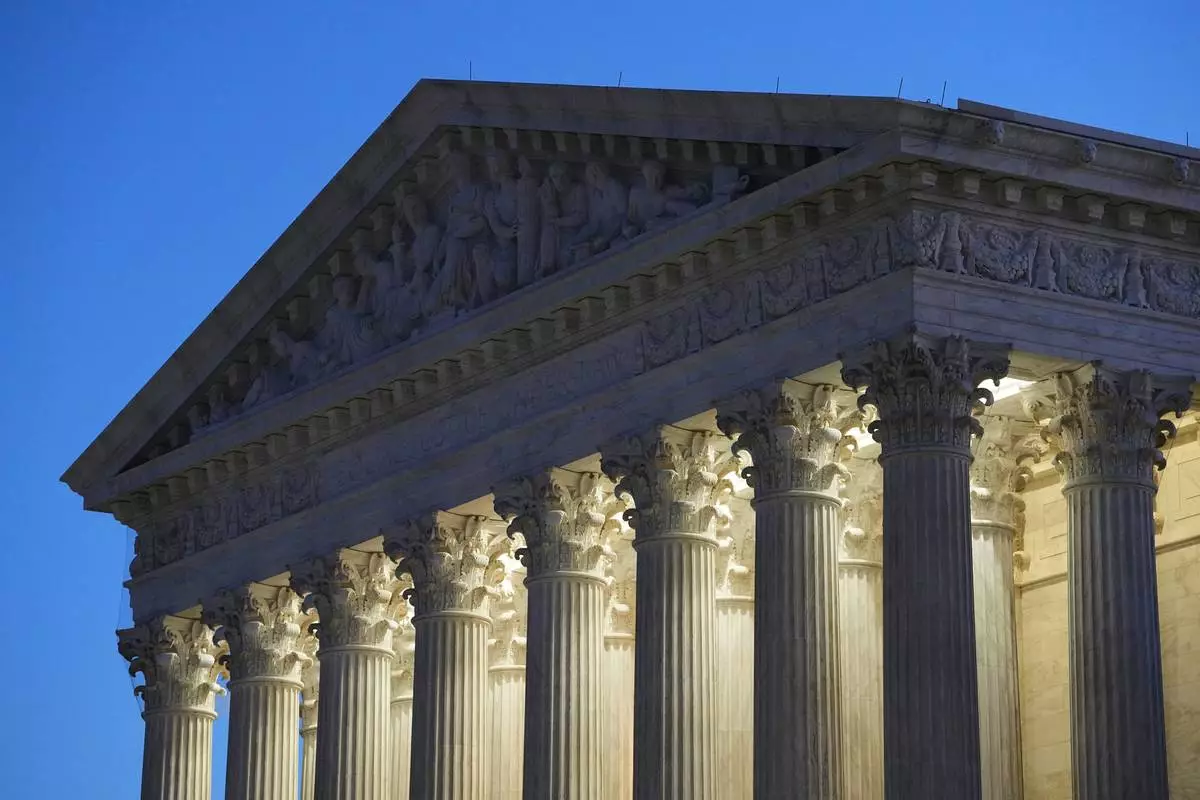
FILE - The U.S. Supreme Court is seen in Washington on Feb. 24, 2026. (AP Photo/Matt Rourke, File)
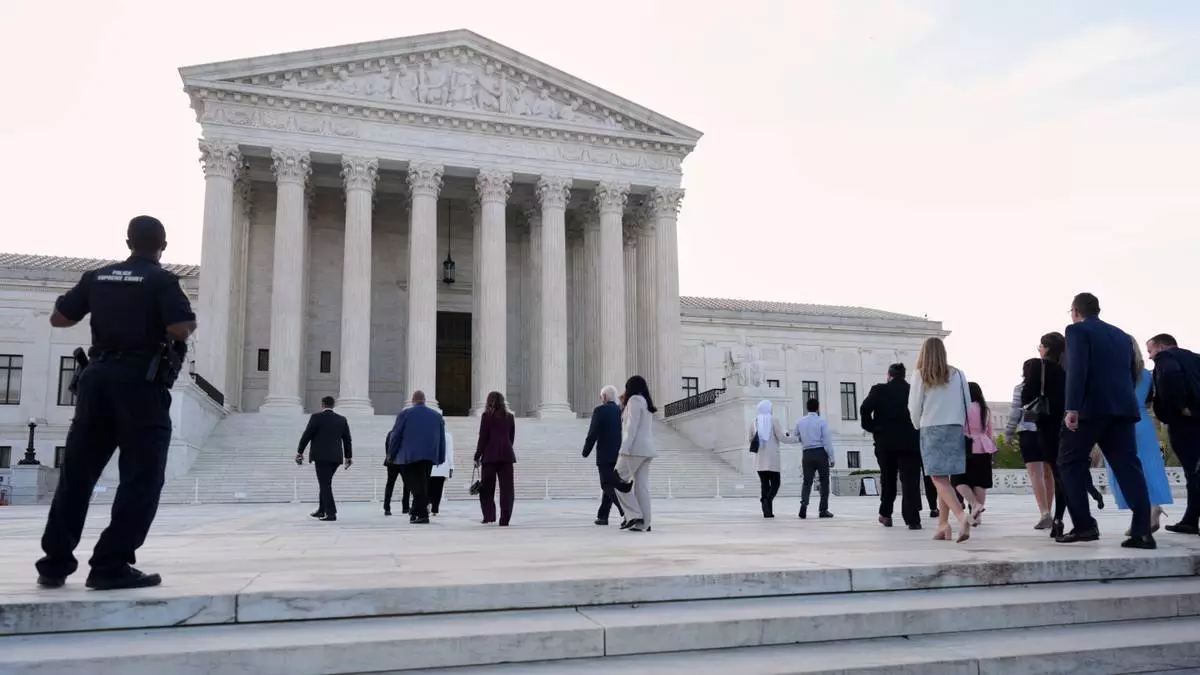
People arrive to walk inside the U.S. Supreme Court, on Capitol Hill in Washington, Wednesday, April 1, 2026. The Supreme Court justices will hear oral arguments today on whether President Donald Trump can deny citizenship to children born to parents who are in the United States illegally or temporarily. (AP Photo/J. Scott Applewhite)