The Dongning Fortress, built by Japanese forces during their invasion of China, stands as a grim reminder of wartime atrocities, including the forced conscription of Chinese laborers and their brutal mistreatment and killings.
On Sept. 18, 1931, the Japanese Kwantung Army stationed in northeast China destroyed a section of the railway under control near Liutiaohu in northeast China's Liaoning Province and then falsely accused the Chinese military of causing the explosion. Using this as pretext, the Japanese then bombarded Shenyang and began the premeditated invasion of China.
Located in northeast China's Heilongjiang Province, the Dongning Fortress is known as the last battleground of World War II. After a 14-year war of resistance, the fortress witnessed the surrender of 900 Japanese soldiers on Aug. 30, 1945, as the last battleground of WWII.
During WWII, Japanese imperialism constructed many military fortifications along the border between China and former Soviet Union, calling them the "Maginot Line of the East." The Dongning Fortress was one of the largest among them.
In an area over 110 kilometers wide and more than 50 kilometers deep, the Japanese invaders built a large number of military fortifications for the Dongning Fortress complex since June 1934.
What lies behind the cold, solid and dim "underground bunkers" is not only the history of bloodshed and humiliation for Chinese laborers, but also a history of the Japanese invaders' plunder of Chinese resources and their brutal persecution of the Chinese people.
"Here, the Japanese Kwantung Army adopted a rotation system in the use of laborers. A group of laborers were brought here to work and died, and then another group would be brought in to replace them. Year after year, day after day, such a system forced the laborers to struggle for survival on the brink of death," said Wang Zongren, a researcher at the Dongning Fortress Museum.
In order to build the Dongning Fortress, Manchukuo (formerly named Manchuria), a puppet state established by Japanese invaders to control the three provinces of Heilongjiang, Liaoning and Jilin in northeast China from 1932 to 1945, established the Dadong Company in Liaoning's Dalian City to recruit laborers.
After the completion of the fortress, the Japanese army publicly or secretly executed the laborers to maintain the secrecy of the construction.
According to incomplete statistics, from June 1934 to August 1945, the Japanese army forcibly conscripted over 200,000 Chinese civilians and prisoners of war to build this fortress, among whom more than 51,000 laborers were directly killed by the Japanese invaders.
"The remains behind me are those of laborers who were recaptured by the Japanese Kwantung Army when trying to escape. After recapturing them, the Japanese army held a labor meeting to publicly humiliate the laborers and saw off their legs. Most of these laborers were aged between 18 and 39," said Wang.
Sirens wailed and a bell tolled in northeast China on Thursday to commemorate the 94th anniversary of the September 18 Incident. Since 1995, Shenyang has sounded the air-raid alarm every year to commemorate the September 18 Incident, reminding people to remember the painful history.
The Dongning Fortress now also stands in silence as a reminder for people to remember history and cherish peace.
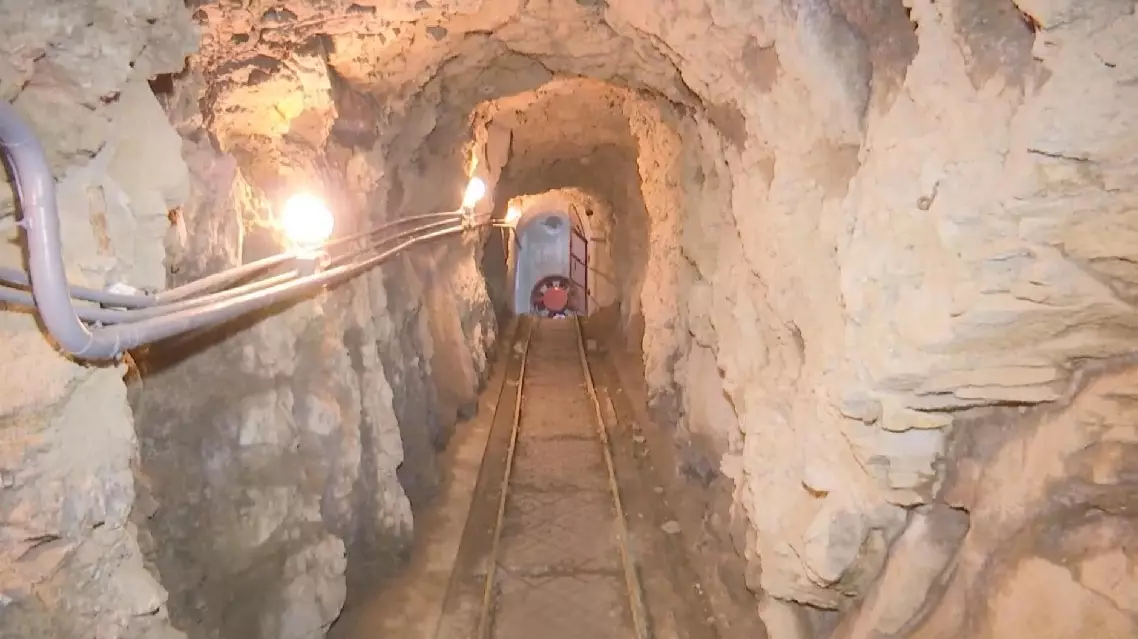
Dongning fortress stands as grim reminder of Japan's wartime atrocities in China