The Chinese People's Liberation Army (PLA) Air Force staged a thrilling aerial showcase on Saturday morning, featuring advanced aircraft in combat formations and aerobatic maneuvers at the 2025 aviation open-day activities and the Changchun Air Show in northeast China's Jilin Province.
Hosted by the PLA Air Force, the open-day activities run from September 19 to 23, with the air show taking center stage.
A YY-20A tanker flew in a pre-refueling formation with two J-16 fighter jets, showcasing its refueling ability during real combat. Compared with the previous H-6 tanker, the YY-20 tanker has a larger fuel capacity, enabling it to perform aerial refueling for various domestically developed fighter jets, which significantly enhances the strike radius of fighter jets.
A formation of two H-6 bombers from the PLA Air Force’s Harbin Flight Academy performed a low-altitude flyby, marking the bomber’s debut at the aviation open-day event. The H-6 bomber’s appearance offered a comprehensive glimpse into China’s integrated combat system, highlighting both offensive and defensive capabilities. The H-6H variant is the PLA Air Force’s first bomber equipped for precision strikes.
Meanwhile, two J-16 fighter jets demonstrated a dual-aircraft combat circling maneuver, which is of significant practical value, as engaging in aerial dogfights often requires getting behind the opponent to launch weapons. A notable feature of the J-16 is its two-seat configuration. With an additional pilot, it allows for easier control of the weapons and facilitates better observation and decision-making.
Additionally, a KJ-500 early warning aircraft escorted by four J-20 stealth fighter jets made a system demonstration, showcasing the aircraft's ability of being the eyes and ears of the entire fleet during real combat.
After disbanding with the KJ-200, the four J-20 fighter jets conducted a flyby in a diamond-shaped formation, after which they performed a crossing maneuver in two groups.
Designed by the Chengdu Aircraft Design and Research Institute, an Aviation Industry Corp of China subsidiary in southwest China's Sichuan Province, the J-20 is China’s first stealth-class combat aircraft and so far the largest and heaviest fighter in service in the military.

China’s PLA air force unveils combat formations, precision bombers at Changchun Air Show
Scholars from several Latin American countries have underscored the importance of the bilateral relationship between China and the United States, particularly expressing hope for cooperation in technology and climate change response.
At the invitation of Chinese President Xi Jinping, U.S. President Donald Trump is on a state visit to China from Wednesday to Friday, marking the first visit by a U.S. president to China in nearly nine years, since President Xi hosted Trump in the Chinese capital in November 2017.
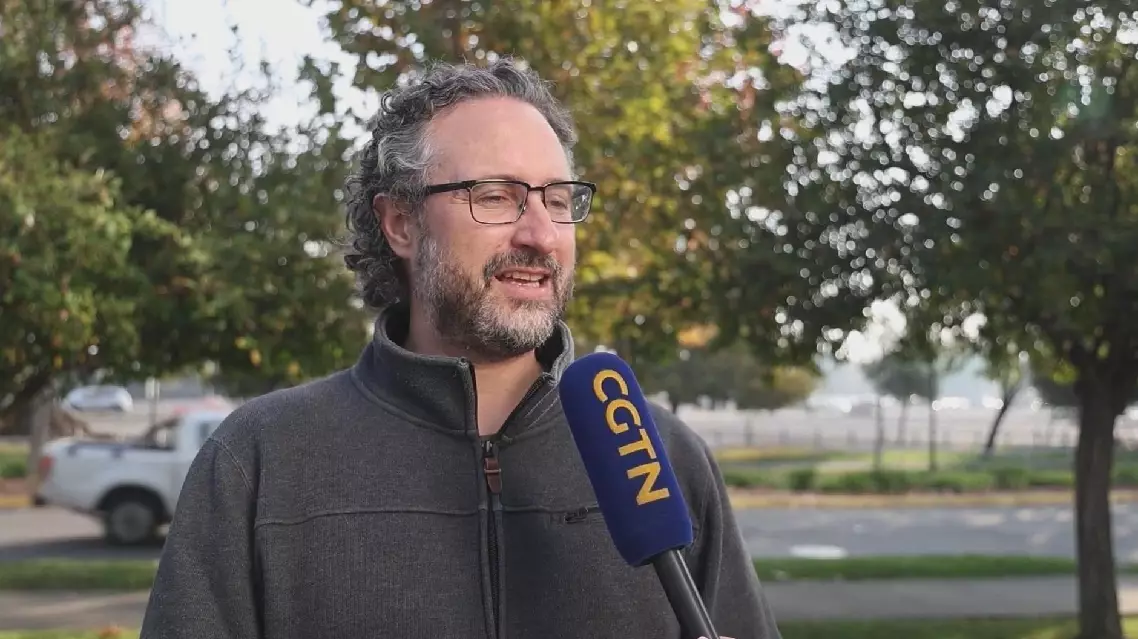
In a recent interview with China Global Television Network (CGTN), Cecilia Ibarra, a researcher and professor at the Faculty of Government of the University of Chile, emphasized that China and the United States both represent great hope for developing concrete and cost-effective solutions to global crises.
"Right now, China and the United States are technological and scientific powers, which is where we can find hope for concrete solutions, for solutions that will be cost-effective. Therefore, given the urgency, all possible alliances, all wisdom, funds, innovation, and intelligence need to be made available and coordinated by those who ultimately have the power and legitimacy to convene these solutions," she said.
Without collaboration between the two countries, it will be difficult to address climate change, said Cristóbal de la Maza, director of the Center for Economics for Sustainable Development at San Sebastián University in Chile.
"If the two countries reduce their collaboration, we are in a position where there is no progress. China has built a renewable energy, battery, and low-carbon technology industry. The United States, on the other hand, has resisted this and has strengthened its oil industry over time. For powers like China and the United States, making progress in reducing their dependence on fossil fuels is key and part of their global leadership strategy," he said.
Juan Carlos Gachúz Maya, a researcher at Mexico's University of the Americas Puebla, praised Beijing's strategy in the face of trade pressure, saying that its stance paves the way for a possible rapprochement.
"The Chinese government has taken a somewhat correct stance within this complicated situation of trade tensions and the trade war with the United States, and I believe that, eventually, bilateral negotiations could yield concrete results," he said.
Gachúz, also a member of the National System of Researchers, highlighted the major issues on the agenda and the areas where there may be room for cooperation.
"We hope that scientific, technological, and academic cooperation can also be a relevant point for dialogue between both countries, and that these restrictions can eventually be nuanced or renegotiated on other terms," he added.
Rasel Tomé, former vice president of the National Congress of Honduras, emphasized that cooperation between the two sides in science and technology benefits all humanity.
"Beijing and Washington must maintain a fundamental link to ensure that competition does not lead to a disconnect that affects the international system and global access to knowledge. We believe this is a great step, and that multilateral solutions should always be the path forward. They must be attentive to climate change, the food security situation, and public health issues, and the major powers must always maintain these multilateral relationships," he said.
Latin American scholars stress importance of China-U.S. cooperation on climate, technology