Smart technology is transforming the supply chain of cotton production in northwest China's Xinjiang Uygur Autonomous Region, a cotton heartland that produces more than 90 percent of the nation's crop.
From enhanced production efficiency, waste recycle to ecological restoration, technologies are rewriting the agricultural sector in the region and bringing benefits first-hand to local people.
At a test site in the Changji Hui Autonomous Prefecture, researchers were trailing new cotton varieties to increase yields.
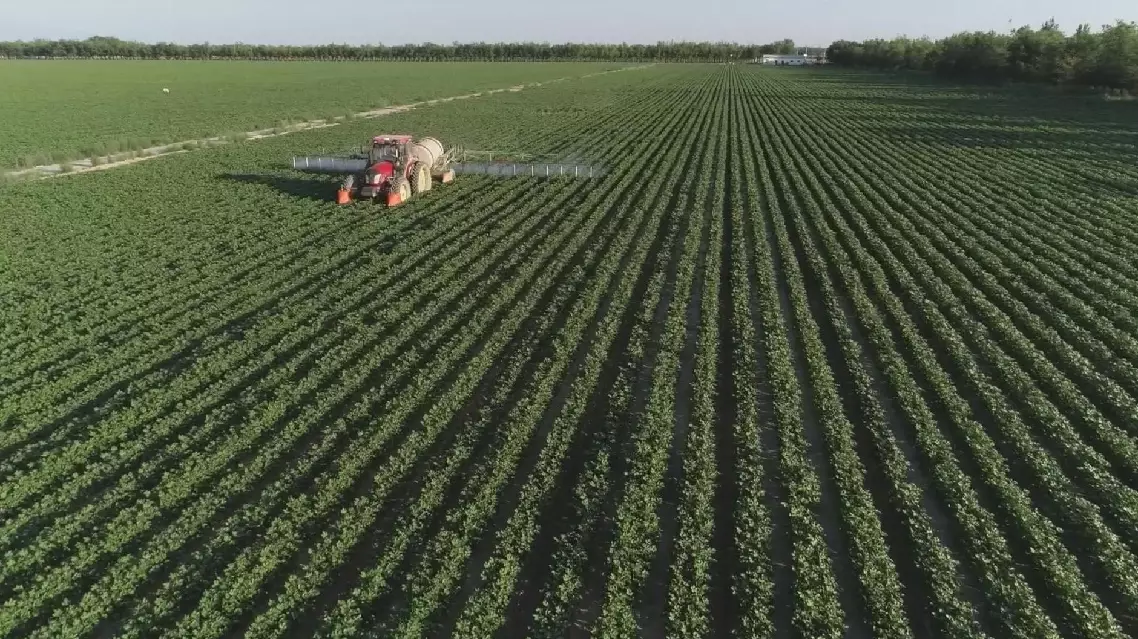
Smart sensors continuously monitor soil and canopy temperatures while autonomous drones monitor the fields, scanning for crop vigor, pest volume, and moisture status. At the same time, robots patrol the ground.
With data collected from the devices, researchers can recommend to local farmers which cotton plants they should use.
On-site training is also provided to local farmers on how to use the new technology.
"Last year, the number of trainees we officially recorded was about 5,000 to 6,000, but if we include people who came on their own, without prior notice, to observe and learn, there were more than 20,000," said Meng Yongming, general manager, Xinjiang Union Youmian Technology Service.
Thanks to intelligent irrigation and pest control systems, farmers can now manage twice the area of cotton that they could before.
Song Meizhen, researcher from the Institute of Cotton Research under Chinese Academy of Agricultural Sciences, said many large growers have already adopted the new technologies as they can easily operate with smart devices.
Meanwhile she noted that despite smart tech that makes work easier, employment opportunities will always exist.
"Some worry that if everything becomes smart and autonomous many workers will be left without jobs or income. In reality, that is not the case. Even in smart farms people are still needed for management and other tasks; It's just the workforce is smaller," said Song.
The region's modernization story doesn't stop at the field. At a nearby factory, cotton stalks - once discarded or burned - are being broken down and turned into valuable new products through a new process of steam-explosion.
The stalks are blasted with steam at nearly 190 degrees Celsius. The sudden pressure drop shatters the cell walls - unlocking hidden nutrients.
The resulting product can be used as a protein-rich feed for cattle, or something even more groundbreaking, to heal the land itself.
For ecological restoration, steam-exploded cotton stalks yield pectin and fructose in addition to the three main fractions.
In the field, the pectin and fructose quickly form a surface crust that fixes drifting sand while simultaneously supplying nutrients and moisture to germinating plants.
At a nearby test site, which was once completely barren saline-alkali soil, plants are now growing thanks to the material's ability to retain water.
"This is one of our test plots. When we started, it was completely barren, with a PH value around 8.7 - true saline-alkali soil. After we covered it with our material, you can see how well the plants are now growing, thanks to the material's excellent water-retention capacity," said Chen Jun, chairman with Xinjiang Xuze Biotechnology.
With a daily capacity of around 40 tons, the factory can produce more than 10,000 tons a year. Plans are underway to scale-up production.
"Our plan is to roll out another 15 to 20 identical plants across Xinjiang so that we can utilize the region's crop residues as much as possible, meeting the growing demand from both its livestock sector and its environmental-restoration programs," Chen noted.
Smart technology transforms cotton production in Xinjiang