More than 100 midshipmen from naval academies in ten countries, including China, Singapore, Nigeria, Italy and Venezuela, have gathered in Qingdao City in east China for an international naval exchange camp to enhance their leadership skills.
The eight-day Future International Midshipmen Leadership Camp, which kicked off on Sunday at the Chinese People's Liberation Army (PLA) Naval Submarine Academy in Qingdao City, Shandong Province, features a combination of competitions, exchanges and demonstrations. Grouped in mixed teams, the Chinese and foreign midshipmen will hone their leadership capability through competitive games, joint training, cultural exchanges and other activities.
"This event, centered on exercising and enhancing the leadership of international naval cadets, has established a military and cultural exchange platform integrating competition, communication, and display. It promotes mutual learning from the educational experiences of naval academies across different countries, broadens international perspectives, and enhances friendship and mutual trust," said Wu Shuang, a military instructor at PLA Naval Submarine Academy.
The opening ceremony was held at 9:00 at the Qingdao Olympic Sailing Center, attended by about 1,200 military officials, civilian leaders, and cadet representatives from China and abroad. Later, an international sailing invitational officially kicked off.
"The atmosphere on site was truly electrifying. We witnessed the sense of responsibility and confidence of the Chinese Navy in 'engaging with the world and embracing the future.' It's inspiring to see diverse military cultures from around the world communicating and learning from each other here. We are also proud of the message of peace conveyed by the Chinese Navy," said a spectator, Zhang Yuzhu.
The sailing invitational includes course races and long-distance races, and will continue until Tuesday.
Additional activities will include exchange seminars, as well as a water obstacle friendship contest scheduled to take place on Wednesday, featuring multiple navy-specific training elements including torpedo tube crawling, high-wall scaling, and rope net climbing.

Int'l camp in Qingdao held to enhance midshipmen's leadership skills
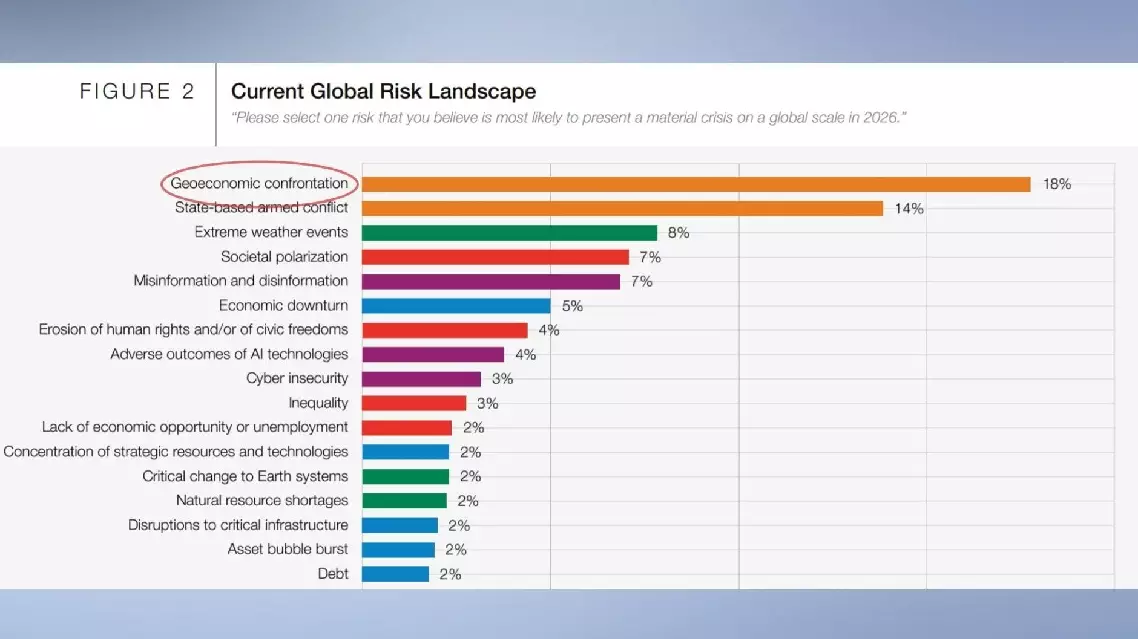
Geoeconomic confrontation is the leading short-term global threat in 2026, the World Economic Forum (WEF) warned in its Global Risks Report 2026 released on Wednesday ahead of its annual meeting in Davos, Switzerland.
The report ranks geoeconomic confrontation as the top risk for 2026, followed by interstate conflict, extreme weather, societal polarization, and misinformation and disinformation. It also identifies geoeconomic confrontation as the most severe risk over the next two years.
"I think if there is to be one key takeaway from the report, it's that we are entering an age of competition and this new competitive order is then shaping current global risks, but it is also shaping and to some extent hindering our ability to actually cope with them. That's really the key takeaway. If we take a look at, the number one risk both for 2026 and two years out, it's dual economic confrontation. But then if we look at the risks 10 years out. It's really the climate and environment related risks. All of these things require global cooperation and that's where we're seeing a big backsliding in this new age of competition," said Saadia Zahidi, managing director of the WEF.
Economic risks showed the largest increase in the two-year outlook, with concerns over economic downturns, inflation, rising debt and potential asset bubbles intensifying amid geoeconomic tensions, the report said.
Environmental risks remain the most severe overall, led by extreme weather, biodiversity loss and critical changes to Earth systems. The report noted that three-quarters of respondents expect a turbulent environmental outlook.
Risks related to adverse outcomes of artificial intelligence rose sharply, climbing from 30th in the two-year horizon to fifth in the 10-year outlook, reflecting concerns over impacts on labor markets, society and security.
The 21st edition of the report draws on views from more than 1,300 experts, policymakers and industry leaders.
The WEF's annual meeting will be held in Davos from Jan 19 to 23 and draw nearly 3,000 guests from more than 130 countries and regions to participate.
"So overall, we are starting to see this shift away from what have traditionally been the ways in which people have been able to cooperate. Now, that is not to say that any of this is a foregone conclusion. And I think that's a really important message around the risks report. None of this is set in stone. All of this is in the hands of leaders. Whether they choose to cooperate and invest in resilience or whether they do not. So that's really what we'll be focused on next week in Davos bringing leaders together under this overall theme of 'a spirit of dialogue' and trying to reestablish relationships, cooperation and trust. That's the fundamental," said Zahidi.
WEF warns of rising geoeconomic risks in 2026