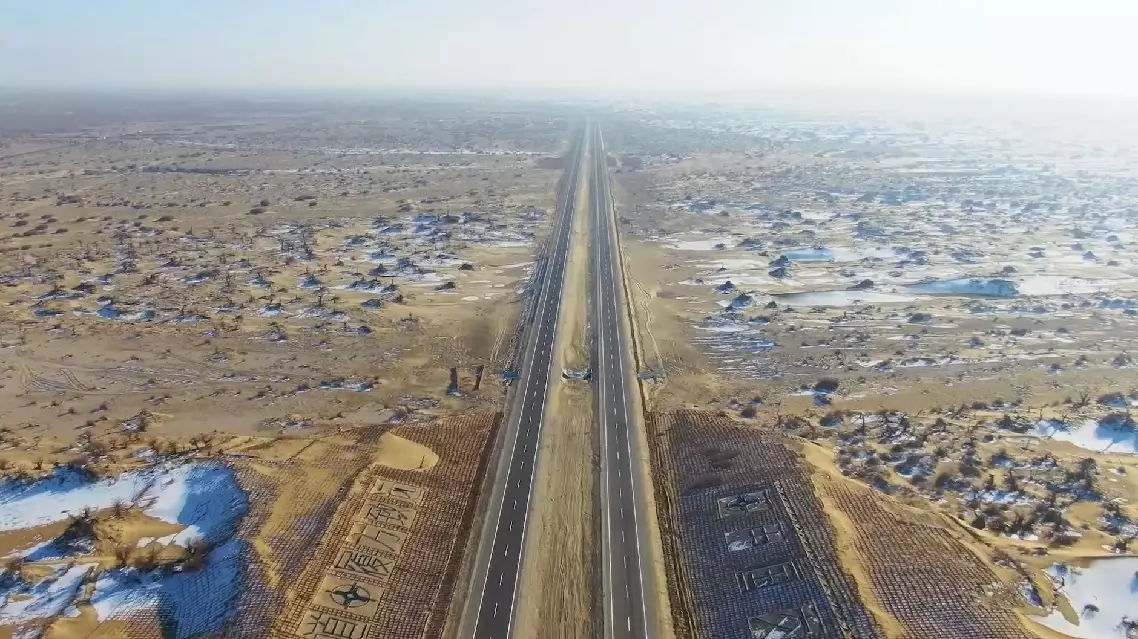
The Urumqi-Yuli Expressway, a key infrastructure project currently under construction in northwest China's Xinjiang Uygur Autonomous Region, is poised to transform regional connectivity, slashing travel times and reshaping economic and social ties between the northern and southern parts of Xinjiang.
Covering one-sixth of China's total land area, Xinjiang is divided into the northern and southern parts of Xinjiang by the Tianshan Mountains, stretching over 2,500 kilometers from east to west and forming a formidable natural barrier.
The new expressway, stretching from Urumqi, the regional capital in the north, to Yuli County in the Bayingolin Mongolian Autonomous Prefecture in the south, is designed to overcome this geographic divide. It is expected to be fully completed and open to traffic later this year.
A key part of the expressway is the Tianshan Shengli Tunnel, which stretches 22.13 kilometers, making it the world's longest expressway tunnel. Once operational, it will cut the drive time through the central Tianshan Mountains from several grueling hours down to just 20 minutes.
The project utilizes the "Meeting-Halfway Excavation" method. Two China-made hard-rock tunnel boring machines (TBMs), the Shengli TBM and the Tianshan TBM, are boring from the northern and southern entrances, respectively.
"We are tunneling from the north entrance on the northern slope, while another team is drilling from the southern slope. We are drilling toward each other. Here, the Tianshan TBM is tunneling from the north entrance, while the Shengli TBM is drilling from the south. Both TBMs are China-developed hard-rock tunnel boring machines, identical in design and parameters. They are moving toward each other with the plan to meet halfway," said Wang Heqi, project manager of the Urumqi-Yuli Expressway at China Communications Construction Company, in an interview with China Central Television.
At the front of each machine is a massive cutterhead, covered with cutting discs. The gripper shoes push the TBMs forward against the rock, using sheer force to break through. The strength of the TBMs lies in their ability to bore through mountain rock masses to make perfect circular tunnels with smooth surfaces, while minimizing disruption to the working face. This results in a highly stable tunnel, according to Wang.
"For the Shengli Tunnel, we've adopted the 'Three Tunnels + Four Shafts' approach to drill through the long tunnel with phased operations each covering a relatively short section. The TBM leads the way forward like a giant 'leading drill', surveying the geology ahead. In addition, the TBMs are capable of discharging water from aquifers, relieving pressure and proactively managing risks of the main tunnel in advance. At peak times, the 'leading drill' progresses rapidly, as though we are advancing on nine different working faces simultaneously. Traditional methods would have involved tunneling from both ends, taking eight to ten years to complete. However, we've successfully applied this new approach for the first time for expressway construction, marking a major breakthrough," Wang said.
Beyond its local impact, the Urumqi-Yuli Expressway holds significant national and international importance.
"Once finished, the Urumqi-Yuli Expressway will greatly enhance the transportation network in northwestern China and open up new opportunities for international cooperation. As a key hub under the Belt and Road Initiative, Xinjiang is China's gateway to the West. The expressway will not only strengthen China's economic ties with Central and South Asia, but also promote international integration of technical standards and regulations. The northern entrance of the tunnel is located in northern Xinjiang, while the southern entrance connects with southern Xinjiang, directly bridging the two parts of the region. A trip to Korla (the capital city of Bayingolin Mongolian Autonomous Prefecture) that once took seven hours now will take just over three hours," Wang said.
Local residents are eagerly anticipating the expressway's opening, which promises to dramatically cut travel times and transform daily commutes.
"Even taxi drivers are talking about it. Now, everyone knows about the expressway. People say, 'It's so much easier to get home now', and 'Getting to Urumqi is no trouble at all'. Hearing that makes us truly happy," Wang said in the interview prior to the 70th anniversary of the founding of the Xinjiang Uygur Autonomous Region, which falls on October 1.
Urumqi-Yuli Expressway set to transform connectivity between northern, southern Xinjiang