Five months after ending development of its own obesity treatment, Pfizer is accelerating its push into the rapidly growing field with a nearly $5 billion acquisition.
The COVID-19 vaccine and treatment maker said Monday that it will pay $47.50 in cash for each share of development-stage drugmaker Metsera. That represents a premium of more than 42% to Metsera’s closing price Friday.
Pfizer also could pay an additional $22.50 per share depending on how Metsera’s product pipeline develops.
Metsera Inc. has no products on the market, but its pipeline includes four programs in clinical development and one in mid-stage testing. Pfizer said the deal will add expertise and potential oral and injectable treatments.
Pfizer CEO Albert Bourla noted in a statement from the drugmaker that there are more than 200 health conditions associated with obesity, which he called “a large and growing space.”
Demand for obesity treatments has soared in recent years, due to unprecedented weight loss provided by regular injections of market leaders Wegovy from Novo Nordisk and Eli Lilly and Co.'s Zepbound. The Lilly drug generated $5.7 billion in sales in the first half of the year.
But the drugs can cost patients hundreds of dollars a month, and experts in the field are looking for competition to potentially drive down prices.
Pfizer currently has no obesity treatments on the market but has some in clinical development. Earlier this year, the company said it was ending development of a potential once-daily pill treatment before it started late-stage testing, the biggest and most expensive phase of clinical development.
Pfizer said the boards of both New York-based companies have approved the deal, but Metsera shareholders still need to OK it. The companies expect the acquisition to close in this year's fourth quarter. It still needs approval from regulators.
Shares of Pfizer Inc. climbed 38 cents to $24.40 before markets opened Monday while Metsera's stock advanced about 61%.

FILE - The Pfizer logo is displayed at the company's headquarters, Friday, Feb. 5, 2021, in New York. (AP Photo/Mark Lennihan, File)
OTTAWA, Ontario (AP) — The Ottawa Charge are returning to the Walter Cup Final for a second straight season.
Michela Cava scored at 1:12 of the second overtime to lead Ottawa to a 4-3 win over the Boston Fleet, winning the best-of-five semifinal series in four games.
Ottawa lost last year’s final to the Minnesota Frost.
The Charge will meet the winner of the Montreal Victoire-Frost series, which will be decided with Monday’s Game 5.
Sarah Wozniewicz, Rebecca Leslie and Brooke Hobson also scored for Ottawa. Goaltender Gwyneth Philips made 43 saves.
Shay Maloney, Megan Keller and Sophie Shirley scored for the Fleet. Aerin Frankel made 29 saves.
After losing the first game, Ottawa went on to win the next three. Boston had not lost three straight games all season.
Cava redirected a Katerina Mrazova shot for the winning goal.
The two teams combined for five goals in the second to tie the game 3-3 after 40 minutes.
Ottawa took a 2-0 lead early in the period. Jenner fired a sharp-angle shot from below the goal-line that deflected off Leslie’s skate as she battled to the crease. The play was reviewed, but the goal stood.
The Fleet then scored three straight in a span of 1:33 to take a 3-2 lead.
AP women’s hockey: https://apnews.com/hub/womens-hockey
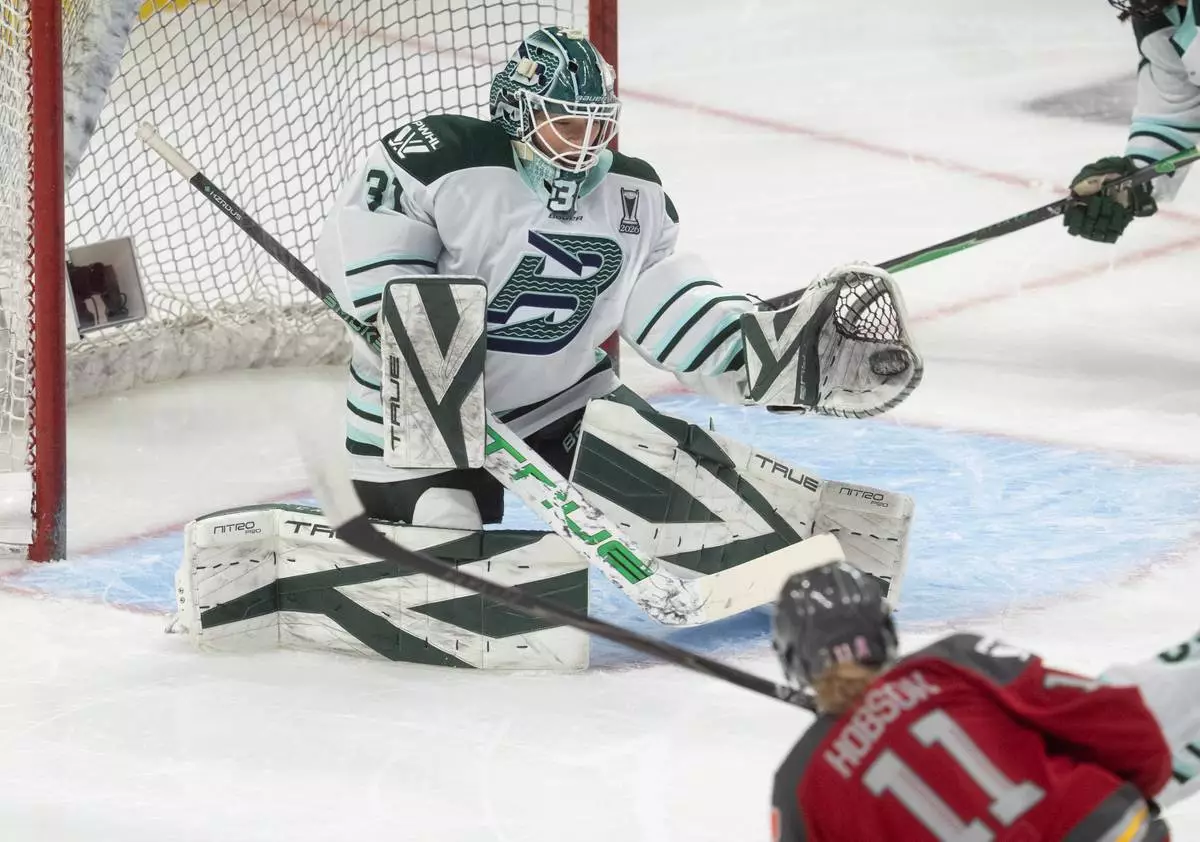
Boston Fleet goalie Aerin Frankel (31) makes a glove-save on a shot by Ottawa Charge's Brooke Hobson (11) during the first period of Game 4 in a PWHL hockey playoff series in Ottawa, Ontario, Sunday, May 10, 2026. (Adrian Wyld/The Canadian Press via AP)
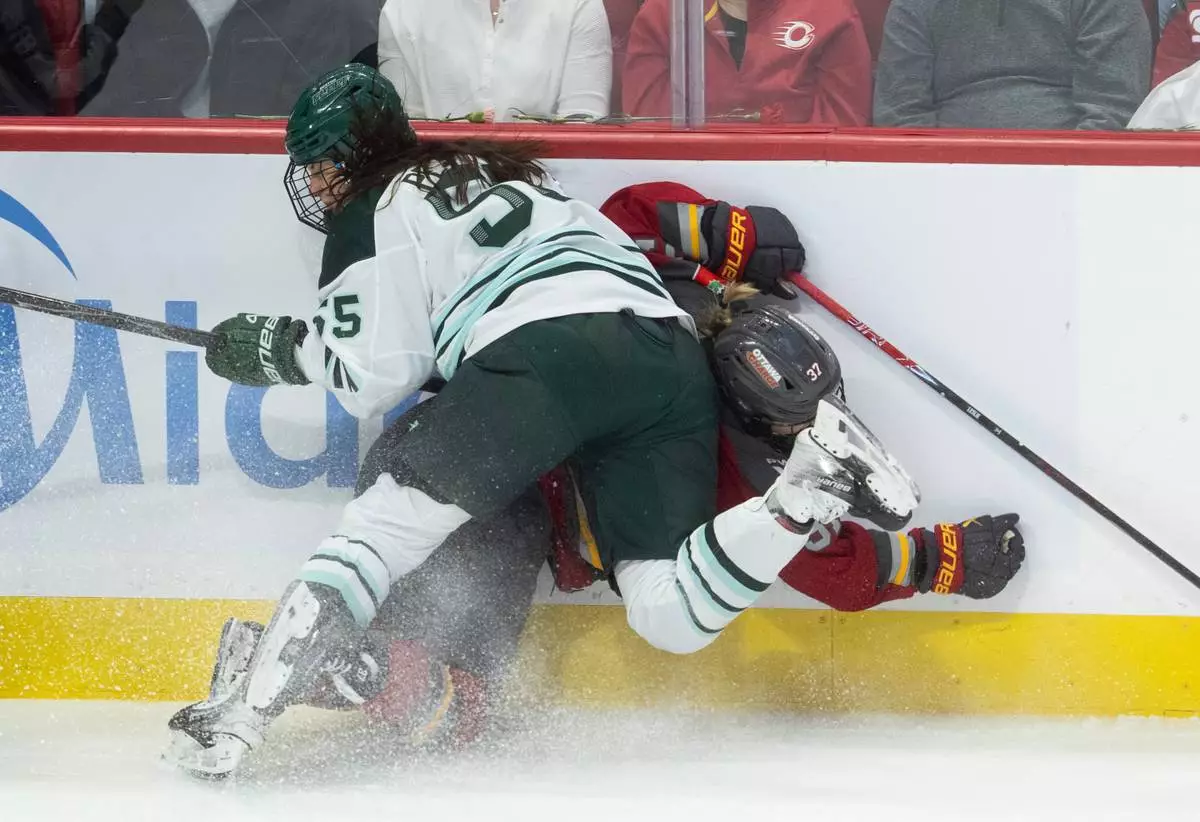
Boston Fleet defense Daniela Pejsova (55) sends Ottawa Charge forward Rebecca Leslie (37) into the boards during the first period of Game 4 in a PWHL hockey playoff series in Ottawa, Ontario, Sunday, May 10, 2026. (Adrian Wyld/The Canadian Press via AP)

Boston Fleet forward Sophie Shirley (9) pressures Ottawa Charge goalie Gwyneth Philips (33) during the second period of Game 4 in a PWHL hockey playoff series in Ottawa, Ontario, Sunday, May 10, 2026. (Adrian Wyld/The Canadian Press via AP)

Ottawa Charge forward Fanuza Kadirova (71) celebrates after her goal with forwards Katerina Mrazova (16) and Sarah Wozniewicz (23) during the first period of Game 4 in a PWHL hockey playoff series against the Bosotn Fleet in Ottawa, Ontario, Sunday, May 10, 2026. (Adrian Wyld/The Canadian Press via AP)
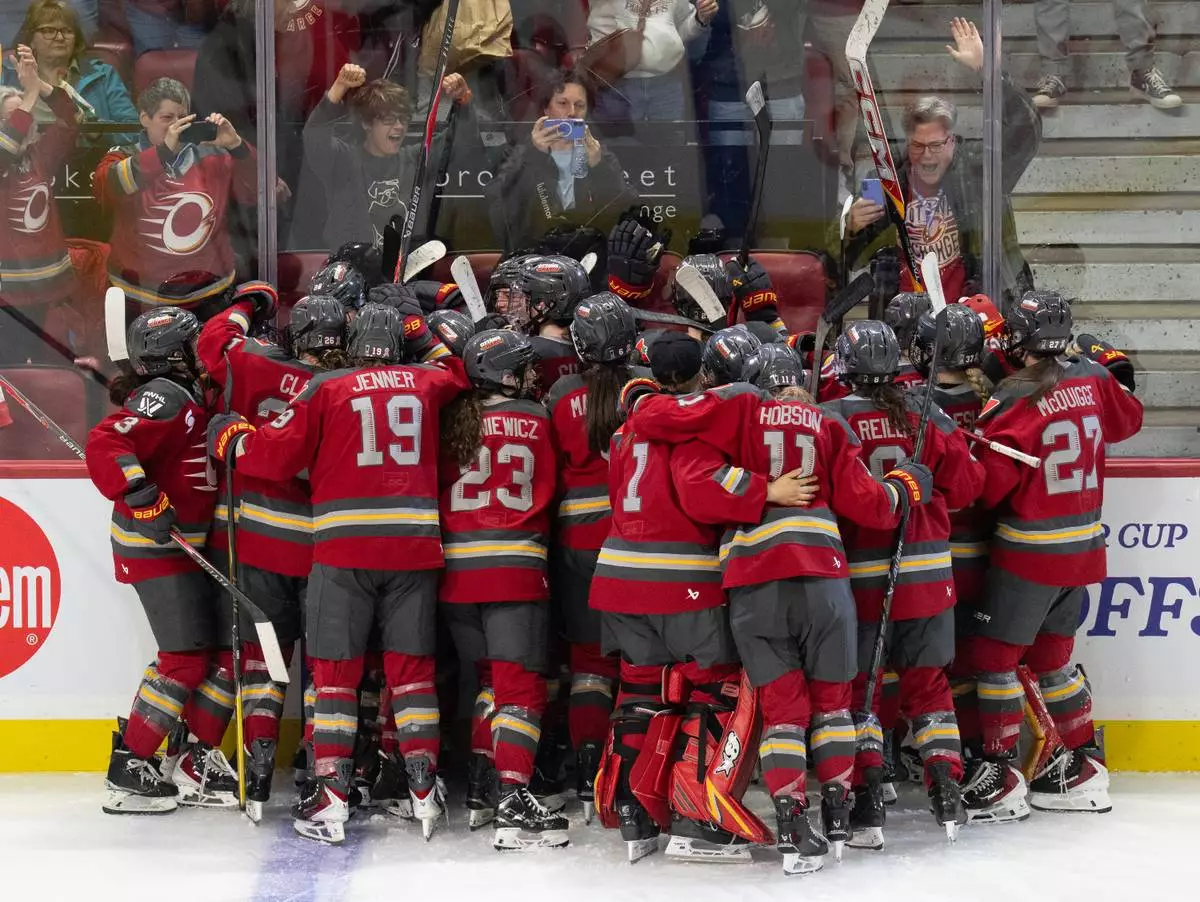
Ottawa Charge players celebrate after defeating the Boston Fleet in double overtime to win their PWHL hockey playoff series in Ottawa, Ontario, Sunday, May 10, 2026. (Adrian Wyld/The Canadian Press)