UNITED NATIONS (AP) — Spain’s top diplomat dismissed Israeli Prime Minister Benjamin Netanyahu’s statement that there will never be a Palestinian state, saying Israelis will one day want to live side by side in peace with Palestinians.
Foreign Minister José Manuel Albares said in an interview with The Associated Press on Monday that “a real wave” of countries have recognized the state of Palestine since Spain, Ireland and Norway did in May 2024 and an overwhelming number support a two-state solution to the nearly 80-year Israeli-Palestinian conflict.
“The day that everyone will have recognized the state of Palestine, we will have to move forward,” he said at the United Nations. “I’m sure that we will find someday the right people for peace on the Israel side, in the same way that we have found it in the Palestinian side" in the Palestinian Authority.
Spain has been in the forefront in pressuring Israel to end the war in Gaza sparked by Hamas’ surprise invasion of southern Israel on Oct. 7, 2023, criticizing “the atrocities” and “endless killing” it is committing in the territory.
Albares spoke before a U.N. General Assembly meeting at its annual gathering of world leaders. At the meeting, the Palestinians expected 10 recent and new countries to formally recognize the state of Palestine, adding to the list of more than 145 nations that already have. France, Luxembourg, Belgium and others did so at the meeting, even after Netanyahu reiterated his vow that there will never be a Palestinian state. Weekend recognitions came from the United Kingdom, Canada and Australia.
The Spanish minister called Hamas “a terrorist organization” that doesn’t want a two-state solution. “So let’s put aside the extremists, and let’s look for the people that want a peaceful and secure coexistence."
Albares said Spain has staked out one of the strongest positions against Israel’s actions in Gaza because “we cannot accept that the natural way for the people in the Middle East to relate is through war, through violence.”
Israel has the right to peace, stability, security and a state and so do the Palestinians, he said. “I don’t see why they should be condemned to be eternally a people of refugees."
Albares said that it was impossible for Spain, as a democratic country that believes in human rights, to have a “normal relation with Israel” while "this endless war continues.”
In recent weeks, Spain ratcheted up its opposition to Israel's actions in Gaza. Spanish Prime Minister Pedro Sánchez called the war a “genocide” earlier this month when he announced plans to formalize an arms embargo and block Israel-bound fuel deliveries from passing through Spanish ports. Netanyahu accused Sánchez of a “blatant genocidal threat.”
The following week, pro-Palestine protesters for whom the government expressed its support disrupted the final leg of an international cycling competition in Madrid due to the presence of a team with ties to Israel.
In the incident's aftermath, Sánchez called for Israel to be banned from all international sporting events while the war continues. A diplomatic tit-for-tat ensued in which both countries banned ministers and Israeli leaders accused the Spanish government of being “antisemitic.”
Albares said that in pressuring Israel to end the war in Gaza, Spain is defending the principles that underpin the creation of the United Nations after World War II — peace, justice, human rights and human dignity.
On another contentious issue, the minister defended Spain's refusal to spend 5% of its gross domestic product on defense as U.S. President Donald Trump demanded. At a NATO conference in June, the Sánchez government was the only NATO member to say it would not increase spending to that level.
“We are going to meet the targets and the commitments that are needed for Euro-Atlantic security within NATO,” Albares said. “We said in order to meet them we don't need the 5%, we can do it with 2.1%. We have already reached the 2% target.”
Citing Spain's military deployments along Europe's eastern flank including “a historical peak” of 3,000 soldiers among its contributions to European security, he said, “We are a very committed ally to transatlantic security."
Albares said the U.S. is a “historic, natural ally” of Spain and Europeans. “Let's keep doing it in the same way. But, of course, we need two for a tango," he said. What's clear, Albares said, is that Europe must increasingly take its destiny into its own hands whether it's ramping up internal trade or security.
Looking at broader challenges from the severity of wars to poverty, climate change and artificial intelligence advancements with no guardrails, Albares said the only answer to address them is by all countries working together — the multilateral approach that underpins the U.N. mission.
“At the end," he said, “cooperation is always much ... stronger than confrontation.”
Naishadham reported from Madrid.
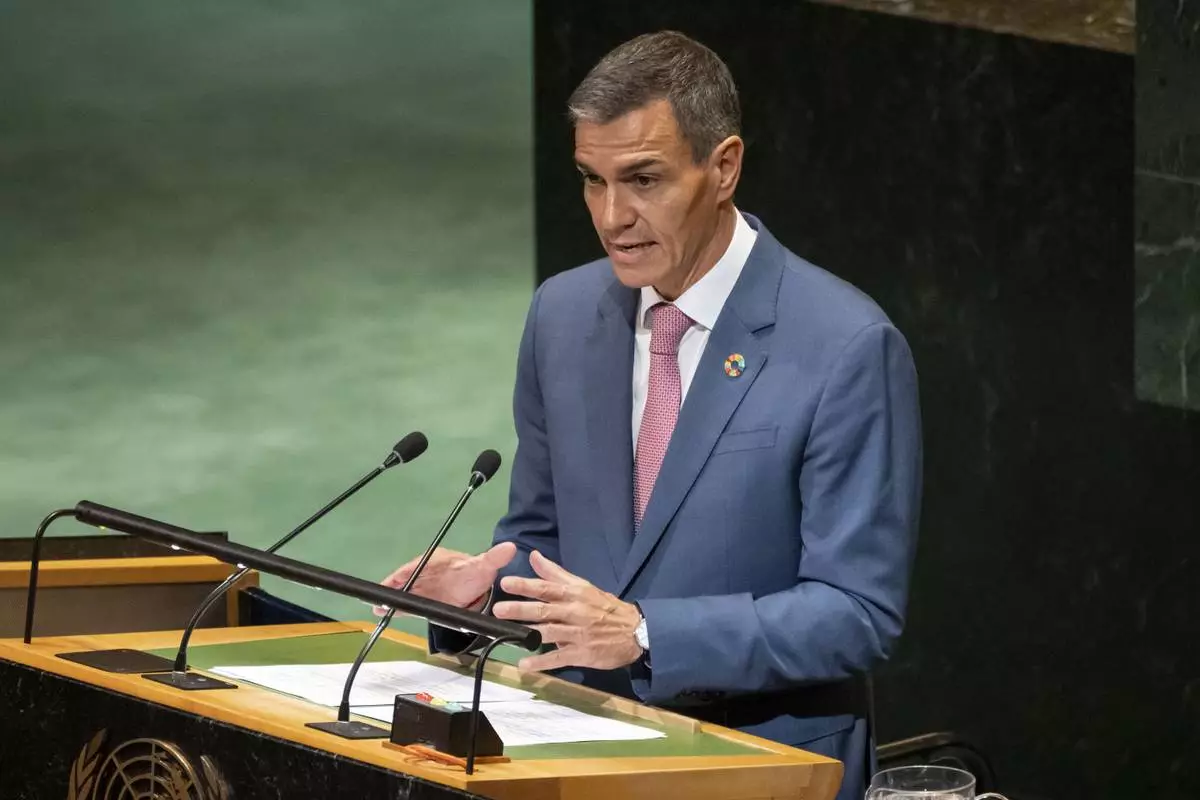
Spain's Prime Minister Pedro Sanchez speaks during a high-profile meeting at the United Nations aimed at galvanizing support for a two-state solution to the Israeli-Palestinian conflict, Monday, Sept. 22, 2025, at U.N. headquarters. (AP Photo/Yuki Iwamura)
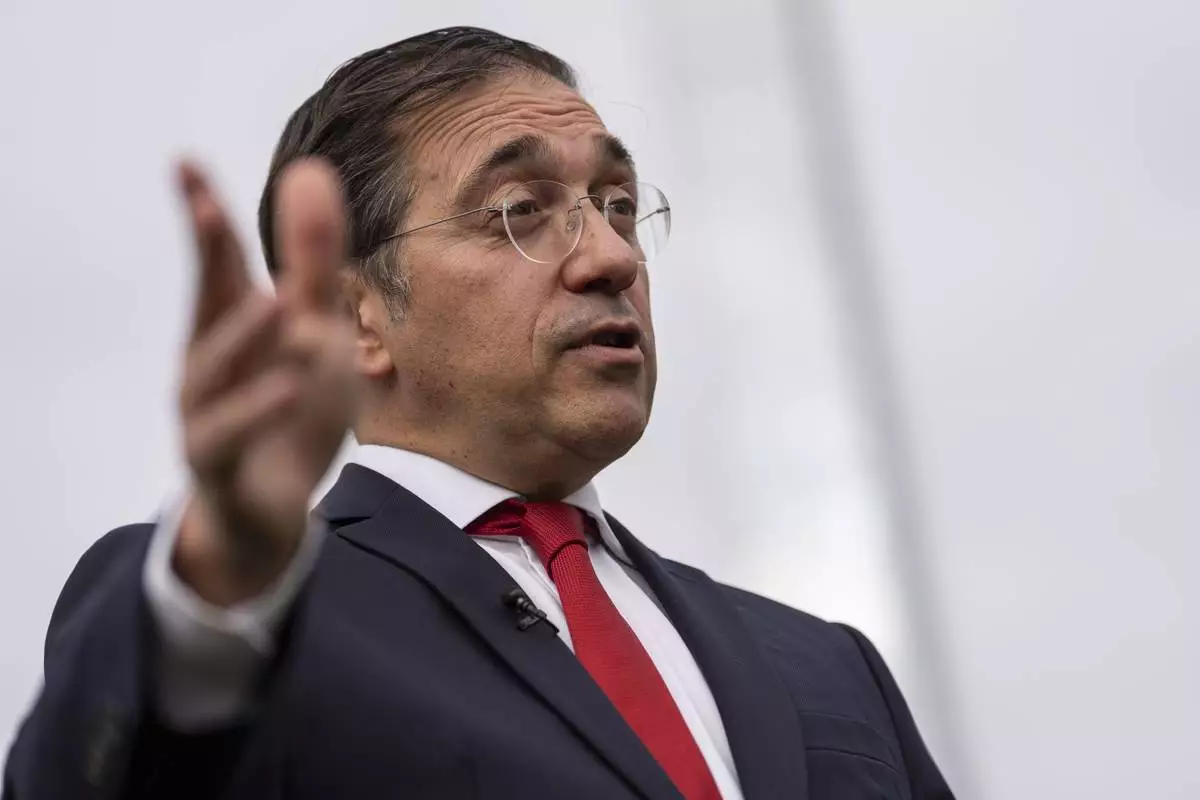
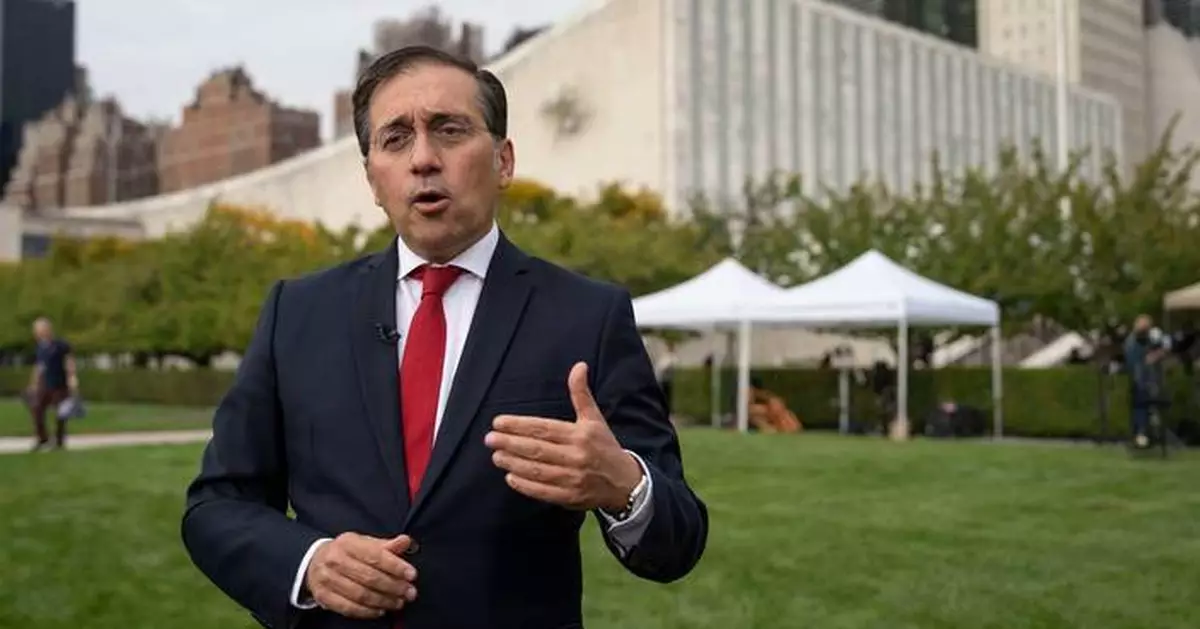
Spain's Minister of Foreign Affairs José Manuel Albares speaks during an interview at United Nations headquarters, Monday, Sept. 22, 2025. (AP Photo/Yuki Iwamura)
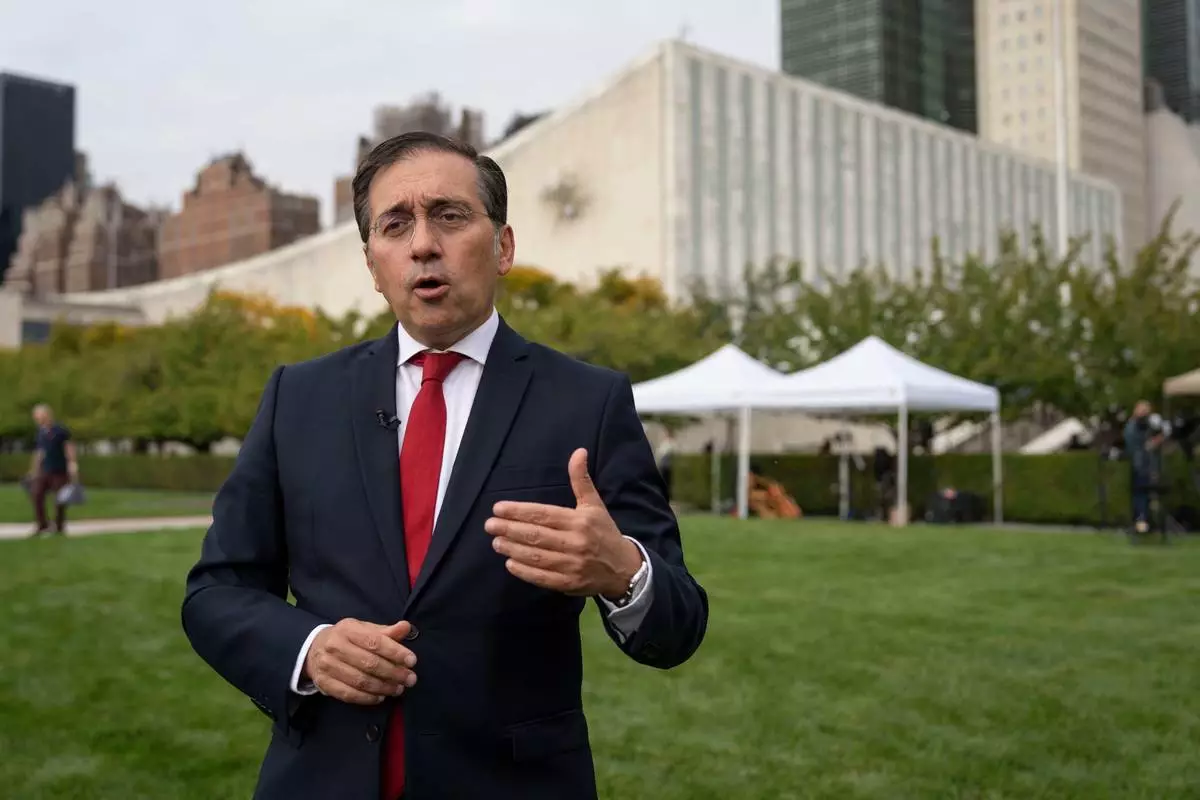
Spain's Minister of Foreign Affairs José Manuel Albares speaks during an interview at United Nations headquarters, Monday, Sept. 22, 2025. (AP Photo/Yuki Iwamura)