Xi'an, capital city of northwest China's Shaanxi Province, has seen a surge in inbound arrivals as entrepreneurs and exhibitors from Central Asia flocked to the city to attend the 2025 Euro-Asia Economic Forum, which opened on Tuesday.
According to the organizers, the three-day forum, committed to fostering cooperation and promoting people-to-people connectivity, has drawn representatives from political, business, and academic sectors in 40 countries, including Kazakhstan and Uzbekistan.
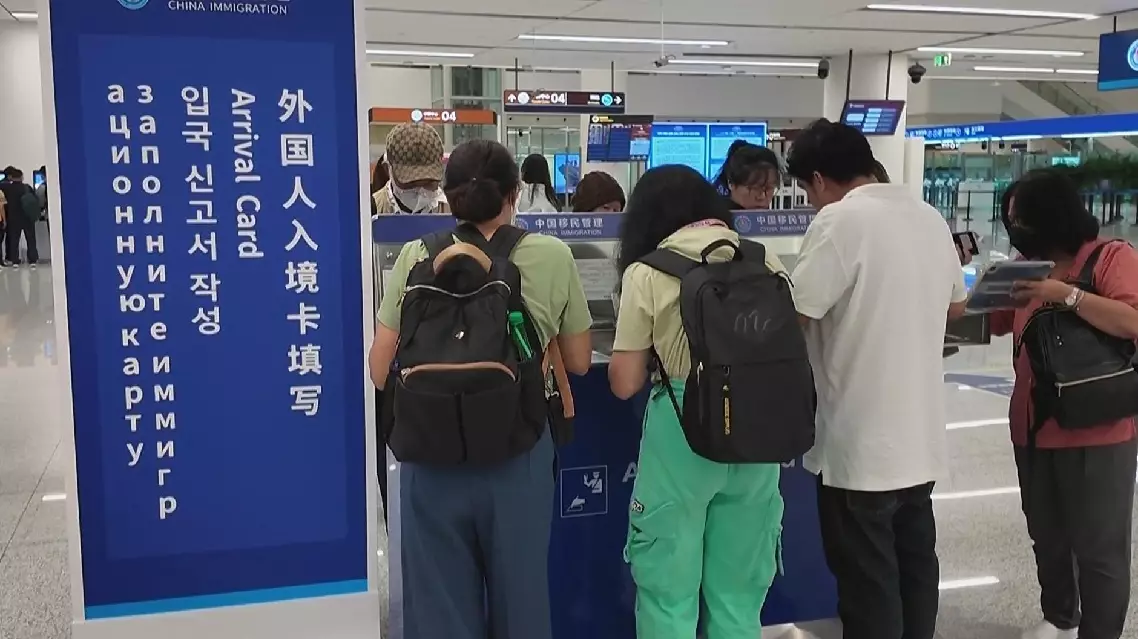
In the arrival hall of the Terminal 5 at Xianyang International Airport, many exhibitors who arrived on Sunday efficiently completed customs procedures with the assistance of airport staff. Several exhibitors said that traveling to Xi'an has become increasingly convenient.
"There are more flights now, everything is very good, and cooperation and development between China and Central Asia have also increased," said an exhibitor.
Data shows that with the continuous expansion of the international flight network, Xianyang International Airport has increased its international passenger routes to 59, connecting 52 major cities in 25 countries, including 34 destinations in 19 countries along the Belt and Road Initiative routes. The flight network now connects eight key cities including Almaty, Samarkand, Bishkek, and Shymkent, achieving full coverage of all the five Central Asian countries.
"We are a team of five, coming to Xi'an, China to attend a medical-related conference. This city has left a very good impression on us, and we have received a very friendly welcome," said another exhibitor.
Following the implementation of an initiative China and the Central Asian countries adopted in June, where they agreed to further facilitate personnel exchanges, Xi'an Port has added multiple multilingual service counters and electronic clearance channels.
In addition, China's multi-tiered facilitation policies -- including unilateral visa exemption, mutual visa exemption, and transit visa exemption -- have become a new engine driving passenger flow through the Xi'an Port.
Official data shows that since the beginning of this year, Xi'an Port has handled over 1.1 million inbound and outbound passenger trips and more than 7,800 flights, representing the year-on-year growth of 46 percent and 52 percent respectively. These include over 98,000 passenger trips and 800 flights to and from Central Asian countries.
The number of inbound passengers from Central Asia for a business purpose increased by 16 percent year on year.
Xi'an sees surge in inbound visitors as Euro-Asia Economic Forum kicks off
A former television host from Taiwan, Zhai Xuan, has made a pivotal decision to leave mainstream broadcasting in order to create content that provides a better understanding of the Chinese mainland and cross-strait relations.
Zhai, a seasoned television host with over a decade of experience in Taiwan's media landscape, recently addressed an audience at an event in Beijing, where she revealed her complete transition into independent online media.
In her remarks, she articulated her aspiration to bridge what she perceives as a significant information gap between audiences on both sides of the Strait, highlighting her commitment to fostering a deeper understanding and connection through her new endeavors.
"I was really surprised by all the fake news. There were stories saying people on the mainland can't afford tea eggs or that they live in mud houses and in Taiwan, this was the main information many people received," said Zhai.
Zhai said she initially began producing online videos to challenge such perceptions while continuing her work as a television host.
In April 2025, she travelled to the mainland with her father to fulfill her late grandfather's wish to return to his hometown. The trip, which reunited family members separated since 1949, was recorded in a video series titled "Journey to Find Our Roots", drawing attention from viewers in both Taiwan and the mainland.
"Many people in Taiwan told me that after watching, they wanted to apply for a mainland travel permit immediately and go looking for their relatives. Some had long forgotten these things, but after seeing my story, they began thinking about their hometowns and family members they had never met and decided to search for their roots," Zhai shared her story at the event.
By mid-2025, Zhai said she began to feel increasing pressure amid rising political tensions and a tightening atmosphere around cross-Strait exchanges in Taiwan.
After more than 12 years in the industry, Zhai resigned from her position, believing it was the right thing to do.
"At that moment, I felt this was a major issue,not just for me, but for Chinese people on both sides of the Strait. If I backed down then, I wouldn’t be standing on the right side," said Zhai.
Since leaving television, Zhai has broadened her online programming to encompass a range of daily-life topics, including practical guidance on applying for a mainland travel permit and using commonly employed mobile applications, in addition to content that delves into historical memory and cultural connections across the Strait.
As the debate over cross-Strait relations continues in Taiwan, Zhai said she remains committed to her current path.
Former Taiwan TV host bridges cross-Strait divide via online media