MIAMI (AP) — Hurricane Gabrielle churned Tuesday afternoon across open Atlantic waters ever closer to the Azores as forecasters warned residents of the volcanic archipelago to be on guard for a possible strike later in the week.
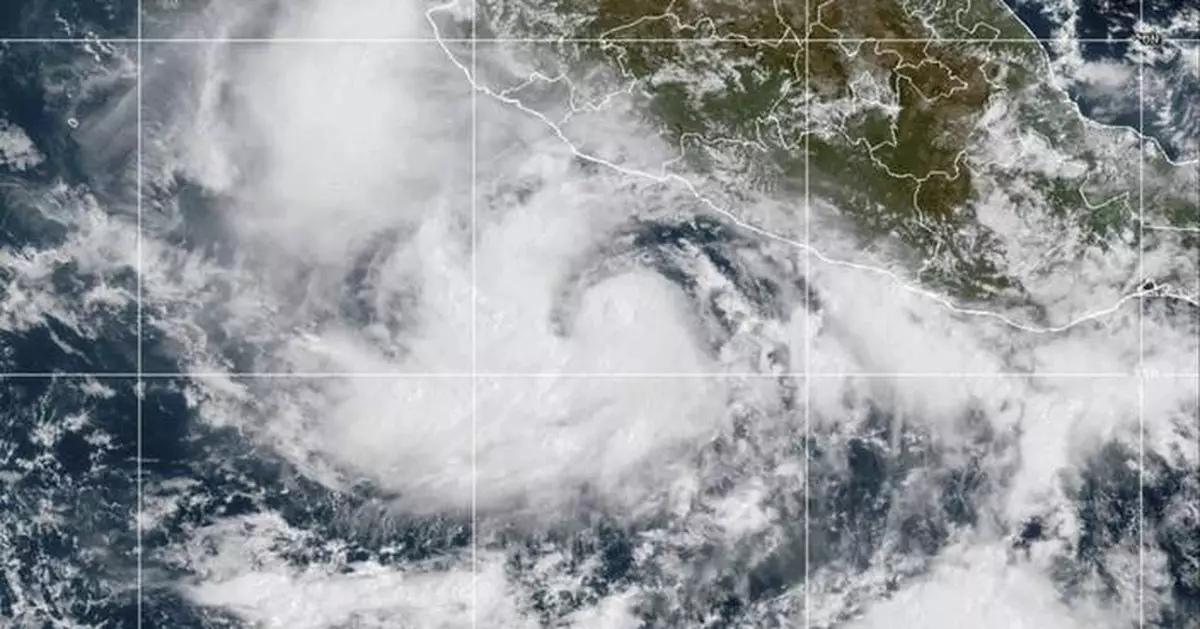
In the Pacific, Narda was upgraded to a hurricane off the west coast of Mexico after steady strengthening while moving away from land, the U.S. National Hurricane Center said.
In the North Atlantic, a hurricane watch was issued for all of the Azores chain ahead of Gabrielle. Currently a dangerous Category 4 hurricane, Gabrielle was centered about 1,635 miles (2,630 kilometers) west of the island chain by Tuesday afternoon and was expected to still be a hurricane upon its approach there Thursday.
Forecasters at the Miami-based hurricane center said Gabrielle was expected to cross over the island chain late Thursday night and early Friday, warning that a dangerous storm surge and significant coastal flooding could be expected in areas near a possible landfall.
Gabrielle had maximum sustained winds Tuesday of 130 mph (215 kph) as a major hurricane and was traveling to the east-northeast at 21 mph (33 kph) with some forward acceleration expected in the coming days.
Forecasters predict Gabrielle will bring up to 5 inches (13 centimeters) of rain across the central and western Azores. The weather center also warned the storm could churn up large and destructive waves near coastlines.
The storm has powered up large ocean swells on Bermuda's beaches after passing by that territory on Monday. The swells were also expected to continuing impacting the U.S. East Coast from North Carolina northward to Atlantic Canada over the coming days.
Meanwhile, the Pacific hurricane Narda had top sustained winds of about 85 mph (140 kph) Tuesday afternoon, according to a hurricane center advisory.
The Category 1 hurricane was centered about 365 miles (590 kilometers) southwest of Manzanillo, Mexico, and was moving west at 13 mph (20 kph). No coastal watches or warnings were in effect as the hurricane was expected to continue moving further offshore.
Forecasters said Narda would continue strengthening Tuesday, but little change in intensity was expected Wednesday and Thursday.
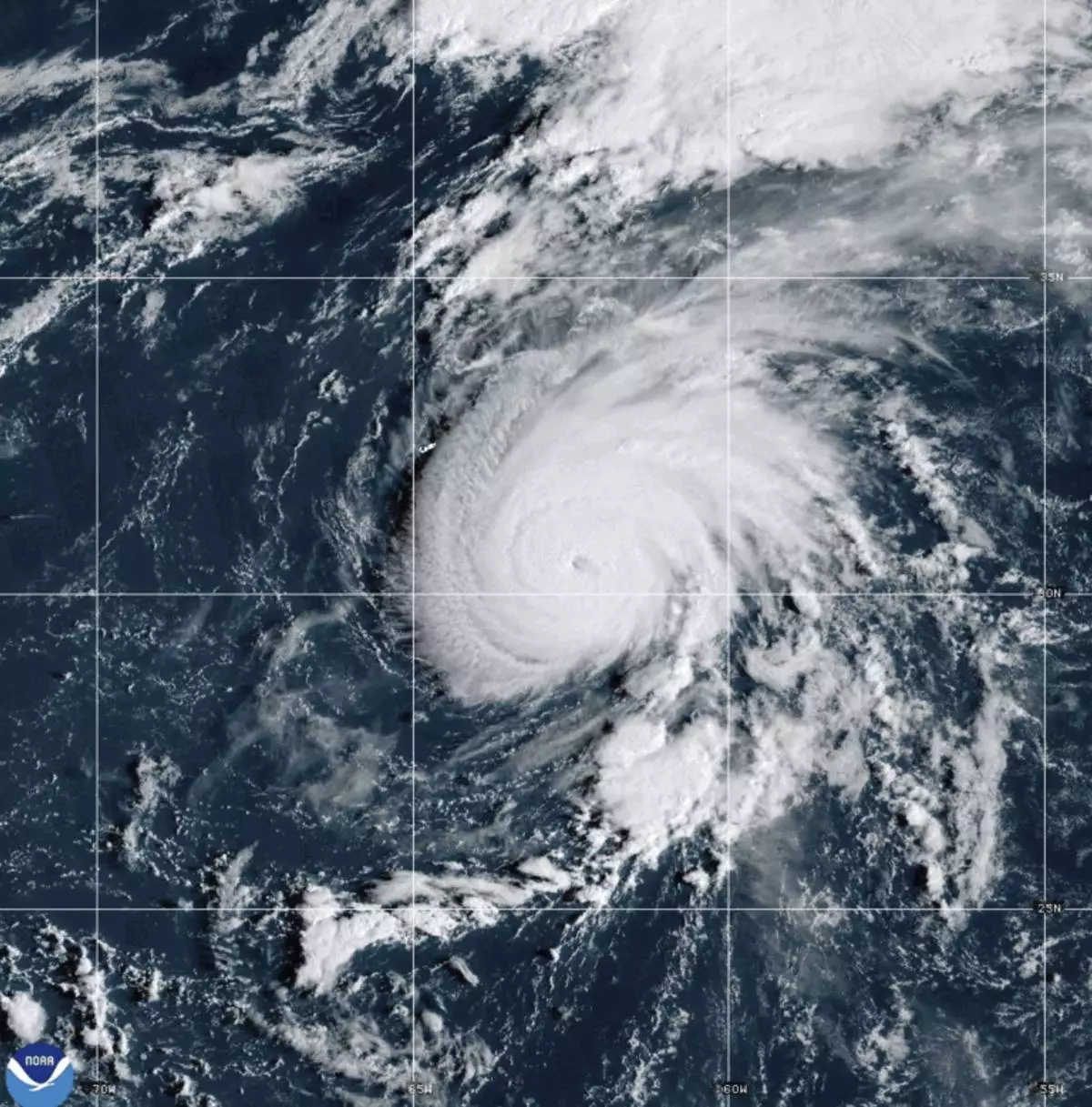
CORRECTED FOR HURRICANE - This Satellite image provided by NOAA Hurricane Gabrielle on Monday, Sept. 22, 2025. (NOAA via AP)
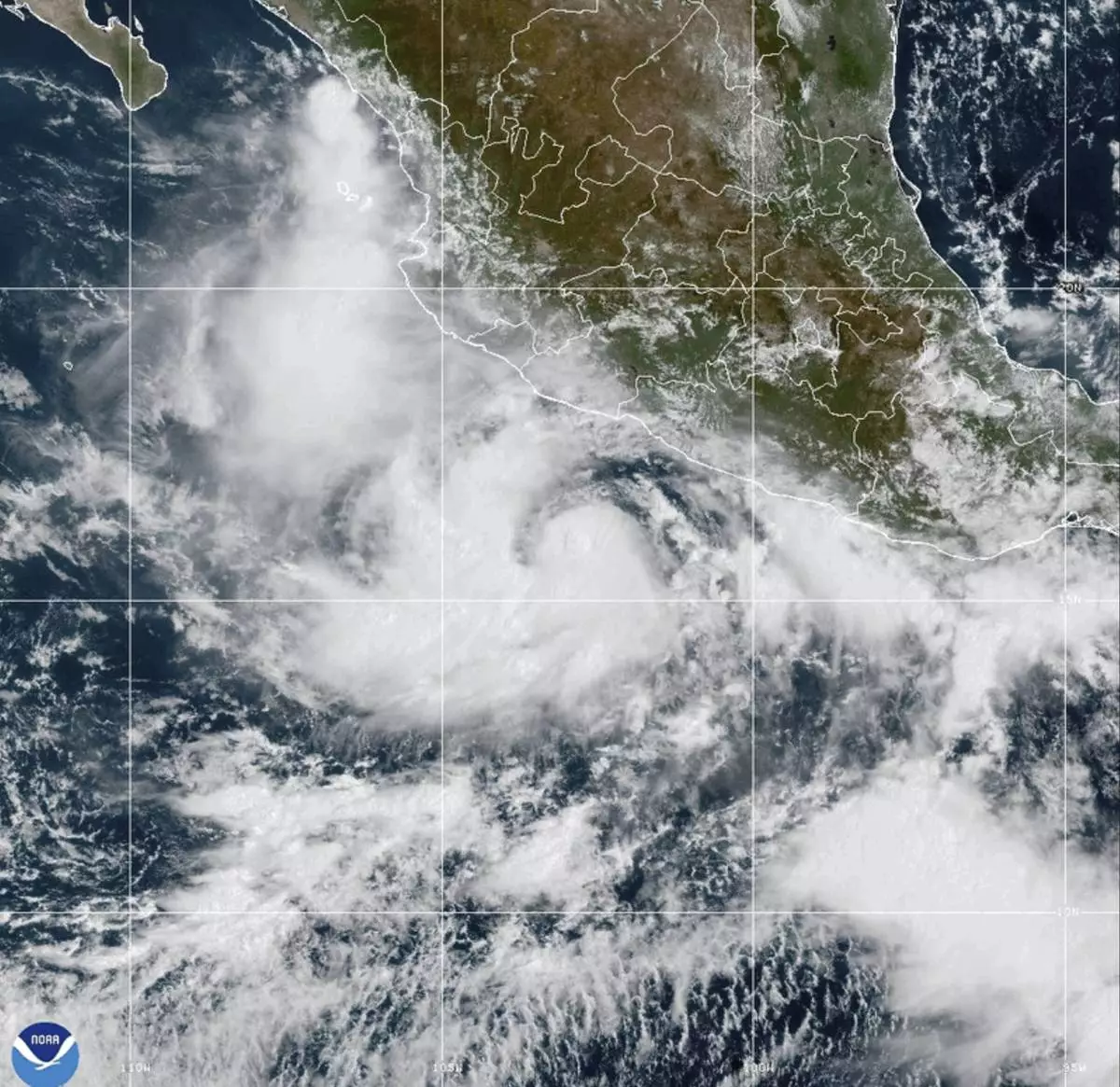
This Satellite image provided by NOAA Tropical Storm Narda on Monday, Sept. 22, 2025. (NOAA via AP)
NEW DELHI (AP) — Russian President Vladimir Putin is set to hold talks with Indian Prime Minister Narendra Modi on Friday at an annual summit aimed at expanding defense and trade ties, as the United States presses New Delhi to revise its decades-old partnership with Moscow.
The 23rd Russia-India Summit comes at a pivotal moment as the United States pushes for a Ukraine peace deal while seeking global cooperation. It will test New Delhi’s efforts to balance relations with Moscow and Washington as the nearly four-year war in Ukraine grinds on.
Putin was received by Modi at an airport in New Delhi on Thursday, who gave the visiting leader a bear hug and a tight handshake with the gusto of an old friend.
According to Indian officials involved in the preparation for the summit, the agenda includes talks on defense, energy and labor mobility.
In his opening remarks before the summit talks, Putin said he informed Modi about the war in Ukraine and U.S.-led peace effort. He thanked Modi for his attention to the war and “efforts directed at resolving the situation” while hailing Russia’s ties with India as historic and profound.
The Russian leader said the two countries have made significant progress in recent years with growth in their economies leading to expansion of cooperation in technology, aviation, space, and artificial intelligence.
“We have a very trusting relationship when it comes to military-technical cooperation. We intend to move forward in all these areas,” Putin added.
Modi, for his part, called for an expansion of India-Russia financial relations. “I hope we will take our meeting forward with such positive outcomes,” he said.
Modi emphasized the need for a “roadmap for peace” and said he hoped the world will soon be free from ongoing tensions.
“India is not neutral. India takes the side of peace. We support all efforts for peace. We stand shoulder to shoulder with respect to peace,” he added.
While India has historically maintained deep ties with Russia, critics say Putin’s visit could strain relations with the European Union and the United States and might jeopardize negotiations for major trade agreements with both that are seen as critical for India’s exports.
U.S. President Donald Trump raised tariffs on Indian goods to 50% in August, citing New Delhi's discounted Russian oil. India has been the second biggest importer of Russian crude after China.
The U.S. says purchases of Russian oil help finance Moscow’s war machine. In October, the U.S. sanctioned two of Moscow’s biggest oil producers to force countries like India to cut down on imports. Indian officials have said New Delhi has always abided by international sanctions and would do so in the case of Russia oil purchases as well.
India and the U.S. set a target for the first tranche of a trade deal by the fall, but the deal hasn’t come through yet amid strains in relations.
India is also in the final stages of talks on a trade agreement with the EU, which sees Russia's war in Ukraine as a major threat.
Putin’s India visit, “given the timing and geopolitical context, underscores New Delhi’s strategic tightrope walk between the West and the rest, chiefly Russia,” said Praveen Donthi, a senior analyst with the International Crisis Group.
Donthi said India’s tilt toward Russia dates back to the Cold War and persists despite its official nonaligned position. “The significant change now is its desire to be a strategic partner with the U.S. at the same time, which will be a diplomatic challenge,” he added.
In his meeting with Putin, Modi is likely to push for faster delivery of two further Russian S-400 surface-to-air missile systems. It has already received three under a 2018 deal worth about $5.4 billion. The delay has been tied to supply chain disruptions linked to the war in Ukraine.
The two sides signed a pact in February to improve military cooperation, exercises, port calls, disaster relief assistance and logistics support. Moscow’s State Duma ratified the same ahead of Putin’s India visit.
Talks are also expected on upgrading India’s Russian-made Su-30MKI fighter jets and accelerating deliveries of critical military hardware.
Trade is also expected to be a major point in talks.
Bilateral trade between the two countries stood at $68.7 billion in the last fiscal year ended March, and the aim is to boost it to $100 billion by 2030. The trade is heavily skewed in favor of Russia with deep deficits for India, which it is looking to bridge by pushing exports.
India is keen to increase exports of pharmaceuticals, agriculture and textiles to Russia and is seeking the removal of non-tariff barriers. New Delhi is also seeking long-term supplies of fertilizers from Moscow.
Another key area where the two countries are expected to finalize an agreement is the safety and regulation of migration of Indian skilled workers to Russia.
Putin last visited India in 2021. Modi was in Moscow last year, and the two leaders briefly met in September in China during a Shanghai Cooperation Organization summit.
Hussain reported from Srinagar, India.

Russian President Vladimir Putin receives a guard of honor during a ceremonial reception at the Rashtrapati Bhavan in New Delhi, India, Friday, Dec. 5, 2025. (AP Photo)

Russian President Vladimir Putin, left, and Indian Prime Minister Narendra Modi pose for a photo prior to their talks in New Delhi, India, Friday, Dec. 5, 2025. (Mikhail Tereshchenko, Sputnik, Kremlin Pool Photo via AP)
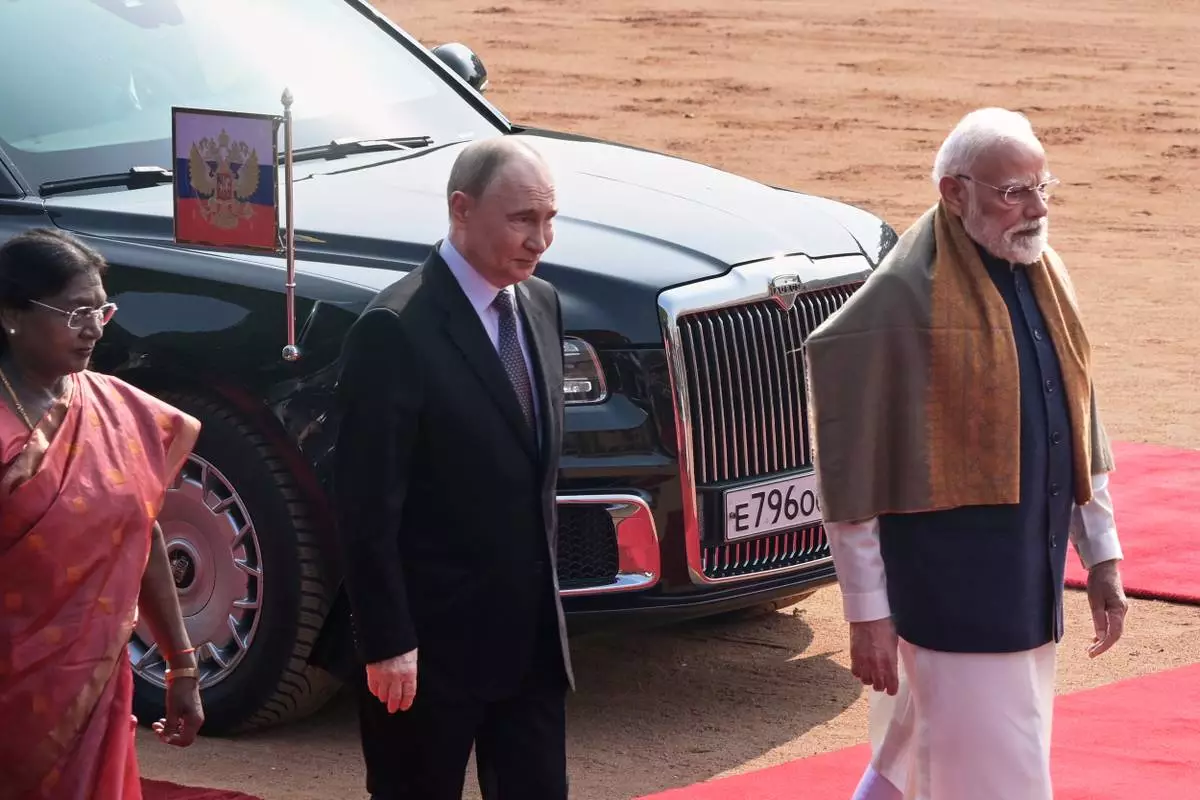
Russian President Vladimir Putin, center, walks along with Indian President Droupadi Murmu, left, and Indian Prime Minister Narendra Modi during a ceremonial reception at the Rashtrapati Bhavan in New Delhi, India, Friday, Dec. 5, 2025. (AP Photo)

Russian President Vladimir Putin, left, and Indian Prime Minister Narendra Modi pose for a photo prior to their talks in New Delhi, India, Friday, Dec. 5, 2025. (Mikhail Tereshchenko, Sputnik, Kremlin Pool Photo via AP)
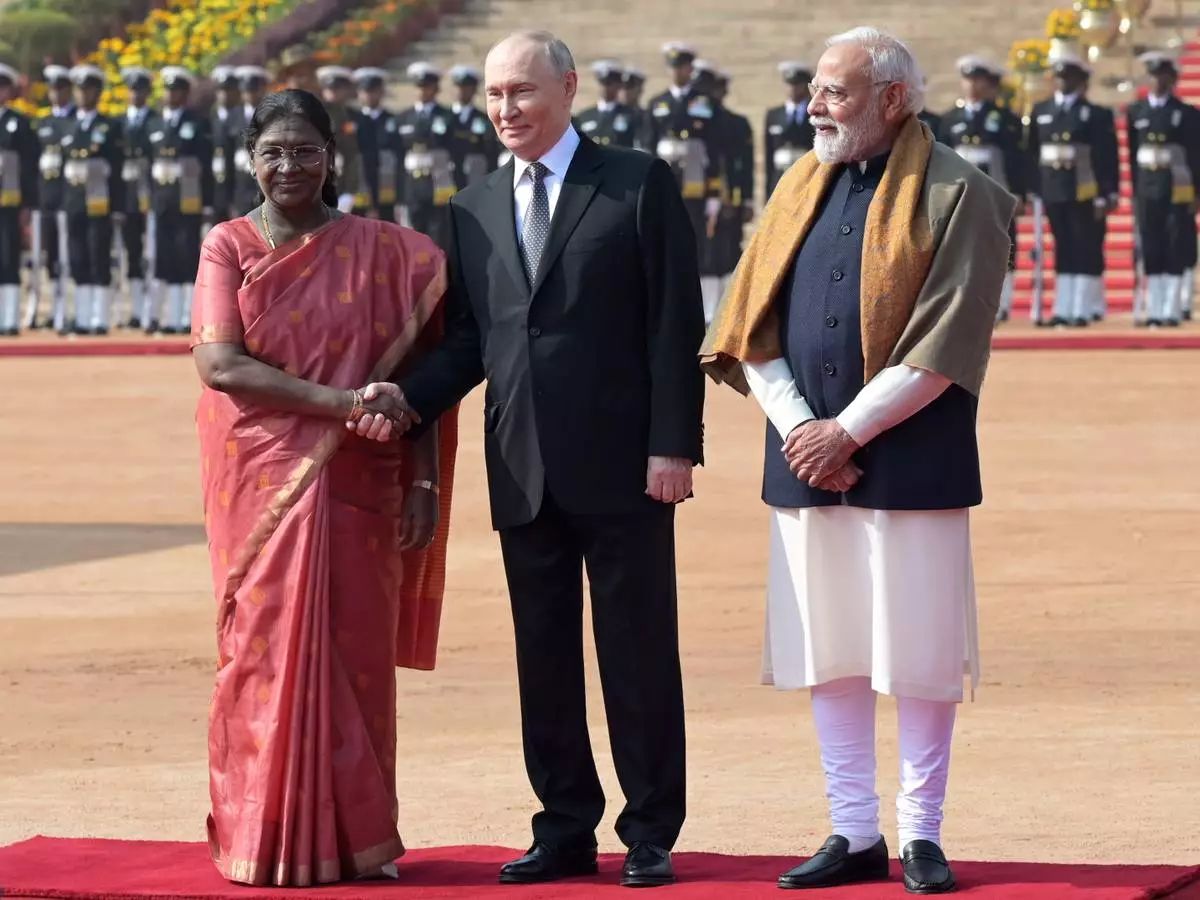
Russian President Vladimir Putin, center, shakes hands with Indian President Droupadi Murmu as Indian Prime Minister Narendra Modi, right, looks on during a ceremonial reception at the Rashtrapati Bhavan in New Delhi, India, Friday, Dec. 5, 2025. (AP Photo)

Russian President Vladimir Putin, center, poses for a photograph with Indian Prime Minister Narendra Modi, right, and Indian President Droupadi Murmu during a ceremonial reception at the Rashtrapati Bhavan in New Delhi, India, Friday, Dec. 5, 2025. (AP Photo)

Russian President Vladimir Putin gestures during an interview with journalists and executives of Aaj Tak and India Today TV channels at the Kremlin in Moscow, Russia, Wednesday, Dec. 3, 2025. (Vyacheslav Prokofyev/Sputnik, Kremlin Pool Photo via AP)
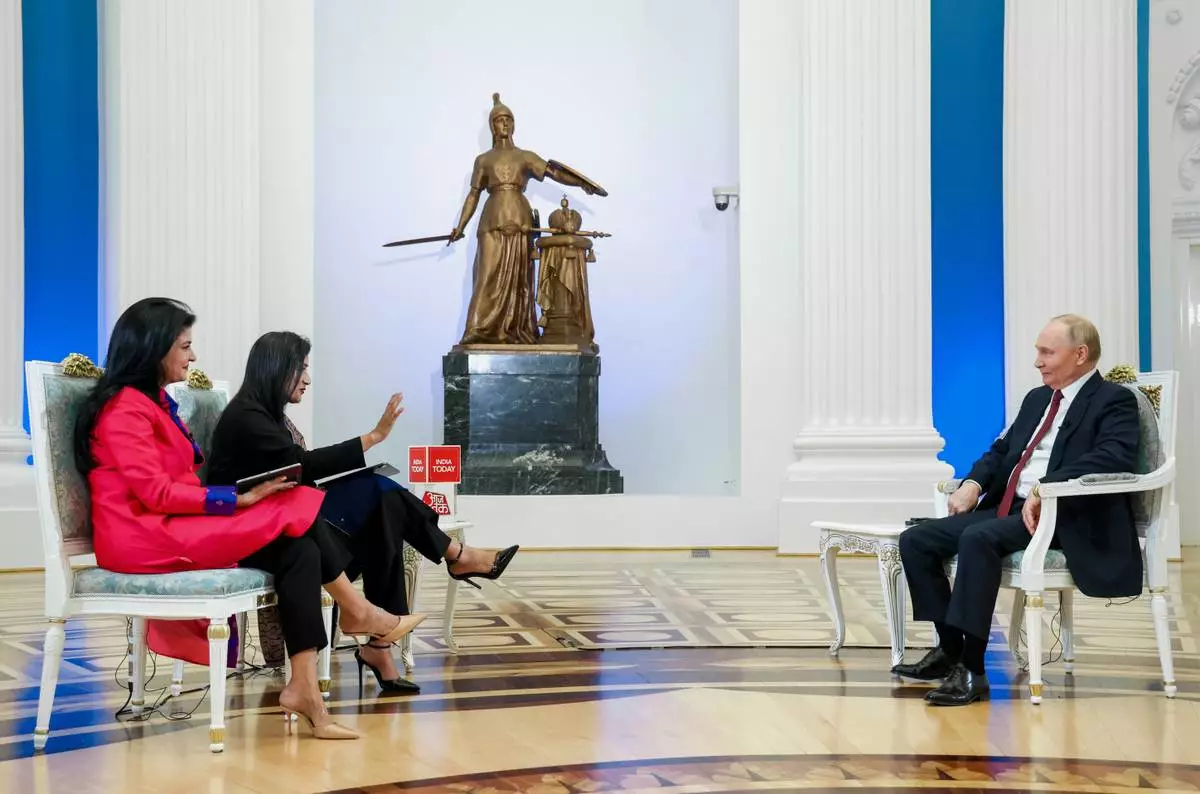
Russian President Vladimir Putin, right, speaks during an interview with journalists and executives of Aaj Tak and India Today TV channels at the Kremlin in Moscow, Russia, Wednesday, Dec. 3, 2025. (Vyacheslav Prokofyev/Sputnik, Kremlin Pool Photo via AP)

Russian President Vladimir Putin, left, and Indian Prime Minister Narendra Modi sit inside a limousine as they arrive at the Indian Prime Minister office in New Delhi, India, on Thursday, Dec. 4, 2025. (Alexander Kazakov, Sputnik, Kremlin Pool Photo via AP)