LONDON--(BUSINESS WIRE)--Sep 24, 2025--
A benchmark study launching today has revealed the most comprehensive global analysis of returns and exchanges, based on 13.8 million returns from 4,000+ Shopify merchants across the UK, US, Australia, New Zealand, and Europe.
This press release features multimedia. View the full release here: https://www.businesswire.com/news/home/20250924618979/en/
Loop, the leading returns management and post-purchase platform for Shopify merchants, today released its 2025 State of Ecommerce Returns Report. The findings show that while returns are a universal pain point, the impact in the UK is particularly stark, with brands leaving revenue and loyalty on the table by not prioritising exchanges within their returns strategies.
With an almost 1 in 5 return rate (17.5%), the UK is nearly double that of the US (11%) and Australia (10.9%). UK merchants also see a refund ratio of 78.1%, meaning the vast majority of returned value exits the brand entirely. In fact, exchange adoption in the UK sits at just 5.8%, the lowest of any region, compared to 17.1% in the US and 13.2% in Australia. This results in revenue retention rates of only 21.9%, versus 23.9% in the US and 45% in Australia, underscoring how UK merchants are losing long-term customer loyalty.
The cost of returns in the UK also weighs heavily on margins, even though average returns costs are relatively low at £5.70 ($7.05), leaving brands to absorb the majority of costs. Around two-thirds (66.1%) of merchants now charge return fees and rather than hurting customer loyalty, this move appears to be working.
“Ecommerce is changing quickly, and customers are gravitating towards the brands who ‘get them’. These brands are gathering data and using it to operate in a smarter way. They’re proactively sharing recommendations to their customers, automating the return and exchange process, and making customer service more seamless,” said John-David Klausner, GM International at Loop.
He continued, “The numbers in this report show the incredible revenue opportunities for brands that invest in the `boring' parts of their ecommerce businesses, which are really the parts that customers notice the most.”
Brands risk falling behind without return strategies that prioritise retention
The report highlights the wider context for ecommerce in 2025, with tariff shocks, inflation, and rising customer expectations forcing brands to rethink every part of the post-purchase journey. In this environment, UK merchants in particular face an urgent need to shift from refund-heavy policies to exchange-first strategies that retain customers and build loyalty.
Globally, the report shows that merchants embracing smarter returns management are already reaping the rewards by using returns data to inform product development and better marketing strategies. On average, brands can retain up to £100,000 in revenue each year by optimising their returns operations. In 2025 alone, Loop merchants collectively retained over £381.7 million in revenue through post-purchase improvements including shrinking return windows, customising returns policies and encouraging exchanges.
As brands navigate macroeconomic volatility and growing consumer scrutiny, the report underlines that post-purchase excellence is now a core competitive differentiator and not just an operational necessity.
UK Returns Stats at a Glance (2025)
Return processing times:
Download the Full 2025 State of Ecommerce Returns Report at: https://www.loopreturns.com/reports/benchmarks-2025/
Loop is going to be at eCommerce Expo - London - on 24th and 25th September - Stand L50
Methodology
The 2025 State of Ecommerce Returns Report uses Loop data from over 13.8 million returns made by more than 4,000 current merchants across ten verticals. The data was collected from January 2025 to August 2025 and analysed by vertical, region, and business size.
About Loop
Loop is the industry’s leading commerce operations platform that empowers Shopify brands to streamline their entire customer journey, reduce friction, and maximize revenue. Its end-to-end approach integrates capabilities that help brands simplify their operations and delight customers, from initial orders to returns and exchanges. Offering features like Workflows, Instant Exchanges, Checkout+, and AI-powered tracking and visibility, Loop reduces costs, increases customer lifetime value, and retains revenue for more than 5,000 of the world’s most-loved Shopify brands. Loop has processed over 55 million returns and counting, and has helped merchants capture more than $2 billion in revenue over the past five years while delivering exceptional customer experiences. Learn more at www.loopreturns.com.

Unlock the largest Shopify returns benchmark report with 250+ data points, global insights, and growth strategies from leading brands.
ST. LOUIS (AP) — Scottie Scheffler is on the cusp of a PGA Tour record Tiger Woods has held for more than 26 years, one that means next to nothing to the world's No. 1 player because of so many factors in play.
Scheffler is coming off his 21st career PGA Tour victory, all in the last five years. Last week's win was worth $3.6 million, the fifth time this year he has earned $2 million or more. That brought him to within $1,034,756 of surpassing Woods on the career earnings list.
He could do that with a three-way tie for third in the BMW Championship. Just don't look for any sparkling wine, much less a celebration. Prize money began to soar because of Woods, and it spiked with the arrival of LIV Golf. It was a matter of time.
Besides, that's not the way Scheffler keeps score.
“That has a lot to do with the purses and all that,” Scheffler said Wednesday. “I'm not really too close to him in terms of career wins. What am I, like a fourth of the way there?”
Close enough. Woods is at 82 wins, tied for the all-time record with Sam Snead.
Money topics at Bellerive Country Club, hosting the BMW Championship for the first time since 2008, is all about 30 players trying to get to East Lake to play for a $40 million purse — $10 million for the winner — and the FedEx Cup.
That's not a concern for Scheffler, either, or for the likes of Matt Fitzpatrick, Cameron Young, Rory McIlroy and a host of others who were among the top 50 in the FedEx Cup to advance to the second FedEx Cup playoffs event.
But it is to Gary Woodland, still recovering from brain surgery and at No. 31 with a chance to reach the Tour Championship for the first time in six years. And it is to 46-year-old Adam Scott, the only player in the field who was at Bellerive for the last BMW Championship.
Getting to East Lake all but assures a spot in all four majors. That's a big perk, along with the chance to win a $10 million payoff.
“Making the Tour Championship has always been important,” Scott said. “It’s always been a marker of your performance throughout the year.”
There's a little more at stake for a short list of players — Scheffler, Fitzpatrick, Young, perhaps even McIlroy. No one has really stood out as PGA Tour player of the year. Scheffler moved to the front with his eight-shot win at the FedEx St. Jude Championship last week. It's only his second win this year, but it goes along with five runner-up finishes and five other top 4s.
Scheffler has played so well he already is guaranteed the $23 million bonus for leading the FedEx Cup through the BMW Championship. That doesn't count toward official earnings.
That number stands at $119,964,411. Perhaps another testament to changing times is that Woods earned his last official paycheck in the 2024 Masters ($44,000), moving his total to $120,999,166. Scheffler won the Masters that year and moved to No. 12 at $57,658,464.
So he has made just over $62.3 million in his last 48 tour starts over two years and four months. Great golf. Big money. It was a matter of time.
And it really doesn't matter to Scheffler.
“Tiger did a lot for the game of golf and he put us in a position where we’re able to earn some pretty good stuff financially, so that’s something we’re very grateful for,” Scheffler said. “When you look at where the purses were at before he came out on tour to where they’re at now is a pretty stark difference. And we’re very thankful for his contributions to the game and hopefully we’ll see him back out here competing again soon.”
Scheffler's first PGA Tour check was $25,080 for a tie for 43rd at the 2018 St. Jude Classic. Last place at the BMW Championship this week pays $66,000.
The testament to Woods is how long he kept his name atop the career money list.
He took over for Davis Love III — Love was at the top for all of two weeks — when Woods tied for second in the Buick Invitational at Torrey Pines (total purse was $3 million) on Feb. 13, 2000. Six players in the BMW Championship field weren't even born then.
Talk of money took Scheffler back to his early days of grinding. He had financial freedom with an endorsement deal he signed with Nike, so there was no concern on entry fees in Monday qualifiers or even gas money to get there. But those were fun times to him.
“Just trying to find my place in the game,” Scheffler said.
See AP’s full golf coverage here

Rory McIlroy, of Northern Ireland, tees off on the seventh hole during the second round of the St. Jude Championship golf tournament Friday, Aug. 14, 2026, in Memphis, Tenn. (AP Photo/George Walker IV)
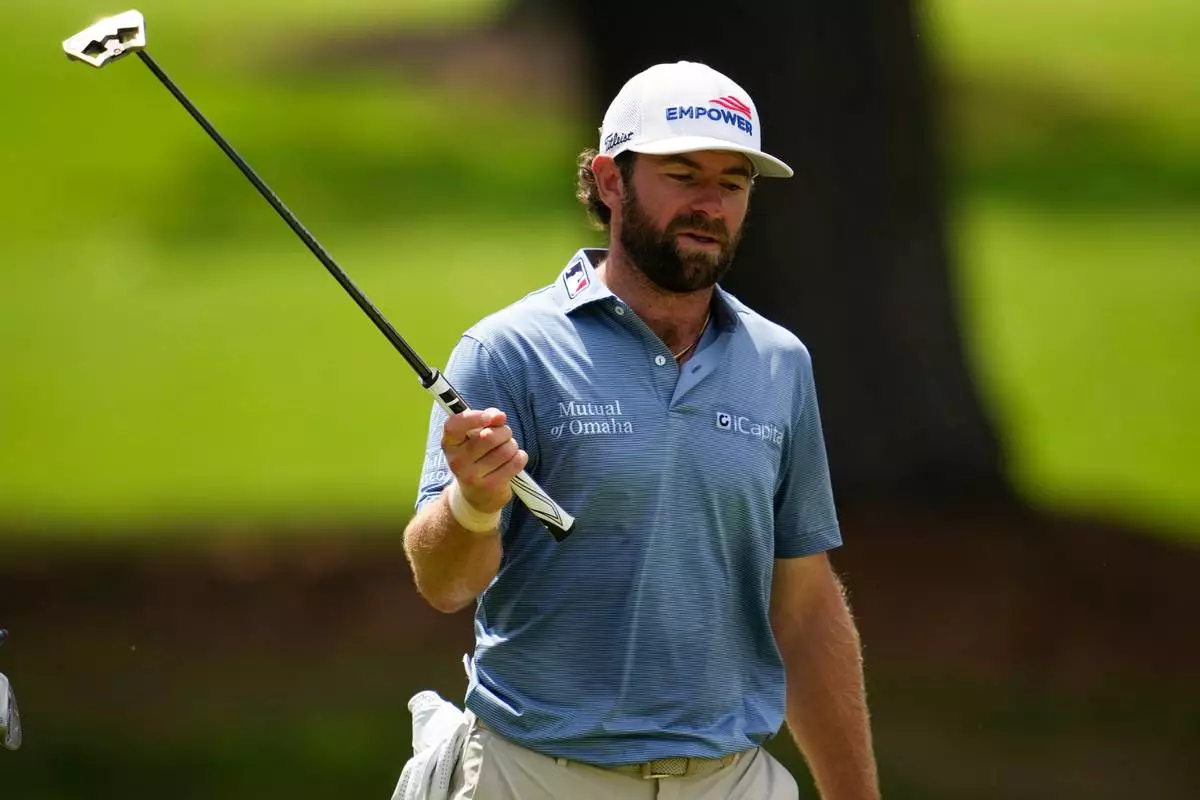
Cameron Young walks to the nineth green during the first round of the St. Jude Championship golf tournament, Thursday, Aug. 13, 2026, in Memphis, Tenn. (AP Photo/George Walker IV)
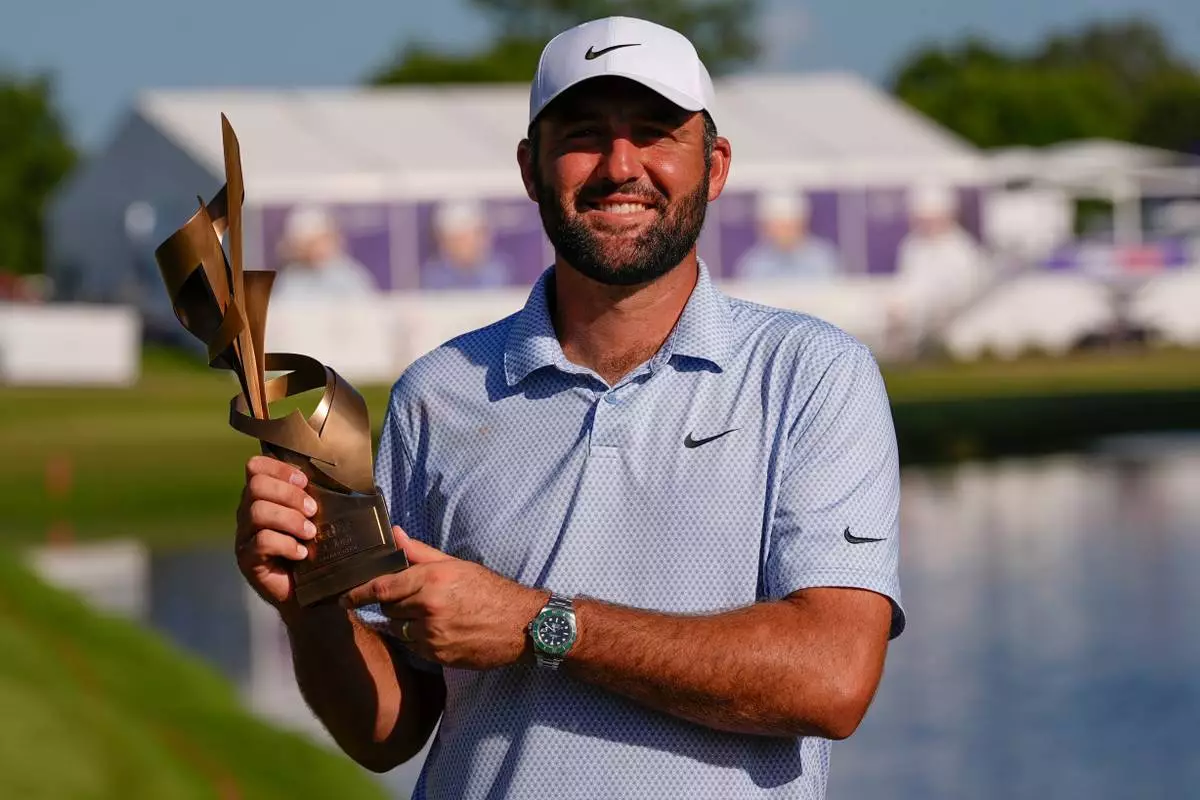
Scottie Scheffler holds the winning trophy after the final round of the St. Jude Championship golf tournament, Sunday, Aug. 16, 2026, in Memphis, Tenn. (AP Photo/George Walker IV)

Scottie Scheffler hits from the 12th tee during the final round of the St. Jude Championship golf tournament, Sunday, Aug. 16, 2026, in Memphis, Tenn. (AP Photo/George Walker IV)