HONOLULU (AP) — Brooks Koepka was allowed to return to the PGA Tour on Monday after four years on Saudi-funded LIV Golf, and his fellow players weighed in on the tour's move.
Koepka is required to make a $5 million charity donation, does not have access to the Player Equity Program for five years and cannot get FedEx Cup bonus money in 2026. He also cannot receive sponsor exemptions to the signature events.
He makes his return Jan. 29 in the Farmers Insurance Open at Torrey Pines.
“There’s probably a mixed bag of, ‘We’re happy you’re back, welcome home’ to ‘You shouldn’t be here.’ I understand everybody’s point of view. I was going to be sitting out possibly a year, and I’m extremely thankful the tour gave me this opportunity.”
“I'm not shocked. I figured there would be a path back for these guys. ... For PGA Tour players who hold some animosity, who want to see some skin, this hopefully gives them what they want. And at the same time, it shows (LIV) guys there's a price you have to pay to come back.”
“I'm in a tough spot because I'm friends with Brooks. A lot of guys are friends with Brooks out here. A couple of years ago, there was a lot more hostility between the two tours. That's gone down. I'm happy for Brooks. I'm happy for the tour that we're finally getting to the point of moving past all this crap and getting back to golf.”
“Like most guys, when you hear he's coming back, your first instinct is to be upset. But I think the punishment is real. It's not a free pass back into perfectly good graces. ... Your main thing is, 'Where’s the one-year suspension? Where's the time served?' I think that will be the hardest hurdle for PGA Tour players to get over. But $5 million is a lot.”
“The punishment, no one knows exactly what it is until you see what happens with what the growth of equity becomes going forward. Could it end up being close to what he went to LIV for? Maybe. Probably not. But regardless, it's substantial enough that if he were to play well, then it would still be a penalty.”
“This is a one-time, defined window and is not a precedent for future situations. Once the door closes, there is no promise that this path will be available again.”
“From the outset, LIV Golf has championed an open ecosystem and freedom, for all. Not just a limited few. One that supports players’ rights to compete across various platforms, reinforcing the belief that the growth of the game is best served when the game’s best players are empowered to seek the most competitive environments around the world.”
“In everything that happens, there's isn't all winners and all losers. There's some good and bad. The positive is the tour with Brooks Koepka is a stronger tour. Regardless of how you feel about him leaving the PGA Tour, regardless of how you feel about LIV Golf, the PGA Tour is stronger today. I find it to be an OK compromise.”
AP golf: https://apnews.com/hub/golf

FILE - PGA Tour CEO Brian Rolapp speaks before a practice round of the Tour Championship golf tournament, Aug. 20, 2025, in Atlanta. (AP Photo/Mike Stewart, File)

FILE - Brooks Koepka laughs while talking with Justin Thomas, left, on the 15th fairway during a practice round at the Masters golf tournament, Tuesday, April 8, 2025, in Augusta, Ga. (AP Photo/Matt Slocum, File)
WASHINGTON (AP) — President Donald Trump’s White House ballroom won final approval from a key agency on Thursday, despite a federal judge recently ordering a halt to construction unless Congress allows what would be the biggest structural change to the American landmark in more than 70 years.
The 12-member National Capital Planning Commission, the agency tasked with approving construction on federal property in the Washington region, took the vote because U.S. District Judge Richard Leon’s ruling — which came two days earlier — affects construction activities but not the planning process, said the commission's Trump-appointed chair, Will Scharf.
A vote of 8-1, with two commissioners voting present and one absent, allowed the plan to move forward.
Despite the agency’s approval, the judge’s ruling and a legal fight over the ballroom could stall progress on a legacy project that Trump is racing to see completed before the end of his term in early 2029. It’s among a series of changes the Republican president is planning for the nation’s capital to leave his lasting imprint while he’s still in office.
Before the vote, Scharf, a top White House aide, noted that Leon's order has been stayed for two weeks as the administration seeks an appeal. He said, as he understood the decision, it “really does not impact our action here today.”
Reading from notes, Scharf also delivered an impassioned defense of the project that reviewed the full history of changes and additions to the White House that were criticized when they were made but have become beloved with the passage of time. He spoke about the addition of the north and south porticos and the balcony added by President Harry Truman.
Scharf suggested that Trump’s proposed ballroom will similarly come to be viewed as a wise addition — despite drawing contemporary opposition from some members of the public and government officials.
“I believe that in time this ballroom will be considered every bit as much of a national treasure as the other key components of the White House,” Scharf said.
Scharf also said the project has been viewed negatively because of opposition to Trump, instead of the merits, saying, “I feel that we’ve been unfairly slighted in the press and otherwise for the way we’ve gone about reviewing this particular project.”
The vote by the commission, which includes three members Trump gets to appoint, had initially been scheduled for March but was postponed to Thursday because so many people signed up to comment at the commission’s meeting last month. The comments were overwhelmingly in opposition to the ballroom.
The lone “no” vote was cast by Phil Mendelson, a Democrat who chairs the Council of the District of Columbia. Linda Argo and Arrington Dixon, the two commissioners appointed by Mayor Muriel Bowser, a Democrat, voted present.
Mendelson criticized the design of the ballroom addition and how fast it was approved.
“It’s just too large,” he said.
Criticism also came from Public Citizen, a nonprofit consumer advocacy organization. One of its attorneys, Jon Golinger, said the commission had discounted opposition from city officials and thousands of people who commented against the project, and ignored the judge's ruling. Several commissioners, including Scharf, had said they took the public feedback seriously.
“This approval is illegitimate and this vote is a joke," Golinger said.
Trump, in a statement after the vote, thanked the commissioners and said he was honored.
“When completed, it will be the Greatest and Most Beautiful Ballroom of its kind anywhere in the World, and a fabulous complement to our Beautiful and Storied White House!” the president said on social media.
Before voting, the commission considered design changes to the 90,000-square-foot (8,400-square-meter) ballroom addition that the president announced aboard Air Force One on Sunday, as he flew back to Washington from a weekend at his Florida home.
He removed a large staircase on the south side of the building and added an uncovered porch to the southwest side. Architects and other critics of the project had panned the staircase as too large and basically useless since there was no way to enter the ballroom at the top.
A White House official said the president had considered comments from the National Capital Planning Commission and another oversight entity, the U.S. Commission of Fine Arts, which approved the project earlier this year, as well as members of the public.
The official, who was not authorized to publicly discuss the ballroom design and spoke on the condition of anonymity, said additional “refinements” had been made to the exterior.
The ballroom, now estimated to cost $400 million, has expanded in scope and price tag since Trump first announced the project last summer, citing a need for space other than a tent on the lawn to host important guests. Trump demolished the East Wing in October with little warning, and site preparation and underground work have been underway since then.
Two other Trump-appointed commissioners, Stuart Levenbach and James Blair, voted for the project.
Levenbach, who serves as vice chairman and is the federal government’s chief statistician, said the White House is currently “not suited” to accommodate large numbers of guests and the addition will improve the “utility” of the compound.
He said tunnels and other structures underground at the White House made it impossible to place many features of the ballroom there, too, as some have suggested might be possible. Levenbach said the addition is a “multipurpose facility,” noting that, in addition to a ballroom, it will also have offices for the first lady, kitchen space and a theater.
“This is not an expansion for its own sake,” Levenbach said.
Blair, a deputy to White House chief of staff Susie Wiles, said visitors and guests of the president deserve a “better experience."
Scharf and Blair also said Trump will get “very limited use” of the ballroom before his term ends.
Trump went ahead with the project before seeking input from the National Capital Planning Commission and the Commission of Fine Arts, which he reconstituted with allies and supporters.
The National Trust for Historic Preservation, a private nonprofit organization, sued after Trump demolished the East Wing last fall to build the ballroom addition — a space nearly twice as big as the mansion itself.
Trump says it will be paid for with donations from wealthy people and corporations, including him, though public dollars are paying for underground bunkers and security upgrades.
The trust sought a temporary halt to construction until Trump presented the project to both commissions and Congress for approval. Leon agreed but said that his order would take effect in two weeks and that construction related to security would be allowed.

President Donald Trump answers questions from reporters after signing an executive order in the Oval Office of the White House Tuesday, March 31, 2026, in Washington. (AP Photo/Alex Brandon)
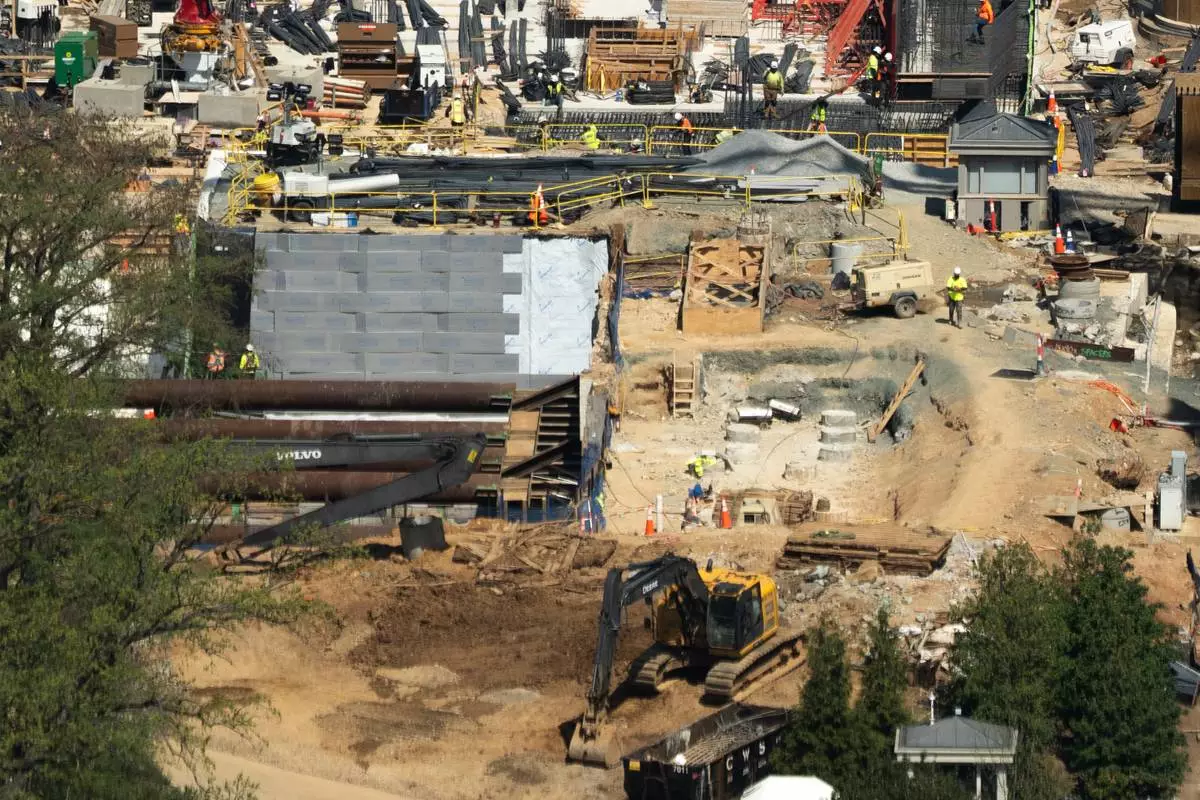
Work continues on the construction of the ballroom at the White House in Washington, Wednesday, April 1, 2026. (AP Photo/Allison Robbert)

President Donald Trump holds a rendering of the proposed new East Wing of the White House as he speaks to reporters aboard Air Force One en route from West Palm Beach, Fla., to Joint Base Andrews, Md., Sunday, March 29, 2026. (AP Photo/Mark Schiefelbein)
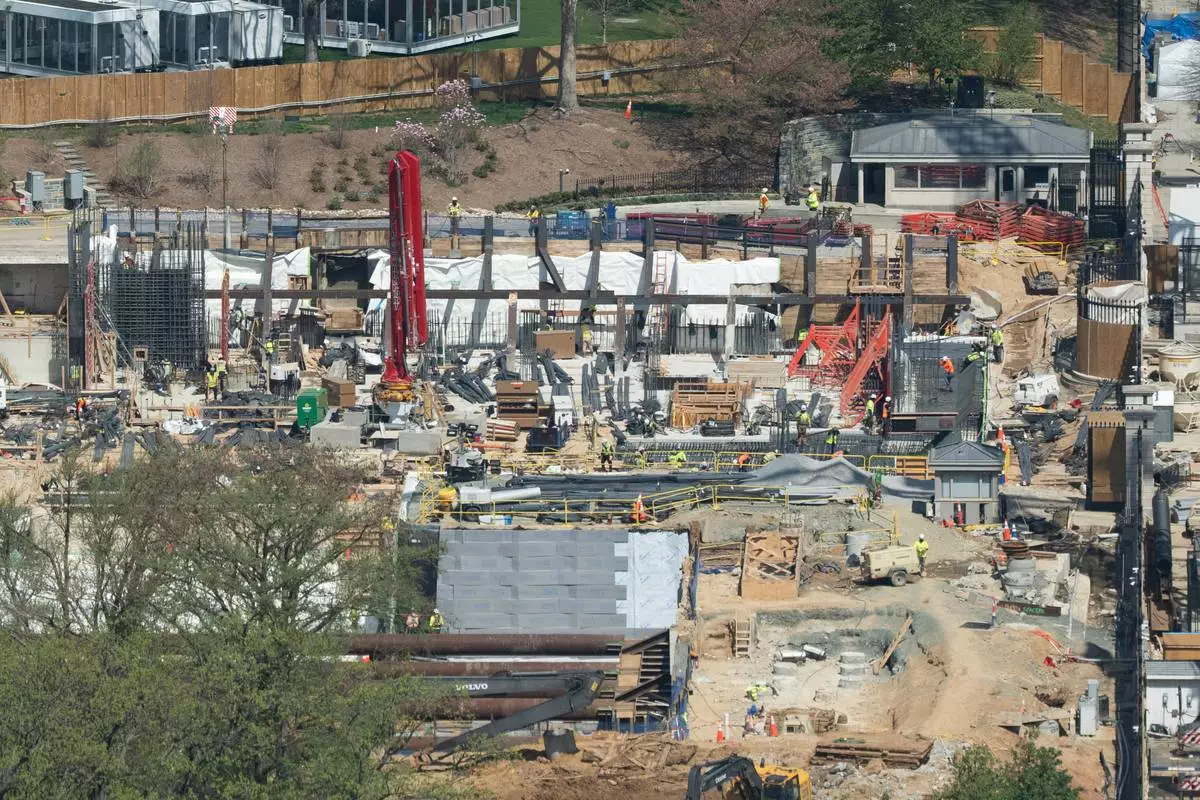
Work continues on the construction of the ballroom at the White House in Washington, Wednesday, April 1, 2026. (AP Photo/Allison Robbert)

President Donald Trump holds a rendering of the proposed new East Wing of the White House as he speaks to reporters aboard Air Force One en route from West Palm Beach, Fla., to Joint Base Andrews, Md., Sunday, March 29, 2026. (AP Photo/Mark Schiefelbein)