China's far-western Xinjiang Uygur Autonomous Region is undergoing a dramatic transformation through the expansion of a modern, multi-layered transport network with new roads, tunnels and airport terminals improving the movement of goods and people.
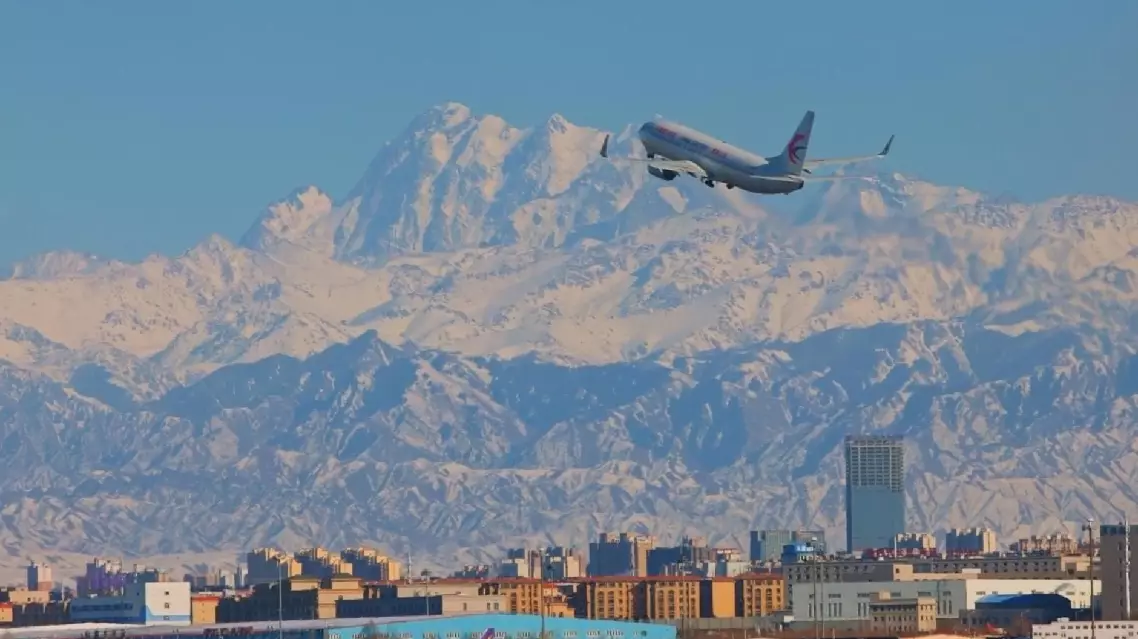
Xinjiang is vast, remote, and striking in its rugged beauty. Spanning 1.6 million square kilometers, it's home to one of the world's longest mountain ranges. For centuries, the Tianshan Mountains have divided the region into north and south, forming a formidable barrier to modern transport links.
The Urumqi-Yuli Expressway is set to slash travel time to just three hours by crossing the Tianshan Mountains with the world's longest expressway tunnel. Mountains will no longer divide northern and southern Xinjiang -- they'll connect them.
The 319.7-km-long expressway, which runs from the regional capital of Urumqi in northern Xinjiang to Yuli County in southern Xinjiang, is expected to get ready for traffic by the end of this year.
Construction on the Urumqi-Yuli Expressway began in 2019, requiring 17 tunnels to be bored through the Tianshan mountain range -- a monumental achievement.
The Urumqi-Yuli Expressway is just part of the even larger 1,305-km Wuyu Highway PPP Project -- from Urumqi in the north, through Korla in the south, crossing the Taklimakan Desert and linking up Ruoqiang and Qiemo counties.
"At its peak, construction on the Urumqi-Yuli Expressway involved more than 21,000 workers working simultaneously along the 319.719-km stretch. The project required a total earthwork volume of 115 million cubic meters, which had to be moved to form the roadbed and deposited in spoil sites," said Liu Kaizhi, chief engineer of the Xinjiang Wuyu Highway Package PPP Project. Among the new tunnels, one stands apart, the 22-km Tianshan Shengli, or "Victory Tunnel". Record breaking in length, its construction methods also set new benchmarks.
Liu said conventional construction methods would have taken ten years to complete it, but they finished the tunnel in just 52 months, a remarkable achievement by global standards.
Engineers also had to contend with seismic risks, as the tunnel cuts across an active fault line.
"We ran simulations to calculate for 75 years, 150 years, even 475 years, and further out to 3,500 and 4,500 years. Based on those models, this tunnel -- even across an active fault -- is designed to remain operational for 475 years," Liu said.
While the new expressway is set to open later this year, another new development has already taken a major step in expanding regional air capacity.
At Urumqi Tianshan International Airport, trial operations began in April on a vast new North Terminal, more than tripling passenger and cargo volume.
"The new North Terminal is designed to ultimately accommodate 63 million passengers, 750,000 tons of cargo and mail, and 451,000 aircraft movements per year," said Fu Yanlin, deputy general manager of the Urumqi Tianshan International Airport. Two additional runways now bring the total to three, boosting international links and solidifying Urumqi's position as China's leading air gateway to Central and West Asia and beyond to Europe.
"In the first half of the year, the airport operated 48 scheduled international routes, achieving full connectivity with the capitals of all five Central Asian countries. In terms of destinations in Central Asia, it ranks first among China's top ten hub airports. The number of international and Hong Kong/Macao/Taiwan passengers reached 387,000, marking a year-on-year increase of 57.4 percent," Fu said.
Thanks to the new terminal, the cargo sector is also expanding at pace. Rail shipments now arrive directly at the airport, transferring to flights bound for multiple European destinations.
"As of now in 2025, the Urumqi Tianshan International Airport has recorded a 715 percent year-on-year increase in cargo throughput, making it the fastest-growing airport in the world for outbound air cargo," Fu said.
The scale of these two vastly different projects demonstrates China's desire to transform Xinjiang. It's also redefining its role on the global map. This is being achieved through continuous development, and once landlocked areas such as this are now able to welcome even more visitors from both inside and outside the country -- bringing all of China closer together.
Xinjiang breaking down transport barriers, opening wider to world