HENDERSON, Nev. (AP) — When Davante Adams played for the Raiders from 2022 into early in the 2024 season, an ongoing storyline was how whoever played quarterback at the time could get him the ball.
Not enough targets could create a week's worth of conversations — and Adams wasn't afraid to express his opinions.
Now Las Vegas receivers, including tight end Brock Bowers, form a much more democratic unit in which just about any pass catcher is likely to step up.
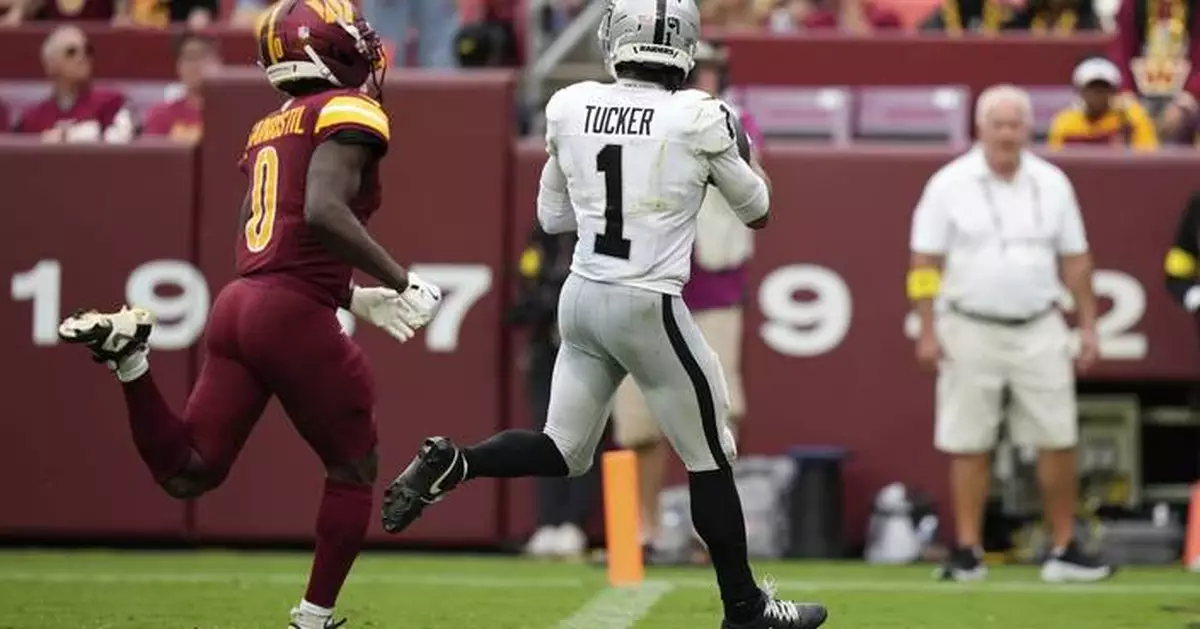
Sunday's 41-24 loss at Washington was a perfect example with third-year pro Tre Tucker setting career highs with eight receptions for 145 yards and three touchdowns.
“I think we have a bunch of options and a bunch of guys that can get open and make plays,” quarterback Geno Smith said. "The key for us is to always get the ball into the hands of the right guy, depending on what the defense shows us. I’m very impressed with how our guys are responding and making plays out there.”
Smith showed from the beginning that he was willing to spread the wealth, targeting eight receivers in the season-opening 20-13 victory at New England, seven them catching passes.
Bowers continued to claim his stake as one of the NFL's top tight ends with five catches for 103 yards. Jakobi Meyers, who posted his first 1,000-yard season last year, caught eight passes for 97 yards.
Meyers led the Raiders with 12 targets, six catches and 68 yards in their 20-9 loss to the Los Angeles Chargers in Week 2.
Then Tucker had his breakout performance against the Commanders.
“When you've got a team with a lot of weapons, you want someone who can use them well,” Meyers said.
One of those weapons, Bowers, is playing through an injured knee.
After that 100-yard performance against the Patriots, he caught nine passes for 76 yards in the two following games. Bowers has worn a brace, but little has helped him back to form in which as a rookie last season he recorded 112 receptions for 1,194 yards and five touchdowns.
He practiced without limitations on Wednesday.
“He’s been making it," coach Pete Carroll said. "They’ve (trainers) treated him well and got him to play in these games. He’s still wearing a legitimate brace that he can feel, but he’ll continue for another couple weeks having to wear that brace to be safe.”
There also are health concerns regarding tight end Michael Mayer, who suffered a concussion at Washington. Carroll said he would have a better idea about Mayer's status closer to Sunday's home game against Chicago.
Given the Bears allow 247.7 yards passing per game, 27th in the NFL, there is an opportunity for the Raiders receivers to shine.
“The quarterback has played some really good football over the last few years and he’s doing that again this year,” Bears coach Ben Johnson said. "They have some weapons all over the place. We have our work cut out for us.”
One of those weapons is rookie Dont'e Thornton Jr., who entered the league known mostly for beating secondaries deep. Smith has worked with Thornton since offseason practices in establishing that long-range passing game.
Thornton averages 18.8 yards on five receptions, with four catches producing first downs.
Smith and the coaches showed their trust in Thornton against New England when it mattered most. Leading by 10 points in the fourth quarter, the Raiders faced a third-and-20 from their 25-yard line. Rather than go with a give-up running play and likely force the Patriots to use a timeout, Las Vegas went for the first down and got it when Smith found Thornton for a 36-yard pass with 2:57 left.
That completion allowed the Raiders to run three more plays and further kill the clock, taking it below the 2-minute warning.
“It's very nice having a quarterback who's willing to spread the ball around," Thornton said. “I feel like that gives all the receivers confidence to know that we can go play and not, OK, I'm just running a route to run a route. It's a true chance that every single route the quarterback might give you the ball.”
ESPN NFL analyst Ryan Clark, a former safety known mostly for his days in Pittsburgh, questioned whether Raiders running back Ashton Jeanty will be a true star.
“What's Ashton Jeanty's ‘it factor?’" Clark asked on “First Take.” “Because when you've got it, you've got it and it pops. You see it at some point.”
The Raiders drafted Jeanty sixth this year after he put together a historical season at Boise State. But playing behind a suspect Raiders offensive line, he has rushed 144 yards on a 3.1 yards-per-carry average.
He was asked about Clark's comments.
“I haven’t seen anything," Jeanty said. "Don’t really care what anybody has to say about me anyways, so it’s cool.”
AP NFL: https://apnews.com/hub/nfl
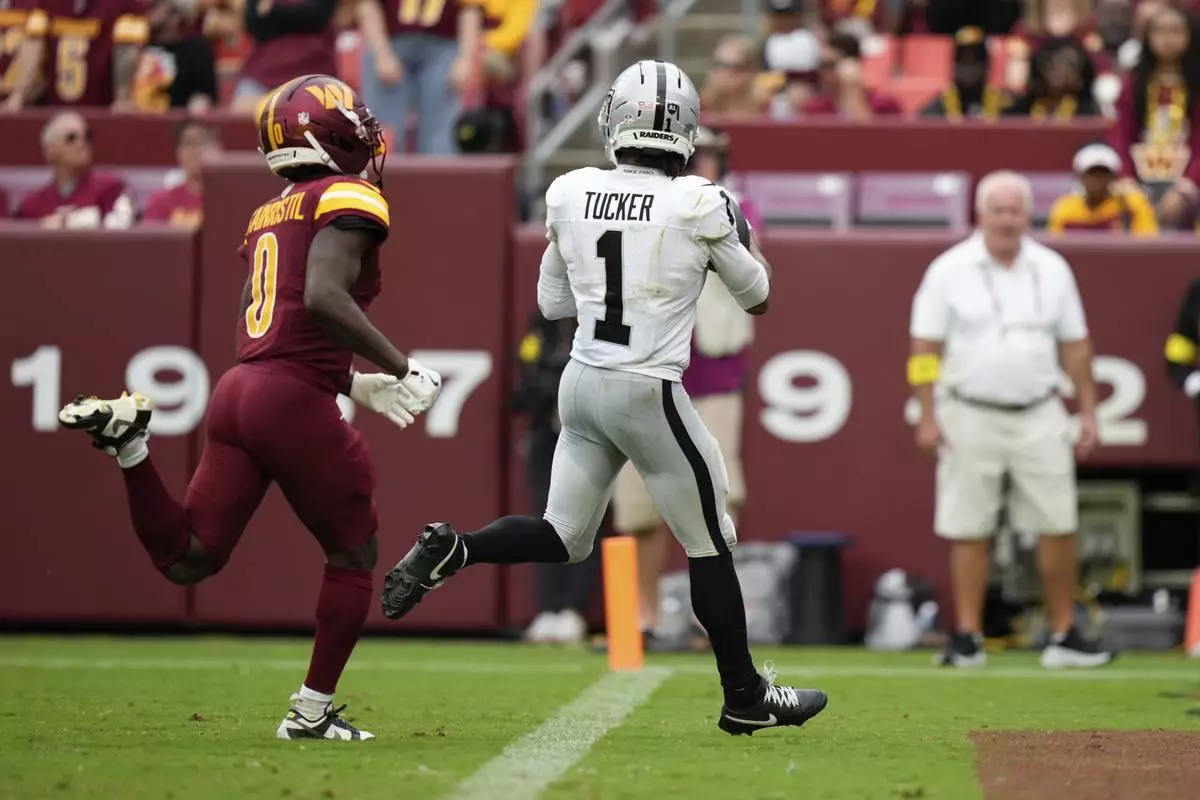
Las Vegas Raiders wide receiver Tre Tucker (1) scores a touchdown as Washington Commanders cornerback Mike Sainristil (0) defends during the second half of an NFL football game Sunday, Sept. 21, 2025, in Landover, Md. (AP Photo/Stephanie Scarbrough)
HAVANA (AP) — Cuban soldiers wearing white gloves marched out of a plane on Thursday carrying urns with the remains of the 32 Cuban officers killed during a stunning U.S. attack on Venezuela as trumpets and drums played solemnly at Havana's airport.
Nearby, thousands of Cubans lined one of Havana’s most iconic streets to await the bodies of colonels, lieutenants, majors and captains as the island remained under threat by the administration of U.S. President Donald Trump.
The soldiers' shoes clacked as they marched stiff-legged into the headquarters of the Ministry of the Armed Forces, next to Revolution Square, with the urns and placed them on a long table next to the pictures of those killed so people could pay their respects.
Thursday’s mass funeral was only one of a handful that the Cuban government has organized in almost half a century.
Hours earlier, state television showed images of more than a dozen wounded people described as “combatants” accompanied by Cuban Foreign Minister Bruno Rodríguez arriving Wednesday night from Venezuela. Some were in wheelchairs.
Those injured and the remains of those killed arrived as tensions grow between Cuba and the U.S., with Trump recently demanding that the Caribbean country make a deal with him before it is “too late.” He did not explain what kind of deal.
Trump also has said that Cuba will no longer live off Venezuela's money and oil. Experts warn that the abrupt end of oil shipments could be catastrophic for Cuba, which is already struggling with serious blackouts and a crumbling power grid.
Officials unfurled a massive flag at Havana's airport as President Miguel Díaz-Canel, clad in military garb as commander of Cuba's Armed Forces, stood silent next to former President Raúl Castro, with what appeared to be the relatives of those killed looking on nearby.
Cuban Interior Minister Lázaro Alberto Álvarez Casa said Venezuela was not a distant land for those killed, but a “natural extension of their homeland.”
“The enemy speaks to an audience of high-precision operations, of troops, of elites, of supremacy,” Álvarez said in apparent reference to the U.S. “We, on the other hand, speak of faces, of families who have lost a father, a son, a husband, a brother.”
Álvarez called those slain “heroes,” saying that they were an example of honor and “a lesson for those who waver.”
“We reaffirm that if this painful chapter of history has demonstrated anything, it is that imperialism may possess more sophisticated weapons; it may have immense material wealth; it may buy the minds of the wavering; but there is one thing it will never be able to buy: the dignity of the Cuban people,” he said.
Thousands of Cubans lined a street where motorcycles and military vehicles thundered by with the remains of those killed.
“They are people willing to defend their principles and values, and we must pay tribute to them,” said Carmen Gómez, a 58-year-old industrial designer, adding that she hopes no one invades given the ongoing threats.
When asked why she showed up despite the difficulties Cubans face, Gómez replied, “It’s because of the sense of patriotism that Cubans have, and that will always unite us.”
Cuba recently released the names and ranks of 32 military personnel — ranging in age from 26 to 60 — who were part of the security detail of Venezuelan President Nicolás Maduro during the raid on his residence on January 3. They included members of the Revolutionary Armed Forces and the Ministry of the Interior, the island’s two security agencies.
Cuban and Venezuelan authorities have said that the uniformed personnel were part of protection agreements between the two countries.
A demonstration was planned for Friday across from the U.S. Embassy in an open-air forum known as the Anti-Imperialist Tribune. Officials have said they expect the demonstration to be massive.
“People are upset and hurt. There’s a lot of talk on social media; but many do believe that the dead are martyrs” of a historic struggle against the United States, analyst and former diplomat Carlos Alzugaray told The Associated Press.
In October 1976, then-President Fidel Castro led a massive demonstration to bid farewell to the 73 people killed in the bombing of a Cubana de Aviación civilian flight financed by anti-revolutionary leaders in the U.S. Most of the victims were Cuban athletes.
In December 1989, officials organized “Operation Tribute” to honor the more than 2,000 Cuban combatants who died in Angola during Cuba’s participation in the war that defeated the South African army and ended the apartheid system. In October 1997, memorial services were held following the arrival of the remains of guerrilla commander Ernesto “Che” Guevara and six of his comrades, who died in 1967.
The latest mass burial is critical to honor those slain, said José Luis Piñeiro, a 60-year-old doctor who lived four years in Venezuela.
“I don’t think Trump is crazy enough to come and enter a country like this, ours, and if he does, he’s going to have to take an aspirin or some painkiller to avoid the headache he’s going to get,” Piñeiro said. “These were 32 heroes who fought him. Can you imagine an entire nation? He’s going to lose.”
A day before the remains of those killed arrived in Cuba, U.S. Secretary of State Marco Rubio announced $3 million in aid to help the island recover from the catastrophic Hurricane Melissa, which struck in late October.
The first flight took off from Florida on Wednesday, and a second flight was scheduled for Friday. A commercial vessel also will deliver food and other supplies.
“We have taken extraordinary measures to ensure that this assistance reaches the Cuban people directly, without interference or diversion by the illegitimate regime,” Rubio said, adding that the U.S. government was working with Cuba's Catholic Church.
The announcement riled Cuban Foreign Minister Bruno Rodríguez.
“The U.S. government is exploiting what appears to be a humanitarian gesture for opportunistic and politically manipulative purposes,” he said in a statement. “As a matter of principle, Cuba does not oppose assistance from governments or organizations, provided it benefits the people and the needs of those affected are not used for political gain under the guise of humanitarian aid.”
Coto contributed from San Juan, Puerto Rico.
Follow AP’s coverage of Latin America and the Caribbean at https://apnews.com/hub/latin-america
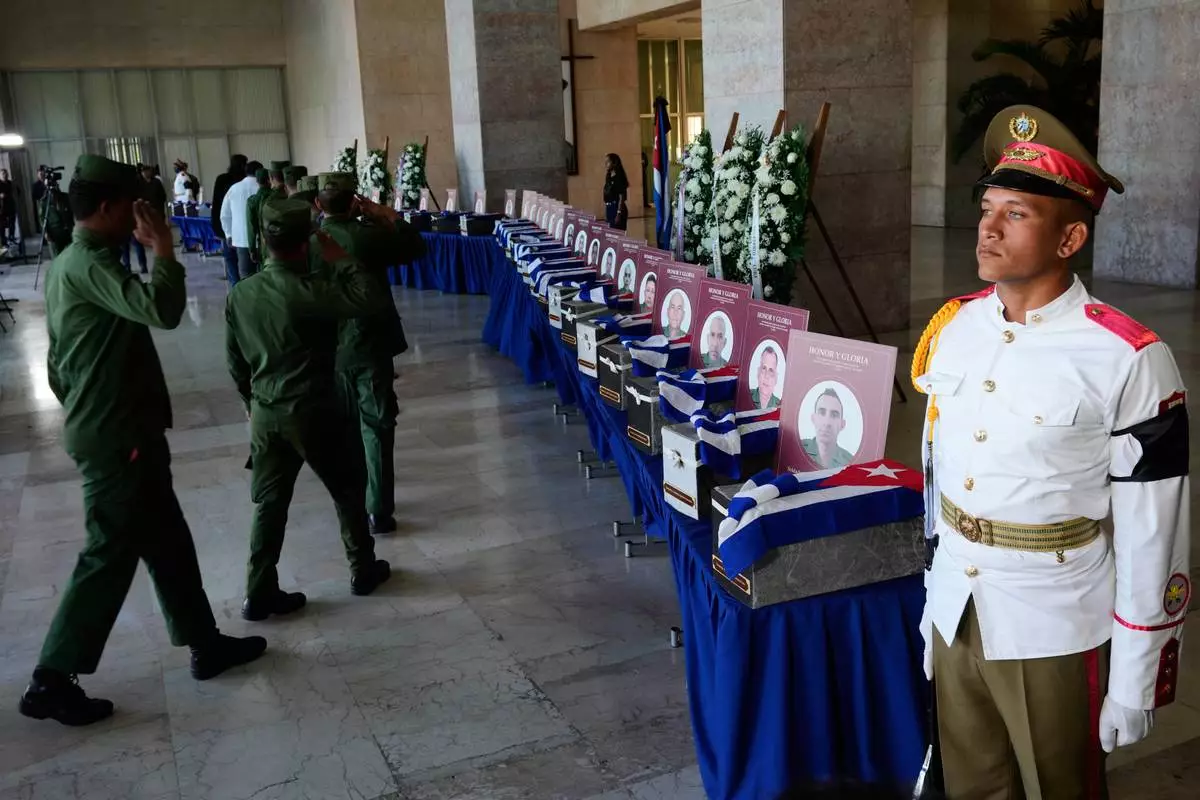
Military members pay their last respects to Cuban officers who were killed during the U.S. operation in Venezuela that captured Venezuelan President Nicolas Maduro, at the Ministry of the Revolutionary Armed Forces where the urns containing the remains are displayed during a ceremony in Havana, Cuba, Thursday, Jan. 15, 2026. (AP Photo/Ramon Espinosa)
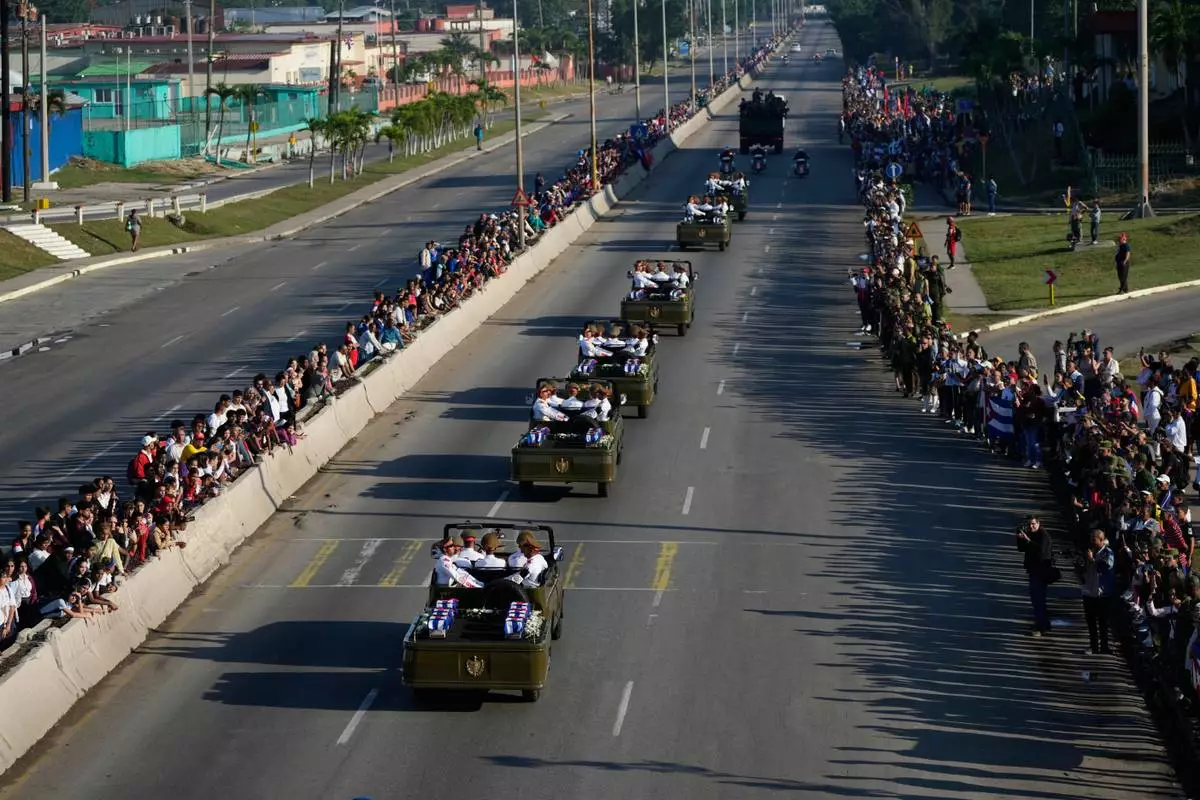
A motorcade transports urns containing the remains of Cuban officers, who were killed during the U.S. operation in Venezuela that captured Venezuelan President Nicolas Maduro, through Havana, Cuba, Thursday, Jan. 15, 2026. (AP Photo/Ramon Espinosa)
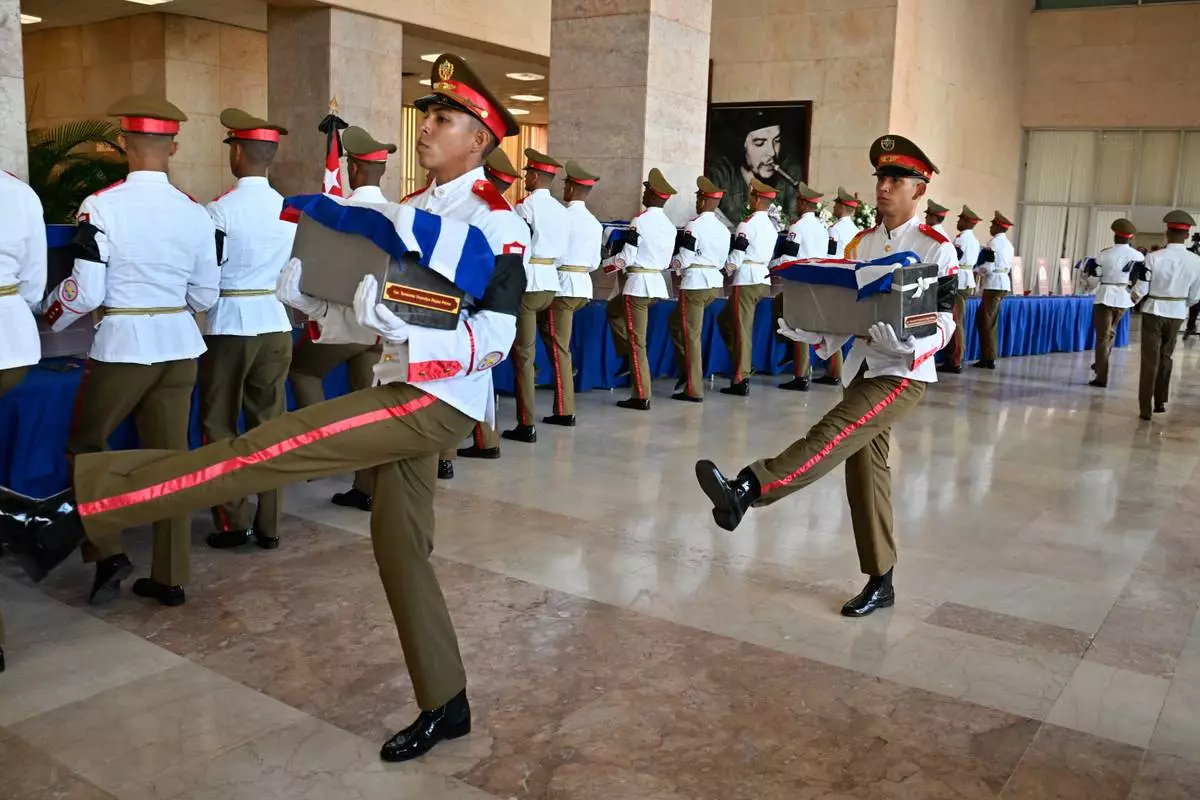
Soldiers carry urns containing the remains of Cuban officers, who were killed during the U.S. operation in Venezuela that captured Venezuelan President Nicolas Maduro, at the Ministry of the Revolutionary Armed Forces in Havana, Cuba, Thursday, Jan. 15, 2026. (Adalberto Roque /Pool Photo via AP)
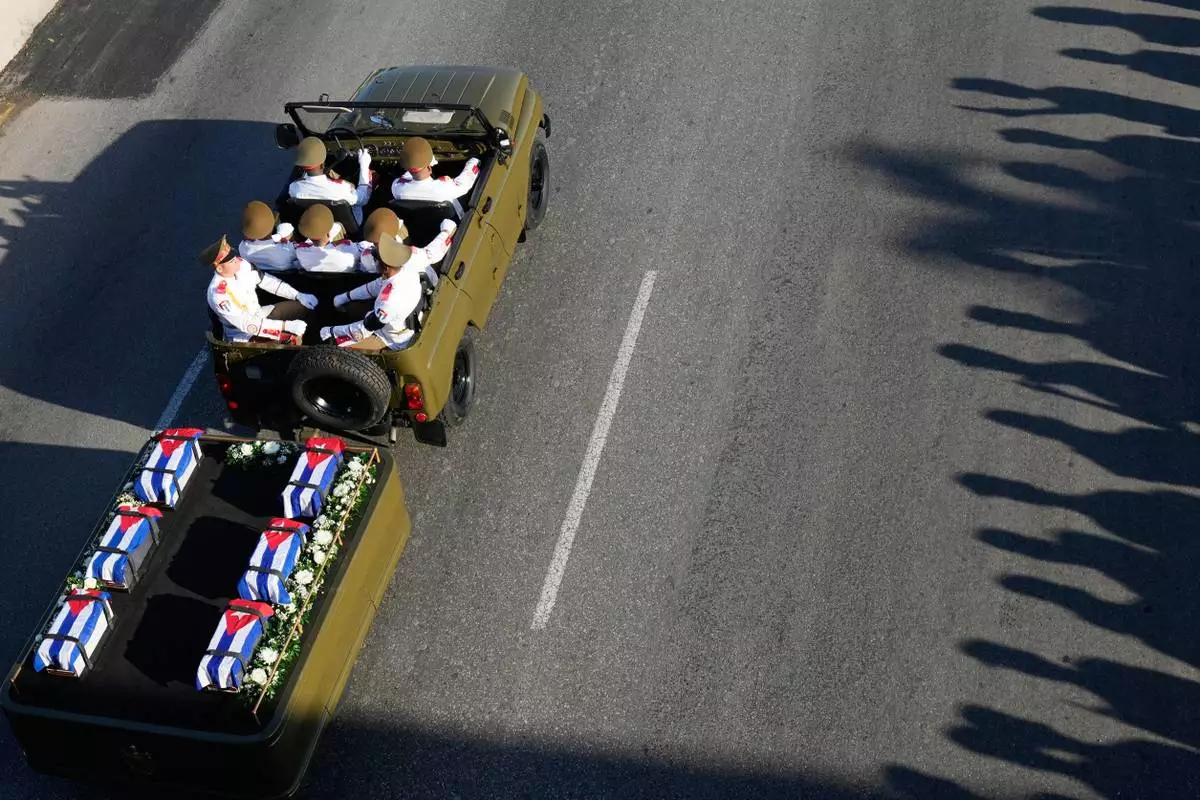
A motorcade transports urns containing the remains of Cuban officers, who were killed during the U.S. operation in Venezuela that captured Venezuelan President Nicolas Maduro, through Havana, Cuba, Thursday, Jan. 15, 2026. (AP Photo/Ramon Espinosa)
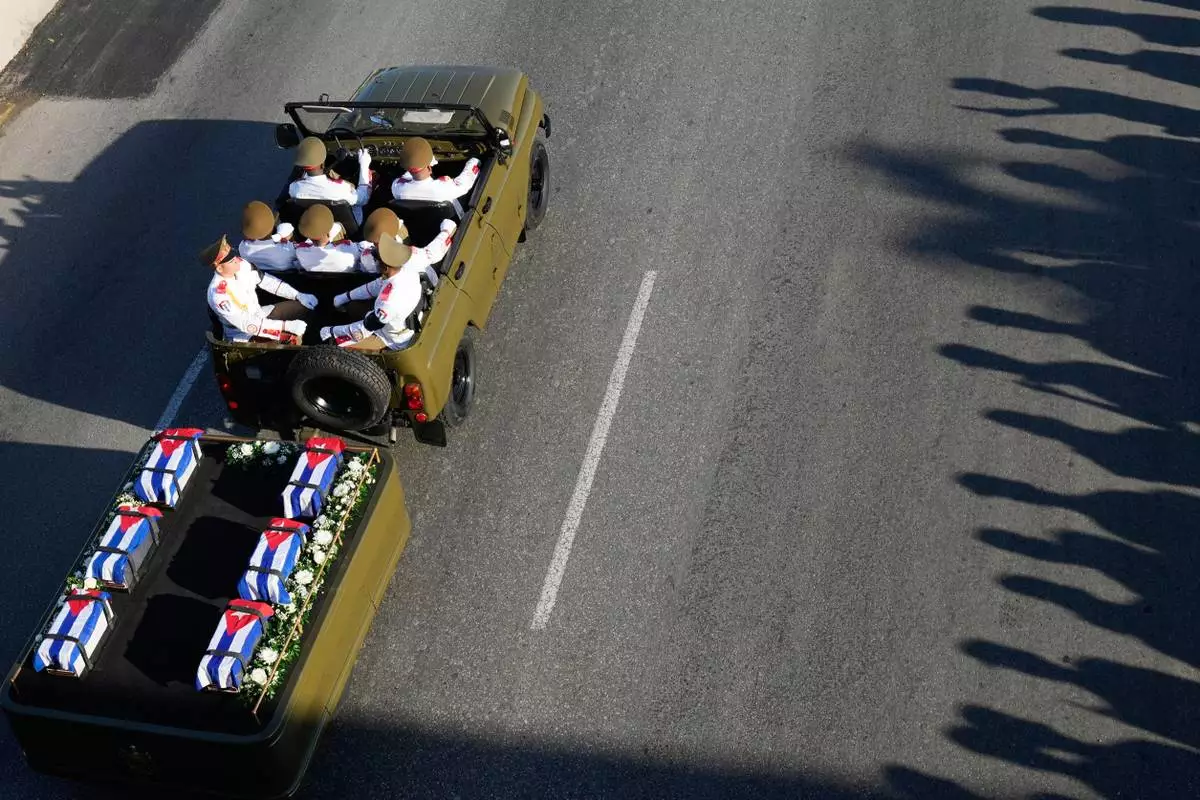
A motorcade transports urns containing the remains of Cuban officers, who were killed during the U.S. operation in Venezuela that captured Venezuelan President Nicolas Maduro, through Havana, Cuba, Thursday, Jan. 15, 2026. (AP Photo/Ramon Espinosa)
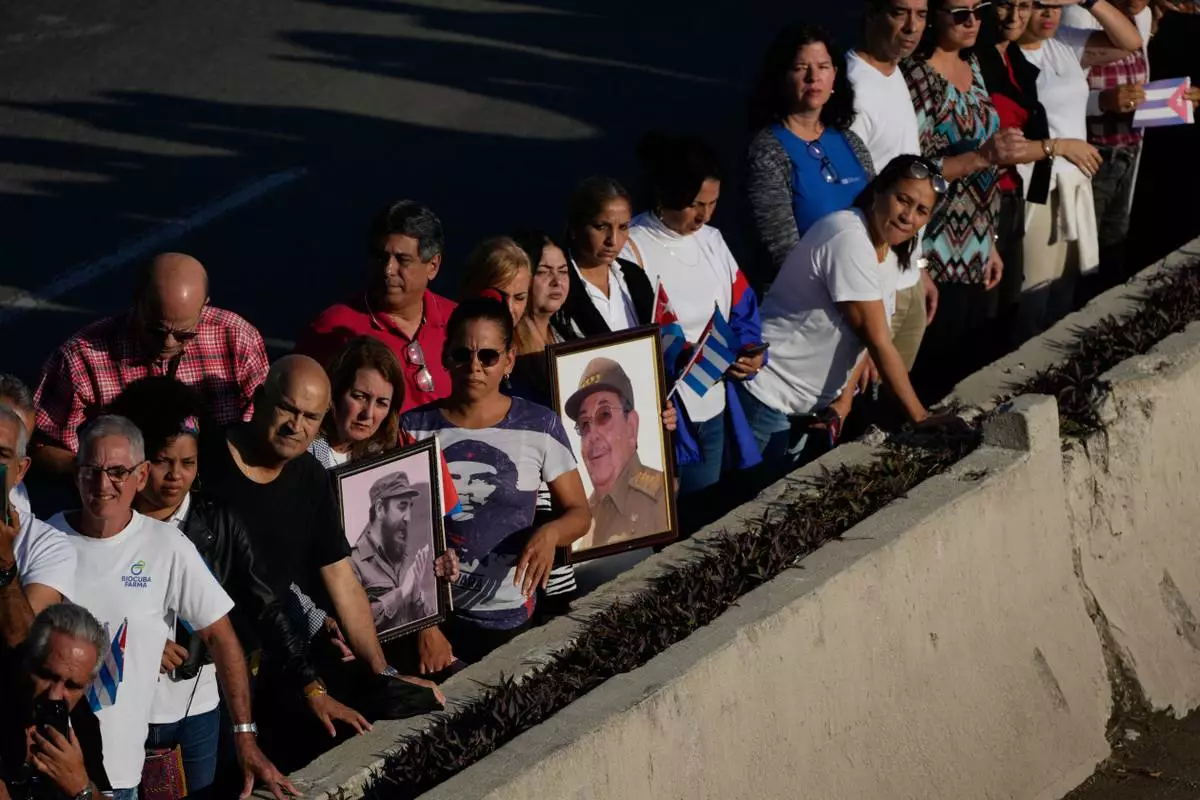
People line the streets of Havana, Cuba, Thursday, Jan. 15, 2026, to watch the motorcade carrying urns containing the remains of Cuban officers killed during the U.S. operation in Venezuela that captured Venezuelan President Nicolas Maduro. (AP Photo/Ramon Espinosa)
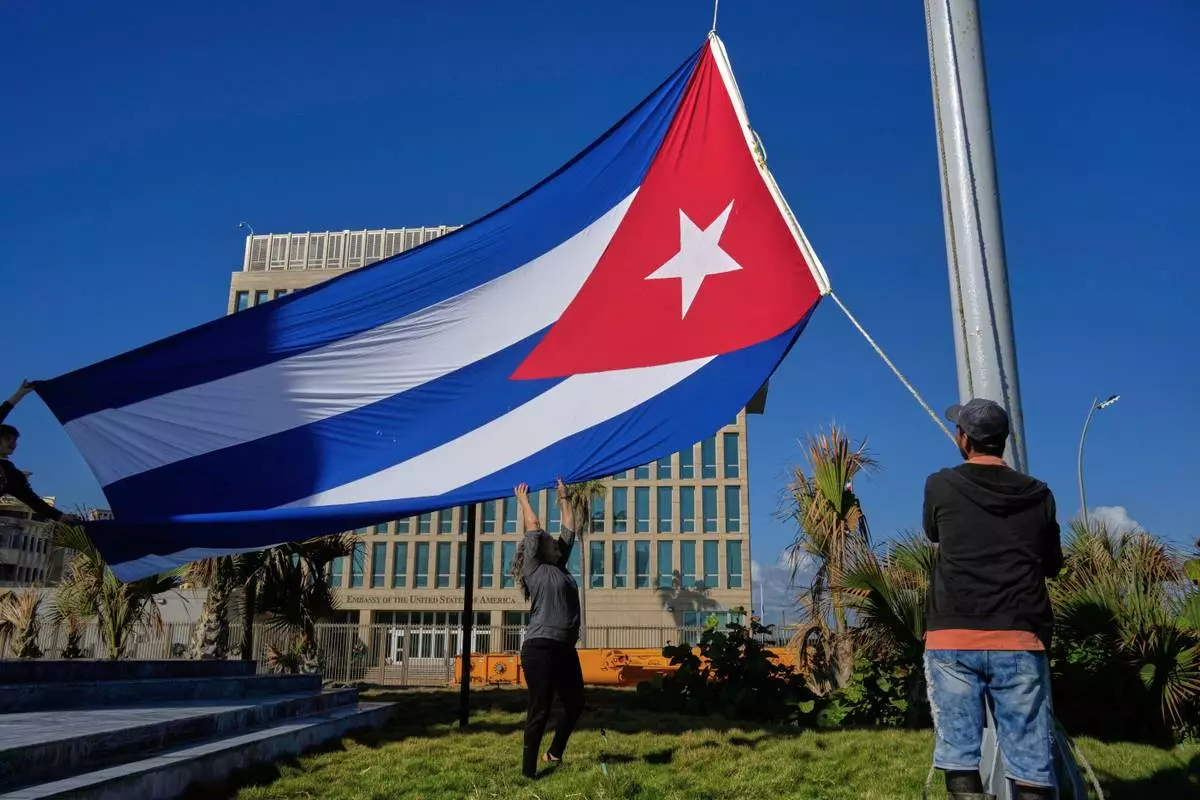
Workers fly the Cuban flag at half-staff at the Anti-Imperialist Tribune near the U.S. Embassy in Havana, Cuba, Monday, Jan. 5, 2026, in memory of Cubans who died two days before in Caracas, Venezuela during the capture of Venezuelan President Nicolas Maduro by U.S. forces. (AP Photo/Ramon Espinosa)