SINGAPORE, Sept. 25, 2025 /PRNewswire/ -- MetaComp Pte Ltd (MetaComp), a leading licensed cross-border FX and digital assets infrastructure provider headquartered in Singapore and regulated by the Monetary Authority of Singapore (MAS), today released its latest whitepaper, Cross-Border Payments for SMEs: Voices in ASEAN and the Rise of Stablecoins. The paper reveals systemic inefficiencies preventing small and medium enterprises (SMEs) from accessing efficient cross-border payment solutions.
Commissioned as part of MetaComp's mission to simplify and streamline global fund flows, the research underscores how misaligned payment infrastructure disadvantages SMEs despite their central role in regional trade. The study also points to the growing role of stablecoins in global markets, noting that their flows already carry systemic financial implications and could be harnessed as practical settlement infrastructure for SMEs.
The report identifies five structural and systemic inefficiencies that are costing SMEs and reshaping global markets:
- A US$6.2 trillion opportunity gap: The study identifies a disconnect between daily global FX trading volumes of more than US$7.5 trillion and blockchain-based cross-border payments and settlements that accounts for less than 5% annually. This imbalance represents a US$6.2 trillion opportunity gap, underscoring how far SMEs remain excluded from faster and more efficient settlement infrastructure.
- Delays that erase value: Each day of settlement delay costs SMEs 0.6% to 2.1% of transaction value. SMEs profiled in the study reported lost contracts and revenue drops of up to 50% when funds failed to arrive on time.
- SMEs pay up to 30 per cent more: Smaller firms routinely pay 15 to 30 per cent in fees on cross-border transactions, while large corporates negotiate preferential pricing. These disproportionate costs cut directly into SME margins and limit their ability to expand into new markets.
- Stablecoins now move bond markets: Stablecoin flows are no longer marginal. They are already influencing US Treasury yields by 2 to 8 basis points, underscoring that new payment rails carry systemic implications for financial markets worldwide.
The study finds that timing costs often outweigh fees, with delayed settlements compounding into lost opportunities, performance degradation, and working capital stress. Scale barriers and fragmented Travel Rule regulations, from €0 in the EU to SGD 1,500 in Singapore and USD 3,000 in the US, further exclude SMEs from efficient participation.
Beyond these inefficiencies, the whitepaper frames the evolution of cross-border payments in three distinct stages:
- Stage One – Traditional (SWIFT): A USD-centric model with settlement delays of 2–7 days.
- Stage Two – Web 2.5 (Today): The transition phase that begins with the emergence of stablecoins. This is where MetaComp operates today — building hybrid infrastructure that blends regulatory compliance with blockchain-enabled programmability to deliver faster, fairer settlement.
- Stage Three – Sovereign Stablecoins (Future): A future ecosystem of national stablecoins exchanging directly powered by blockchain, which allows point-to-point direct exchange in a multi-polar world while maintaining regulatory oversight.
StableX is MetaComp's flagship platform for Stage Two, enabling Web 2.5 settlement now while laying the foundation for Stage Three.
Author Perspectives
Dr. Bo Bai, Executive Chairman and Co-Founder of Alpha Ladder Group and Chairman of MetaComp shared, "The journey of cross-border payments is evolving in phases. Stage one was SWIFT era; stage two is today's Web 2.5, where compliance meets programmability; and stage three will be sovereign stablecoins exchanging value directly. At MetaComp, we are already building toward this vision, with StableX as a critical step on that journey."
Dr. Ben Charoenwong, Associate Professor of Finance, INSEAD said, "SMEs face challenges that go beyond transaction fees. Settlement delays erode working capital, regulatory fragmentation creates uncertainty, and volume-based barriers exclude growing businesses from efficient infrastructure. These structural issues must be addressed if SMEs are to participate fully in global trade."
Tin Pei Ling, Co-President of MetaComp, said, "SMEs remain at the heart of ASEAN's economies, yet too often they face barriers that slow growth and limit opportunity. What they need is confidence that payments will be fast, compliant, and reliable across borders. At MetaComp, our focus is on closing this gap with solutions such as StableX that combine innovation and regulation to deliver faster, fairer settlement."
Eddie Hui, Co-President and COO of MetaComp, added, "Every day of delay erodes SME value. This is not about marginal cost savings, it is about survival and growth. Our study shows that adoption depends on business model realities, which is why the next generation of infrastructure must deliver instant settlement that SMEs can actually use in practice."
StableX, developed and operated by MetaComp, bridges the gap between digital and traditional finance. Designed as an institutional-grade cross-border FX and liquidity routing platform, StableX delivers same-day (T+0) settlement across 30 currencies and six major stablecoins. By combining blockchain speed with a strong focus on compliance, it provides SMEs with faster, more reliable, and more transparent cross-border settlement.
The full study Cross-Border Payments for SMEs: Voices in ASEAN can be downloaded here: https://www.mce.sg/metacomp-whitepaper-cross-border-payments-for-smes-voices-in-asean-and-the-rise-of-stablecoins/
-END-
About MetaComp
MetaComp is a leading licensed cross-border FX and digital assets infrastructure provider headquartered in Singapore and licensed by the Monetary Authority of Singapore (MAS) under the Payment Services Act 2019. Operating on a P2B2C (platform-to-business/partners-to-clients) model, MetaComp empowers institutions, payment service providers, fintechs, and global enterprises to navigate the evolving cross-border payments and the digital asset economy with confidence.
With a strong emphasis on compliance, security, and institutional-grade infrastructure, MetaComp delivers an end-to-end suite of digital finance solutions — including OTC and exchange trading, fiat payment rails, regulated digital asset custody, and prime brokerage services. MetaComp is a subsidiary of Alpha Ladder Finance Pte. Ltd., a MAS-licensed Capital Markets Services (CMS) licensee and Recognised Market Operator (RMO).
Through its proprietary Client Asset Management Platform (CAMP), MetaComp provides a secure, integrated environment that bridges traditional finance with digital assets.
MetaComp's latest innovation, StableX, is a next-generation cross-border FX and liquidity routing infrastructure designed to simplify and accelerate global fund flows. Powered by stablecoins and USD, StableX intelligently optimises multi-currency conversions and settlements, enabling faster, more cost-effective, and highly competitive cross-border transactions. As the FX layer within CAMP, StableX combines the programmability of digital assets with the reliability of regulated infrastructure, delivering a scalable, compliant and seamless ecosystem for the future of global finance.
To learn more about MetaComp and its regulated infrastructure and solutions, visit www.mce.sg
** The press release content is from PR Newswire. Bastille Post is not involved in its creation. **

MetaComp Calls for Faster, Fairer Settlement as New Study Reveals USD 6 Trillion SME Payment Opportunity Gap in Cross-Border Finance
From RPO and Romomo to PartyOS, RoboParty is building an open humanoid robotics foundation for developers worldwide.
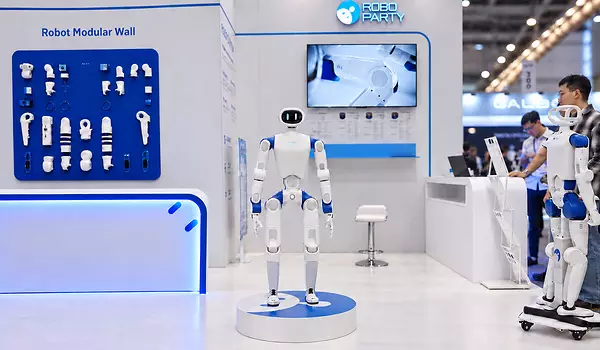
PITTSBURGH, Oct. 4, 2026 /PRNewswire/ -- On September 28, 2026, RoboParty publicly unveiled RP1 (ROBOTO 01) at IROS 2026, marking the robot's global debut.
In January 2026, RoboParty fully open-sourced RPO (ROBOTO ORIGIN), its first open-source humanoid robotics project. To date, RPO has received more than 2,500 GitHub stars. As a developer-oriented open-source humanoid robot, RPO has attracted broad attention worldwide and inspired multiple community builds and reproductions.
Building on this foundation, RoboParty positions RP1 as the world's first high-performance full-stack open-source bipedal humanoid robot. RP1 is designed for researchers, educators, robotics developers and embodied AI teams, with the goal of providing a humanoid robotics system that can be used, modified, trained and continuously extended in real development workflows.
Kick Me: Putting Dynamic Stability to the Test
At RoboParty's IROS booth, the "Kick Me" interactive demonstration was one of the most direct ways for visitors to experience RP1's capabilities.
During the demonstration, visitors could directly apply external disturbances to the robot. When pushed or kicked, RP1 rapidly adjusted its posture and recovered its balance. Unlike demonstrations based only on predefined motions, this open interaction allowed visitors to observe the robot's dynamic stability and control performance under external disturbances.
The repeated high-intensity interactions also provided a direct test of the robot's body performance and system-level robustness.
RP1's dynamic motion and disturbance-recovery capabilities at IROS were supported by PartyOS, RoboParty's open R&D foundation for humanoid robotics, which integrates the UFO framework.
UFO — short for "A General Unsupervised Reinforcement Learning Framework for Humanoid Control" — is a training framework for discovering humanoid motor skills through unsupervised reinforcement learning. It trains low-level motion policies that allow robots to learn dynamic behaviors without relying entirely on conventional predefined motion trajectories, including skill transitions, disturbance recovery and fall recovery.
Rather than treating motion control as an isolated algorithmic module, RoboParty is integrating the robot body, actuator modules, low-level control and embodied AI algorithms into one system for continuous joint validation. The goal is to ensure that algorithmic capabilities are built on a stable and reproducible humanoid robotics platform.
The IROS demonstration marked an important validation milestone for this technical direction.
Throughout the exhibition, researchers, university faculty and students, robotics developers and industry professionals from different countries and regions visited RoboParty's booth. Discussions extended beyond motion performance to RP1's robot body, Romomo actuator modules, motion control, modular design and future open-source plans.
Multiple research teams and developers also discussed the procurement of robots and core components, algorithm reproduction, embodied AI research and open-source collaboration with the RoboParty team.
From Closed Systems to Full-Stack Open Source
With RP1, RoboParty is exploring an alternative path for humanoid robotics.
Today, high-performance humanoid robots are typically delivered as complete products or closed systems. Researchers and developers may be able to use or observe these robots, but the underlying hardware, motion-control systems, simulation environments and software stacks are often difficult to inspect, modify, reproduce or extend.
RP1 is designed to redefine how humanoid robots are developed — from a developer's perspective.
For RoboParty, "full-stack open source" does not mean releasing only mechanical files or a single software module. In addition to the robot body and core actuator modules, RoboParty plans to progressively open its motion-control systems, simulation environments, SDKs, training tools and PartyOS development foundation.
This will allow developers to participate more deeply in humanoid robotics development, from hardware and low-level control to model training and deployment.
"Humanoid robots should not be closed systems that only a small number of teams can build while everyone else can do little more than watch," said Yi Huang, founder of RoboParty. "We want RP1 to become an open foundation that developers can access, modify, train and continuously improve. Full-stack open source has been our technical direction since the RPO project."
RoboParty plans to announce further details of RP1's open-source roadmap in October 2026, with broader software and hardware releases and a mass-production program to follow later in Q4.
RP1: A High-Performance Open-Source Body for Embodied AI
RP1 is designed to provide a high-performance humanoid platform for dynamic motion, embodied AI model training, validation and deployment, data collection and continuous development.
RP1 delivers peak joint torque of up to 160 N•m. From its in-house-developed Romomo actuator modules and mechanical structure to its real-time motion-control system, RP1 is designed around the requirements of dynamic motion, disturbance recovery and long-term development experiments.
These capabilities were demonstrated live at IROS. During the "Kick Me" interaction, visitors directly applied external disturbances while RP1 adjusted its posture and regained its balance. The robot also demonstrated continuous motion, disturbance recovery and fall recovery. These behaviors reflected not only algorithmic performance but also the coordination of the robot body, actuator modules and motion-control system.
RP1 builds on RoboParty's broader full-stack open-source roadmap.
RoboParty began with RPO, its fully open-source bipedal humanoid robotics project. Through the development and community adoption of RPO, RoboParty expanded its technical capabilities to cover core actuators, robot bodies, motion control, dexterous manipulation and robotics software systems.
RoboParty subsequently introduced the Romomo actuator modules and its dexterous RP Hand while continuing to build PartyOS.
RPO validated an open-source bipedal robot body, motion-control system and developer workflow. Romomo expanded the technical foundation to cover core actuator modules. RP Hand extended the stack into dexterous manipulation and human-robot interaction. RP1 now brings these capabilities together into a humanoid robotics system designed for research and development.
Based on these capabilities, PartyOS is evolving across humanoid locomotion, perceptual interaction, whole-body manipulation and autonomous intelligent humanoids.
By bringing the robot body, actuators, motion control, perception, manipulation and intelligent software into one coordinated development system, RoboParty is building a full-stack open-source humanoid robotics platform from low-level hardware to high-level intelligence.
Building a Global Developer Community
RoboParty's team spans robot hardware, motion control, artificial intelligence, systems software and manufacturing engineering. Core team members studied at Tsinghua University's Yao Class, Peking University's Zhi Class, Harbin Institute of Technology, Stanford University, Carnegie Mellon University, Zhejiang University and other leading institutions.
RoboParty has already built a global community of more than 5,000 developers across research, education and maker communities.
As RP1 becomes progressively more open, RoboParty aims to further develop this community into an open ecosystem spanning robot hardware, algorithms, data and applications, enabling more researchers, model-development teams and developers to participate in building and advancing humanoid robotics.
Media Contact: marketing@roboparty.com
GitHub: https://github.com/Roboparty/roboto_origin
Website: https://roboparty.com/
** This press release is distributed by PR Newswire through automated distribution system, for which the client assumes full responsibility. **
RoboParty Unveils RP1, a High-Performance Full-Stack Open-Source Humanoid Robot at IROS