If Neko Case had just one word to describe her first solo album in seven years, she would settle on “formidable.”
Fair enough. Writers have twisted themselves into knots trying to describe Case's sound — “gothic Americana” is one iteration — yet it's generally a thrill ride through shifting tones and tempos, anchored by her vivid imagery and titanic voice.
On the “Neon Grey Midnight Green” album, Case was intent on inviting a large number of musicians to join her, and their power is evident. She employs a 16-piece orchestra. Add in 10 other listed players (including herself) and that makes for 26 musicians on the album-ending song “Match-Lit” alone.
“I wanted to remind people of what it sounded like to have a large group of people playing together,” Case said. “That doesn't mean I have anything against synthesizer string sections or horn sections, because those things sound cool when you use them in the right way. And having a whole orchestra is cost prohibitive, especially now. I really wanted to do it because I didn't think I'd have the chance to do it again.”
Maybe it’s not a wall of sound, but the swirling strings on “Wreck,” for example, take her music to a joyful place. Listen carefully for the harp.
It wasn't writer's block that kept Case out of the picture for a few years. The pandemic was an interruption for everybody. The Vermont-based singer also records and tours with the band The New Pornographers. She has written the music for an upcoming stage adaptation of “Thelma & Louise.” And she also wrote a memoir, “The Harder I Fight the More I Love You,” published earlier this year.
The book describes a harrowing upbringing, mostly in the Pacific Northwest by parents who conceived her as teenagers and were unprepared and uninterested in raising her. Case says at one point, she was told her mother had died, only to have her show up again a year and a half later with no explanation.
Case was essentially on her own by the time she was a teenager. Music, to a great extent, saved her.
The on-again, off-again relationship with her mother is off. “I don't even know anything about my mother anymore,” Case said.
Pain doesn't disappear, though. “From her I learned to be cruel,” Case sings in new song “An Ice Age.” “I learned the look that goes right past the ones who love you as if there's no one standing there.”
What will be interesting in coming months, as she prepares to take new songs on the road, is whether opening her life to the world with the memoir will draw more people to her music. Her management has seen preliminary signs that it has, but Case isn't sure.
Colin Dickerman, editor-in-chief at Grand Central Publishing and editor of Case's book, has a hunch that it will. From reading reviews of the memoir, he knows it attracted fans who wanted to learn more about the writer of songs they loved. But it also reached people who were interested in the story about overcoming adversity and subsequently said they would check out her music.
“I think it really did reach a bigger audience,” Dickerman said.
Two of Case's new songs honor friends, both musicians, who died recently. One is for Dexter Romweber of the Flat Duo Jets, whose songs inspired her to make music before he later became a friend and collaborator. Dallas Good, late singer of The Sadies, who played with Case early in her career, is the inspiration for “Match-Lit.”
The latter, a detailed description of what happens when a match is lit, illustrates Case's often intriguing pathways to songs; she memorably once wrote from the point of view of a tornado. “I don't do it purposely to try and be weird,” she said. “I'm just a noticer, a chronic noticer.”
Sometimes it's up to the listener to determine what a song means to them, rather than try to figure out what Case specifically meant.
“There's a bit of, not withholding, but leaving space for people to come into the song and wear it like it's theirs and for them to make associations about their own lives, to make it about themselves,” she said. “Those are the songs that meant a lot to me, or did when I was younger. I want the listener to feel invited into it.”
On “Rusty Mountain,” Case sings about how writing love songs is mostly “an exercise in futility for me.” Slowly it dawns on you that you're listening to a love song. Similarly, “Wreck” — with the memorable line “I'm a meteor shattering around you” — suggests Case protests a bit too much.
“There's all different kinds of love on there,” she said. “I think pretty much every song, save maybe one, is a love song — about music or musicians or specific people here or there. There are love songs about other things, rather than just heterosexual love, which is the thing people write about most of all.
“It's difficult to avoid cliches when you're writing love songs,” she said, “and the people who are good at it are so good at it that you're like, ‘why bother?’ I always think about Louie Armstrong singing, ‘If I Could Be With You,’ and I think, ‘is there a better love song than that?’ I don't think so. Or his version of ‘I Can’t Give You Anything But Love.' The bar of people who write love songs is so high that I kind of feel daunted by it.”
She knows enough people who are gay or gender-nonconforming who don't hear love songs they can relate to. That's a challenge she accepts.
“It made me want to make sure there was room for people, no matter who these people were, to wear the song like a punk rock vest and to feel held onto and comforted,” she said.
David Bauder writes about the intersection of media and entertainment for the AP. Follow him at http://x.com/dbauder and https://bsky.app/profile/dbauder.bsky.social.

FILE - Singer-songwriter Neko Case poses at a hotel in New Yor on July 9, 2013. (Photo by Dan Hallman/Invision/AP, File)

FILE - Singer-songwriter Neko Case poses at a hotel in New Yor on July 9, 2013. (Photo by Dan Hallman/Invision/AP, File)
After a frenetic few months of congressional redistricting efforts, President Donald Trump’s plan to reshape voting districts for partisan advantage ahead of this year’s midterm elections stands at an important juncture.
Will Republican- and Democratic-led states ramp up their remapping of U.S. House districts as new legislative sessions get underway? Or will the mid-decade redistricting frenzy fade away following Indiana’s resounding rejection of Trump’s pressure-packaged campaign?
“We’re at a crossroads to see if the mid-decade redistricting movement gains more speed or was simply an attempt by Donald Trump to impact elections that in many states fizzled,” said Jeffrey Wice, director of the Elections, Census and Redistricting Institute at New York Law School.
Virginia and Florida are two key states to watch. Democrats who lead Virginia and Republicans who lead Florida could try to swing multiple seats in their party’s favor by an aggressive redistricting. Virginia’s legislative session begins Wednesday. Florida Gov. Ron DeSantis plans to call a special session in April on congressional redistricting.
What happens next in Democratic-led Illinois and Maryland and in Kansas' Republican-led Legislature also could affect the GOP’s ability to maintain a narrow House majority in the face of political headwinds that typically favor the party out of power in midterm elections. Key lawmakers in all three of those states remain opposed to redistricting.
Trump kick-started an unusual redistricting plan in July by calling on Texas Republicans to redraw their congressional map to create more favorable districts for the party — even though there was no new census data to base it upon. That triggered a mid-decade redistricting battle the likes of which has not been common since the late 1800s.
Texas, Missouri and North Carolina all approved new Republican-friendly House districts. Ohio, which had to redistrict because of its state constitution, used the opportunity to enact a more favorable House map for Republicans.
But Ohio’s action on Oct. 31 marked a turning point. That same day, Virginia’s Democratic-led legislature took a first step toward redistricting. Then in November, California voters approved new House districts helping Democrats, Kansas Republicans dropped plans for a special session on redistricting, and a Utah judge adopted a new House map that benefits Democrats.
Trump suffered a stunning setback Dec. 11, when Indiana’s Republican-led Senate defeated a redistricting plan that could have helped the GOP win all nine of the state’s U.S. House seats, up from their current seven.
The net result from the 2025 jockeying could be three additional seats for Republicans. But even that is in question, because legal challenges remain in some states, and there is no guarantee that parties will win the districts they redrew.
When the Virginia General Assembly begins its annual session, the agenda will include a proposed constitutional amendment allowing mid-decade redistricting in response to other states.
The amendment, which received first-round approval in the fall, would also need to pass a statewide vote before the new districts could be implemented. Quick action would be necessary to get all that accomplished in time for candidates to run in redrawn districts later this year.
Democrats, who currently hold six of the state’s 11 U.S. House seats, have not unveiled what those new districts would look like. But some have talked of trying to gain as many as four additional seats.
Virginia Gov.-elect Abigail Spanberger has embraced the redistricting effort but has not committed to a particular plan.
“I will look at any map that is kind of reasonable and keeping communities compact and together,” Spanberger, a Democrat, told The Associated Press. “But ultimately, it’s up to the people of Virginia to choose whether or not to move forward with the referendum.”
Republicans currently hold 20 of Florida’s 28 U.S. House seats. That advantage could grow if districts are reshaped during a special session.
Although Florida’s regular legislative session starts Tuesday, DeSantis said he is waiting until April to call a special redistricting session to allow time for a possible U.S. Supreme Court ruling on a key provision of the federal Voting Rights Act. If the court rules in a Louisiana case that race cannot be the predominant factor in creating voting districts, it could open the way for several Republican-led states to redraw districts represented by Black or Hispanic lawmakers who are Democrats.
DeSantis said the high court's ruling could affect “at least one or two” Florida districts.
But any redistricting that aids Republicans could face a court challenge. A voter-approved Florida constitutional provision prohibits drawing district boundaries to favor or disfavor a political party or incumbent.
Some Democrats seeking to counter Trump have urged lawmakers in Illinois and Maryland to redraw their already heavily Democratic districts to try to gain one additional seat in each state. But the plans appear to lack traction as legislative sessions begin this week in both states.
Illinois House Speaker Pro Tem Kam Buckner said “there is no active push” for congressional redistricting.
“There is no appetite to reopen something that will consume enormous time, energy and, frankly, political capital without a compelling justification,” Buckner, a Democrat, told the AP.
Democratic Maryland Gov. Wes Moore has created a special commission to recommend a new congressional map. But Democratic Senate President Bill Ferguson remains opposed and insists that a majority of residents also do not want new districts.
In Kansas, some Republicans want to redraw U.S. House districts to try to gain an additional seat. But House Republicans have failed to gain the two-thirds support needed to override a likely veto by Democratic Gov. Laura Kelly.
House Speaker Dan Hawkins told reporters that he has no plans to hold a vote on congressional redistricting during the annual legislative session that starts Monday.
“I do not have the votes,” Hawkins said.
Associated Press reporters Olivia Diaz, John Hanna, Mike Schneider and Brian Witte contributed to this story.

President Donald Trump points to the crowd as he walks off stage after speaking to House Republican lawmakers during their annual policy retreat, Tuesday, Jan. 6, 2026, in Washington. (AP Photo/Evan Vucci)
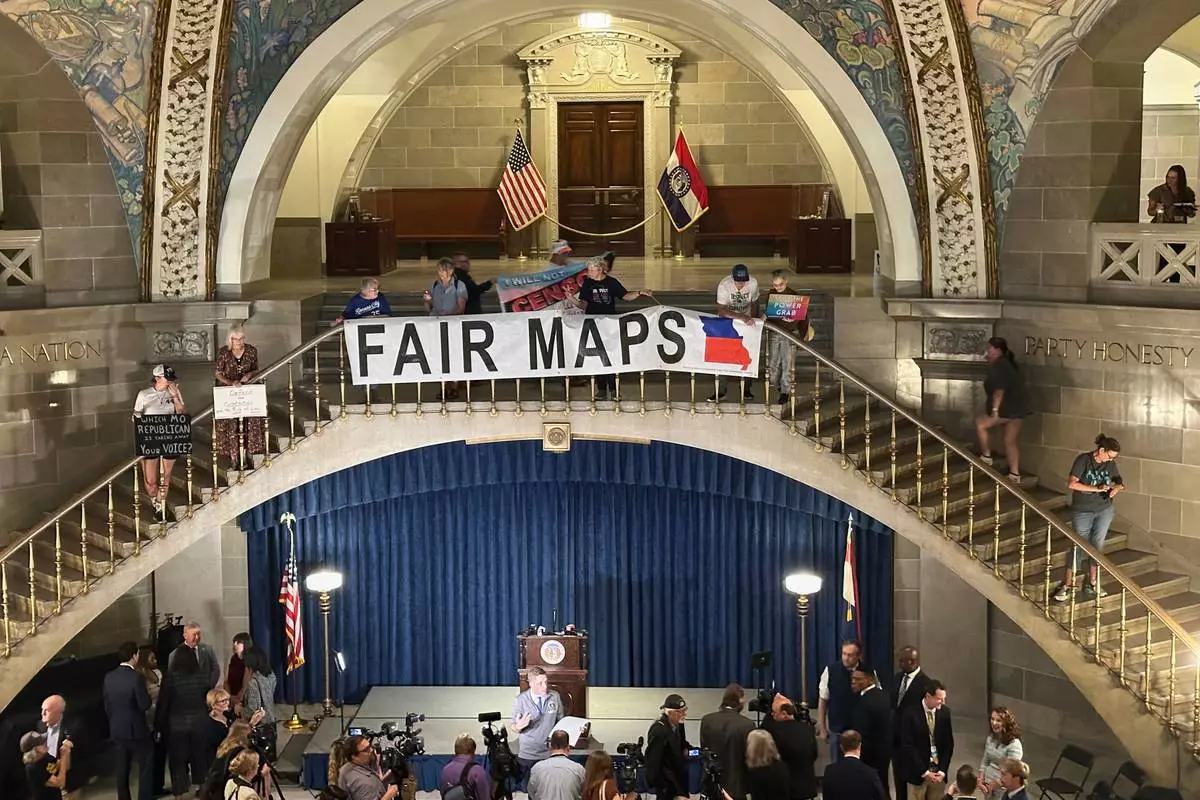
FILE - Opponents of Missouri's Republican-backed congressional redistricting plan display a banner in protest at the State Capitol in Jefferson City, Missouri, Sept. 10, 2025. (AP Photo/David A. Lieb, File)

FILE - ndiana Lt. Gov. Micah Beckwith announces the results of a vote to redistrict the state's congressional map, Dec. 11, 2025, at the Statehouse in Indianapolis. (AP Photo/Michael Conroy, File)
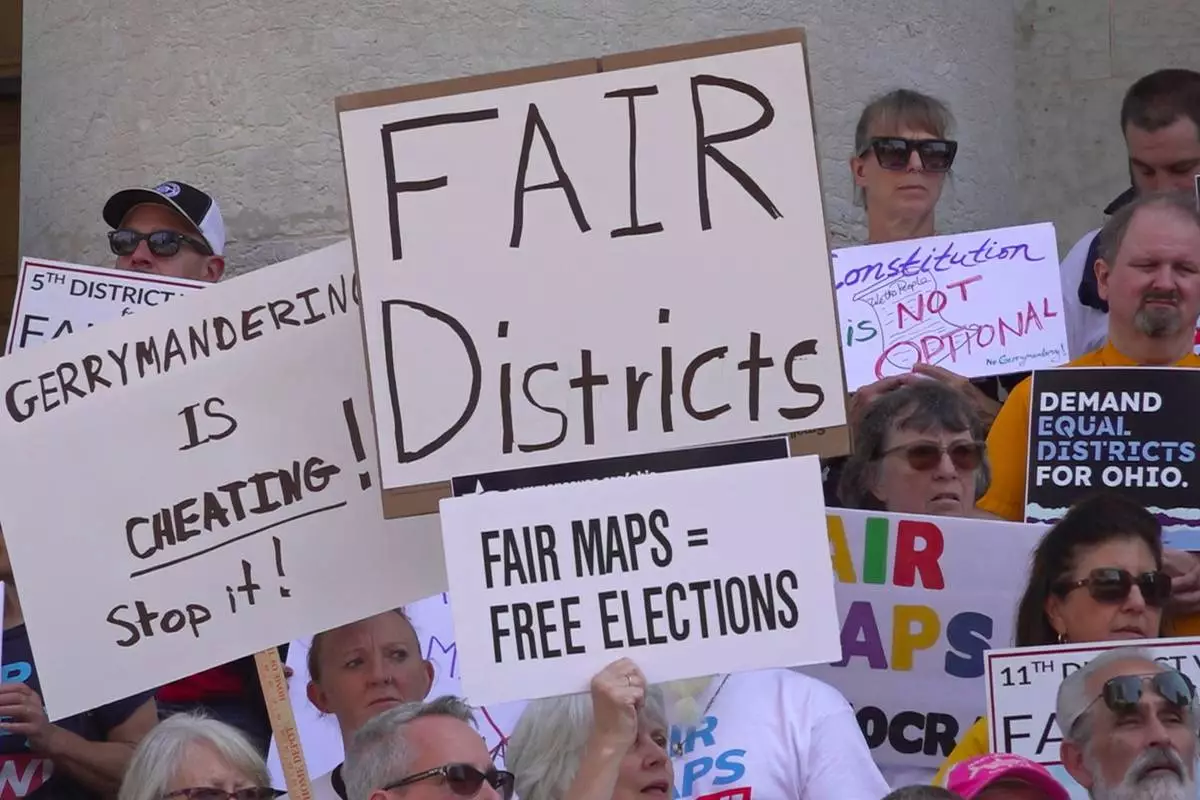
FILE - This photo taken from video shows organizers rallying outside of the Ohio Statehouse to protest gerrymandering and advocate for lawmakers to draw fair maps in Columbus, Ohio, Sept. 17, 2025. (AP Photo/Patrick Aftoora-Orsagos, File)