The 2025 Sanxingdui Forum, focusing on archaeological breakthroughs at the Sanxingdui Ruins in southwest China's Sichuan Province, officially opened in Deyang City on Saturday, unveiling the latest discoveries, including the precise dating of the historic site.
Scheduled for September 26–28, the forum has brought together scholars, experts, and cultural leaders from around the world to share insights on Sanxingdui, exploring the ancient civilization from multiple angles and a global perspective.
Discovered in the late 1920s in Guanghan, Sichuan Province, the Sanxingdui Ruins are considered one of the world's most significant archaeological discoveries of the 20th century. Spanning 12 square kilometers, the site is believed to be the remnants of the Shu Kingdom, dating back 4,500 to 3,000 years.
Ran Honglin, director of the Sanxingdui Archaeological Research Institute, presented new findings on the precise dating of the Sanxingdui sacrificial pits.
A joint study by the Sichuan Provincial Institute of Cultural Relics and Archaeology and Peking University, using radiocarbon dating, has shown that the burial dates of Pits Nos. 3, 4, 6, and 8 have a 95.4-percent probability of falling between 1201 B.C. and 1012 B.C., corresponding to the late Shang Dynasty (1600 B.C.-1046 B.C.), according to Ran.
Additionally, fragments of the same artifacts found in Pits Nos. 1, 2, 3, 4, 7 and 8 were identified as matching, further confirming that these pits share the same burial date.
The discoveries provide crucial evidence for clarifying the dating of the sacrificial pits and for building a detailed chronological framework for the site, offering new insights into the evolution and history of Sanxingdui culture.
Beyond academia, the forum also embraces innovation and public engagement, exploring new approaches to cultural heritage protection, digital preservation, and creative storytelling to bring the ancient world into today’s global conversation.
"As a diplomat, there are the agreements, right, that were recently signed with President Lula and President Xi Jinping when President Lula visited, and so I hope for an opportunity to meet people who are involved in preservation, especially high-tech preservation. And I hope that, through that, opportunities of cooperation will appear," said Carla Chelotti, deputy consul general at the Brazilian Consulate General in Chengdu.
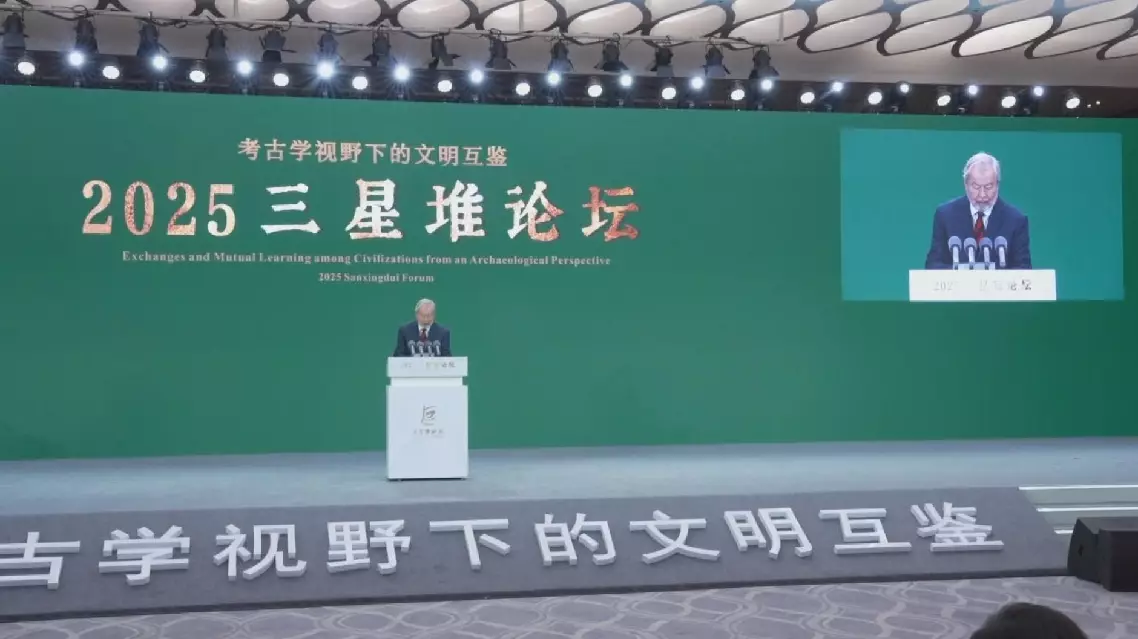
Sanxingdui Forum opens in Sichuan, unveils new discoveries