Hydrogen energy is regarded as a low-carbon energy with development potential, as the world is striving to phase out fossil fuels and accelerate energy transition to tackle the challenge of climate change.
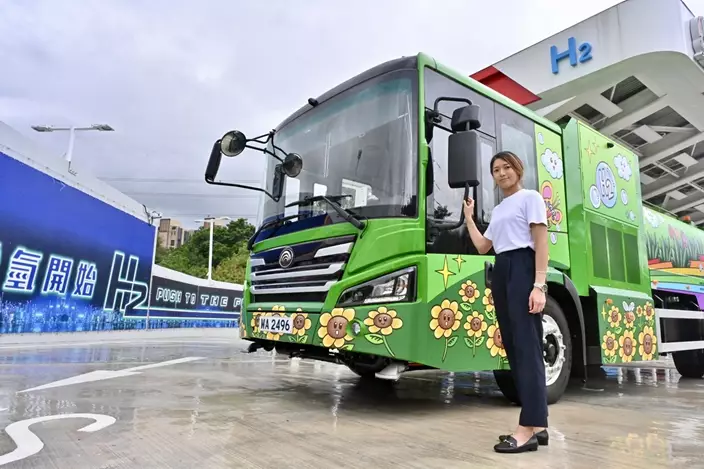
Environmentally friendly: Electrical & Mechanical Services Department Engineer Rachel Li explains that unlike conventional fuel-powered vehicles, which emit exhaust gases, hydrogen fuel cell vehicles produce only water as a byproduct. Image source news.gov.hk
The Government unveiled a comprehensive strategy last year to support the development of hydrogen energy. One of the Government's initiatives in promoting hydrogen technology is the deployment of hydrogen fuel cell street washing vehicles in June, as well as the city’s first public hydrogen refuelling station.
Clear strategy
On the surface, they do not appear to be any different to traditional street washing vehicles, but they are actually new energy vehicles equipped with a hydrogen fuel cell, a power battery and an electric motor.
Compressed hydrogen is used to refuel the vehicle through a hydrogen receptacle and the hydrogen is stored in six cylinders within the vehicle. Refuelling takes approximately 15 minutes.
During operation, the hydrogen stored in the cylinders enters the hydrogen fuel cell, where it reacts chemically with oxygen from the air to generate electricity.
This design provides many advantages.
Convenient power
Electrical & Mechanical Services Department Engineer Rachel Li, who specialises in hydrogen fuel safety, explained that the electricity generated by hydrogen fuel cells powers the street washing vehicle and charges its batteries.
Unlike conventional fuel-powered vehicles, which emit exhaust gases, hydrogen fuel cell vehicles produce only water as a byproduct. Also, compared to pure electric vehicles, hydrogen fuel cell cars require fewer and smaller batteries, reducing future battery disposal concerns.
“Hydrogen energy, therefore, has significant potential for wider use in heavy-duty vehicles.”
Miss Li underlined that on the fuel cell street washing vehicle, there is a charging port next to the hydrogen receptacle which allows the power battery to be charged directly. That dual energy system optimises the use of hydrogen and electricity, maximising the advantages of new energy vehicles.
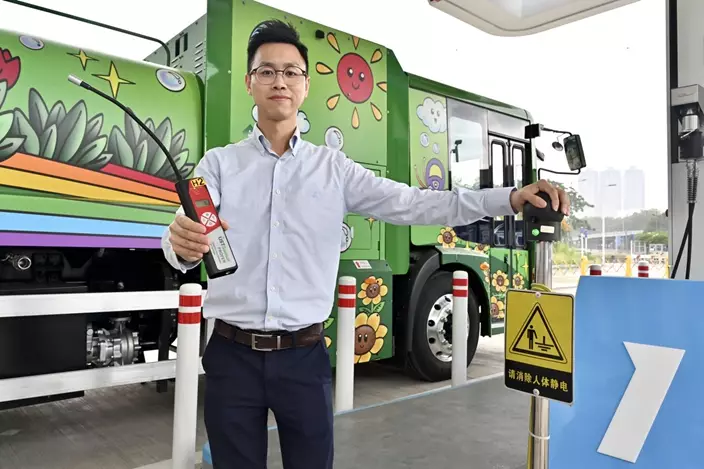
Safety first: Electrical & Mechanical Services Department Engineer Marco Lam says to ensure safety, hydrogen refuelling must be operated by trained personnel. Image source news.gov.hk
The street washing vehicles are currently utilised by the Food & Environmental Hygiene Department.
To ensure safety, hydrogen refuelling must always be operated by trained personnel.
Meticulous safety
Another engineer from the department, Marco Lam explained that when the hydrogen street washing vehicle arrives at the filling bay, the driver will switch off the power supply. The refuelling operator will then place wheel stoppers to ensure it remains stationary.
Before refuelling, the operator will discharge static by touching an electrostatic discharge pole and connect the vehicle to an earthing device. They will then check for hydrogen leaks with a handheld detector, and once clear, connect the dispensing nozzle, secure it and begin refuelling.
The safety procedure ensures that hydrogen refuelling is conducted securely, minimising risks and safeguarding both operators and the environment.
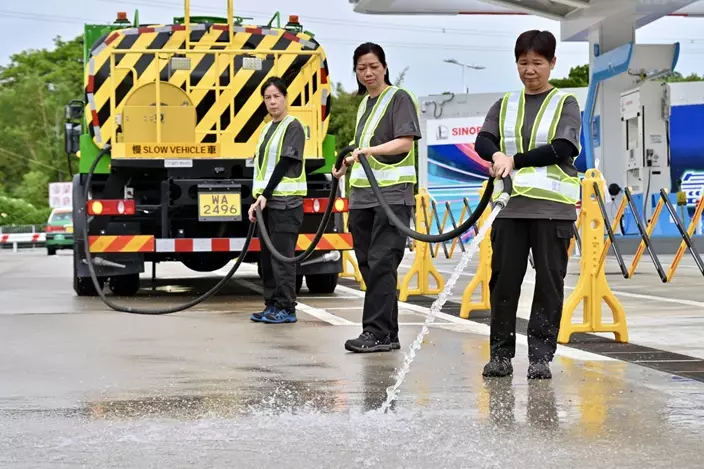
Multifunctional vehicle: The street washing vehicle is equipped with a water spray system and can also be connected to a hose for manual street cleaning. Image source news.gov.hk
WASHINGTON (AP) — A federal judge ruled Monday that the Trump administration acted illegally when it canceled $7.6 billion in clean energy grants for projects in states that voted for Democrat Kamala Harris in the 2024 election.
The grants supported hundreds of clean energy projects in 16 states, including battery plants, hydrogen technology projects, upgrades to the electric grid and efforts to capture carbon dioxide emissions.
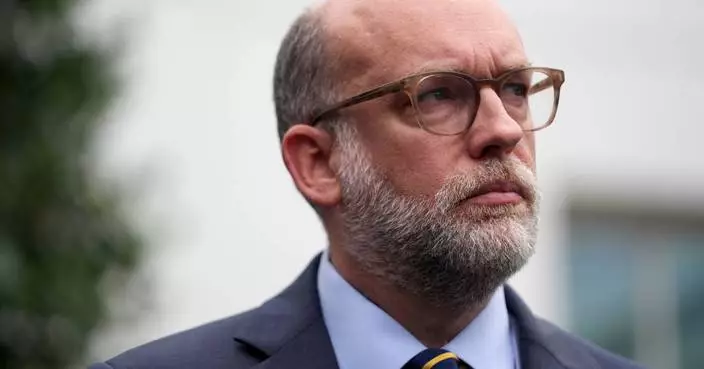
The Energy Department said the projects were terminated after a review determined they did not adequately advance the nation’s energy needs or were not economically viable. Russell Vought, the White House budget director, said on social media that “the Left’s climate agenda is being canceled.”
U.S. District Judge Amit Mehta said the administration's action violated the Constitution’s equal protection requirements.
“Defendants freely admit that they made grant-termination decisions primarily — if not exclusively — based on whether the awardee resided in a state whose citizens voted for President Trump in 2024," Mehta wrote in a 17-page opinion. The administration offered no explanation for how their purposeful targeting of grant recipients based on their electoral support for Trump — or lack of it — "rationally advances their stated government interest,” the judge added.
The ruling was the second legal setback for the administration’s rollback of clean energy program in a matter of hours. A separate federal judge ruled Monday that work on a major offshore wind farm for Rhode Island and Connecticut can resume, handing the industry at least a temporary victory as Trump seeks to shut it down.
A spokesman for the Energy Department said officials disagree with the judge’s decision on clean energy grants.
Officials “stand by our review process, which evaluated these awards individually and determined they did not meet the standards necessary to justify the continued spending of taxpayer dollars,” spokesman Ben Dietderich said. “The American people deserve a government that is accountable and responsible in managing taxpayer funds.”
Projects were canceled in California, Colorado, Connecticut, Delaware, Hawaii, Illinois, Maryland, Massachusetts, Minnesota, New Hampshire, New Jersey, New Mexico, New York, Oregon, Vermont and Washington state. All 16 targeted states supported Harris.
The cuts include up to $1.2 billion for California’s hydrogen hub that is aimed at accelerating hydrogen technology and production, and up to $1 billion for a hydrogen project in the Pacific Northwest. A Texas hydrogen project and a three-state project in West Virginia, Ohio and Pennsylvania were spared, according to clean-energy supporters who obtained a list of the DOE targets.
The city of St. Paul and a coalition of environmental groups filed a lawsuit after they lost grants.
Trump said in an interview last fall with One America News, a conservative outlet, that his administration could cut projects that Democrats want. “I’m allowed to cut things that never should have been approved in the first place and I will probably do that,” Trump said in the Oct. 1 interview.
Vickie Patton, general counsel for the Environmental Defense Fund, one of the groups that filed the suit, said the court ruling “recognized that the Trump Department of Energy vindictively canceled projects for clean affordable energy that just happened to be in states disfavored by the Trump administration, in violation of the bedrock Constitutional guarantee that all people in all states have equal protection under the law.”
The administration’s actions violated the Constitution, foundational American values and “imposed high costs on the American people who rely on clean affordable energy for their pocketbooks and for healthier lives,” Patton said.
Anne Evens, CEO of Elevate Energy, one of the groups that lost funding, said the court ruling would help keep clean energy affordable and create jobs.
“Affordable energy should be a reality for everyone, and the restoration of these grants is an important step toward making that possible,” she said.
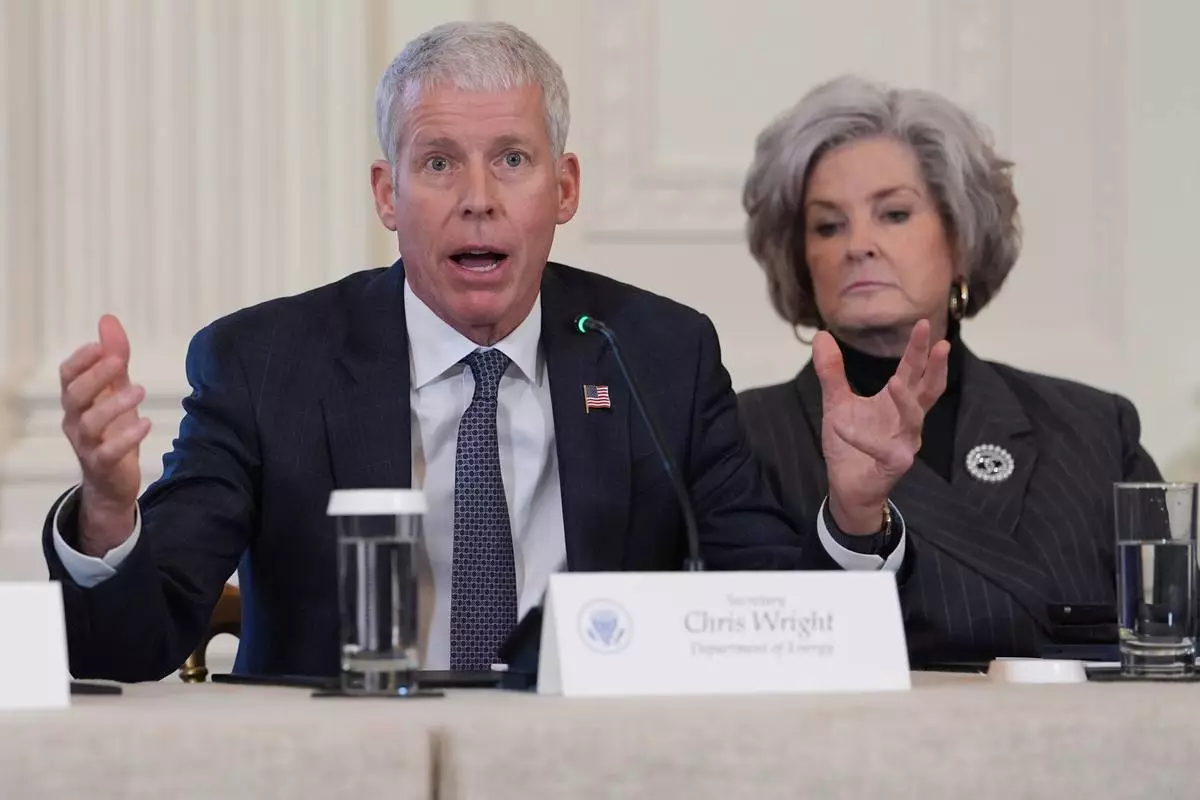
Energy Secretary Chris Wright speaks as White House chief of staff Susie Wiles listens during a meeting with President Donald Trump and oil executives in the East Room of the White House, Friday, Jan. 9, 2026, in Washington. (AP Photo/Evan Vucci)
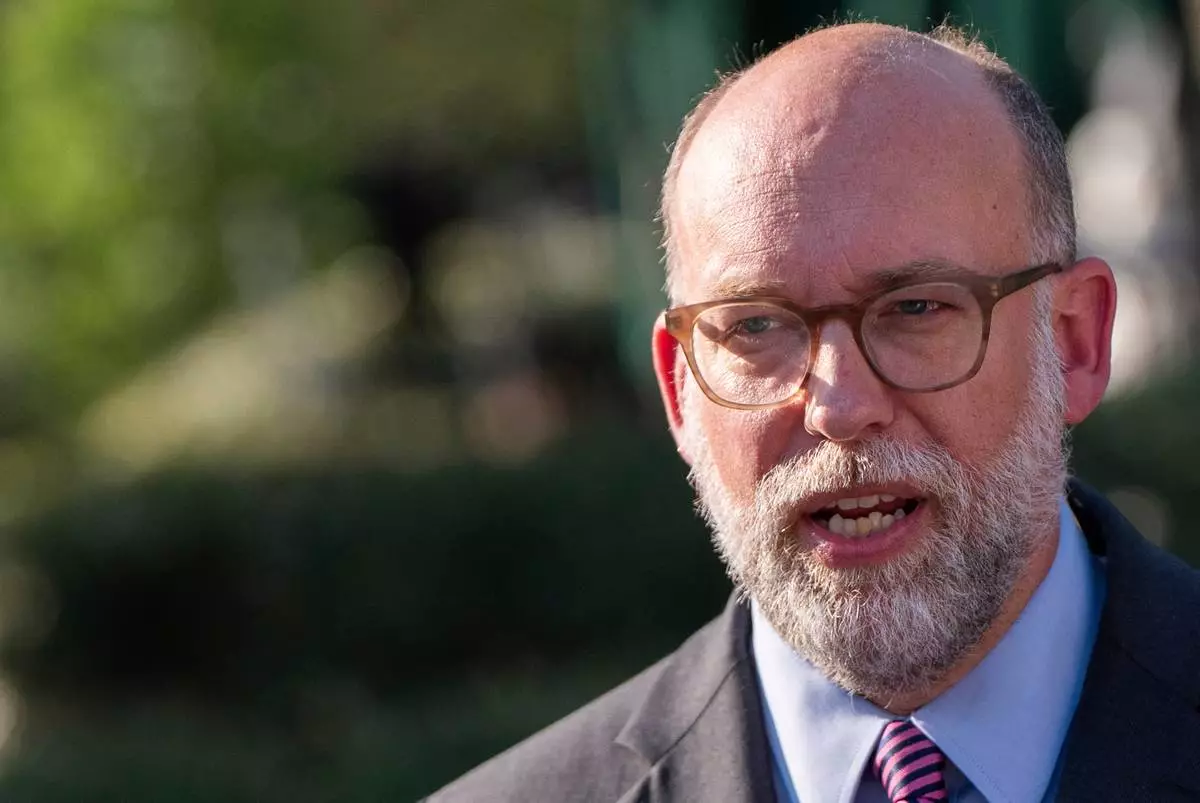
FILE - Director of the Office of Management and Budget Russell Vought speaks to reporters at the White House, Thursday, July 24, 2025, in Washington. (AP Photo/Julia Demaree Nikhinson, File)