A screening event of China's first space documentary to schools in Shanghai was launched at Fudan University on Thursday.
The movie, titled "Shenzhou 13" or "Blue Planet Outside the Window", is China's first 8K movie shot in space. Produced by China Media Group (CMG), the film premiered nationwide on Sept 5.
The film features footage captured by Shenzhou-13 astronauts Zhai Zhigang, Wang Yaping and Ye Guangfu. The story is based on the crew's six-month orbital mission in the country's Tiangong space station.
After the film ended, Chinese Academy of Sciences (CAS) academician Jin Yaqiu and movie director Zhu Yiran shared the story behind the film from the perspectives of technology and creation respectively.
The students said that the film combined scientific value with humanistic warmth, and many details of life in the space station left a deep impression on them.
"The camera focused on the doll given by [Wang Yaping]'s daughter, which allowed me to see that the astronaut is not only a aerospace hero in space, but also a mother on Earth. I could sense a richer spectrum of colors in the hero," said Zhou Jiayi, a student of Fudan University.
"My heart was filled with emotion because this was my first time to approach the vast universe in this way. As an aeronautics and astronautics student, I also experienced some details of our astronauts' lives in this space station, and these are the daily routines that we don't usually see," said Li Jinghui, also a student.
On Oct 16, 2021, the Shenzhou-13 mission sent three astronauts to China's space station core module for a six-month in-orbit stay.

Shanghai holds school screening event of China's 1st space documentary
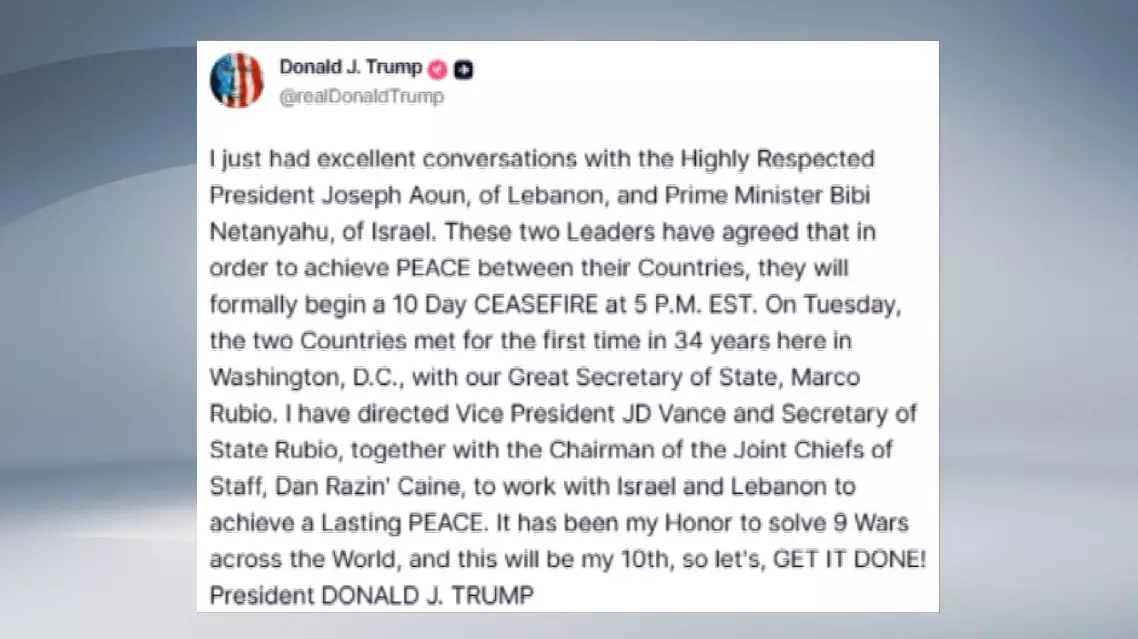
Israel and Lebanon will formally begin a 10-day ceasefire at 17:00 U.S. Eastern Time (2100 GMT) on Thursday, U.S. President Donald Trump announced after his phone calls with the two countries' leaders.
"I just had excellent conversations with the Highly Respected President Joseph Aoun, of Lebanon, and Prime Minister Bibi Netanyahu, of Israel. These two Leaders have agreed that in order to achieve PEACE between their Countries, they will formally begin a 10 Day CEASEFIRE at 5 P.M. EST," Trump wrote on Truth Social.
"I have directed Vice President JD Vance and Secretary of State Rubio, together with the Chairman of the Joint Chiefs of Staff, Dan Razin' Caine, to work with Israel and Lebanon to achieve a Lasting PEACE," he said.
He added that he will invite President Joseph Aoun and Prime Minister Benjamin Netanyahu to the White House "for the first meaningful talks between Lebanon and Israel since 1983," expressing belief that peace will be achieved between the two countries.
According to multiple Israeli media outlets, Netanyahu convened the security cabinet by phone to inform them of his acceptance of Trump's ceasefire request.
He told cabinet ministers that the Israeli army would remain in its current positions in southern Lebanon, which Israel defines as a security zone, and that the ceasefire conditions would allow Israeli forces to operate if it detected threats.
The prime minister noted that Israel has two main demands in these talks -- the disarmament of Hezbollah and a lasting peace agreement.
Following Trump's ceasefire announcement, a Hezbollah lawmaker said that the group will monitor Israel's "practical and effective" commitment to halting all hostile actions against Lebanon, following what he described as an Iran-mediated comprehensive ceasefire.
"We call on our people to wait for the actual implementation of the ceasefire, as we are accustomed to Israel reneging on its commitments," Hassan Fadlallah, the lawmaker, told Lebanese broadcaster Al Mayadeen.
Hezbollah sources, quoted by local Al Jadeed TV, said that any proposed ceasefire must include a comprehensive halt to Israeli attacks across all Lebanese territory and must not grant Israel any freedom of movement.
The sources added that the continued Israeli occupation of Lebanese territories grants Lebanon and its people the right to resist.
Israel and Lebanon held their first direct diplomatic talks since 1993 earlier this week in Washington, with both sides agreeing to launch "direct" negotiations after the meeting.
Lebanese health authorities said Thursday that the cumulative death toll from ongoing Israeli attacks on the country has risen to 2,196, with 7,185 others injured since March 2.
Trump says Israel, Lebanon to begin 10-day ceasefire