COPENHAGEN, Denmark (AP) — Denmark's defense ministry said Sunday that it had again observed drones at several of its armed forces’ locations overnight, a day after the NATO alliance announced that it would enhance its vigilance in the Baltic Sea region.
The ministry said in a statement that it had “several capacities deployed” after drone sightings from Saturday into Sunday night. It didn't offer any further details about the specifics of the deployment, the number of drones or locations.
This is the latest unexplained drone activity after several sightings, including over five Danish airports last week, raising concerns about security in northern Europe amid suspected growing Russian aggression.
Following a NATO meeting in Riga, Latvia, on Saturday, Col. Martin O’Donnell, the Supreme Headquarters Allied Powers Europe spokesperson, announced that “we will conduct even more enhanced vigilance with new multi-domain assets in the Baltic Sea region, which includes Denmark, under Baltic Sentry.”
He also said that NATO leaders were in constant contact with Danish officials following the drone sightings.
As Denmark gears up for the upcoming European Union Summit in Copenhagen, the Danish transportation ministry said Sunday that “all civilian drone flying in Danish airspace will be prohibited” from Monday to Friday to “remove the risk that enemy drones can be confused with legal drones and vice versa.”
“We cannot accept that foreign drones create uncertainty and disturbances in society, as we have experienced recently. At the same time, Denmark will host EU leaders in the coming week, where we will have extra focus on security,” Danish transportation minister Thomas Danielsen said in a statement.
“A violation of the prohibition can result in a fine or imprisonment for up to two years," according to the statement.
The prohibition does not apply to military drone flights, drones used by state aviation, including police and emergency drone operations, as well as municipal and regional emergency and health-related drone operations.
On Sunday afternoon, the Danish defense ministry announced that the German air defense frigate, FSG Hamburg, had arrived in Copenhagen.
“Here, the ship will contribute to strengthening Denmark’s surveillance of the airspace in connection with the upcoming EU summit in Copenhagen,” the ministry said in a statement. “The German frigate is part of NATO’s Baltic Sentry activity, which is intended to strengthen NATO’s presence along the alliance’s eastern flank.”
Separately, Germany said that following a request from Denmark, its armed forces would provide military support for the upcoming EU summit through “Counter-small Unmanned Aircraft Systems capabilities,” also known as C-sUAS, which are detection systems that use radar, optical and acoustics technologies.
Sweden had already announced earlier that it would "lend Denmark a military anti-drone capability” without giving further details.
Tensions have been running high in Denmark in recent days following reports of drone activity, and hundreds of possible sightings reported by concerned citizens that couldn’t officially be confirmed. Nonetheless, the public has been asked to report all suspicious activity to the police.
Danish Minister of Justice Peter Hummelgaard said on Sept. 25 that the goal of the flyovers is to sow fear and division, adding that the country will seek additional ways to neutralize drones, including proposing legislation to allow infrastructure owners to shoot them down.
While it's not clear who is behind the drone activity, Denmark’s prime minister and NATO’s secretary-general said last week that Russian involvement couldn’t be ruled out.
The Russian Embassy in Denmark last week rejected claims of Moscow's involvement in the incidents.
Speaking to Russian media in comments released Sunday, Belarusian President Alexander Lukashenko said that any attempt by NATO to shoot down Russian or Belarusian aircraft would be met with an “immediate response."
“Let them try, let them shoot. Or they’ll shoot down something Russian over Kaliningrad. Then, of course, we’ll have to fight, as they say in Russia, with all we’ve got. Is that necessary? No,” he said, asking whether NATO would shoot down his helicopter when flying close to the Polish border.
The release of Lukashenko’s comments came after Russian Foreign Minister Sergey Lavrov told the U.N. General Assembly on Saturday that his nation doesn’t intend to attack Europe, but will mount a “decisive response” to any aggression.
“I think people will very much regret if they commit the most flagrant violation of our territorial integrity and territorial sovereignty,” Lavrov said, including “attempts to shoot down … any object in general over our territory, in our airspace.”
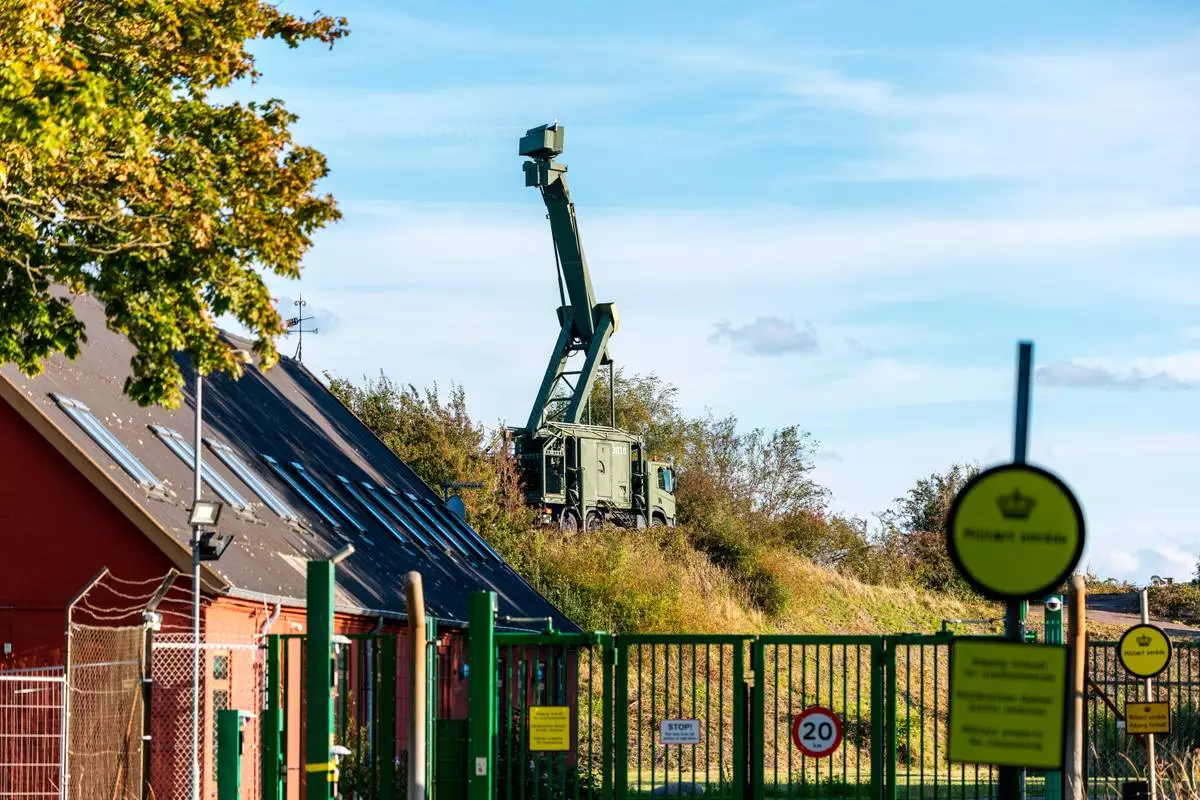
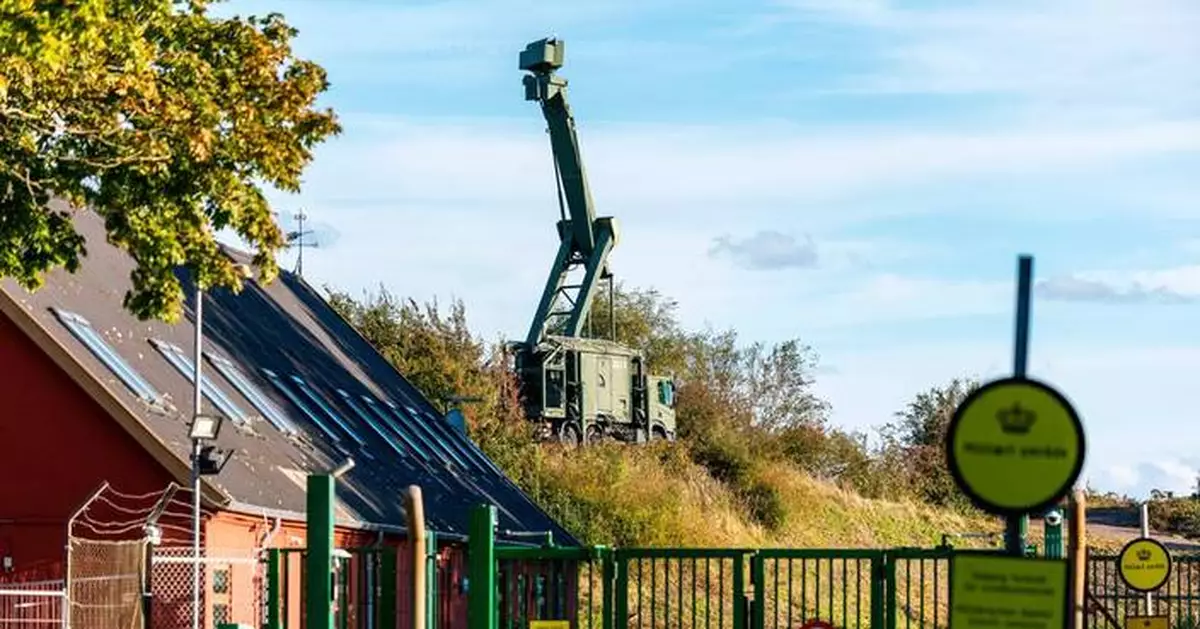
A mobile radar installation is seen at the Danish military site on Amager, Pionegaarden, near the village of Dragoer and on the coast of Oresund, the sea between Denmark and Sweden, on Friday, Sept. 26, 2025. (Steven Knap/Ritzau Scanpix via AP)
WASHINGTON (AP) — Venezuelan opposition leader María Corina Machado said she presented her Nobel Peace Prize medal to President Donald Trump at the White House on Thursday even as he has questioned her credibility to take over her country after the U.S. ousted then-President Nicolás Maduro.
The Nobel Institute has said Machado could not give her prize to Trump, an honor that he has coveted. Even if it the gesture proves to be purely symbolic, it was extraordinary given that Trump has effectively sidelined Machado, who has long been the face of resistance in Venezuela. He has signaled his willingness to work with acting President Delcy Rodríguez, who had been Maduro’s second in command.
“I presented the president of the United States the medal, the Nobel Peace Prize," Machado told reporters after leaving the White House and heading to Capitol Hill. She said she had done so "as a recognition for his unique commitment with our freedom.”
Trump has raised doubts about his stated commitment to backing democratic rule in Venezuela, giving no timetable on when elections might be held. Machado indicated that he had provided few specifics on that front during their discussion.
She did not provide more information on what was said, and the White House did not say if Trump accepted the medal or offer other details of its own.
After a closed-door meeting with Trump, Machado greeted dozens of cheering supporters waiting for her near the White House gates, stopping to hug many.
“We can count on President Trump,” she told them without elaborating, prompting some to briefly chant, “Thank you, Trump.”
Before her visit to Washington, Machado had not been seen in public since she traveled last month to Norway, where her daughter received the peace prize on her behalf. She had spent 11 months in hiding in Venezuela before she appeared in Norway after the ceremony.
The jubilant scene after her meeting with Trump stood in contrast to political realities in Venezuela. Rodríguez remains in charge of day-to-day government operations, along with others in Maduro’s inner circle. In her first state of the union speech Thursday, the interim president promoted the resumption of diplomatic ties between the historic adversaries and advocated for opening the state-run oil industry to more foreign investment after Trump pledged to seize control of Venezuelan crude sales.
Trump has said it would be difficult for Machado to lead because she “doesn’t have the support within or the respect within the country.” Her party is widely believed to have won 2024 elections rejected by Maduro.
White House press secretary Karoline Leavitt called Machado “a remarkable and brave voice” but also said the meeting didn’t mean Trump’s opinion of her changed, calling it “a realistic assessment.”
Leavitt told reporters that Trump supported new Venezuelan elections “when the time is right” but did not say when he thought that might be.
Leavitt said Machado had sought the face-to-face meeting without setting expectations for what would occur. She spent about two and a half hours at the White House.
“I don’t think he needs to hear anything from Ms. Machado," the press secretary said while the meeting was still going on, other than to have a ”frank and positive discussion about what’s taking place in Venezuela.”
After leaving the White House, Machado went on to a closed-door meeting with a bipartisan group of senators.
Sen. Chris Murphy, D-Conn., said Machado told them that “if there’s not some progress, real progress towards a transition in power, and/or elections in the next several months, we should all be worried.”
“She reminded us that Delcy Rodríguez is, in many ways, worse than Maduro,” he added.
Asked if Machado had heard any commitment from the White House on holding elections in Venezuela, Murphy said, “No, I don’t think she got any commitment from them."
Sen. Bernie Moreno, an Ohio Republican, was exultant following the meeting, saying Machado "delivered a message that loud and clear: What President Trump did was the most important, significant event in Latin America. That getting rid of Maduro was absolutely essential.”
Machado's Washington stop coincided with U.S. forces in the Caribbean Sea seizing another sanctioned oil tanker that the Trump administration says had ties to Venezuela. It is part of a broader U.S. effort to take control of the South American country’s oil after U.S. forces captured Maduro and his wife less than two weeks ago at a heavily guarded compound in the Venezuelan capital of Caracas and brought them to New York to stand trial on drug trafficking charges.
Leavitt said Venezuela's interim authorities have been fully cooperating with the Trump administration and noted that Rodríguez's government said it planned to release more prisoners detained under Maduro. Among those released were five Americans this week.
Trump said Wednesday that he had a “great conversation” with Rodríguez, their first since Maduro was ousted.
Just hours after Maduro's capture, Trump said of Machado that “it would be very tough for her to be the leader.” Machado had steered a careful course to avoid offending Trump, notably after winning the peace prize, and had sought to cultivate relationships with him and key administration voices like Secretary of State Marco Rubio.
The industrial engineer and daughter of a steel magnate, Machado began challenging the ruling party in 2004, when the nongovernmental organization she co-founded, Súmate, promoted a referendum to recall then-President Hugo Chávez. The initiative failed, and Machado and other Súmate executives were charged with conspiracy.
A year later, she drew the anger of Chávez and his allies again for traveling to Washington to meet President George W. Bush, whom Chávez considered an adversary.
Almost two decades later, she marshaled millions of Venezuelans to reject Chávez’s successor, Maduro, for another term in the 2024 election. But ruling party-loyal electoral authorities declared him the winner despite ample credible evidence to the contrary. Ensuing anti-government protests ended in a brutal crackdown.
Garcia Cano reported from Caracas, Venezuela. Associated Press writers Lisa Mascaro, Stephen Groves, Michelle L. Price and Matthew Lee in Washington, and Megan Janetsky in Mexico City contributed to this report.
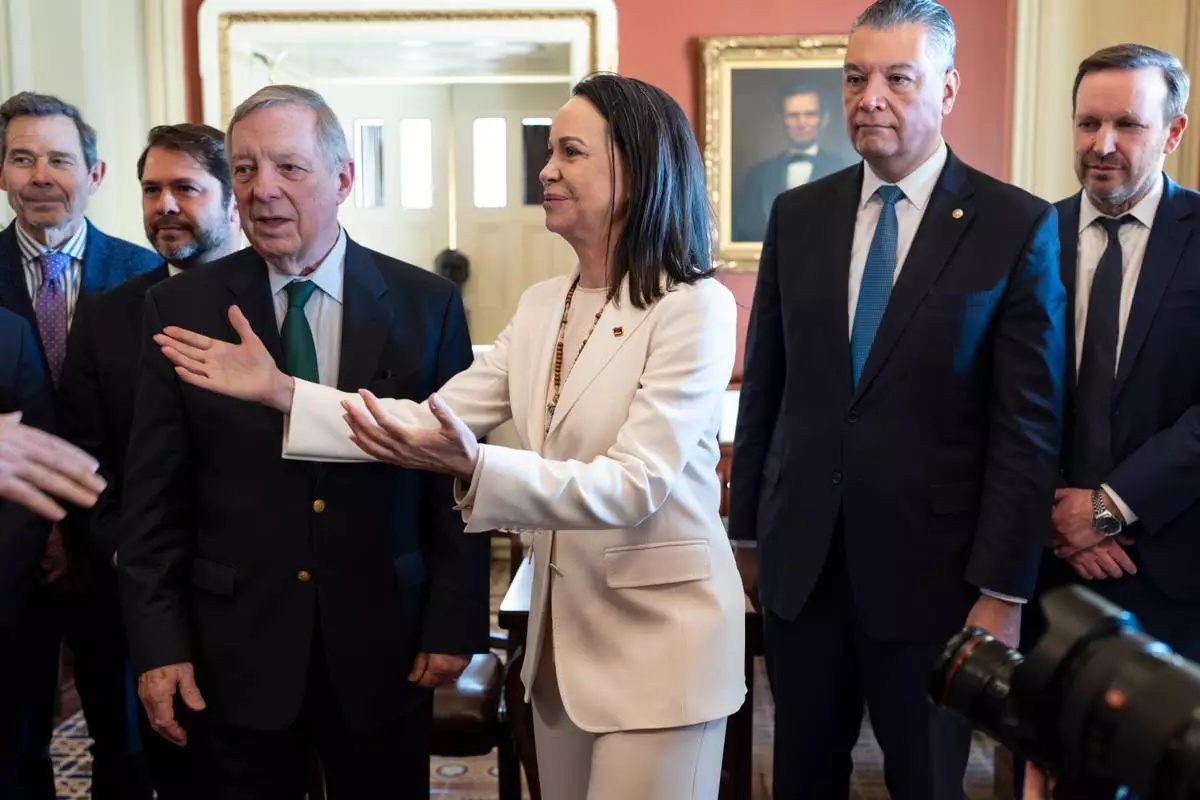
Venezuelan opposition leader Maria Corina Machado is welcomed at the Capitol before a meeting with senators, from left, Sen. John Curtis, R-Utah, Sen. Ruben Gallego, D-Ariz., Sen. Dick Durbin, D-Ill., Sen. Alex Padilla, D-Calif., and Sen. Chris Murphy, D-Conn., as the Nobel Peace Prize recipient visits American leaders two weeks after President Donald Trump toppled Venezuelan president Nicolas Maduro in a stunning military raid, at the Capitol in Washington, Thursday, Jan. 15, 2026. (AP Photo/J. Scott Applewhite)
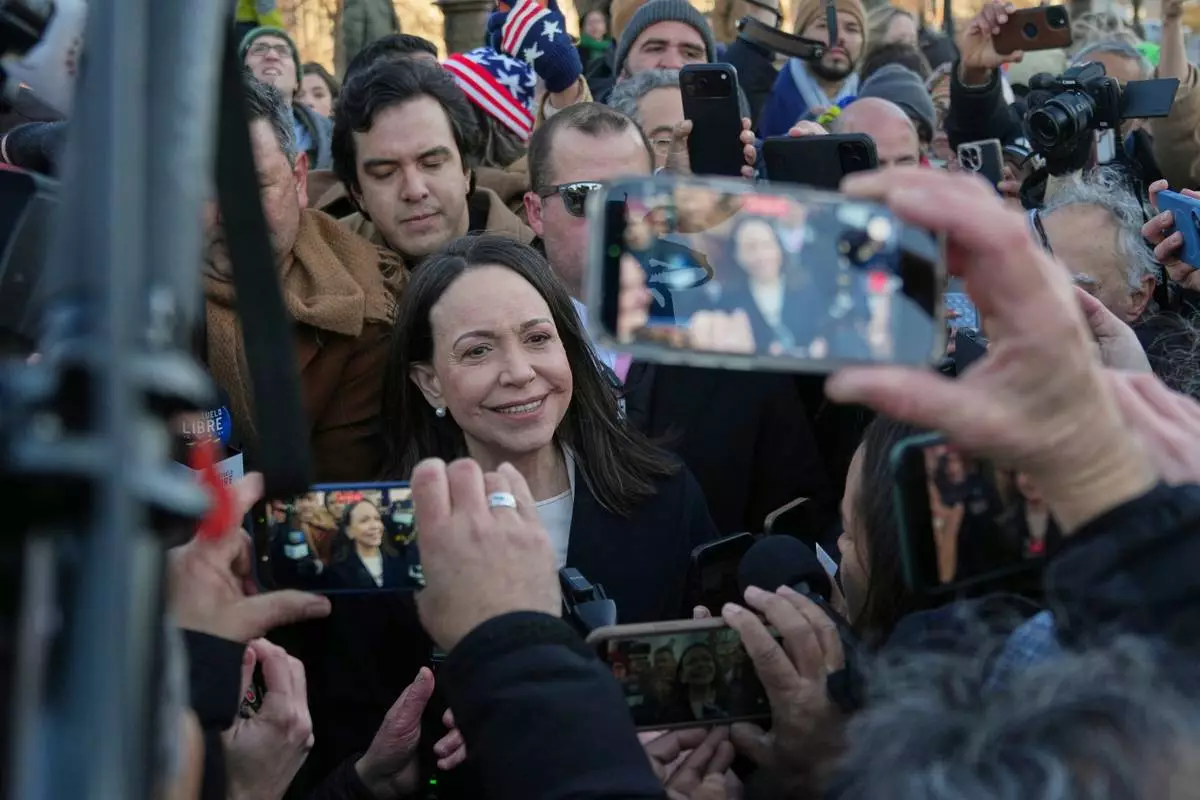
Venezuelan opposition leader María Corina Machado, center, leaves the Capitol, Thursday, Jan. 15, 2026, in Washington. (AP Photo/Allison Robbert)
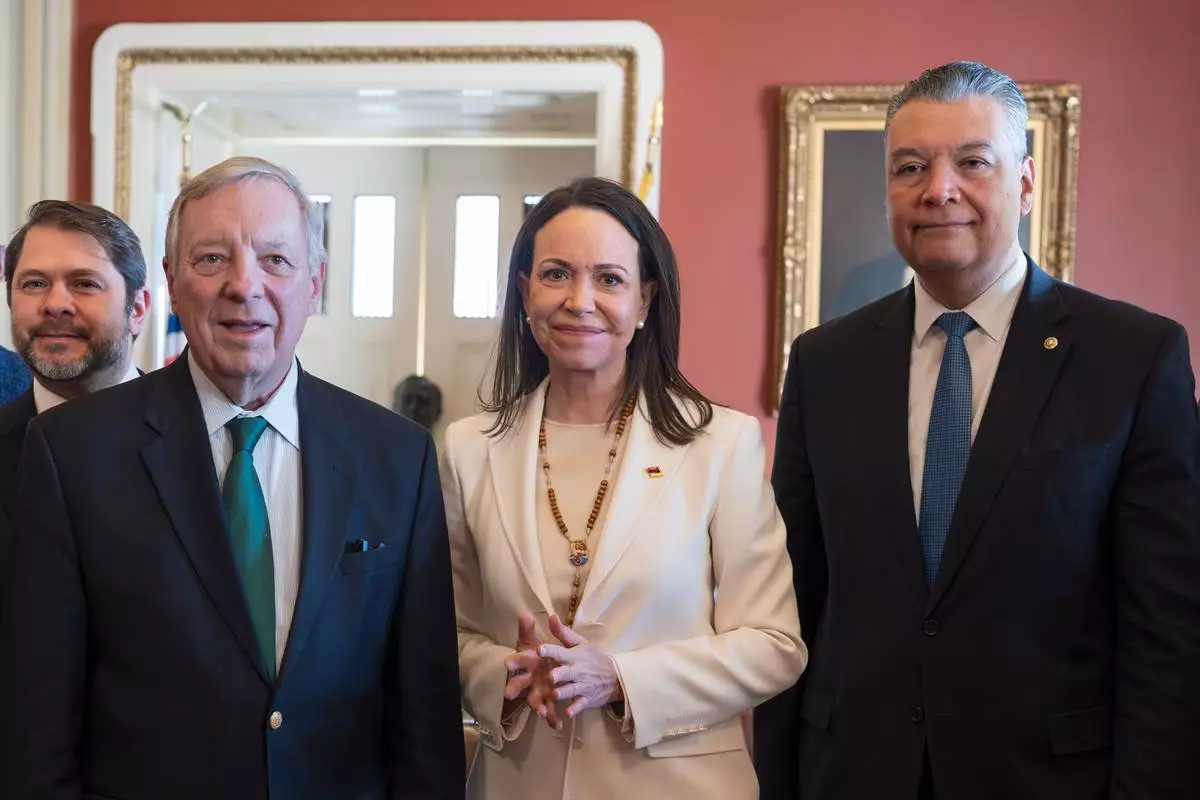
Venezuelan opposition leader Maria Corina Machado, center, is welcomed by Sen. Dick Durbin, D-Ill., left, Sen. Ruben Gallego, D-Ariz., far left, and Sen. Alex Padilla, D-Calif., right, as the Nobel Peace Prize recipient visits American leaders at the Capitol in Washington, Thursday, Jan. 15, 2026. (AP Photo/J. Scott Applewhite)
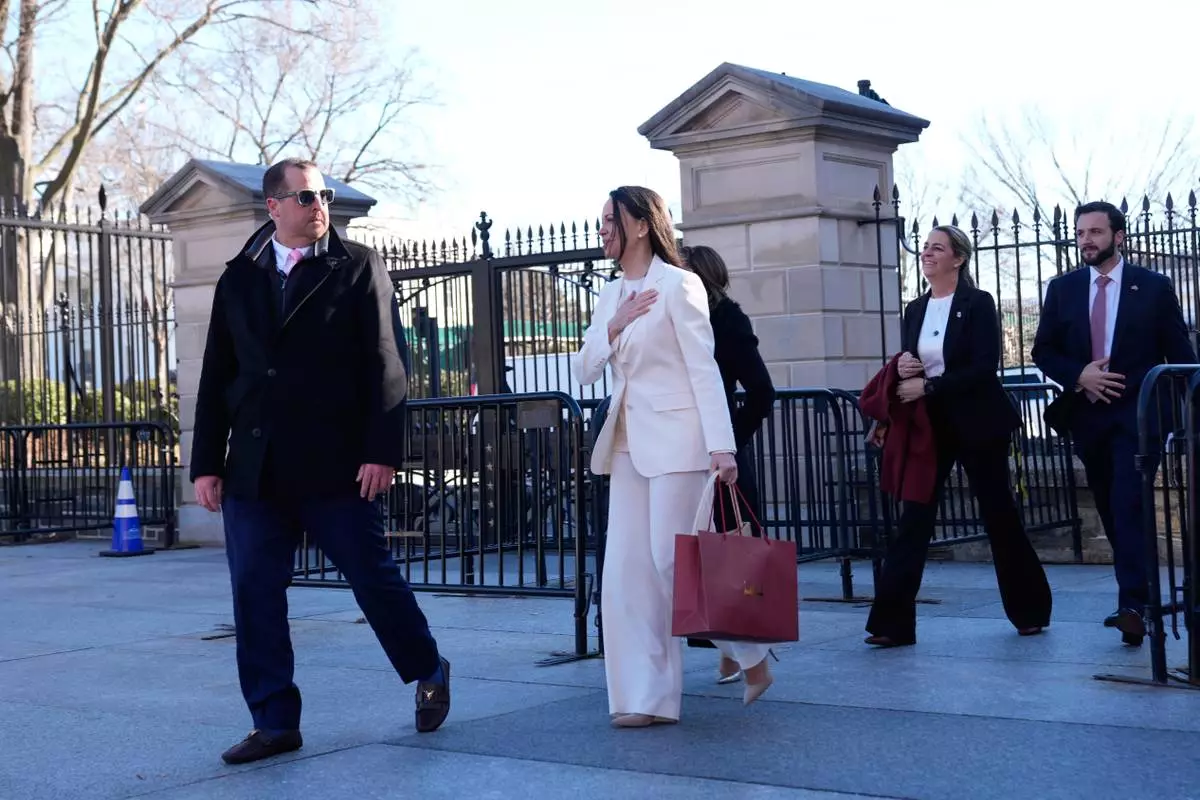
Venezuelan opposition leader María Corina Machado gestures to supporters on Pennsylvania Avenue as she leaves the White House after meeting with President Donald Trump Thursday, Jan. 15, 2026, in Washington. (AP Photo/Pablo Martinez Monsivais)
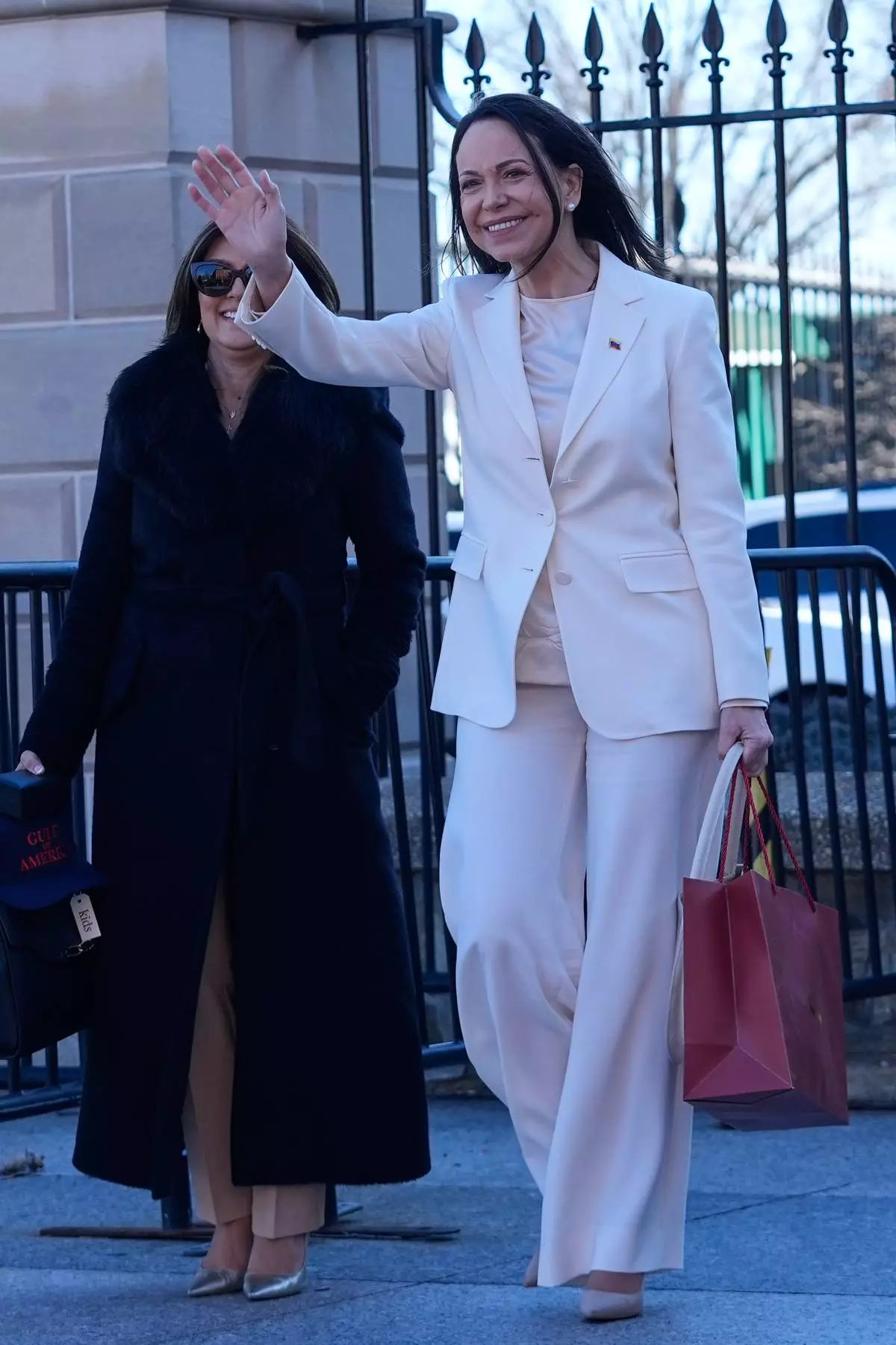
Venezuelan opposition leader María Corina Machado waves to supporters on Pennsylvania Avenue as she leaves the White House after meeting with President Donald Trump Thursday, Jan. 15, 2026, in Washington. (AP Photo/Pablo Martinez Monsivais)
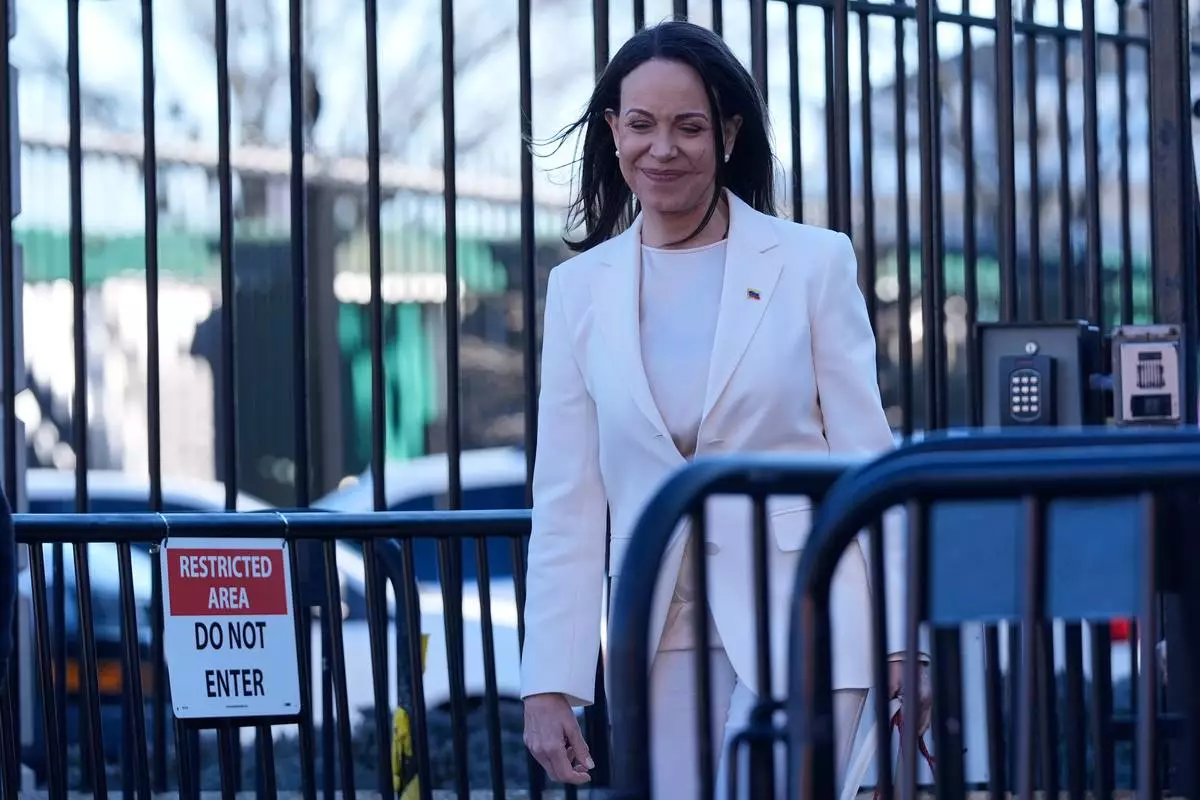
Venezuelan opposition leader María Corina Machado smiles on Pennsylvania Avenue as she leaves the White House after meeting with President Donald Trump Thursday, Jan. 15, 2026, in Washington. (AP Photo/Pablo Martinez Monsivais)
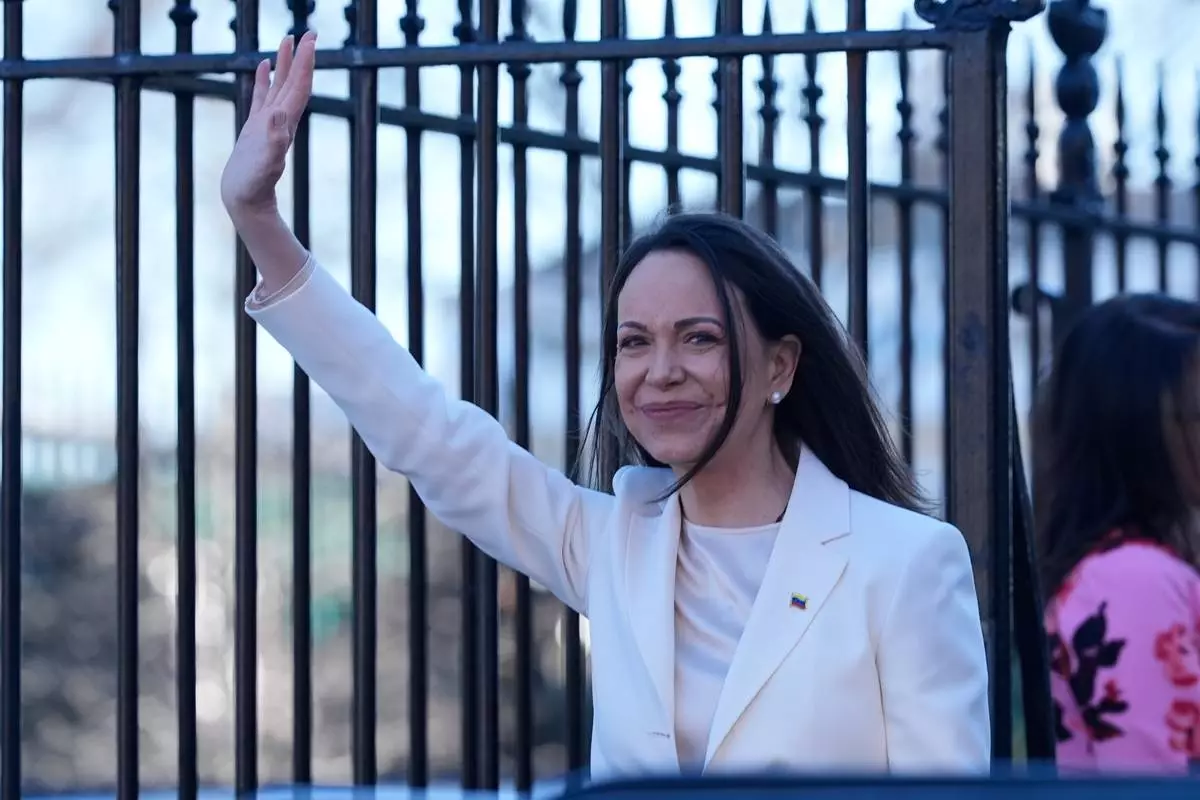
Venezuelan opposition leader María Corina Machado waves to supporters on Pennsylvania Avenue as she leaves the White House after meeting with President Donald Trump Thursday, Jan. 15, 2026, in Washington. (AP Photo/Pablo Martinez Monsivais)
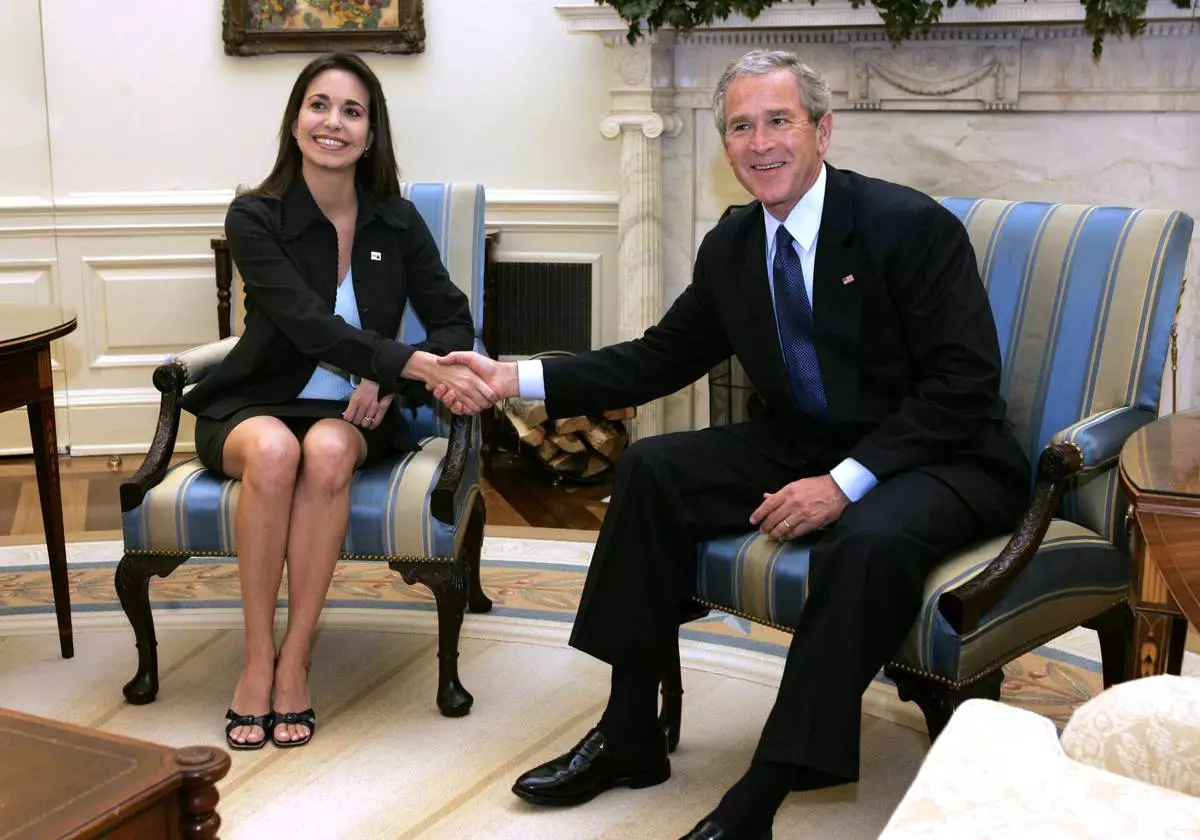
FILE - U.S. President George Bush, right, meets with Maria Corina Machado, executive director of Sumate, a non-governmental organization that defends Venezuelan citizens' political rights, in the Oval Office of the White House, Washington, May 31, 2005. (AP Photo/Charles Dharapak, File)
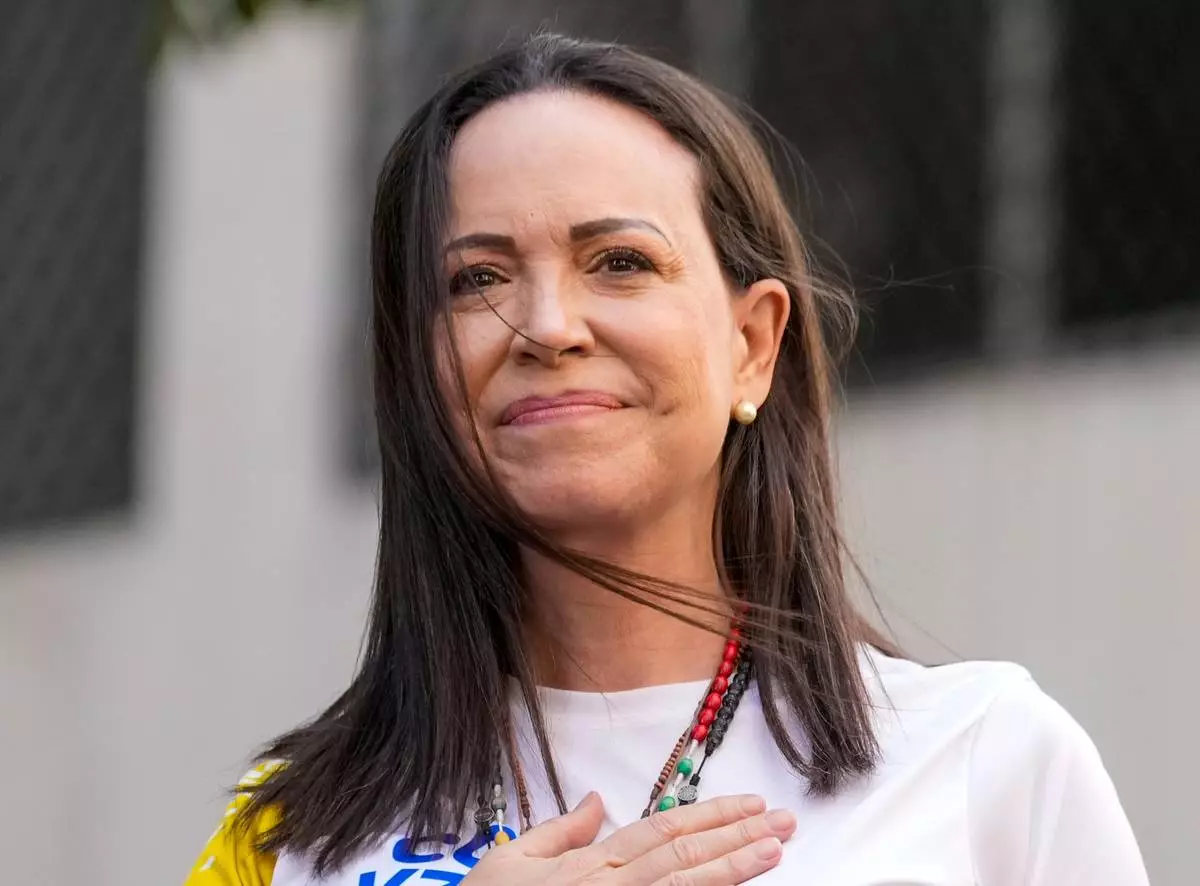
FILE - Opposition leader Maria Corina Machado gestures to supporters during a protest against President Nicolas Maduro the day before his inauguration for a third term, in Caracas, Venezuela, Thursday, Jan. 9, 2025. (AP Photo/Ariana Cubillos, file)