China's civil aviation sector is expected to handle 19.2 million passenger trips during the eight-day National Day and Mid-Autumn Festival holiday starting Wednesday, according to data released by the Civil Aviation Administration of China (CAAC) on Sunday.
The country's National Day is celebrated on Oct 1, with the official holiday period running from Oct 1 to 7. This year, the Mid-Autumn Festival falls on Oct 6, creating a combined holiday period extending from Oct 1 to 8.
"As predicted, the number of passenger trips during this year's Mid-Autumn Festival and National Day holiday may reach 19.2 million, an increase of 3.6 percent over the same period last year, marking a record high for the same period in history," said Xiong Jie, chief pilot of the CAAC.
According to Xiong, travelers have grown noticeably more rational in recent years. Many are choosing to set out after the peak, smoothing early-holiday numbers, so the real surge is expected in the second half of the holiday.
With the Mid-Autumn Festival landing on the sixth day of the holiday, most travelers are expected to head home at once, so the last two days of the holiday are expected to deliver the biggest rush of the holiday -- daily numbers could match or even top this summer's record 2.56 million.
Traditionally popular domestic routes remain among top choices, and passenger volume at several small and medium-sized airports in tourist destinations has also been growing rapidly.
Ten international aviation hub cities - Beijing, Shanghai, Guangzhou, Chengdu, Shenzhen, Chongqing, Kunming, Xi'an, Urumqi, and Harbin - are expected to handle 17 million passengers trips.
"Thanks to continuously improved visa-free policies, departure tax refund measures, payment systems, and travel facilitation at China's international gateways, the Mid-Autumn Festival and National Day holiday is expected to see a fresh surge in outbound travelers. Short-haul destinations in East and Southeast Asia are anticipated to experience a significant increase in bookings, while travel to South Asia and Europe is also poised to rise noticeably," Xiong said.

China forecasts 19.2 mln air passenger trips during upcoming holiday
Thick smoke from persistent wildfires burning across Canada has shrouded communities along the Canada-U.S. border, reducing highway visibility, degrading air quality, and prompting local authorities to issue public smoke advisories for affected areas.
The drifting smoke comes as Canada grapples with widespread, rampant wildfire activity across multiple provinces. According to data released on Tuesday by the Canadian Interagency Forest Fire Center, there are currently more than 900 active fires in the country. Since the beginning of 2026, 3,951 wildfires have been recorded across Canada, scorching an area of more than 3.3 million hectares.
High temperatures and shifting wind patterns have pushed the dense smoke toward the border. Along Highway 3 near the Canada-U.S. border, the road remains open, but the fire danger is visible.
A nearby fire has been rapidly expanding its burning radius while firefighters actively cut firebreaks to isolate the flames and control the spread. Authorities in British Columbia's Greater Vancouver area have already issued a formal smoke advisory for the region.
In Hope, a British Columbia town located less than 50 kilometers north of the Canada-U.S. border, the usual bustling tourist season has been replaced by a noticeable drop in visitors.
Travelers passing through the area have felt the immediate impact of the deteriorating air conditions.
"A small sensation of smoke. Quality of the air is indeed not so good," a Belgian tourist said.
For local residents, the lingering smoke has brought severe disruptions and tangible health risks.
"I think that people are suffocating actually. I can show you something. I currently have an inhaler and I am struggling to breathe. Low visibility on the traffic, on the highway," a local resident said, showing her inhaler to a reporter.
In recent days, U.S. government officials have repeatedly blamed Canada for poor forest management, claiming it has led to the cross-border spread of smog that is degrading air quality in the United States. In response, Canadian officials said that they are doing everything possible to fight the fires and have dismissed the U.S. remarks as unacceptable.
Frontline volunteer firefighters, however, have pointed out the futility of assigning blame across borders.
"Smoke knows nothing about borders, of course. And to think that it does. And you hear this from time and time again, Americans will say it's from Canada, Canadians will say it's from the United States. Fires are fires. It's silliness," a volunteer firefighter said.
Real-time wildfire smoke maps of North America show the haze shifts dynamically across the continent, with dozens of active fire sites also burning on the U.S. side of the border. Just as smoke does not respect national boundaries, no country can insulate itself from the deepening climate crisis, as extreme events like wildfires grow increasingly frequent against the backdrop of climate change.
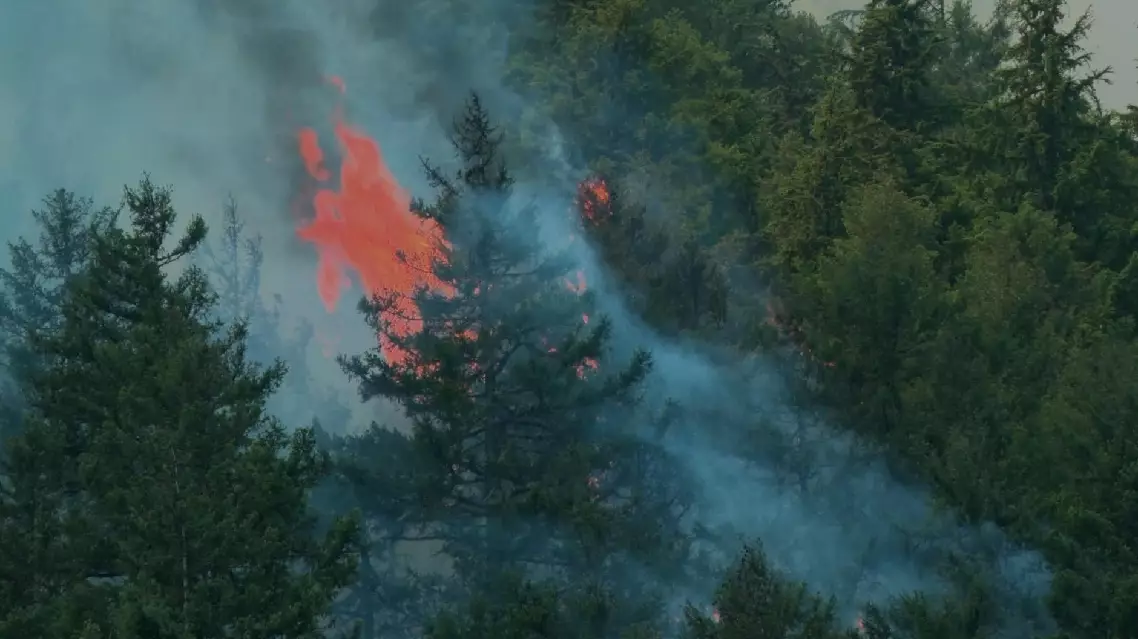
Thick smoke from persistent Canadian wildfires blankets Canada-U.S. border regions