Electronic Arts, the maker of video games like “Madden NFL," “Battlefield,” and “The Sims,” is being acquired by an investor group including Saudi Arabia's sovereign wealth fund in the largest private equity-funded buyout in history.
The investors, who also include a firm managed by Jared Kushner, President Donald Trump’s son-in-law, and the private equity firm Silver Lake Partners, valued the deal $55 billion.
Click to Gallery

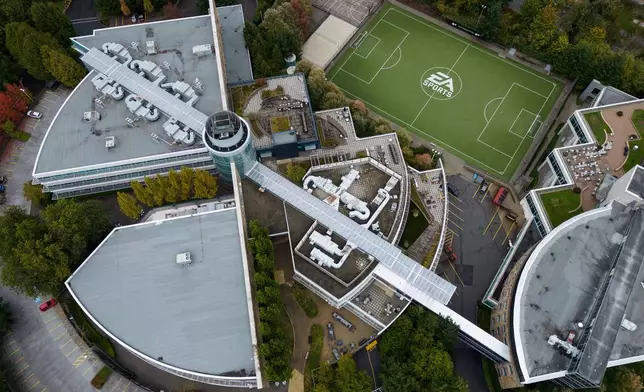
The EA Sports logo is seen on a soccer pitch at the Electronic Arts' office and studio complex, in Burnaby, British Columbia, Monday, Sept. 29, 2025, as the maker of video games like “Madden NFL," “Battlefield,” and “The Sims,” is being acquired for $55 billion in what could become the largest private equity-funded buyout in history. (Darryl Dyck/The Canadian Press via AP)
The EA Sports logo is seen on a soccer pitch at the Electronic Arts' office and studio complex, in Burnaby, British Columbia, Monday, Sept. 29, 2025. (Darryl Dyck/The Canadian Press via AP)
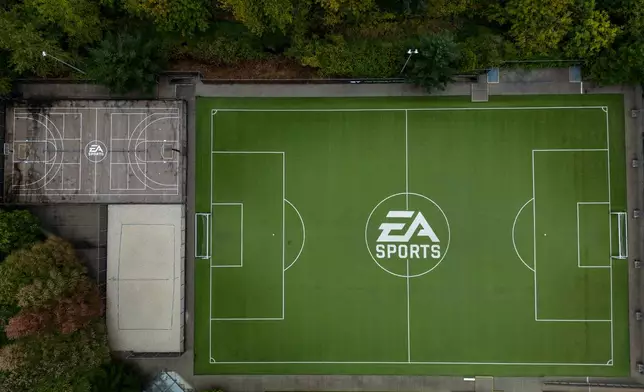
The EA Sports logo is seen on a soccer pitch at the Electronic Arts' office and studio complex, in Burnaby, British Columbia, Monday, Sept. 29, 2025. (Darryl Dyck/The Canadian Press via AP)
FILE - The logo for Electronic Arts is displayed during the Electronic Entertainment Expo in Los Angeles on June 12, 2013. (AP Photo/Jae C. Hong, File)
EA stockholders will receive $210 per share. The deal far exceeds the $32 billion price tag to take Texas utility TXU private in 2007, which had shattered records for leveraged buyouts.
PIF, which was currently the largest insider stakeholder in Electronic Arts, will be rolling over its existing 9.9% investment in the company.
The commitment to the massive deal is in line with recent activity in the gaming sector by the Saudi fund, wrote Andrew Marok of Raymond James.
“The Saudi PIF has been a very active player in the video gaming market since 2022, taking minority stakes in most scaled public video gaming publishers, and also outright purchases of companies like ESL, FACEIT, and Scopely,” he wrote. “The PIF has made its intentions to scale its gaming arm, Savvy Gaming Group, clear, and the EA deal would represent the biggest such move to date by some distance.”
PIF is also a minority investor in Nintendo.
The deal needs approval from national security regulators on the Committee on Foreign Investment given that the Saudis are involved, but there are plenty of reason to expect it will go through.
Not only does Trump’s son-in-law want to do the deal, but the president could also be inclined to look favorably on any Saudi investment because he has benefited directly from their spending. His family business has been paid by Saudi-backed LIV Golf for hosting its tournaments at his clubs starting at a difficult time years ago when the PGA Tour pulled out of events at the same venues following the Jan. 6 siege of the Capitol by Trump supporters in 2021.
The U.S. agency leading the foreign investment committee, the Treasury Department, did not immediately respond to a request for comment about the potential conflicts of interest.
If the transaction closes as anticipated, it will end EA’s 36-year history as a publicly traded company that began with its shares ending its first day of trading at a split-adjusted 52 cents.
The IPO came seven years after EA was founded by former Apple employee William “Trip” Hawkins, who began playing analog versions of baseball and football made by “Strat-O-Matic” as a teenager during the 1960s.
CEO Andrew Wilson has led the company since 2013 and he will remain in that role, the firms said Monday. Electronic Arts would be taken private and its headquarters would remain in Redwood City, California.
Kushner, the CEO of Affinity Partners, said, “I’ve admired (EA's) ability to create iconic, lasting experiences, and as someone who grew up playing their games - and now enjoys them with his kids - I couldn’t be more excited about what’s ahead.”
The size of the video game market has attracted large investors in recent years.
One of EA’s biggest rivals Activision Blizzard was snapped up by technology powerhouse Microsoft for nearly $69 billion in 2023, while the competition from mobile video game makers such as Epic Games has intensified.
This marks the second high-profile deal involving Silver Lake and a technology company with a legion of loyal fans in recent weeks. Silver Lake is also part of a newly formed joint venture spearheaded by Oracle involved in a deal to take over the U.S. oversight of TikTok’s social video platform, although all the details of that complex transaction haven’t been divulged yet.
By going private, EA will be able to retool operations without worrying about market reactions. Although its video games still have a fervent following, EA’s annual revenues have been stagnant during the past three fiscal years, hovering from $7.4 billion to $7.6 billion.
Mike Hickey of The Benchmark Company thinks the proposed deal's $210 per share offer price may be falling short of EA's intrinsic value.
“With Battlefield 6 about to launch and a pipeline that could add more than $2B in incremental bookings by FY28, the true earnings power of EA is only beginning to emerge,” he wrote.
Hickey is unsure if the transaction is in shareholders' best interest.
“The board’s decision to recommend a sale at $210 per share suggests a prioritization of near-term certainty and legacy over maximizing long-term shareholder value,” he wrote to clients.
But Nick McKay of Freedom Capital Markets believes the offer makes sense for EA because share price appreciation is likely limited given that the success of its sports franchises and various live services streams are already mostly baked into the stock.
“The financial backing and resources of the investor consortium should enable EA to increase its focus on long-term growth opportunities that may have been viewed as too risky or expensive as a public company,” he wrote in an analyst note.
EA shares rose 4.5% Monday after jumping 15% on Friday when reports of a possible takeover began to circulate.
The deal is expected to close in the first quarter of fiscal 2027. It still needs approval from EA shareholders.

The EA Sports logo is seen on a soccer pitch at the Electronic Arts' office and studio complex, in Burnaby, British Columbia, Monday, Sept. 29, 2025, as the maker of video games like “Madden NFL," “Battlefield,” and “The Sims,” is being acquired for $55 billion in what could become the largest private equity-funded buyout in history. (Darryl Dyck/The Canadian Press via AP)
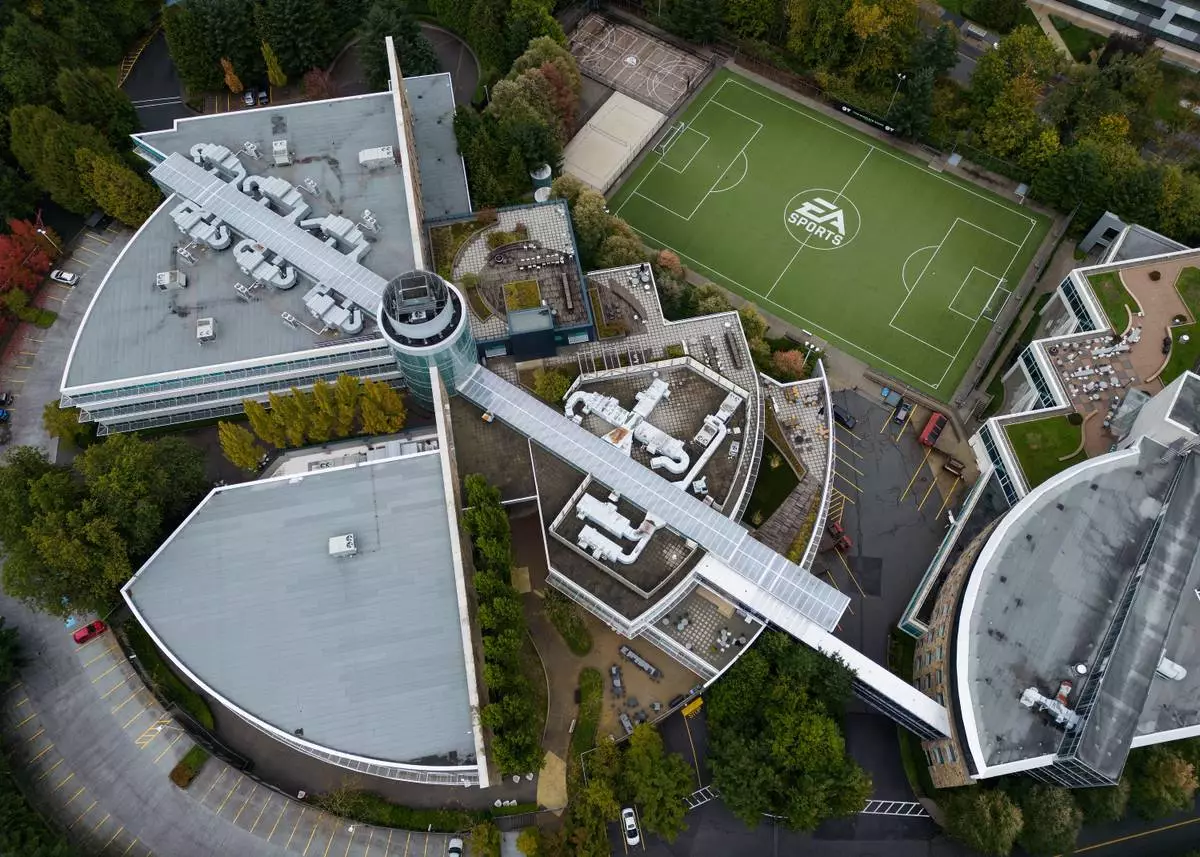
The EA Sports logo is seen on a soccer pitch at the Electronic Arts' office and studio complex, in Burnaby, British Columbia, Monday, Sept. 29, 2025. (Darryl Dyck/The Canadian Press via AP)

The EA Sports logo is seen on a soccer pitch at the Electronic Arts' office and studio complex, in Burnaby, British Columbia, Monday, Sept. 29, 2025. (Darryl Dyck/The Canadian Press via AP)
FILE - The logo for Electronic Arts is displayed during the Electronic Entertainment Expo in Los Angeles on June 12, 2013. (AP Photo/Jae C. Hong, File)