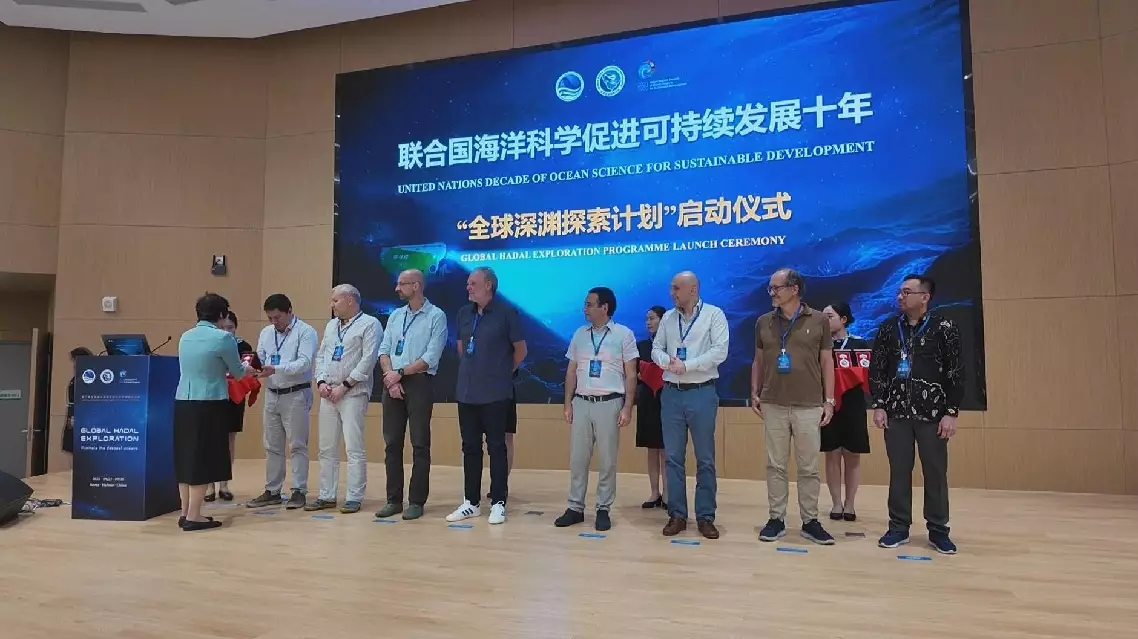
The UN-approved Global Hadal Exploration Program (GHEP) was officially launched on Sunday in Sanya City in the island province of Hainan in south China, marking a major step forward in international collaboration to study the deepest parts of the world's oceans.
The hadal zone is the deepest region of the ocean, found within oceanic trenches between approximately 6,000 and 11,000 meters below sea level.
Spearheaded by the Institute of Deep-sea Science and Engineering of the Chinese Academy of Sciences (CAS), this global initiative brings together research institutions from more than 10 countries, including New Zealand, Denmark, Germany, and Chile, to shift hadal science from fragmented efforts toward coordinated, systematic exploration.
At the heart of the program is China's full-ocean-depth manned submersible Fendouzhe, or Striver, which enables scientists to descend to the ocean's deepest zones to conduct in-situ experiments, collect high-quality samples, and gather unprecedented data.
"This is a very huge opportunity. For us, it's a real honor and privilege to be part of this program, because we have the Atacama Trench in front of us. The deepest place is over 8,000 meters. There are only two submersibles in the world that can go all the way to the deepest part of the trench. The other one was Limiting Factor from the U.S. And actually, I went down in 2022 with the Limiting Factor, but they didn't have the capacity to do experiments. It was just to go down and come up. So, the Chinese submersible is much more advanced because it allows us to do experiments, collect samples. So for science, it's a much, much, better platform," said Osvaldo Ulloa, a professor at the Department of Oceanography at the Universidad de Concepcion in Chile.
"Using a submersible for hadal science has become this new benchmark. The diving capability of the submersible (Fendouzhe) is unique, is found nowhere else. So, what China is contributing is this technology that nobody really has at the moment. So, we can all of a sudden conduct research that we never could do before. Every time I talk about the fact that I've been on this submersible, people are very keen to do it as well. A lot of excitement, and a lot of new science will be made, and new questions will be addressed. It's very exciting for everyone," said Daniel Leduc, a marine scientist from the Earth Sciences New Zealand.
The CAS first proposed the initiative in 2022. Since then, it has attracted 145 scientists from 10 countries to conduct joint international research cruises, which has reached nine of the world's hadal trenches -- each deeper than 6,000 meters. They have yielded groundbreaking discoveries that are reshaping scientific understanding of these extreme ecosystems.
In June this year, the program received formal endorsement from the Executive Planning Group of the UN Decade of Ocean Science for Sustainable Development (2021-2030), officially becoming a UN "Ocean Decade" action.
"We are currently collaborating with Chile, Tonga, and the UK to advance joint manned deep-sea diving expeditions. In the future, we hope to promote more multinational, multidisciplinary manned submersible missions under the broad framework of the UN Decade of Ocean Science for Sustainable Development, fostering the establishment of a global hadal research center through shared expeditions, data, samples, and equipment," said Du Mengran, director of the deep-sea scientific research department at the Institute of Deep-sea Science and Engineering.
China-led UN program launched to unlock secrets of oceanic trenches