China's largest humanoid robot training center has recently opened in Beijing where developers are busy putting the latest generation of robots through their paces in a series of practical tasks to ready them for real-world use.
At the new center, located in the city's Shijingshan District and operated by the Leju Robotics company, around 100 humanoid robots are being trained using VR and motion capture systems to learn the physical skills necessary to undertake numerous warehouse tasks, from material sorting to product packaging.
With the human teachers overseeing and guiding their humanoid apprentices, the scene may resemble science-fiction, but far from being a mere technological showcase, it captures a critical evolution in China's robotics sector. Here, these advanced robots are moving beyond executing laboratory stunts to now learning practical skills in this "vocational school" setting.
The robots have already achieved success rates of over 95 percent in practical tasks such as returning empty crates, sorting materials, as well as weighing, packing and boxing products.
The pragmatic approach adopted by the training center is seen as the key to unlocking the effective use of these robots in real-world applications from auto manufacturing to logistics -- as well as unleashing the full potential of a fledging trillion-dollar market.
A think tank report forecasts that by 2045, China will have over 100 million humanoid robots deployed across numerous industries, creating a total market value of approximately 10 trillion yuan (1.4 trillion U.S. dollars).
But technical hurdles still lie ahead before the market can truly take off. While viral videos of robots performing acrobatics stunts or demonstrating choreographed dance moves have captured the public's imagination over the past year, such displays of technical mastery in these often one-off scenarios obscures the underlying challenge of deploying robots in the more unstructured and unpredictable settings of everyday life.
To bridge the data shortage and accelerate development, Chinese robot makers are already seeking to push their machines into internships in automotive plants, warehouses, elderly care facilities and even a theater school.
Much like their human counterparts, developers say that practice also makes perfect for these robots.
"Robots need constant training, just like how children learn how to walk. Only through repeated practice across diverse scenarios can the robots become more intelligent. This facility was built to address the current data shortage across the industry," said Wang Qiang, the center's technical director.
The newly inaugurated facility spans some 14,000 square meters, about the size of two football fields, and is expected to generate more than six million data entries each year.
It is replicating 16 intricate scenarios across industrial, home, healthcare, and 5G applications, which makes it the largest, most comprehensive and realistic testing environment in the country.
By collecting the increasing data from the training school, the robotic developers can refine algorithms, enhance perception systems and improve decision-making capabilities.
"As we generate more real-world training data, robots will become more precise in their work. And then more and more robots will 'graduate' [from here] and enter factories, logistics hubs, and elderly care institutions, truly serving thousands of industries and households," said Yang Shuai, head of the center.
The Beijing training ground will also be linked to facilities established in the eastern and central Chinese cities of Suzhou, Jinan, Hefei and Zhengzhou, and is projected to generate 5,000 hours of data every month, aiding the rapid expansion and learning process of the robotics sector.
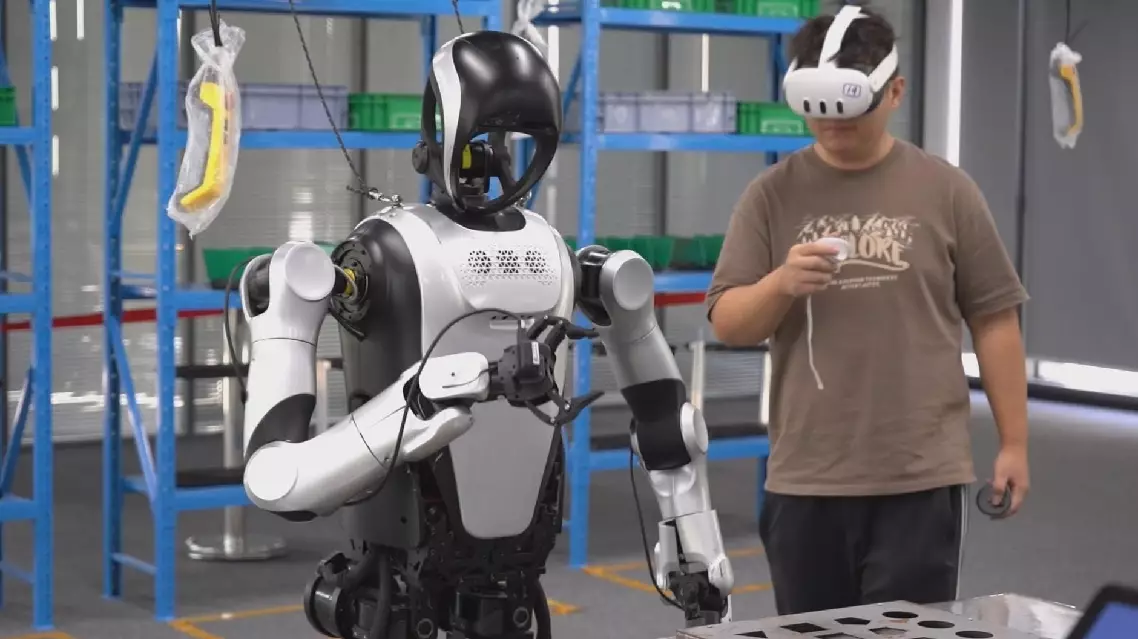
China's largest humanoid training center opens to ready robots for real world